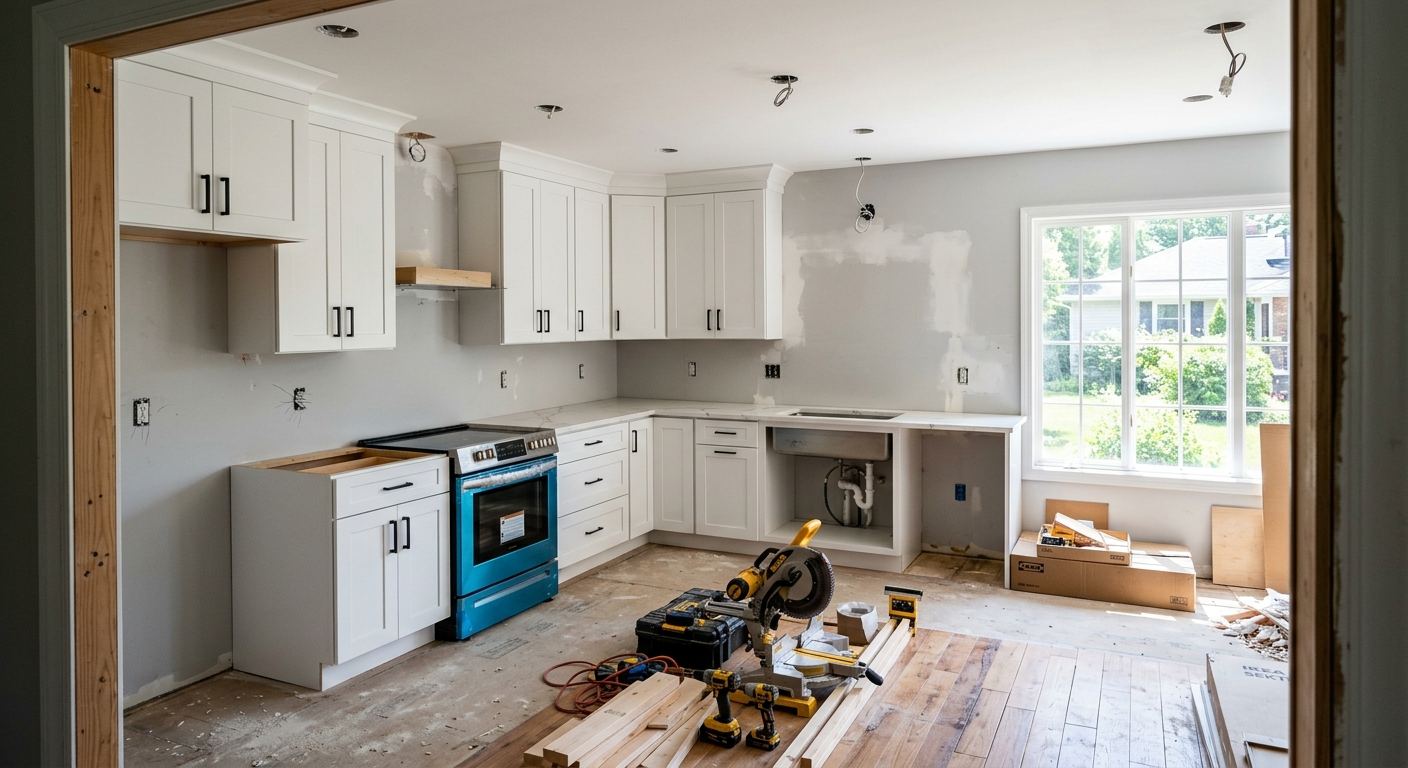
Kitchen renovation options and costs in Rockway
Kitchen renovations in Rockway, Ontario tend to follow the broader Toronto market more than day-to-day weather. With a 2021 population of 1,266 in Rockway (Statistics Canada, 2021 Census), the town’s demand is smaller than bigger GTA hubs, but homeowners still renovate to match what buyers expect across the Toronto economic region. Since home values and household purchasing power are closely linked to finish choices (Statistics Canada, 2021 Census), higher-value pockets of the region typically push projects toward quartz or natural stone, upgraded appliances, and more detailed cabinet work—often aligning with the mid-to-high end of the budget bands.
In practical terms, Toronto’s renovations are driven by materials availability, contractor scheduling, and the usual mix of older housing stock. Spring and early summer often book up faster because many homeowners time renovations around school schedules, not climate windows. While Ontario winter weather doesn’t directly “damage” kitchens, it affects logistics: driveways, indoor protection during dust control, and inspection scheduling for any permitted electrical, plumbing, or gas work. In Rockway, trades are especially in demand around the older residential areas near the core and along commuter routes where resale value matters most.
Below are common renovation tiers and typical timelines so you can compare quotes apples-to-apples before you choose finishes.
| Renovation Tier |
What's Included |
Typical Duration |
Price Range |
| Cosmetic refresh (paint, hardware, new appliances only) |
Cabinet paint or trim touch-ups, new hardware, appliance swap, minor caulking/trim, basic electrical hookups for appliances |
2–5 days |
$2,000–$12,000 |
| Mid-range full renovation (new cabinets, counters, sink, tile) |
New semi-custom or stock cabinets, countertop (quartz or laminate), sink + faucet, backsplash tile, under-cabinet prep, flooring adjustments as needed |
2–4 weeks |
$25,000–$60,000 |
| High-end full renovation (custom cabinets, stone counters, island) |
Fully custom millwork, premium quartz/stone counters, island build (and potentially new plumbing/electrical), designer backsplash, upgraded fixtures and appliance package |
4–8 weeks |
$60,000–$90,000 |
| Cabinet refacing only (new doors + drawer fronts, same boxes) |
Door/drawer replacement, new veneer panels, hardware, alignment updates, backsplash/trim often included as an add-on |
1–3 weeks |
$8,000–$35,000 |
| Countertop swap only (laminate to quartz or stone) |
Remove old tops, install new countertop material, seam/fabrication, sink re-set, basic plumbing reseal, optional backsplash tie-in |
2–7 days |
$3,000–$15,000 |
| Backsplash tile installation only |
Surface prep, tile install, grouting/sealing, finishing at countertops and edges, minor outlets/trim adjustments if needed |
3–7 days |
$2,000–$10,000 |
Prices are estimates only and vary by project scope, site access and material selection.
What affects the price of kitchen renovation in Rockway
In the Toronto economic region, two homeowners can receive quotes for what looks like the “same kitchen” and still see a 30–50% difference. The usual reasons aren’t weather—they’re finish tier choices, how much the layout changes, and how many trades need permits. Even within Rockway, jobsite conditions (access to the work area, how easy it is to protect floors, and whether the home has older rough-ins) can shift labour time and material waste.
Local home values and median income shape typical finish tiers far more than Ontario climate. Where buyers expect turnkey, owners often default to quartz or stone counters and semi-custom cabinetry because the cost is easier to recover on resale. In more price-sensitive pockets, laminate or stock cabinets keep total budgets closer to the mid-range bands, while still delivering a noticeable refresh. Layout changes add the most unpredictable cost regardless of finish: removing a wall, adding an island, moving a gas line, or relocating plumbing forces carpentry, electrical, and inspection work that can’t be “lightened” without affecting quality.
Concrete examples we see around Rockway: (1) a 1–2 week schedule bump when countertop templating and fabrication land a week later than planned; (2) added cost when an older panel requires new circuits for under-cabinet lighting and an island receptacle; (3) lower cost when you keep the cabinet boxes and do refacing or keep plumbing where it is. If you’re targeting the $25,000–$60,000 mid-range band, avoiding major plumbing or gas moves usually helps. If you move to the $60,000–$90,000 high-end range with an island and premium stone, the layout and permitted trade work are where the budget climbs fastest.
| Price Factor |
Why It Matters |
Cost Impact |
| Cabinet tier — stock vs. semi-custom vs. fully custom millwork |
Custom sizing, door styles, internal drawer systems, and hardware options drive labour and material time |
Stock can keep you near the low–mid range; semi-custom commonly lands in the budget centre; custom is a major driver toward high-end totals |
| Countertop material — laminate vs. quartz vs. granite vs. stone |
Material cost, fabrication complexity, and sink cut-outs change both pricing and schedule |
Laminate is typically lowest; quartz is mid; granite/natural stone is higher and often increases installation cost |
| Layout change — wall removal, island add, plumbing/gas move |
Triggers engineering/structural work, new rough-ins, longer timelines, and multiple inspections |
Often the fastest way to add a large portion of the 30–50% quote spread even when finishes are similar |
| Appliance package tier — builder vs. mid-range vs. pro-grade |
Controls, finishes, venting requirements, and installation details differ by tier |
Appliance choice can shift a project by thousands and affects the electrical and venting allowance |
| Flooring — refinish existing vs. full replacement |
Kitchen renos expose subfloor and require protection or removal; uneven transitions add labour |
Refinishing is usually cheaper; full replacement adds demo, prep, and material layers |
| Backsplash — ceramic tile vs. marble vs. full-height slab |
Tile layout, grout/grind detail, and slab handling affect labour and material wastage |
Full-height and premium stone escalate cost quickly, especially if walls are not flat |
| Electrical — new circuits for island, under-cabinet lighting |
More fixtures means more wiring, panel capacity checks, and licensed electrical work |
Can add noticeable cost and timeline due to inspection scheduling and cable routing |
| Permit fees and licensed trade requirements |
Any work that involves gas/plumbing/electrical circuits or structural changes requires the right trades and sign-offs |
Not optional—budgets should include permit and inspection admin alongside licensed labour |
Permits & regulations in Ontario
For Ontario homeowners in Rockway, the rule of thumb is: cabinet and countertop swaps usually don’t need permits, but anything that changes a building system typically does. That means a straightforward countertop replacement or cabinet refacing (no new plumbing/gas/electrical runs) is commonly treated as a finishing job. By contrast, if you move water supply or drain lines, relocate a gas stove, add or change a gas range venting setup, remove a load-bearing wall, or add new electrical circuits (like dedicated island receptacles or under-cabinet lighting tied into new wiring), you’ll generally require permits and licensed trades.
Gas work must be performed by a licensed gas fitter, and electrical work must be done by a licensed electrician, with inspections completed after rough-in and before final close-up. Before you sign anything, confirm who pulls permits—contractors sometimes include it, but sometimes it’s billed as a separate line item under their licence responsibility. In your contract, you want a clear statement of permit responsibility and inspection scope (what will be inspected and when).
To verify a contractor in Ontario, start with the Ontario licence/registry listing for their trade category (where available), then request:
- Certificate of liability insurance (and ask for the coverage amount and effective dates).
- WSIB/WCB clearance letter or proof of coverage, if applicable to their workforce.
- Any manufacturer installer certification for cabinets or stone fabrication, if they claim special warranty handling.
When you have those documents in hand, your renovation is easier to manage—especially if inspections are required for plumbing, gas, or electrical upgrades.
Cabinets, countertops and layout decisions in Rockway
The three most consequential decisions in a Rockway kitchen renovation are cabinet tier, countertop material, and whether you change the layout. Cabinet tier determines how quickly the kitchen installs and how “custom-fit” it looks at the walls and around windows. Stock cabinets are the fastest and usually cheapest, while semi-custom is the sweet spot for most homeowners because you can adjust sizes and still keep pricing predictable. Custom cabinets deliver the best fit and storage planning, but they add cost and often extend lead times.
Countertop material is next. Laminate can be budget-friendly and durable for everyday use, but it’s more limited in edge profiles and can be less forgiving over time if the kitchen sees heavy moisture exposure at the sink area. Quartz is popular in the Toronto market because it resists staining and is consistent, which helps resale appeal. Granite and natural stone are premium, with a unique look, but sealing/maintenance planning matters. Layout changes are the biggest “bang for buck” when the current plan feels cramped or closed-in: opening up for an open-concept feel, adding an island, or relocating plumbing/gas can improve function dramatically. Just note: once you move plumbing or gas, the cost can jump because you’re not only paying for materials—you’re paying for the rough-in work, inspections, and patch-and-finish carpentry.
In the Toronto resale context, many buyers expect a clean, modern finish. For example, moving from laminate tops to quartz often fits well in a $25,000–$60,000 mid-range renovation without blowing up the budget—whereas adding an island plus stone counters is where projects more naturally climb toward the $60,000–$90,000 high-end band because of electrical and plumbing coordination.
Ontario’s housing stock also matters: older homes may have less generous cabinet spacing or outdated rough-ins, so confirming what’s behind the existing cabinets early can prevent surprises once demolition starts.
| Option |
Durability |
Maintenance |
Best For |
Price Range |
| Stock cabinets (big-box) |
Good everyday durability with standard hinges and drawer slides |
Low maintenance; wipe clean, handle gently near seams |
Fast timelines and tighter budgets |
$8,000–$18,000 |
| Semi-custom cabinets (local dealer) |
Very good durability; upgraded drawer systems available |
Low maintenance; better adjustability at installation for older walls |
Most Rockway renos aiming for strong resale-ready finishes |
$18,000–$35,000 |
| Custom cabinets (local millwork shop) |
Excellent durability; best storage layout and fit |
Low maintenance but requires careful cleaning around finishes and hardware |
Maximizing functionality and premium appearance |
$35,000–$60,000 |
| Laminate countertop |
Good for daily use; sensitive to heat and cutting at seams/edges |
Easy clean-up; avoid hot cookware and aggressive abrasives |
Budget-conscious projects staying in the low–mid tiers |
$3,000–$6,000 |
| Quartz engineered countertop |
Very durable; resistant to staining and everyday impacts |
Low maintenance; wipe clean and avoid harsh chemical cleaners |
Most popular “resale-safe” choice for Toronto buyers |
$6,000–$12,000 |
| Granite / natural stone countertop |
Highly durable surface; varies by stone type |
Periodic sealing may be required; wipe spills promptly |
Premium look and unique veining |
$10,000–$15,000 |
| Butcher block countertop |
Strong, but can be scratched; needs thoughtful care |
Oiling and regular conditioning recommended to prevent drying |
Warm, traditional style kitchens and frequent food prep |
$4,000–$9,000 |
| Marble countertop |
Beautiful but more susceptible to etching from acids |
Higher upkeep: seal and clean carefully to reduce staining |
High-end aesthetics where homeowners maintain the surface |
$12,000–$20,000 |
How to choose a kitchen renovation contractor in Rockway
Choosing the right contractor in Rockway comes down to proof, process, and clarity. First, verify Ontario licensing for the trades involved (especially gas fitter and electrician if your plan includes gas or new circuits). Ask for liability insurance documents—then confirm the certificate shows appropriate coverage and that the effective dates align with your project window. For worker coverage, request WSIB/WCB clearance documentation where applicable; reputable Ontario contractors can provide it without pushing back or delaying.
Second, get 2–3 itemised written quotes rather than a single lump sum. You want a breakdown showing labour and materials separately, and ideally line items for demolition, framing/cabinet install, countertop fabrication and install, tile/backsplash, electrical/plumbing allowances, permits/disposal, and any patch-and-paint or flooring transition work. Scope gaps are the most common reason budgets drift upward in the GTA.
Third, read warranties carefully. You should see the workmanship warranty length (and what it covers), the product/manufacturer warranty for cabinets, countertops, and appliances, and whether coverage is transferable if you sell the home. Payment terms matter too: never agree to pay more than 10–15% upfront. Hold back the remainder until key milestones are complete—final countertop install and tile/trim close-out are typical retainage points.
Finally, insist on a written timeline with a start date and a realistic completion estimate. For example, if quartz slabs are involved, fabrication lead time can control the schedule more than labour availability.
- Confirm who pulls permits and lists inspections in writing.
- Ask for proof of licence for each relevant trade (gas, electrical, and plumbing).
- Verify liability insurance and request WSIB/WCB clearance documentation.
- Ensure disposal/hauling is included or clearly priced as an add-on.
- Check whether patch-and-paint, caulking, and trim finishing are included.
- Request itemised allowances for appliances, fixtures, and lighting.
- Make sure electrical scope includes island receptacles and lighting wiring if planned.
- Clarify who is responsible for countertop templating, fabrication, and seam placement.
- Confirm backsplash includes outlet/cover adjustments and wall surface prep.
- Look for a documented change-order process (pricing method and approval steps).
- Ask what happens if materials arrive late—schedule responsibility should be stated.
- Get warranty details in writing, including exclusions and how claims are handled.
Common red flags in Rockway: (1) quotes that exclude disposal and then “add it later” after demo; (2) no clear permit responsibility when gas/plumbing/electrical changes are proposed; (3) workmanship warranty that is vague or shorter than typical expectations; (4) large upfront payments without milestone-based billing; (5) refusing to provide insurance or WSIB/WCB proof during the quoting stage.
Frequently asked questions — kitchen renovation in Rockway
How long does a kitchen renovation take in Rockway?
In Rockway, timelines usually hinge on how much you change the layout and whether you’re ordering premium materials. A cosmetic refresh can be as short as 2–5 days, while a mid-range full renovation typically lands around 2–4 weeks if cabinet and countertop lead times are stable. If you’re aiming for a high-end build with custom millwork, an island, and premium stone, a common window is 4–8 weeks. Winter planning in Ontario often adds scheduling pressure because contractors protect finished areas and inspections for any permitted electrical, plumbing, or gas work must be booked. The biggest schedule variable is often countertop templating and fabrication. If you have a target budget around $25,000–$60,000, try to lock your countertop choice early to avoid shifting the schedule. (Statistics Canada, 2021 Census)
Quartz vs granite countertops — which is better?
“Better” depends on how you cook and how much maintenance you want. Quartz (engineered) is generally the easiest everyday option: it’s highly resistant to staining and typically needs no routine sealing, which is why it’s a common resale-friendly choice in Ontario homes. Granite and other natural stones are extremely durable and give a unique, upscale look, but maintenance can be slightly higher—many homeowners choose periodic sealing and careful cleaning to protect the stone. In Rockway-area kitchens, I usually recommend quartz when you want a consistent look, low hassle, and strong buyer appeal without extra upkeep. Granite can be a great fit if you love the natural veining and you’re comfortable maintaining the surface. Price-wise, quartz often fits within the common mid-range kitchen totals, while granite/natural stone can push you toward the upper tier depending on edges and slab sourcing—frequently aligning with budgets nearer $60,000–$90,000 when paired with islands or custom cabinets.
Should I reface or replace my cabinets?
Refacing is usually the best choice when your cabinet boxes are solid, level, and structurally sound, and you’re mainly after a modern door style and refreshed faces. Replacing is better when you need bigger storage changes, when boxes are warped, or when plumbing/electrical upgrades require significant rework behind the cabinetry. In Rockway, older homes sometimes have uneven wall conditions; if your base boxes are still good, refacing can save money while keeping the footprint. If you want new drawer layouts, full-height pantries, or you’re adding an island and changing adjacent storage, replacement often becomes the more practical long-term option. Budget-wise, refacing typically sits in the $8,000–$35,000 range, while full replacement usually aligns with broader mid-range or high-end renovations depending on countertop and whether you’re adding permitted electrical/plumbing work.
Do I need a permit for a kitchen renovation in Ontario?
Often, no permit is required for straightforward cabinet and countertop swaps in Ontario—especially when you’re not changing plumbing, gas, or electrical systems. You generally do need permits and licensed trades if your kitchen renovation involves moving plumbing supply/drain lines, relocating gas appliances or updating gas range venting, removing a load-bearing wall, or adding/changing electrical circuits (like new island receptacles or significant lighting rewiring). Gas work must be performed by a licensed gas fitter and electrical by a licensed electrician, with inspections required. For homeowners in Rockway, the key is clarity: confirm in the written contract who is pulling permits and whether disposal, rough-in, inspection scheduling, and final sign-off are included. If your scope moves you out of a simple refresh and into anything structural or system-related, you should expect permitting and plan costs accordingly.
What's the ROI on a kitchen renovation?
Kitchen renovations can improve resale value, but the exact ROI depends on how the finish tier matches buyer expectations in your market and whether you overbuild for the neighbourhood. In the Toronto economic region, higher-value areas tend to support premium finishes more readily, with many owners investing a larger share of home value into kitchens, often targeting around 8–15% of property value when they go custom. If you keep things in a mid-range scope—say a renovation around $25,000–$60,000 with quartz counters and semi-custom cabinetry—you’re more likely to stay aligned with what buyers consider “turnkey” without paying for features that won’t be rewarded at resale. Also, smart ROI comes from layout utility: better storage, safe clearances, and cohesive finishes usually outperform risky upgrades. If you’re planning to change the layout significantly, ensure the improvements are functional (not just trendy) so the buyer benefits from day one.
How do I budget for a kitchen renovation?
Start by deciding what you’re actually upgrading. A budget line for a cosmetic refresh can be relatively small, but most homeowners planning a true kitchen transformation need to prepare for a full project range. For Rockway homeowners, realistic budgets for a complete kitchen renovation often fall between $25,000–$90,000 depending on whether you choose stock/semi-custom/custom cabinetry and laminate vs. quartz/stone countertops. Build your budget around the biggest drivers: cabinet tier, countertop material, and whether you’re changing the layout (plumbing/gas/electrical). If you want to control cost, keeping plumbing where it is and choosing quartz or even a high-quality laminate top can keep you closer to the mid-range band. Get itemised quotes so you can compare apples-to-apples: labour, materials, permits, disposal, and any allowance for lighting and appliance upgrades. Finally, include a small contingency for site surprises—older rough-ins are common in Ontario housing stock.