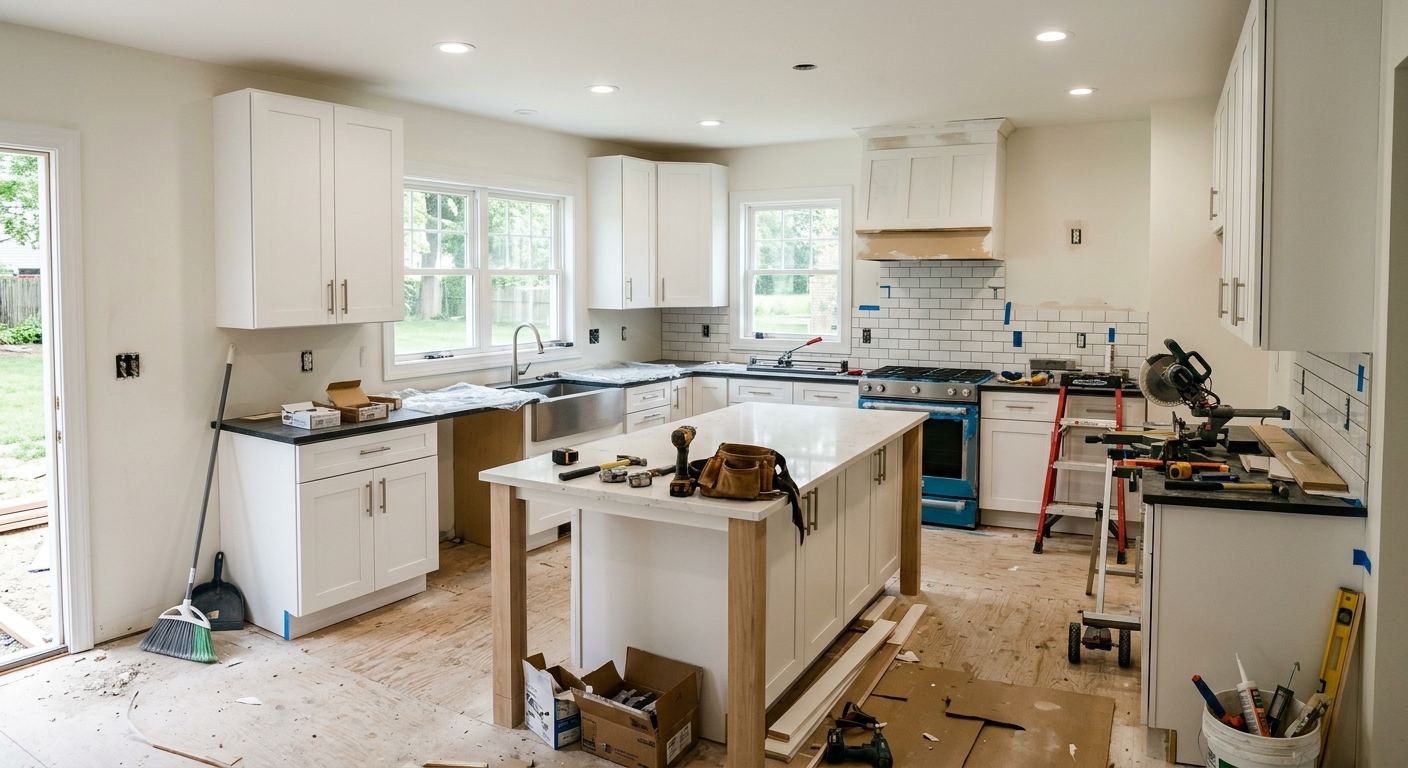
Kitchen renovation options and costs in Edenbridge-Humber Valley
Edenbridge-Humber Valley kitchen renovations are priced differently than people expect, because homeowners here tend to be selective about finishes and long-term usability, not just surface changes. With a population of 15,535 (Statistics Canada, 2021 Census), the area has a steady stream of owner-occupied homes, and that usually means more planned projects than rushed “flip” work. In the broader Toronto economic region, renovation spending also tracks closely to where homeowners sit in the local income and home-value mix—those higher-value pockets often push cabinetry and stone selections toward premium tiers.
In practice, Toronto doesn’t drive costs the way a coastal climate does; we don’t see the same pattern of weather-driven construction booms. Instead, market demand and construction scheduling do the most work: cabinets, stone slabs, and appliance deliveries can move project start dates, and contractor availability tightens when multiple trades are booked for larger custom builds. That’s why two kitchens with the same footprint can land 20–40% apart in price—one is scheduled around in-stock cabinetry and quick counter lead times, while the other gets bumped into a custom millwork window.
In Edenbridge-Humber Valley, the trade demand is especially noticeable around the Humber Valley Village/Princess Avenue corridor, where many homeowners refresh kitchens as part of broader interior upgrades. If you’re considering options, the easiest way to compare is to line them up by renovation tier, then choose where you want to spend versus where you can save.
| Renovation Tier |
What's Included |
Typical Duration |
Price Range |
| Cosmetic refresh (paint, hardware, new appliances only) |
Cabinet paint or refinish, new pulls/knobs, backsplash touch-up, swapping selected appliances (dishwasher/range/hood where plumbing already aligns), minor caulking and trim |
3–7 days |
$8,000–$18,000 |
| Mid-range full renovation (new cabinets, counters, sink, tile) |
New semi-custom cabinets, quartz or good laminate counters, new sink and faucet, backsplash tile, reinstalled/updated lighting, standard plumbing connection (no major relocation) |
3–6 weeks |
$35,000–$65,000 |
| High-end full renovation (custom cabinets, stone counters, island) |
Fully custom millwork, premium quartz/stone, island build-out, upgraded appliance package, full backsplash (often to ceiling), upgraded electrical/lighting, higher-end hardware and finishing |
6–12 weeks |
$75,000–$120,000 |
| Cabinet refacing only (new doors + drawer fronts, same boxes) |
Door/drawer-front replacement, new veneer or laminate faces, new hardware, adjustment of hinges, refinish touch-ups where needed |
1–3 weeks |
$10,000–$28,000 |
| Countertop swap only (laminate to quartz or stone) |
Remove existing top, template, install new material, sink cut-out adjustments, seam finishing, basic backsplash reset where required |
5–10 business days (plus fabrication lead time) |
$5,000–$15,000 |
| Backsplash tile installation only |
Surface prep, tile install, grouting/sealing where applicable, caulking at edges, optional outlet trim updates |
3–7 days |
$2,500–$9,000 |
Prices are estimates only and vary by project scope, site access and material selection.
What affects the price of kitchen renovation in Edenbridge-Humber Valley
In Edenbridge-Humber Valley and across the Toronto economic region, the same “kitchen refresh” can come in 30–50% apart because contractors price risk and outcomes differently—especially around lead times, demolition surprises, and how much of the work includes rework. On paper, one quote may look similar to another, but the difference is often in cabinetry tier, countertop choice, and whether the layout needs structural or service changes.
Local home values and median-income realities shape the typical finish tier far more than weather. In higher-value pockets, homeowners commonly move toward quartz or stone counters and semi-custom cabinetry because the renovation cost is easier to recover on resale—especially when buyers expect a modern, durable look. In more price-sensitive areas of the region, many projects use laminate tops and stock or refacing approaches to keep the total closer to the lower end of the market, while still updating the visual core. The result is that budgets can span from mid-$20k refreshes to $80k+ full kitchens, depending on how quickly you’re ready to trade up.
Layout changes add unpredictability regardless of finish level. For example, removing a wall to open sightlines, adding an island, or moving plumbing/drain lines (and potentially gas connections if you have a gas range) tends to create the biggest cost swings because it affects subflooring, venting paths, and electrical coordination. In older Toronto-area homes, concealed surprises under cabinets and behind older tile often push labour hours, and in winter scheduling the trades may need more time for proper drying and cure cycles on patch/level products before counters install.
Where you land within the price bands typically comes down to two things: your chosen cabinet and countertop tier, and whether you’re keeping plumbing in place. A straightforward mid-range full renovation is frequently priced in the $35,000–$65,000 neighbourhood, while fully custom millwork and stone selections with an island often push closer to the upper end of the region’s $80k+ outcomes.
| Price Factor |
Why It Matters |
Cost Impact |
| Cabinet tier — stock vs. semi-custom vs. fully custom millwork |
Tier determines material quality, adjustability, detailing, and lead time; it also affects installation time |
$8,000–$45,000 |
| Countertop material — laminate vs. quartz vs. granite vs. stone |
Material drives cost per square foot, fabrication complexity, and installation method (especially for seams and thickness) |
$3,000–$18,000 |
| Layout change — wall removal, island add, plumbing/gas move |
Structural and service changes add labour, coordination, and inspection/permit steps; they can also require subfloor repairs |
$5,000–$35,000 |
| Appliance package tier — builder vs. mid-range vs. pro-grade |
Appliances influence electrical/plumbing rough-ins, venting requirements, and installation complexity |
$3,500–$20,000 |
| Flooring — refinish existing vs. full replacement |
Protecting and patching existing floors is less disruptive; full replacement adds materials, labour, and transitions |
$2,500–$12,000 |
| Backsplash — ceramic tile vs. marble vs. full-height slab |
Premium tile/stone needs additional substrate prep, careful layout, and longer installation time |
$2,000–$15,000 |
| Electrical — new circuits for island, under-cabinet lighting |
Electrical adds coordination and licensed labour; more fixtures and dedicated circuits increase cost |
$1,500–$9,000 |
| Permit fees and licensed trade requirements |
Permits and trade coordination introduce fees and scheduling; they also reduce uncertainty if managed correctly |
$300–$4,500 |
Permits & regulations in Ontario
In Ontario, a straight swap of cabinets and a countertop replacement usually does not require a permit, because you’re not changing building systems. That typically includes removing the old countertop and installing a new one (even quartz/stone), and replacing cabinet fronts/boxes or installing new cabinets using the existing plumbing/electrical locations.
Permits and licensed trades are typically required when you change how the kitchen functions. Examples that commonly require a permit and inspection include: moving plumbing supply or drain lines, relocating a kitchen sink or dishwasher where rough-in routes change, installing or relocating a gas line or moving a gas appliance connection, removing a load-bearing wall, and adding electrical circuits (for example, dedicated circuits for an island, moving major receptacles, or significant under-cabinet lighting changes that require new wiring paths).
For Edenbridge-Humber Valley homeowners, the verification process should be systematic. First, ask for the contractor’s Ontario business registration details and evidence of liability insurance (certificate of insurance). For electrical work, confirm the electrician is licensed and provide their certificate/clearance documentation where applicable; for gas-related work, confirm the gas fitter licence and inspection sign-off for the specific connection and appliance tie-in. You should also confirm WSIB/WCB coverage in writing (or an accepted equivalent arrangement) before demolition starts, not after.
Always confirm in writing who pulls the permit and who covers inspection scheduling—permit responsibility should be in the contract, with costs itemized and timelines stated.
Cabinets, countertops and layout decisions in Edenbridge-Humber Valley
The three most consequential decisions in an Edenbridge-Humber Valley kitchen renovation are cabinet tier, countertop material, and whether you’ll change the layout. Those choices drive not only your budget, but also how quickly you recover value in the local Toronto resale market where buyers increasingly expect durable, cleanable surfaces and storage that feels “built-in.” Climate plays a smaller role than people assume for pricing—Toronto’s cost swings usually come from market scheduling and lead times, while day-to-day performance depends on material and sealing choices.
1) Cabinet tier: Stock cabinets are the fastest and cheapest option, but they can limit your ability to fine-tune storage. Semi-custom cabinets are often the sweet spot locally because they balance price and design flexibility. Custom cabinets deliver the best fit for odd walls and deeper storage goals, but they carry longer lead times and typically a larger labour/install allowance.
2) Countertops: Laminate can be a good ROI refresh if you’re keeping the layout and finish palette simple. Quartz is popular because it resists staining and wipes clean, which fits busy household life. Granite/stone and marble look premium and can be stunning in brighter kitchens, but they usually require more careful sealing/maintenance expectations.
3) Layout changes: Removing an open-concept wall or adding an island can be worth the cost when it improves circulation and creates usable prep space. But moving plumbing/gas and adding dedicated electrical circuits is where budgets can jump unpredictably.
Here’s a practical dollar example: if you start with a semi-custom kitchen package around the $35,000–$65,000 band, upgrading from laminate to quartz might add a few thousand dollars, often making sense. However, if you also relocate plumbing and add an island, that can push you toward the upper end of full renovation budgets—where the extra cost is justified only if the new layout better matches how you and future buyers actually use the space.
| Option |
Durability |
Maintenance |
Best For |
Price Range |
| Stock cabinets (big-box) |
Good for everyday use; limited customization for corners and wall heights |
Basic cleaning; careful handling during installation for chips/warping in dry-stores |
Budget-conscious refreshes with straightforward dimensions |
$8,000–$20,000 |
| Semi-custom cabinets (local dealer) |
Very durable; better drawer upgrades and adjustable options |
Simple wipe-down; hardware serviceable and refinishing options available |
Most resale-focused renovations in Ontario |
$18,000–$40,000 |
| Custom cabinets (local millwork shop) |
Highest build quality; best fit for non-standard spaces |
Regular cleaning; higher-end finishes can be more sensitive to harsh cleaners |
When you need exact wall-to-wall fit or specialty storage |
$35,000–$70,000 |
| Laminate countertop |
Decent everyday durability; seams require careful care |
Wipe clean; avoid prolonged standing water at seams |
Cost-effective upgrades where you want a modern look |
$3,000–$7,000 |
| Quartz engineered countertop |
Very durable; resistant to staining and everyday heat/impact compared to many alternatives |
Low maintenance; clean with non-abrasive products |
Busy households and resale buyers who want “easy-care” surfaces |
$6,000–$14,000 |
| Granite / natural stone countertop |
Excellent durability; variation in pattern and density is normal |
Requires periodic sealing depending on stone type |
Homeowners seeking premium, unique look |
$8,000–$18,000 |
| Butcher block countertop |
Strong but can be scratched; benefits from regular oiling |
Oil and maintain finish; best for owners comfortable with upkeep |
Warm aesthetic and cooking-focused kitchens |
$5,000–$12,000 |
| Marble countertop |
Premium look; more susceptible to etching and staining than quartz |
Higher maintenance: sealing and immediate spill cleanup |
Statement kitchens where appearance matters most |
$10,000–$22,000 |
How to choose a kitchen renovation contractor in Edenbridge-Humber Valley
Choosing the right contractor matters in Edenbridge-Humber Valley because kitchen work isn’t just carpentry—it’s coordination between cabinet installs, countertop fabrication, plumbing/electrical timing, and cleanup. Start with Ontario licensing and proof of coverage: confirm each trade involved (especially electrical and gas-related work) is appropriately licensed and provide their licence proof or documentation as applicable. Ask for a certificate of insurance (liability) and verify the coverage limits are current. For coverage related to workplace incidents, confirm WSIB/WCB coverage is in place and provide evidence in writing.
Next, get 2–3 itemised written quotes. “Itemised” means you can see labour and materials separately (cabinet supply, install, countertop fabrication, demolition, tile labour, electrical line items), not a single lump sum. Check whether permits are included, who pulls them, and whether disposal/hauling is included. If the scope is unclear, change orders typically show up mid-project—right when you’re already paying for delays. Also ask about the warranty: confirm workmanship warranty length, what manufacturer warranties cover (cabinets/counters/appliances), and whether warranties transfer to the next owner if you sell.
Payment schedule should be conservative: never more than 10–15% upfront for deposits, and use holdback until you have a complete punch list. Request a start date and completion estimate in writing, including lead-time assumptions for cabinets and countertops.
- Ask who is pulling permits and whether that cost is included in the quote.
- Confirm liability insurance and trades’ licensing paperwork before demolition.
- Get an itemised breakdown for labour vs materials (no vague allowances).
- Verify disposal/hauling is included and specify what’s hauled away.
- Confirm countertop template date and fabrication lead-time assumptions.
- Ask how they protect floors/doorways during demolition and install.
- Review inclusions for plumbing tie-ins and sink/faucet installation.
- Confirm electrical scope: outlet locations, island lighting, and circuit needs.
- Ask how they handle uneven walls and subfloor levelling.
- Check warranty terms for workmanship and product, including transferability.
- Use a written payment schedule with a meaningful completion holdback.
- Require a written timeline and identify who provides delivery/installation coordination.
Red flags I commonly see in the Edenbridge-Humber Valley market include: quotes that only state “kitchen renovation” without itemized line items, contractors asking for large upfront payments (beyond 10–15%), promises of countertop install dates without acknowledging fabrication lead times, missing proof of insurance/coverage, and vague warranty terms that don’t clearly separate workmanship from manufacturer coverage.
Frequently asked questions — kitchen renovation in Edenbridge-Humber Valley
Custom vs stock cabinets — is custom worth it?
In Edenbridge-Humber Valley and the wider Toronto region, custom cabinets are worth it when your kitchen has non-standard dimensions, unusual wall lines, or you want specialty storage that stock can’t match. Stock cabinets are typically fastest and lowest cost, but you may lose flexibility on corner storage and drawer layouts. Semi-custom is often the practical middle step for resale-focused renovations, balancing design choices with a more predictable timeline. If your budget is closer to the mid-band full renovation range (for example, $35,000–$65,000), semi-custom plus a durable countertop like quartz usually delivers a strong buyer-ready look without letting costs balloon. Custom tends to make the most sense when you’re also doing layout work and can use the improved fit to maximize the new plan.
How do I choose a kitchen contractor in Edenbridge-Humber Valley?
Start by verifying credentials the right way: request proof of liability insurance, confirm relevant trade licensing (especially for electrical and any gas-connected work), and ask for WSIB/WCB coverage evidence in writing. Then compare 2–3 quotes that are itemised—labour and materials broken out—so you’re not comparing apples to bundled “allowances.” Look for clarity on permits (who pulls them and who pays), demolition and disposal, and whether the contractor coordinates countertop templating with cabinet delivery. Finally, confirm warranty details: workmanship coverage length and what product warranties cover. In Ontario kitchen projects, scope gaps show up quickly once cabinets are ordered, so the best contractor will document inclusions/exclusions and provide a written timeline before work begins.
What order do kitchen renovation steps happen in?
A typical Edenbridge-Humber Valley sequence is: design/selection (cabinet layout, countertop template plan, finishes), demolition, rough-ins (electrical/plumbing updates as required), then cabinet installation and levelling. After cabinets are set, the countertop templating happens, followed by countertop fabrication lead time. Once the counters arrive, installation is done, then sink/faucet and backsplash coordination follows. Flooring repairs/finishes usually occur before the final trim and caulking, depending on whether you’re replacing flooring or refitting the existing surface. If you’re doing a backsplash-only refresh, that can happen later, after other work that risks dust. This order is also why timelines can vary—counter fabrication timing is often the biggest bottleneck.
Can I live at home during a kitchen renovation in Edenbridge-Humber Valley?
Often yes, but it depends on the scope. A cosmetic refresh (paint/hardware and new appliances only) can be handled with minimal disruption, and most homeowners stay in the home. For a mid-range full renovation—such as new cabinets, counters, sink, and tile—living on-site is common, but you’ll usually need a temporary cooking setup (microwave/hot plate) while the countertop and sink are out. If you’re doing an island addition, moving plumbing/drain lines, or relocating electrical circuits, expect more disruption because demolition and rough-ins expand the work footprint. For high-end custom builds that run longer, many families either set up a temporary kitchen in another room or choose to stay elsewhere for the most disruptive phases. Your contractor can advise a realistic plan based on your exact layout and whether you’re changing services.
Should I renovate my kitchen before selling in Edenbridge-Humber Valley?
It can be a smart move, but only when you align the renovation tier with what buyers will pay for in your specific Toronto market pocket. A strong, durable refresh—like a quartz upgrade and semi-custom cabinetry—often improves buyer confidence because it signals “move-in ready” quality. However, over-improving beyond your home’s segment can reduce resale return if the rest of the house doesn’t match. As a practical rule: keep cosmetic-only work focused and budget-controlled, and for full renovations, stay mindful of the common regional ranges—mid-range full kitchens often land around $35,000–$65,000, while higher-end custom builds can approach $80k+. If you plan to sell soon, prioritize kitchen function (layout flow, storage, lighting) and durability over highly bespoke details.
What's the most popular kitchen style in Edenbridge-Humber Valley right now?
Right now, homeowners in Edenbridge-Humber Valley and the broader Toronto area tend to favour clean-lined, modern transitional kitchens: warm neutral cabinetry (often in two-tone looks), matte hardware, and countertops that read upscale but stay practical. Quartz remains a top choice because it delivers a polished look with low day-to-day maintenance. Layout-wise, many renovations aim for an open, connected feel (when feasible) and more efficient storage—more drawers, better corner utilization, and improved lighting, especially under-cabinet task lights. Style preferences also reflect local buyer expectations: in higher-value market pockets, buyers often expect custom or semi-custom cabinetry with stone-look surfaces, while more budget-sensitive projects still lean modern through paint/refacing and laminate-to-quartz upgrades where possible. The result is a consistent “bright, functional, durable” look across many current projects.