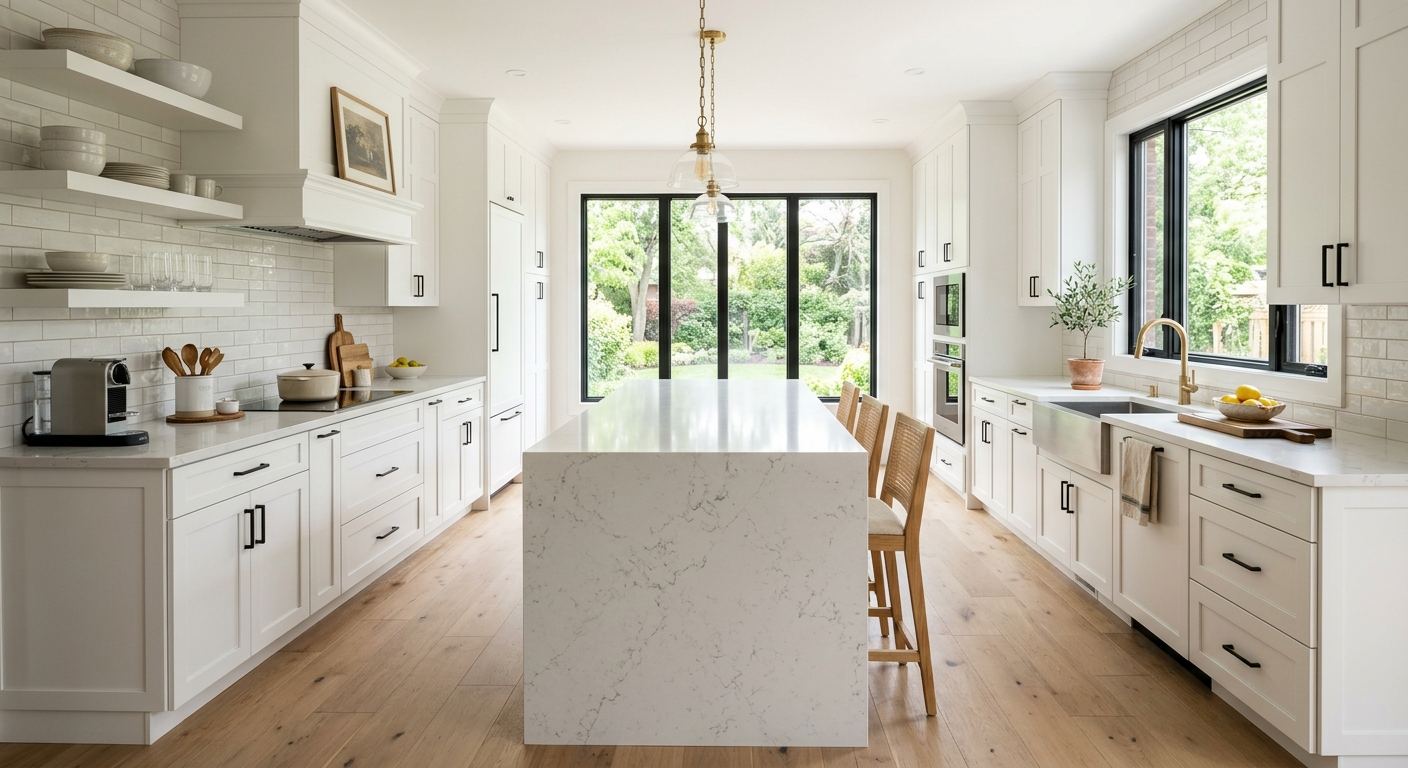
Kitchen renovation options and costs in South Clearbrook
Kitchen renovation options in South Clearbrook typically start with what you want to change—and how “refresh” you want the end result to look. South Clearbrook (population 10,120; Statistics Canada, 2021 Census) sits in the Lower Mainland–Southwest, where pricing is driven more by home value and expected finish level than by cold-weather construction effects. In higher-value parts of Metro Vancouver, homeowners more often lean into semi-custom or custom cabinetry and quartz/stone counters; that finish expectation pushes totals into the upper end of typical bands. Even within this region, the same kitchen size can price very differently depending on whether it’s a practical refresh with laminate surfaces or a full rebuild with made-to-fit millwork.
Climate still matters, but mainly through moisture management and ventilation details rather than “freeze-thaw” demolition like some colder provinces. In the Lower Mainland–Southwest, kitchens see frequent indoor humidity swings, so cabinet installation practices, caulking, and countertop sealing are important for longevity. Labour availability is also a steady factor here: Surrey, Abbotsford, and many Burnaby jobs can pull experienced installers and trades, which can tighten schedules and affect pricing. In South Clearbrook, trade demand is especially noticeable in older established pockets near transit and commercial corridors, where homeowners often renovate to update dated layouts and improve resale appeal.
Below is a practical comparison of common renovation tiers you’ll see in quotes for South Clearbrook projects, before we break down what drives price differences.
| Renovation Tier |
What's Included |
Typical Duration |
Price Range |
| Cosmetic refresh (paint, hardware, new appliances only) |
Prep and paint, new cabinet hardware/pulls, appliance swap, minor caulk/trim touch-ups |
3–7 days |
$8,000–$25,000 |
| Mid-range full renovation (new cabinets, counters, sink, tile) |
New stock or semi-custom cabinets, countertop installation, sink and faucet, backsplash tile, labour for demo and install |
2–4 weeks |
$40,000–$75,000 |
| High-end full renovation (custom cabinets, stone counters, island) |
Fully custom cabinets, quartz/stone counters, island build, upgraded hardware, extended tile/stone detailing, upgraded lighting/finishes |
4–8 weeks |
$90,000–$120,000 |
| Cabinet refacing only (new doors + drawer fronts, same boxes) |
Refacing doors/drawer fronts, new pulls, colour change (where feasible), minor trim adjustments |
1–3 weeks |
$8,000–$30,000 |
| Countertop swap only (laminate to quartz or stone) |
Remove existing tops, measure/template, install quartz/stone, seam placement, silicone and edging work |
3–10 days |
$6,000–$12,000 |
| Backsplash tile installation only |
Surface prep, tile install, grout/seal where needed, caulking at countertop and wall edges |
2–5 days |
$1,500–$6,000 |
Prices are estimates only and vary by project scope, site access and material selection.
What affects the price of kitchen renovation in South Clearbrook
In South Clearbrook and across the Lower Mainland–Southwest, two quotes for the same “basic” kitchen can differ by 30–50% mainly because the finish tier and the work complexity aren’t actually the same. In higher-value Lower Mainland–Southwest neighbourhoods, homeowners tend to choose quartz or stone counters and semi-custom cabinetry because the renovation cost is easier to recover on resale. In more modest scopes, laminate and stock cabinetry dominate because they deliver a strong ROI without changing the underlying kitchen footprint. Climate is rarely the main cost driver here; instead, it’s the market expectations and the trade choreography.
Layout changes are the biggest unpredictable cost regardless of finish level. Removing a wall, adding an island, or moving a gas line/plumbing for a new sink and dishwasher can trigger additional rough-in work, inspections, and drywall/flooring repairs. Those items often push a “mid-range” plan toward the higher band even when materials stay similar. For example, a straightforward cabinet-and-counter update in the mid-range band ($40,000–$75,000) can climb quickly when you add electrical for under-cabinet lighting and a new island circuit, because that’s labour-intensive and requires coordinated scheduling.
In South Clearbrook, I also see two local conditions that affect cost. First, many homes have older framing and slightly out-of-level walls, so cabinet installation and countertop templating take more labour (especially if you’re moving from laminate to quartz). Second, because Lower Mainland–Southwest schedules can be tight, delays in cabinet lead times can extend site work days for demo, floor protection, and backsplash preparation—small per-day costs add up.
With that in mind, the table below shows the main price factors contractors use when building your quote, including how they map to common cost bands such as the full renovation range ($40,000–$120,000) versus narrower cabinet/refacing and countertop-only upgrades.
| Price Factor |
Why It Matters |
Cost Impact |
| Cabinet tier — stock vs. semi-custom vs. fully custom millwork |
Build quality, drawer runs, door styles, internal accessories, and how well the system fits your kitchen’s exact measurements |
$10,000–$70,000 swing depending on scope |
| Countertop material — laminate vs. quartz vs. granite vs. stone |
Material price, fabrication complexity, edge/seam layout, and durability under daily use |
$3,000–$12,000 typical installed range |
| Layout change — wall removal, island add, plumbing/gas move |
Rough-in work, framing/drywall repair, inspection coordination, and schedule risk |
$5,000–$40,000 |
| Appliance package tier — builder vs. mid-range vs. pro-grade |
Higher-end units cost more and may require upgraded electrical ventilation considerations |
$2,000–$15,000 |
| Flooring — refinish existing vs. full replacement |
What you uncover during demo determines whether you need subfloor/underlayment fixes |
$1,500–$12,000 |
| Backsplash — ceramic tile vs. marble vs. full-height slab |
Material weight, cutting complexity, and whether it’s just a splash or a full feature wall |
$1,500–$6,000 (or more for premium slabs) |
| Electrical — new circuits for island, under-cabinet lighting |
Licensed labour, panel capacity checks, and required permits/inspections |
$1,000–$8,000 |
| Permit fees and licensed trade requirements |
Permits and inspections add admin time; licensed trades prevent rework and safety issues |
$500–$5,000 |
Permits & regulations in British Columbia
In British Columbia, not every kitchen change requires a permit, but many do—especially when you touch plumbing, gas, load-bearing structures, or electrical capacity. Generally, cabinet installation and countertop swaps are usually permit-free because you’re replacing finishes rather than altering services. A backsplash install also typically doesn’t require a permit by itself.
Work that typically does require permits and licensed trades includes: moving plumbing supply or drain lines (for example, relocating a sink or dishwasher), relocating gas appliances or gas lines (including changes tied to a stove/range and some hood configurations), removing a load-bearing wall or altering structural members, and adding new electrical circuits—such as for an island, adding dedicated outlets, or installing under-cabinet lighting when it requires new wiring or circuit changes. Gas work must be performed by a licensed gas fitter, and electrical work by a licensed electrician; both should be arranged to allow required inspections.
For a homeowner in South Clearbrook, the practical verification process is straightforward. First, ask for the contractor’s licence numbers and confirm them using the relevant online provincial licence registry. Second, request a certificate of insurance (liability) and ensure coverage is active for the job dates. Third, ask how WSIB/WCB coverage applies to the trades they use—then request proof of coverage or clearance documentation where applicable. Finally, confirm in writing who is pulling permits. The permit responsibility should be stated in the contract before work begins.
Cabinets, countertops and layout decisions in South Clearbrook
The three most consequential decisions in a South Clearbrook kitchen renovation are the cabinet tier, the countertop material, and whether you’ll change layout. Start with cabinet tier: stock cabinets are the fastest and cheapest option, semi-custom is usually the best “local fit” balance (more sizing flexibility and better internal storage), and custom cabinets are the highest cost but give you the tightest fit and best integration for awkward corners, tall pantry builds, and fridge/hood detailing. Next, pick countertops based on realistic day-to-day use in a Lower Mainland–Southwest home: laminate is affordable but can be less forgiving to heavy impact; quartz offers a strong mix of durability and low maintenance; granite and other natural stones bring unique patterning but may require more care; butcher block provides warmth but needs ongoing sealing and attention to moisture; marble looks premium but is more susceptible to etching from acidic spills.
Finally, layout changes are the “value or risk” call. In the resale-minded Lower Mainland–Southwest market, an open-concept wall removal or well-planned island can help buyers “see” usable space. But plumbing/gas relocation is where budgets often jump. If your goal is mainly appearance and function without moving services, staying in the mid-range band ($40,000–$75,000) is achievable with stock/semi-custom cabinets and quartz counters. If you add an island that requires new electrical circuits and you move the sink and/or gas line, the same kitchen can push toward the full high-end renovation range ($90,000–$120,000) because rough-in work, repairs, and inspections stack up.
Here’s a concrete example: upgrading from laminate to quartz is often a smaller, easier win—typically within a countertop-only swap band ($6,000–$12,000)—whereas relocating plumbing to support an island sink can add thousands more for rough-in, drywall patching, and rework coordination, even if the cabinet finishes stay mid-range.
| Option |
Durability |
Maintenance |
Best For |
Price Range |
| Stock cabinets (big-box) |
Solid for standard measurements; hinges/drawer quality varies by model |
Basic cleaning; minor adjustments over time depending on alignment |
Fast timelines and predictable budgets |
$8,000–$25,000 |
| Semi-custom cabinets (local dealer) |
Better build and options for storage (pantry units, trays, soft-close) |
Routine cleaning; occasional hardware adjustment expected |
Most South Clearbrook renos aiming for better fit and resale appeal |
$20,000–$45,000 |
| Custom cabinets (local millwork shop) |
Highest fit and detailing; best for unusual layouts and architectural features |
Routine cleaning; quality hardware typically requires less frequent service |
Design-led kitchens and tight spaces needing made-to-fit solutions |
$35,000–$70,000 |
| Laminate countertop |
Good for everyday use; can chip at edges if impacts are frequent |
Wipe clean; protect seams and avoid prolonged standing water |
Cost-effective refreshes and rentals |
$3,000–$6,000 |
| Quartz engineered countertop |
Very durable; resistant to stains and most daily wear |
Low maintenance; regular household cleaner is typically enough |
Families who want a long-lasting surface with easy upkeep |
$6,000–$10,000 |
| Granite / natural stone countertop |
Extremely durable to impact; performance depends on the specific stone |
Sealing and periodic care based on stone type |
Owners who want natural variation and premium look |
$8,000–$12,000 |
| Butcher block countertop |
Durable but can mark or scratch; handles wear well when cared for |
Regular oiling and sealing; must manage moisture |
Warm, traditional kitchens and “lived-in” style homes |
$5,000–$9,000 |
| Marble countertop |
Premium look; softer than quartz and can etch |
Careful cleaning; prompt attention to acidic spills and sealing |
Statement kitchens where appearance is the top priority |
$10,000–$18,000 |
How to choose a kitchen renovation contractor in South Clearbrook
Choosing the right kitchen contractor in South Clearbrook is about proof, clarity, and control of risk. Start by verifying British Columbia licensing and insurance before you compare pricing. Ask for their licence information (and confirm it through the provincial licence registry), and request a certificate of liability insurance for your project dates. For the labour portion, confirm WSIB/WCB coverage applies to the trades involved—request clearance documentation where appropriate. Don’t accept “we have coverage” as a phrase; get the document.
Next, get 2–3 itemised written quotes rather than one lump-sum number. You want a labour and materials breakdown that clearly shows: demo and disposal, cabinet supply, countertop template/fabrication, plumbing/electrical work (if included), flooring/backsplash scope, and allowance items. Pay attention to what’s excluded (for instance, drywall repair beyond a set line, permit pulling, or floor replacement after demo). If disposal is excluded, you can get surprised by dump fees and haul-away costs.
Warranty matters too. Ask for workmanship warranty length (and what triggers service), plus the product/manufacturer warranties for cabinets and countertops. Also ask whether warranties are transferable to new owners, since that can matter to resale in the Lower Mainland–Southwest market.
For payment, avoid large deposits: typically keep upfront payment around 10–15%, and request a holdback until key punch-list items are complete. Finally, get the start date and completion estimate in writing, including a realistic buffer for cabinet lead times.
- Confirm licence numbers and confirm in the provincial online registry.
- Request a current certificate of liability insurance (match to your address and dates).
- Verify WSIB/WCB coverage/clearance for the trades used.
- Get 2–3 itemised quotes (labour vs materials, not just totals).
- Ensure allowances are clearly listed (appliances, flooring, grout/tile items).
- Ask who pulls permits and whether permit fees are included in the quote.
- Confirm disposal/haul-away is included (or priced separately).
- Write down exclusions for hidden damage discovered after demo.
- Review the warranty: workmanship length, exclusions, and response timelines.
- Clarify start date, construction days, and completion target in writing.
- Use a payment schedule that holds back until punch list is completed.
- Ask for a site protection plan (floor protection, dust control, mask protocols).
Red flags I see in South Clearbrook: contractors who won’t provide licence/insurance documentation upfront, quotes that are mostly “lump sum” with no disposal/permit clarity, unusually low pricing that ignores electrical/plumbing inspection requirements, vague warranty wording, and payment requests for more than 10–15% upfront without a signed timeline and scope.
Frequently asked questions — kitchen renovation in South Clearbrook
Can I move my kitchen sink or stove?
Yes, but in British Columbia moving a sink or stove is where the project becomes more regulated and more expensive—because you’re often changing plumbing supply/drain lines and potentially gas connections. If you move the sink, the plumbing rough-in (supply and drain) typically requires permits and licensed plumbing work, and you’ll also budget for drywall and floor repairs after demo. If you move a stove tied to gas, gas relocation must be performed by a licensed gas fitter, with inspection requirements. In a South Clearbrook kitchen, it’s common to see this work push a mid-range renovation toward the full renovation band (for example, beyond $40,000–$75,000), even when cabinets stay the same.
What's the most cost-effective kitchen upgrade?
Most often, the best value in South Clearbrook is a targeted upgrade that creates visual impact without triggering major rough-in. If your cabinets are sound, cabinet refacing can be very cost-effective because you’re keeping the boxes and only replacing doors and drawer fronts (often in the $8,000–$50,000 band depending on coverage and finish). Another strong option is a countertop swap to quartz—typically within the countertop installation range (often $3,000–$12,000). For a lower-cost “wow” moment, a backsplash tile install also helps a lot and usually lands around $1,500–$6,000. If you’re thinking resale, pair these with updated hardware and good lighting rather than moving plumbing.
Custom vs stock cabinets — is custom worth it?
Custom can be worth it when your kitchen has non-standard dimensions, tight clearances, or you want made-to-fit storage (pantries to the ceiling, specialized corner solutions, appliance garages, or a layout that needs perfect alignment). In South Clearbrook’s Lower Mainland–Southwest market, many buyers do respond to a cleaner, more “built-in” look. But if you’re staying practical—especially if your budget is closer to a refresh or mid-range scope—stock or semi-custom usually delivers the best cost-to-impact ratio. A realistic way to think about it: stock cabinets tend to support faster installs and lower cabinet supply costs, while custom can significantly increase your cabinet line item and extend lead times. If your plan needs layout changes, that’s usually the bigger budget driver than the difference between semi-custom and stock.
How do I choose a kitchen contractor in South Clearbrook?
Start with verification: confirm their British Columbia licensing through the provincial registry, and ask for proof of current liability insurance matching your project dates. Next, verify WSIB/WCB coverage for the trades they bring onto your site—request clearance documentation where applicable. Then compare 2–3 itemised written quotes so you can see labour vs materials, what disposal includes, and whether permit pulling is included when required. Read the scope carefully: exclusions for hidden damage after demo, drywall/floor repair limits, and whether electrical or plumbing is included can change the actual final cost. Finally, protect yourself with a payment schedule—typically no more than 10–15% upfront—and get a written start/completion timeline.
What order do kitchen renovation steps happen in?
In a typical South Clearbrook kitchen renovation, the order matters for efficiency and for avoiding rework. First, design/measurements and selections are confirmed, and the team schedules any required licensed trades and permits if plumbing/gas/electrical changes are planned. Demo comes next, followed by rough-ins (electrical, plumbing, gas) when your scope includes relocating services. After rough-ins, insulation, drywall, and flooring repairs are completed, then cabinets are installed and levelled. Countertops are templated after cabinets are set, then installed. Finally, backsplash tile, trim/paint touch-ups, and appliance installs happen at the end. If you’re only doing a refresh or countertop swap, the sequence is shorter, but the principle stays the same: finish installs come after any work that can cause dust and damage.
Can I live at home during a kitchen renovation in South Clearbrook?
Often, yes—especially for smaller scopes like a backsplash tile installation, refacing, or a countertop swap—because the work can be concentrated and the rest of the home can stay usable with dust control. For mid-range or full renovations that include demo, new cabinetry, and flooring, many homeowners still stay home, but you need a clear plan for access, meal prep, and noise. You’ll typically need to protect floors and restrict dust (plastic containment, HEPA filtration where practical) to keep daily life manageable. If the project includes significant layout changes (plumbing/gas/electrical relocation), the disruption is higher and timelines can stretch due to inspection scheduling. A full renovation in the broader $40,000–$120,000 range is more likely to require temporary alternate arrangements, but it depends on the scope and how well the contractor sequences the trades.