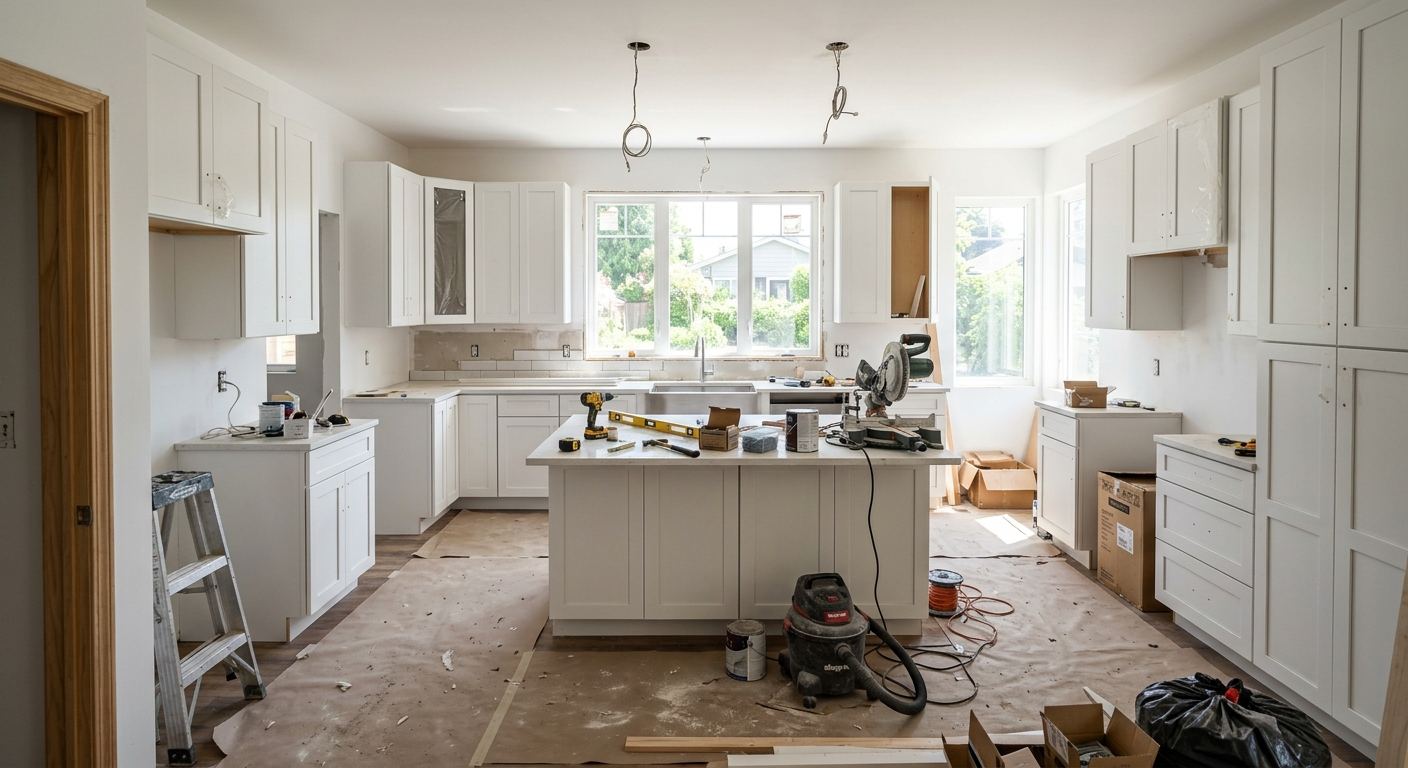
Kitchen renovation options and costs in Chilliwack Mountain
Kitchen renovation in Chilliwack Mountain starts with one big reality: your budget and finish choices will often track the expectations set by the Lower Mainland–Southwest market, not the province-wide “average.” In a community of about 2,510 people (Statistics Canada, 2021 Census), most projects still resemble the broader Metro Vancouver pricing style—because homeowners are planning for resale and daily use in the same housing-stock corridor. That’s why, even when costs are influenced by trades availability, finish level is usually the driver.
In the Lower Mainland–Southwest, quotes for the same kitchen size can swing depending on whether you’re targeting a practical refresh or a design-led rebuild with premium millwork. Climate plays a smaller role than homeowners expect: the coast-to-interior swings in humidity can affect how quickly wood-based products acclimatise, but contractors price more for cabinet complexity, counter thickness, plumbing/gas changes, and labour intensity than for “weather.” That said, the summer humidity can also mean more careful scheduling for cabinet installation and caulking around seams.
Local demand is especially strong around the Fraser Valley corridor and activity near the town’s older residential pockets, where many kitchens are dated and are being updated during ownership changes. As a result, you’ll see labour show up quickly for standard scopes, while custom cabinet builds can take longer due to fabrication scheduling.
To help you compare options, review the typical tiers below, then match the tier to your timeline, layout goals and finish expectations before you request quotes.
| Renovation Tier |
What's Included |
Typical Duration |
Price Range |
| Cosmetic refresh (paint, hardware, new appliances only) |
Cabinet paint or touch-ups, new pulls/hinges, appliance swap, basic caulking, alignment adjustments |
5–10 days |
$8,000–$25,000 |
| Mid-range full renovation (new cabinets, counters, sink, tile) |
Semi-custom or quality stock cabinets, countertop install, sink + faucet, backsplash tile, new flooring patching or partial replacement, labour to reconnect plumbing |
3–6 weeks |
$40,000–$85,000 |
| High-end full renovation (custom cabinets, stone counters, island) |
Fully custom millwork, quartz/stone counters, island build (sometimes with seating), upgraded hardware, premium backsplash treatment, electrical updates for island lighting, disposal + refined plumbing |
6–12 weeks |
$85,000–$120,000 |
| Cabinet refacing only (new doors + drawer fronts, same boxes) |
Refacing veneer/laminate or panel replacement, new doors/drawers, hardware, basic cleaning of existing boxes, re-installation and adjustments |
1–3 weeks |
$8,000–$35,000 |
| Countertop swap only (laminate to quartz or stone) |
Demolition and install of new top, sink/cooktop cut-outs as applicable, edge profile change, caulking and sealing |
3–7 days |
$3,000–$12,000 |
| Backsplash tile installation only |
Tile supply & labour or labour-only (depending on quote), surface prep, waterproofing where needed, grout/seal, clean-up |
2–6 days |
$1,500–$6,000 |
Prices are estimates only and vary by project scope, site access and material selection.
What affects the price of kitchen renovation in Chilliwack Mountain
It’s common to see the same kitchen renovation come in 30–50% apart across the Lower Mainland–Southwest and other parts of British Columbia. In this region, local home values and the buyer “finish expectations” push projects toward quartz/stone counters and semi-custom cabinetry, especially for listings meant to show well. In lower-cost markets, owners often lean on laminate and more basic cabinet lines because the perceived payback is smaller. In Chilliwack Mountain, you’ll usually find a middle path: homeowners can still do a mid-range renovation, but the moment you add layout changes or step up cabinet/counter tiering, costs jump fast.
Layout changes are the most unpredictable cost regardless of finish level. Removing a wall, adding an island, or moving a gas line can add major labour time, materials, and permit requirements. As a rule of thumb, a practical refresh-style scope can stay near the lower end of the band, while a full remodel with new cabinets and countertops tends to track the wider range of $40,000–$120,000 because multiple trades overlap.
Concrete examples we see around Chilliwack Mountain: (1) older homes often have undersized electrical panels or dated wiring paths, which can push an electrical “simple upgrade” into more circuit work; (2) venting for hoods and dryer-style ducting can be routed more expensively depending on wall cavities; and (3) cabinet installation on out-of-level walls can require more shimming, filler panels, and redo time, especially when you switch from stock to semi-custom.
These factors can also affect timeline. Even when the price goal is in the mid-range, the real cost pressure often comes from how quickly trades can schedule and how many change orders you avoid after demo.
| Price Factor |
Why It Matters |
Cost Impact |
| Cabinet tier — stock vs. semi-custom vs. fully custom millwork |
Custom sizing, internal organisation, finishing quality, and lead times increase fabrication and installation complexity |
Stock may keep cabinetry closer to the lower end of cabinet installation/refacing ranges; semi-custom and custom push totals toward the higher end of full-reno budgets |
| Countertop material — laminate vs. quartz vs. granite vs. stone |
Material cost, sink/cooktop cut-outs, edge profiles, and installation crew time vary widely |
Laminate can fit near the low end of countertop installation; quartz and natural stone typically raise the countertop line item toward upper ranges |
| Layout change — wall removal, island add, plumbing/gas move |
More labour hours, carpentry changes, rough-in work, and inspections |
Commonly shifts a project from “refresh scope” pricing toward full renovation pricing bands |
| Appliance package tier — builder vs. mid-range vs. pro-grade |
Brand tier affects trim kits, electrical requirements, and delivery/set-up |
Builder units can keep costs controlled; pro-grade packages often increase appliance + install time, influencing overall budget |
| Flooring — refinish existing vs. full replacement |
Removal exposes subfloor issues; matching existing finishes can limit demolition |
Floor patching/refinish can reduce waste; full replacement can add cost even if cabinetry/counters stay mid-range |
| Backsplash — ceramic tile vs. marble vs. full-height slab |
Slab material weight and detailing, or tile pattern complexity, changes labour and prep |
Simple ceramic often sits in the mid to lower backsplash band; marble/full-height increases labour and material cost |
| Electrical — new circuits for island, under-cabinet lighting |
More circuits mean more rough-in, drywall access, and inspection |
Electrical scope can add disproportionately to “simple” renovations, especially when you add island lighting |
| Permit fees and licensed trade requirements |
Work that touches gas, electrical circuits, or structural elements triggers permits and inspections |
Permits and trade time can nudge projects into the higher end of full renovation budgets |
Permits & regulations in British Columbia
In British Columbia, some kitchen updates are permit-light, while others trigger both permits and inspections. A cabinet or countertop swap typically does not require a permit—if you’re not changing plumbing, gas, electrical circuits, or any structural elements. That means replacing countertops, installing new sink hardware, swapping cabinet fronts, or updating a backsplash tile surface are usually handled as standard trades work.
However, these common kitchen tasks DO typically require permits and licensed trades in Chilliwack Mountain homes: moving plumbing supply/drain lines, relocating a gas stove or range location (including gas connections), removing a load-bearing wall, and adding electrical circuits (for example, extra outlets on an island or new lighting circuits). Gas work must be completed by a licensed gas fitter, and electrical work must be done by a licensed electrician; inspections are part of the process for work that requires permits. If you’re converting from electric to gas or altering venting routes, plan for additional scope and lead time.
To verify a contractor before you sign, ask for (1) the contractor’s British Columbia licence details and their permit responsibility in writing, (2) a Certificate of Insurance (liability coverage) and confirm it includes work at your address, and (3) coverage documentation relevant to your project—commonly WCB clearance/coverage proof where applicable. For licence and trade compliance, homeowners can typically check via online licence registries for the relevant licensed trades, then cross-match the name and number on the contractor paperwork.
Always confirm who pulls permits and pays permit fees in the contract—“included” should be explicit, not implied.
Cabinets, countertops and layout decisions in Chilliwack Mountain
In Chilliwack Mountain, three decisions tend to control 80% of your result: (1) cabinet tier (stock, semi-custom, or custom), (2) countertop material (laminate, quartz, granite, butcher block, or marble), and (3) layout changes (open-concept wall removal, island addition, or relocating plumbing/gas). In the Lower Mainland–Southwest, many buyers expect a modern look at mid-range budgets, so semi-custom cabinets and quartz counters are the most common “sweet spot.” If you go full custom, you’re buying better fit and storage efficiency—especially in older homes where walls aren’t perfectly square.
BC’s humid coastal conditions mean wood products acclimatise more slowly than many homeowners assume. The fix is good site conditions and proper installation practices; the pricing impact is usually in labour time and finishing details, not in huge climate premiums. Where costs spike is when you relocate lines or add an island: moving plumbing/drain runs, updating venting, and bringing electrical up to modern requirements can push a project away from a restrained renovation tier and toward full remodel pricing.
A practical dollar example: if you’re considering laminate-to-quartz only (no cabinet changes), the countertop upgrade might sit in the $3,000–$12,000 band. But if you also change the layout and add an island, your scope becomes a broader renovation and is more likely to land within the $40,000–$120,000 full kitchen range because of cabinetry, electrical, and trades coordination.
Plan around resale and everyday function: keep walkway clearances, choose finishes that hide wear, and avoid “small” layout changes that require major rough-in work unless the space gain is clear.
| Option |
Durability |
Maintenance |
Best For |
| Stock cabinets (big-box) |
Durable for daily use; limits on fit for out-of-square spaces |
Low—wipe clean; plan on minor adjustments/caulking |
Fast timelines, budget-controlled refreshes, straightforward layouts |
$8,000–$25,000 |
| Semi-custom cabinets (local dealer) |
Strong construction with better interior organisation and better options for fit |
Low to moderate; routine cleaning, hardware tightening as needed |
Most common mid-range rebuilds aiming for a “finished” look |
$20,000–$55,000 |
| Custom cabinets (local millwork shop) |
Excellent fit and long-term build quality; best for complex spaces |
Low—properly finished; periodic hardware maintenance |
Design-led layouts, unusual dimensions, maximizing storage |
$45,000–$90,000 |
| Laminate countertop |
Good for light-to-moderate use; edges and seams are the wear points |
Low—avoid heavy impacts and excessive heat; keep seams sealed |
Controlled budgets and kitchens used more casually |
$3,000–$7,000 |
| Quartz engineered countertop |
Very durable surface; resistant to staining and daily wear |
Low—no sealing; wipe clean, protect from very high heat |
Busy households, resale-friendly finishes, modern clean lines |
$5,000–$11,000 |
| Granite / natural stone countertop |
High durability; natural variations and edge impacts depend on fabrication |
Moderate—often benefits from periodic sealing based on stone |
Homeowners wanting natural character and a premium look |
$7,000–$14,000 |
| Butcher block countertop |
Durable when maintained; can show dents if not cared for |
Moderate to high—regular oiling and careful moisture management |
Warm, traditional styles and households willing to maintain surfaces |
$4,500–$10,000 |
| Marble countertop |
Beautiful but softer than quartz/granite; can etch or stain |
High—protect from acids/grease and plan for sealing and care |
Low-spill lifestyles or design-focused renovations with careful upkeep |
$8,000–$16,000 |
How to choose a kitchen renovation contractor in Chilliwack Mountain
Choosing the right contractor in Chilliwack Mountain is mostly about verification plus clarity. Start by confirming British Columbia licensing where applicable, and don’t stop at “they say they’re insured.” Ask for a Certificate of Insurance showing liability coverage that matches your job scope and address. For coverage related to workplace safety, request WCB/WCB clearance evidence where applicable; reputable contractors can provide it without hesitation. If subcontractors are involved (plumbing, gas fitting, electrical, tile), ask who is responsible for pulling permits and ensure the licensed trades are clearly named in the documentation.
Next, request 2–3 itemised written quotes. You want labour and materials broken out—demolition, cabinet installation, countertop install, backsplash prep, electrical scope, plumbing reconnections—rather than one lump sum. Read the scope line by line: what’s excluded (old appliance haul-away, patching drywall, custom cabinet fillers), is permit pull included, and is disposal included. A good quote also notes what happens if site conditions change after demo.
Warranty matters for both craftsmanship and products. Ask for workmanship warranty length, whether it’s transferable to future owners, and the manufacturer warranty terms for cabinets, counters and appliances. For payment, never agree to more than 10–15% upfront; holdback until completion is a normal practice. Finally, lock in a start date and realistic completion estimate in writing.
- Confirm written scope includes permits (if required) and who pulls them
- Ask for proof of liability insurance before work starts
- Request WCB/WCB clearance evidence where applicable
- Verify that licensed trades are named for gas and electrical work
- Get quotes with itemised labour/material breakdowns
- Check inclusions: disposal, drywall patching, caulking/finishing, trim
- Clarify appliance installation responsibilities and any required electrical changes
- Ask who handles field measurements for cabinets and countertops
- Confirm waste management plan for demo and packaging
- Review timeline with lead times for cabinets and countertops
- Ask about warranty terms for workmanship and product warranties
- Use a payment schedule with holdback until completion and punch-list items
Red flags we commonly see in Chilliwack Mountain kitchen jobs: vague quotes with no inclusions/exclusions, “no permits needed” claims when moving gas/plumbing/electrical circuits, unwillingness to provide insurance/coverage proof, pressure for large upfront deposits, and no clear start/completion dates or change-order process.
Frequently asked questions — kitchen renovation in Chilliwack Mountain
How do I budget for a kitchen renovation?
Budgeting in Chilliwack Mountain starts by choosing a renovation tier and protecting a contingency for unknowns after demo. If you’re doing a refresh (paint, hardware, new appliances only), many projects fit the lower band of $8,000–$25,000. If you’re installing new cabinets, countertops, sink and tile, most full renovations tend to land in the mid-range of $40,000–$85,000, while island + custom/stone upgrades can stretch toward $85,000–$120,000. Plan extra for layout changes, especially moving plumbing or gas—labour and trades coordination often increase the total even when the finish level stays mid-range. For the Lower Mainland–Southwest, expect finish choices to drive price more than climate, but include time for proper acclimation and sealing on wood-based components.
Can I move my kitchen sink or stove?
Yes, it’s often possible in British Columbia, but moving a sink or stove is where renovation cost and permitting change quickly. If you move plumbing supply/drain lines, you should assume permits and licensed plumbing work are required, and the contractor should specify who pulls permits and schedules inspections. Moving a stove location that involves gas connections generally requires a licensed gas fitter and can add complexity if venting routes change. In Chilliwack Mountain homes with older framing and wiring paths, wall cavities and subfloor access can be more difficult, which affects labour. For budgeting, consider that layout changes are typically the “unpredictable” cost driver—so even if your counters and cabinets are mid-range, rough-in work can push totals toward full renovation pricing.
What's the most cost-effective kitchen upgrade?
The most cost-effective upgrade depends on what’s currently dated, but two common winners in Chilliwack Mountain are: a targeted backsplash refresh and a countertop upgrade. Backsplash tile installation only often fits around $1,500–$6,000 and can dramatically modernize the look without disturbing cabinet structure. If your cabinets are in good shape, swapping to quartz (or a better edge profile and undermount sink setup) is another high-impact option; countertop-only projects commonly fall in the $3,000–$12,000 band. If you want a “near full kitchen” look with less demo, cabinet refacing can be a smart step—staying within $8,000–$35,000 in many scopes. The best value comes from upgrading what people see daily while minimizing plumbing/gas/electrical disruption.
Custom vs stock cabinets — is custom worth it?
Custom cabinets can be worth it, but mostly when your kitchen layout and wall conditions demand it. Stock cabinets are the fastest and typically cheapest option, and they work well in straightforward, square spaces with minimal filler needs. Semi-custom is usually the “best balance” in the Lower Mainland–Southwest: you get better options for storage, more choices in sizing, and a more resale-friendly finish without paying for full bespoke production. Fully custom cabinets shine when you have awkward dimensions, need a unique island configuration, or want integrated storage that fits your exact cooking workflow. The trade-off is longer lead time and higher budget impact. A practical way to decide is to compare your quote totals: if custom pushes your project toward the upper full renovation range (near $85,000–$120,000) while layout stays mostly the same, semi-custom may deliver similar day-to-day value with less risk.
How do I choose a kitchen contractor in Chilliwack Mountain?
Choose a contractor by verifying coverage and making quotes comparable. First, ask for proof of liability insurance and evidence related to WCB/WCB clearance where applicable; reputable contractors provide documents readily. Next, confirm the right licensing for any work that requires licensed trades in British Columbia—particularly gas fitting and electrical circuits. Then request 2–3 itemised written quotes that separate labour vs materials and list inclusions/exclusions (disposal, drywall patching, permit pull if required). Review warranty terms: workmanship coverage length and product/manufacturer warranty details, including whether warranties transfer. Finally, use a payment schedule that limits upfront deposits (ideally 10–15%) and include holdback until the punch list is complete. In Chilliwack Mountain, avoiding “lump sum with no scope” is the single biggest protection for homeowners.
What order do kitchen renovation steps happen in?
Most kitchen renovations follow a consistent order in British Columbia. Typically, you start with planning and measurements, then procurement for cabinets and countertops (lead times can control your timeline). Once materials are confirmed, the project begins with site protection and demolition. After demo, rough-ins happen next—this is where plumbing supply/drain, gas connections (if changing), and electrical circuits are installed or updated and inspected when required. Then carpentry and cabinet installation go in, followed by countertop templating (if needed) and countertop fabrication/installation. Flooring patching and backsplash work usually follow cabinets and counters. Finally, finish work (painting-touchups, trim, hardware alignment, caulking) and a punch list complete the job. If you’re planning a refresh, you still want the same sequence minus the “rough-in/permit” steps.