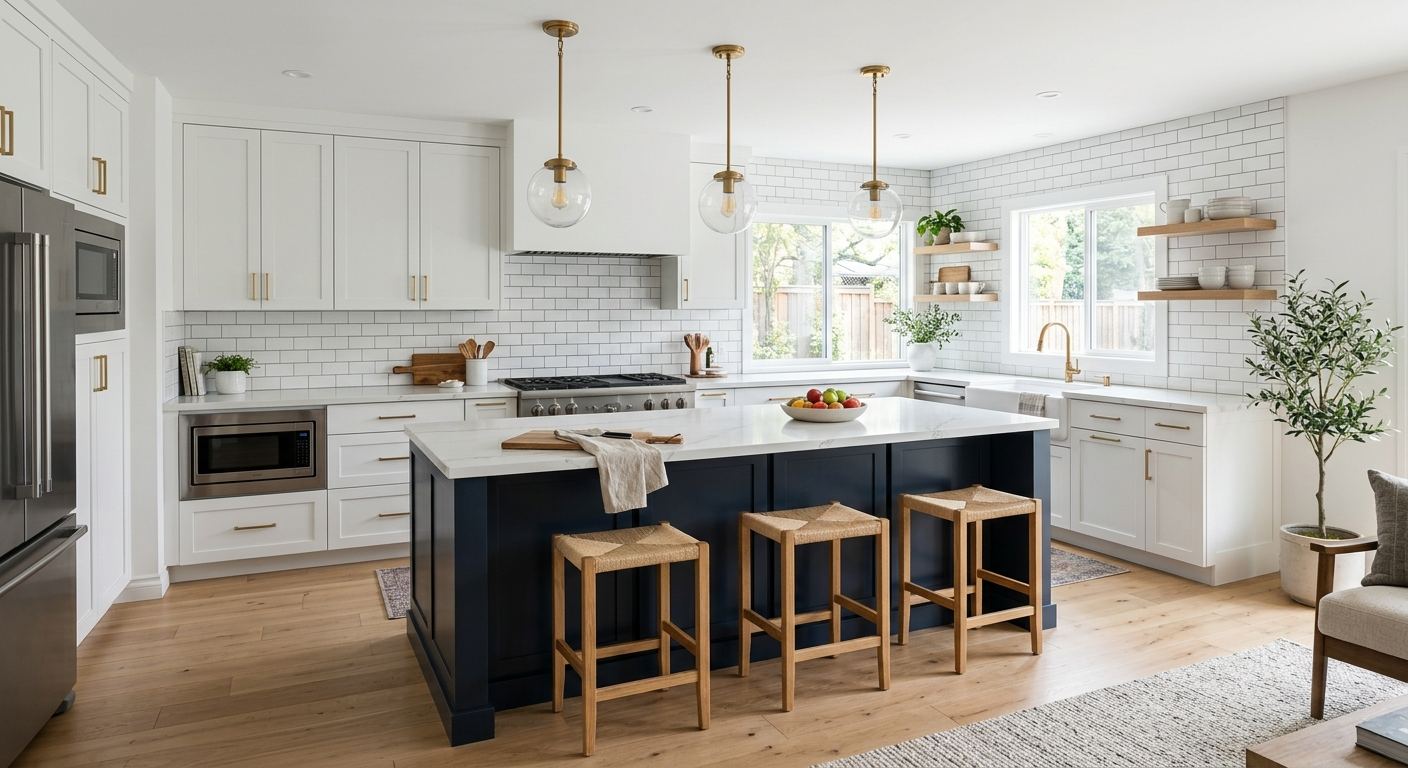
Kitchen renovation options and costs in West Clayton
In West Clayton, BC, homeowners typically start by choosing how big a “kitchen refresh” they want—because in this Lower Mainland–Southwest market, pricing is driven more by expected finish level and resale confidence than by climate. With a population of 13,102 (Statistics Canada, 2021 Census), most projects follow a predictable rhythm: either a practical refresh for lived-in homes, or a more design-led rebuild for buyers who want premium-looking materials. It also helps to note that kitchen budgets in the Lower Mainland track closely with household earning power; where homeowners have the means to pay for stone counters and upgraded cabinetry, those finishes show up more often in quotes (Statistics Canada, 2021 Census). That same pattern is why the same kitchen footprint can land in different price tiers—ranging from a laminate-and-paint approach to semi-custom or fully custom millwork with quartz or stone.
BC’s coastal weather isn’t usually the “cost driver” people think it is, but the region’s humidity swings and wet-season salt air can matter for surface longevity—especially at cabinet bases, caulking lines, and grout. West Clayton also benefits from solid contractor availability from Surrey and nearby commercial trades, so mid-range schedules are often steadier than in smaller towns. If you’re targeting high demand areas, jobs around South Surrey/West Clayton corridor-adjacent residential streets tend to move quickly when homeowners are matching neighbourhood-level finishes.
Below is a practical way to compare renovation tiers before you request quotes, so you can see what you’re buying and what you’re not.
| Renovation Tier |
What's Included |
Typical Duration |
Price Range |
| Cosmetic refresh (paint, hardware, new appliances only) |
Cabinet paint or refinishing, new pulls/knobs, appliance swap (range/fridge/dishwasher as applicable), basic caulking and touch-ups |
1–3 weeks |
$8,000–$25,000 |
| Mid-range full renovation (new cabinets, counters, sink, tile) |
Semi-custom or stock cabinets, countertop (quartz or upgraded laminate), sink and taps, backsplash tile, new flooring under scope where needed, standard plumbing updates |
4–8 weeks |
$40,000–$85,000 |
| High-end full renovation (custom cabinets, stone counters, island) |
Custom cabinetry, stone counters (quartz slab or natural stone), island build-out, premium hardware/soft-close, upgraded lighting, extended backsplash to feature lines, likely layout and service upgrades |
8–16 weeks |
$85,000–$120,000 |
| Cabinet refacing only (new doors + drawer fronts, same boxes) |
Refaced front materials, new doors/drawers, matching trim, hardware swap, minor repairs to existing frames |
2–5 weeks |
$8,000–$35,000 |
| Countertop swap only (laminate to quartz or stone) |
Removal and install of new countertop, sink cut-outs if applicable, backsplash rework as needed for a clean seam, disposal and basic resealing |
3–10 days |
$3,000–$12,000 |
| Backsplash tile installation only |
Tile supply and install, substrate prep, waterproofing where required, grouting/sealing, finishing at edges and outlets |
4–10 days |
$1,500–$6,000 |
Prices are estimates only and vary by project scope, site access and material selection.
What affects the price of kitchen renovation in West Clayton
Across the Lower Mainland–Southwest (including West Clayton) and the rest of British Columbia, quotes for the “same” kitchen can easily swing by 30–50%. The reason isn’t usually climate—it’s how local home values and owner expectations influence the chosen finish tier. In higher-value areas of the region, homeowners more often default to quartz or stone counters and semi-custom cabinetry because the higher renovation cost is easier to justify on resale. In more modest finish plans, laminate and stock cabinetry help keep the project closer to the $40,000–$85,000 mid-range band. Where homeowners plan layout changes, that randomness becomes bigger regardless of finish level.
In West Clayton, two practical examples that commonly move costs: (1) older homes and original subfloors can require extra prep to get cabinets level and secure, which pushes labour time upward; (2) if you’re adding or relocating services—like moving a sink run or reworking a gas line for the cooktop—your quote shifts because trades schedules and cut-in requirements change. Even a well-planned island can add cost quickly due to countertop fabrication tolerances, electrical placement for under-cabinet lighting or outlets, and the need to coordinate plumbing/gas rough-ins early.
Finish selection also matters in real dollars. Upgrading countertops from laminate toward quartz often lands inside the $3,000–$12,000 countertop installation range, but if you need to change sink cut-outs or add a waterfall edge, the same “swap” can climb. Similarly, moving from a standard backsplash to a feature tile wall or full-height slab can add cost beyond the typical tile band, especially when prep and waterproof detailing are included.
| Price Factor |
Why It Matters |
Cost Impact |
| Cabinet tier — stock vs. semi-custom vs. fully custom millwork |
Box quality, door styles, internal options (organizers/soft-close), and how precisely it fits your walls |
Often shifts the total by tens of thousands; custom can push projects toward the high-end $85,000–$120,000 band |
| Countertop material — laminate vs. quartz vs. granite vs. stone |
Material cost, fabrication complexity, edges, seams and weight handling |
Can move a countertop line item anywhere within the $3,000–$12,000 band |
| Layout change — wall removal, island add, plumbing/gas move |
Unexpected framing, service rework, and trade coordination |
Often the largest swing factor; 30–50% quote variation commonly comes from this alone |
| Appliance package tier — builder vs. mid-range vs. pro-grade |
Electrical/gas requirements, fit/finish, warranty terms and venting needs |
Typically modest vs. cabinetry, but can add several thousand depending on brand tier |
| Flooring — refinish existing vs. full replacement |
Subfloor condition, moisture tolerance, and matching transitions |
Refinish can keep costs down; full replacement adds labour, underlay and material |
| Backsplash — ceramic tile vs. marble vs. full-height slab |
Material fragility, installation time, seam planning, and waterproof prep |
Tile-only scopes usually sit around the $1,500–$6,000 range; premium formats climb fast |
| Electrical — new circuits for island, under-cabinet lighting |
Licensed work, box locations, and lighting/power planning |
Often adds cost unpredictably if the electrician needs to open walls or adjust rough-in locations |
| Permit fees and licensed trade requirements |
When permits apply, you pay for admin time plus inspections |
Most projects remain manageable, but service changes can increase both direct costs and scheduling overhead |
Permits & regulations in British Columbia
In British Columbia, some kitchen changes are straightforward, and others trigger permits and licensed trades. Cabinet and countertop swaps—like replacing doors and drawer fronts, or installing new quartz over existing cabinet tops—typically do not require a permit as long as you’re not altering plumbing, gas, structural elements, or electrical systems. However, permits generally are required when you move plumbing supply/drain lines, relocate gas appliances or gas connections (for a cooktop/range and certain venting changes), remove a load-bearing wall, or add new electrical circuits (for example, outlets in an island or new dedicated lines for under-cabinet lighting and range hoods).
For a homeowner in West Clayton, the practical way to verify responsibility is to follow a simple paper trail before you sign: ask the contractor to list which permits (if any) they will pull and which trades will perform each task. Then confirm licensing and insurance documentation. Look for the contractor’s certificate of insurance (general liability) and any required clearance letters or proof of coverage from their trades. For licensed trades, confirm the specific licence for the person performing the gas or electrical work, and ensure there’s liability coverage that matches the scope (especially where walls are opened or services are rerouted).
Step-by-step: (1) request an itemised scope, (2) ask “What needs permits and who pulls them?”, (3) ask for insurance certificates, (4) verify licences for gas fitting and electrical work, and (5) require inspections to be scheduled and completed before close-in.
Cabinets, countertops and layout decisions in West Clayton
When you renovate a kitchen in West Clayton, the three decisions that most influence both cost and resale appeal are cabinet tier, countertop material, and whether you change the layout. Cabinet tier: stock is fastest and usually the lowest cost, semi-custom is the most common sweet spot for West Clayton homeowners, and custom delivers the best fit where ceilings, corners, or appliances demand it. Countertops: laminate is budget-friendly but can show wear faster at seams; quartz is durable and low-maintenance; granite/natural stone looks premium but needs a bit more care. Marble offers a dramatic look but is easier to stain/etch than quartz or granite, so I typically recommend it for buyers who want the aesthetic and understand sealing/maintenance.
Layout changes are where your money either buys space or creates cost without value. Removing a wall for an open-concept feel can justify the spend if it improves sightlines and how the kitchen functions for family life and entertaining. Adding an island makes sense when you have enough clearance for circulation; otherwise, you pay more for a design that’s less practical. Plumbing or gas relocation is justified only when it unlocks a better work triangle or creates the ability to add storage and seating where it matters.
Here’s a concrete example: if you keep the existing sink location and avoid moving plumbing, you may stay closer to a countertop-focused upgrade around $3,000–$12,000. If instead you relocate the sink and change cabinet runs to suit, the plumbing/gas and finish coordination can push you into higher full-renovation pricing—often closer to the $40,000–$85,000 mid-range band, even before you consider layout electrical work for task lighting.
In the Lower Mainland–Southwest, buyers increasingly expect clean, consistent lines: solid-looking cabinetry faces, modern hardware, and countertops that read premium in daylight. Picking these wisely often gives you more resale confidence than “over-upgrading” one element while leaving the rest mismatched.
| Option |
Durability |
Maintenance |
Best For |
Price Range |
| Stock cabinets (big-box) |
Good for daily use; may need filler/trim to match uneven walls |
Low; wipe-down and routine hardware tightening |
Budget-conscious refreshes where speed matters |
$12,000–$30,000 |
| Semi-custom cabinets (local dealer) |
Very strong; better internal organization and consistent door quality |
Low; keep seals and edges clean |
Most West Clayton renovations aiming for resale-friendly finishes |
$25,000–$55,000 |
| Custom cabinets (local millwork shop) |
Highest precision fit; excellent for awkward corners and ceiling heights |
Low; depends on finish type but generally easy to care for |
Design-led kitchens and homes needing made-to-fit solutions |
$50,000–$85,000 |
| Laminate countertop |
Resilient to everyday mess; less forgiving at impacts and damaged seams |
Easy cleaning; watch for water at seams |
Cost-controlled projects wanting a fresh look |
$3,000–$6,000 |
| Quartz engineered countertop |
High scratch and stain resistance; holds up well to heat management practices |
Low; wipe and avoid abrasive pads |
Busy households and buyers who want “premium” without extra upkeep |
$6,000–$11,000 |
| Granite / natural stone countertop |
Very durable with proper sealing; varies by slab |
Needs periodic sealing and attention to spills |
Owners who want natural variation and a higher-end look |
$8,000–$12,000 |
| Butcher block countertop |
Durable for chopping; can be vulnerable if water isn’t maintained/managed |
Requires oiling and disciplined cleaning |
Homes that lean warm/natural and can commit to care |
$5,000–$10,000 |
| Marble countertop |
Beautiful but softer than quartz; can etch/stain |
Higher care: sealing and quick spill cleanup |
Aesthetic-forward kitchens with a maintenance plan |
$10,000–$18,000 |
How to choose a kitchen renovation contractor in West Clayton
Choosing the right contractor in West Clayton starts with verifying the right credentials and then getting the right kind of paperwork. For British Columbia, confirm their liability insurance (so you’re protected if something is damaged on site) and ask for proof of WSIB/WCB coverage where applicable through their trade network. Then verify licences by trade: gas work must be done by a licensed gas fitter, and electrical work by a licensed electrician. Don’t rely on a general statement—ask to see the insurance certificate and the trade licences tied to the people performing the permitted or risk-sensitive scope. If the contractor refuses to provide documentation or pushes back on verification, that’s usually a sign you’ll pay later.
Next, request 2–3 itemised written quotes, not one lump-sum number. You want breakdowns for labour and materials (cabinets, counters, tile, demolition, disposal, and any allowances) and clear exclusions. Specifically ask: “Does the quote include permit pulls if required?” “Is jobsite disposal included?” “What’s excluded for plumbing/electrical rough-in and finish?” Warranty matters too—look for a workmanship warranty period and separate product/manufacturer warranties, plus whether warranties transfer if you sell the home.
For payment scheduling, insist on a conservative plan: never pay more than 10–15% upfront, and hold back a portion until the job is complete and documented (warranty start date should align with completion). Finally, get start date and completion estimate in writing so you can manage cashflow and daily life.
- Ask for an itemised quote with line-by-line labour and materials, plus allowances.
- Confirm who pulls permits and which trades do gas/plumbing/electrical work.
- Review certificate of insurance (liability) and ask for a fresh COI close to start.
- Verify licences for gas and electrical with the trades assigned to your scope.
- Check warranty terms in writing: workmanship length and product warranty details.
- Confirm demolition and disposal are included (and what “included” actually means).
- Ask how they protect floors/doors during demolition and cabinet installation.
- Get a detailed schedule: ordering lead times for cabinets/quartz and when template/measure happens.
- Ensure electrical plans cover outlets/lighting locations for island tasks and under-cabinet lighting.
- Request a written change-order process (pricing method and approval steps).
- Confirm caulking/finishing standards at tile edges, countertop seams, and backsplash transitions.
- Plan for site access, parking, and scheduling constraints in West Clayton.
Concrete red flags I see in West Clayton include: contractors who won’t provide licences/insurance details on request, vague scopes that omit disposal or protection measures, quotes with unrealistic timelines that ignore cabinet/counter fabrication lead times, “change order” language that’s overly discretionary, and payment terms demanding large upfront deposits instead of a modest 10–15% start.
Frequently asked questions — kitchen renovation in West Clayton
What's the most cost-effective kitchen upgrade?
If you’re optimizing dollars in West Clayton, the most cost-effective upgrade is often a cabinet refresh paired with a clear appliance swap—especially when your existing cabinet boxes are solid. A cosmetic refresh (paint, hardware, and new appliances only) commonly lands in the $8,000–$25,000 range, and it avoids the high labour coordination costs of layout changes. If your cabinets are dated but structurally fine, cabinet refacing is frequently the next-best value compared with full cabinet replacement, while still delivering a modern look. Where homeowners get more visual impact per dollar is matching finishes across backsplash and lighting—many small updates read like a “new kitchen” in photos and showings.
Custom vs stock cabinets — is custom worth it?
Custom cabinets can be worth it in British Columbia when your kitchen has unusual measurements, awkward corners, or you want built-ins that match your lifestyle (beyond what stock offers). In West Clayton, the “worth it” calculation is usually about fit and function: if you’re replacing a kitchen that doesn’t lay out cleanly with standard widths, custom can reduce filler work and improve storage. That said, stock cabinets remain the best route when the goal is speed and budget control. Many projects land in different total tiers depending on cabinetry choice—moving from stock toward semi-custom or custom often pushes you from more restrained scopes toward the mid-range full renovation pricing and sometimes the high-end band, especially if you’re also upgrading countertops and adding an island.
How do I choose a kitchen contractor in West Clayton?
Choose a kitchen contractor in West Clayton by starting with documentation and itemised quoting. Verify the contractor’s liability insurance and confirm trade licences for anything that requires it—gas work by a licensed gas fitter and electrical by a licensed electrician. Ask for two or three itemised quotes that separate labour, materials, and allowances, and confirm whether permit pulls are included when the scope triggers them. Also check warranty details: workmanship warranty length, product warranty terms, and whether warranties transfer if you sell your home. Finally, demand a reasonable payment schedule—never more than 10–15% upfront—and get a written start date and completion estimate.
What order do kitchen renovation steps happen in?
In West Clayton renovations, the standard sequence is: planning and measurements (including cabinet layout and countertop template timing), demolition, rough-in work for any plumbing/electrical/gas changes, then cabinet installation, followed by countertop fabrication and install, then backsplash tile and finishing trim. Flooring and paint usually happen around the cabinet/counter stage, depending on how transitions are handled. If you’re doing only a countertop swap, it’s typically removal, countertop install, then targeted backsplash/seam work. Coordinating order matters because cabinet and countertop lead times are often the pace-setters. A reputable contractor will map this in writing so you’re not stuck waiting mid-project.
Can I live at home during a kitchen renovation in West Clayton?
Often yes, you can live at home during a kitchen renovation in West Clayton, but it depends on how invasive the scope is and whether plumbing/electrical work is underway. For a cosmetic refresh, most people can continue daily routines since the kitchen is minimally disrupted and work is mainly paint/hardware/appliance swaps. For a full renovation, you’ll usually set up a temporary kitchen in an adjacent room with a microwave, kettle, and basic prep space. If you’re moving plumbing or gas, you may experience longer “down times” for cooking, and the schedule can stretch when permits and inspections are involved. Your contractor should provide a plan for dust control, access times, and how food prep will work during countertop fabrication or tile curing.
Should I renovate my kitchen before selling in West Clayton?
If you’re planning to sell, focus on renovations that modernize how buyers perceive value without overextending. In British Columbia, kitchens are a high-visibility purchase driver, so many sellers target a mid-range update—new cabinets and counters—so the kitchen photographs well and feels updated on walk-through. A mid-range full renovation commonly sits in the $40,000–$85,000 band, and it’s often where buyers see the “complete” transformation. If your budget is tighter, a targeted countertop upgrade (often within the $3,000–$12,000 countertop installation range) plus fresh hardware and a clean backsplash can still move the needle. The key is matching what local buyers expect in the Lower Mainland–Southwest: quartz/stone looks are currently the safe premium baseline, while heavy layout overhauls should only be done if the result clearly improves usability.