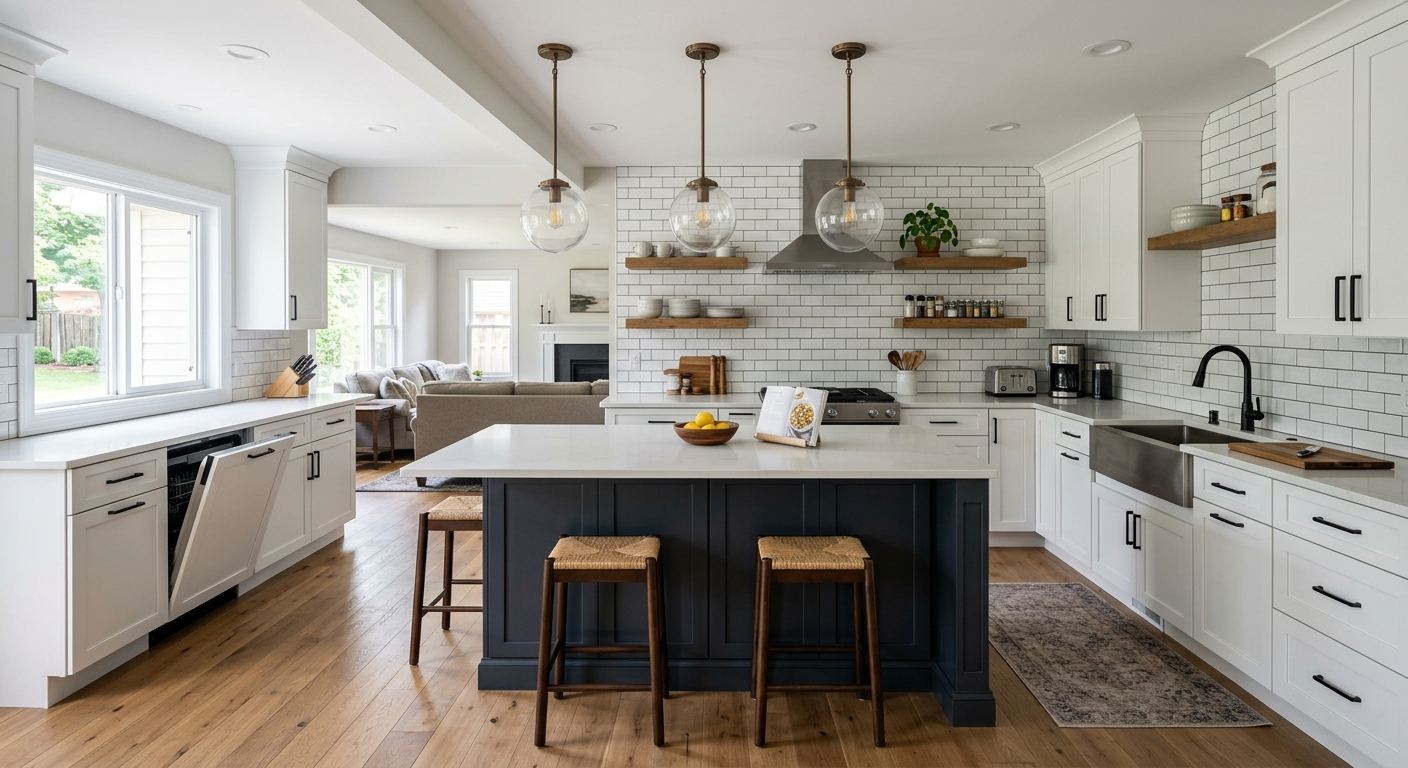
Kitchen renovation options and costs in Chilliwack-Downtown
Kitchen renovation costs in Chilliwack-Downtown typically follow finish expectations and project complexity more than weather. With a population of 31,410 (Statistics Canada, 2021 Census), the area draws steady demand from homeowners upgrading older housing stock in the Lower Mainland–Southwest. At the same time, the broader Lower Mainland–Southwest pricing environment is shaped by household purchasing power—when incomes are stronger, buyers more often prioritize semi-custom cabinetry, upgraded hardware, and quartz/stone surfaces that feel “current” at resale.
Across British Columbia, contractors also see a pricing spread because Lower Mainland markets tend to support a wider range of project tiers: a practical refresh can stay restrained, while a plan that includes layout changes (island, wall removal, plumbing or gas moves) can climb quickly even if finishes are modest. Climate plays a smaller role than in northern provinces, but local humidity and seasonal temperature swings still matter for product performance—especially around caulking, adhesive-bonded surfaces, and long runs of flooring behind a fridge or near exterior doors.
In Chilliwack-Downtown, this trade is especially busy around the core shopping and older residential pockets near community amenities, where many homes are dated and owners want better storage and brighter layouts for everyday use. Below is a practical comparison of common renovation tiers, so you can sanity-check quotes before you commit.
| Renovation Tier |
What's Included |
Typical Duration |
Price Range |
| Cosmetic refresh (paint, hardware, new appliances only) |
Cabinet paint or finish refresh (no box changes), new pulls/knobs, new appliances (like-for-like placement), basic caulking and touch-ups |
1–3 weeks |
$8,000–$25,000 |
| Mid-range full renovation (new cabinets, counters, sink, tile) |
New cabinets (stock-to-semi-custom), countertop replacement, sink + faucet, backsplash tile, new flooring transitions, plumbing fixtures adjustments (no major relocation) |
3–6 weeks |
$40,000–$70,000 |
| High-end full renovation (custom cabinets, stone counters, island) |
Custom or fully fit cabinetry, quartz/stone counters, island with upgraded plumbing/electrical, full backsplash (often tile + specialty finishes), premium hardware and design-led layout |
6–12 weeks |
$85,000–$120,000 |
| Cabinet refacing only (new doors + drawer fronts, same boxes) |
Door/drawer front replacement, new trim, hardware upgrades, prep and resurfacing; counters may be reused |
2–4 weeks |
$8,000–$35,000 |
| Countertop swap only (laminate to quartz or stone) |
Remove existing top, install new quartz/stone (template + install), sink cut-out adjustments (if needed), basic sealing and finishing |
1–3 weeks |
$3,000–$12,000 |
| Backsplash tile installation only |
Tile supply (average mix), layout and installation, grout/sealing, finishing around outlets and edges |
3–7 days |
$1,500–$6,000 |
Prices are estimates only and vary by project scope, site access and material selection.
What affects the price of kitchen renovation in Chilliwack-Downtown
For the same kitchen size, quotes across the Lower Mainland–Southwest (including Chilliwack-Downtown) and other British Columbia markets can vary by 30–50% because pricing is driven by buyer expectations, labour availability, and how far the plan departs from “like-for-like.” In higher-value areas, homeowners more readily choose quartz or stone counters, semi-custom cabinetry, upgraded hardware, and design-led layouts; in more budget-focused scopes, laminate and stock cabinets dominate. That difference in “finish tier” changes material costs, but layout and service moves add the largest uncertainty regardless of décor.
In high-value Lower Mainland–Southwest neighbourhood conditions, many homeowners default to quartz/stone and semi-custom cabinetry because the renovation cost is more easily recovered on resale—especially when the kitchen becomes a selling feature. In more modest homes and refresh projects, owners often prioritize paint, hardware, and new appliances, keeping the total spend closer to a cosmetic tier and avoiding full cabinet teardown.
Two concrete Chilliwack-Downtown examples we see often:
- Older drain locations: When the sink drain is poorly aligned for the new layout, contractors may need more labour and patching for subfloor repairs, pushing a mid-range plan toward the upper edge of a $40,000–$70,000 renovation.
- Exterior door and moisture exposure: Kitchens near exterior entries can experience more seasonal expansion/contraction. If flooring and caulking aren’t detailed correctly, you may end up paying twice for trim fixes—this is one reason full replacements can outperform “spot repairs.”
Layout changes—removing a wall, adding an island, or moving a gas line—are where budgets are most likely to jump, and those moves can be the difference between a restrained rebuild and a higher-end total that lands in the $85,000–$120,000 range.
| Price Factor |
Why It Matters |
Cost Impact |
| Cabinet tier — stock vs. semi-custom vs. fully custom millwork |
Tier changes material quality, build time, and fit/finish (adjustability, interior organizers, dovetail construction) |
Can add several thousand to tens of thousands depending on scope |
| Countertop material — laminate vs. quartz vs. granite vs. stone |
Material cost and installation method (templates, fabrication complexity, edge profiles, sink cut-outs) |
Often ranges from “budget” swaps to full premium premium installs |
| Layout change — wall removal, island add, plumbing/gas move |
Creates structural trades, moving services, patching and inspection work |
Typically the most unpredictable line item |
| Appliance package tier — builder vs. mid-range vs. pro-grade |
Electrical requirements, venting needs, fit tolerances, and integration style |
Can widen budget more than people expect |
| Flooring — refinish existing vs. full replacement |
Whether you remove cabinetry/flooring, undercut transitions, and match finish to surrounding rooms |
Full replacement usually adds cost and schedule risk |
| Backsplash — ceramic tile vs. marble vs. full-height slab |
Labour intensity, pattern matching, and weight/handling requirements |
Can turn a simple upgrade into a premium finish |
| Electrical — new circuits for island, under-cabinet lighting |
New circuits require licensed work and often add cost for labour and inspection readiness |
Frequently adds measurable cost even when layout stays “same” |
| Permit fees and licensed trade requirements |
Permits and inspections add admin time; licensed trades have specific compliance steps |
Can add both direct fees and schedule length |
Permits & regulations in British Columbia
In British Columbia, a countertop or cabinet swap is usually straightforward from a permit standpoint. Cabinet and countertop swaps typically do not require permits when you are not changing plumbing, gas, structural elements, or electrical systems. In Chilliwack-Downtown, that means repainting, replacing cabinet faces/doors, or installing new counters over the existing setup is commonly done as a direct renovation scope.
Permits and licensed trade work do come into play when you move services or alter structural and electrical conditions. Work that typically requires permits and licensed trades includes: moving sink drain and supply lines, relocating a stove or cooktop that involves gas connections, changing the location of a hood that vents through new ducting, removing a load-bearing wall, and adding new electrical circuits (for example, dedicated island receptacles or new under-cabinet lighting circuits). Gas work must be done by a licensed gas fitter, and electrical work must be done by a licensed electrician; both require inspections where applicable.
To verify a contractor’s credentials in BC, homeowners can do this in order: (1) ask for licence details and confirm them using the relevant online licensing registry for the trade they’re performing, (2) request a certificate of insurance (liability) showing coverage limits and effective dates, and (3) confirm WSIB/WCB coverage if applicable for the trades involved and ask for a clearance letter or evidence of coverage. Always ensure permit responsibility is clearly written into your contract before work begins.
Cabinets, countertops and layout decisions in Chilliwack-Downtown
The three most consequential decisions in a Chilliwack-Downtown kitchen renovation are (1) cabinet tier, (2) countertop material, and (3) layout changes. Start with cabinet tier: stock cabinets are the fastest and cheapest, semi-custom is the most popular mid-range option for families who want better storage and better fit, and custom cabinets deliver the highest cost but can be worth it when your room has unusual dimensions or you need a full-height solution to maximize capacity. Next is countertop choice. Laminate is the budget-friendly route, while quartz offers a strong balance of durability and maintenance with a consistent look. Granite and other natural stones can be premium and timeless, but they require more decision-making around sealing and finish consistency. Finally, decide on layout changes: open-concept wall removal, island addition, or plumbing/gas relocation can be justified when you gain real circulation and storage—not just when you “want it to look different.”
Because Lower Mainland–Southwest buyers often expect modern, durable surfaces, a quartz/stone direction is common at the higher-end of pricing, while laminate and stock cabinets remain practical for ROI-focused refreshes. In Chilliwack-Downtown’s climate of seasonal humidity and temperature swings, careful sealing and proper installation details matter—especially around exterior door areas and near sinks where moisture exposure is routine.
Dollar example: upgrading from laminate to quartz can add several thousand depending on size and edge profiles, but when it replaces a worn surface that discourages buyers, that cost is usually easier to defend than “upgrading everything” cosmetically. If you’re staying in the mid-range band of $40,000–$70,000, choose quartz for key visual zones (main run and island) before considering premium stone everywhere. If you’re building toward a higher-end finish plan near $85,000–$120,000, custom cabinetry plus premium counters becomes more cost-effective because the layout typically supports an island and upgraded service runs.
| Option |
Durability |
Maintenance |
Best For |
Price Range |
| Stock cabinets (big-box) |
Good everyday durability; limited customization and fewer fit adjustments |
Low maintenance; wipe clean and keep hardware tightened |
Fast turnarounds and budget-aware refreshes |
$8,000–$25,000 |
| Semi-custom cabinets (local dealer) |
Very durable construction; better options for storage and interior organization |
Low maintenance; occasional hardware tightening |
Most homeowners targeting a mid-range full renovation |
$25,000–$55,000 |
| Custom cabinets (local millwork shop) |
Highest durability and precision fit; best for awkward spaces |
Low maintenance; premium finishes may require gentle cleaners |
Complex layouts, full-height pantry walls, and design-led kitchens |
$55,000–$90,000 |
| Laminate countertop |
Decent for daily use; can be less resilient to heat and heavy impact |
Easy cleaning; avoid prolonged heat exposure and monitor edges |
Budget refresh and rental-style upgrades |
$3,000–$6,000 |
| Quartz engineered countertop |
Very durable and consistent; resistant to staining and everyday wear |
Low maintenance; wipe clean, no routine sealing |
Families who want premium look with practical upkeep |
$6,000–$10,000 |
| Granite / natural stone countertop |
High durability; natural variations can affect finish consistency |
Generally easy, but sealing and careful cleaning are recommended |
Premium visual impact and timeless appeal |
$7,000–$12,000 |
| Butcher block countertop |
Durable with proper care; sensitive to standing water and heat |
Requires regular oiling/maintenance |
Warm look for heritage-style kitchens and cooking-centric homes |
$4,000–$8,000 |
| Marble countertop |
Premium look; softer and more susceptible to etching/scratching than quartz |
Higher maintenance: sealing and gentle cleaning needed |
Design-forward kitchens where aesthetics lead |
$9,000–$14,000 |
How to choose a kitchen renovation contractor in Chilliwack-Downtown
Choosing the right contractor in Chilliwack-Downtown starts with verifying British Columbia licensing, liability insurance, and coverage for workers. For licensing, ask which trades will do the gas and electrical work and confirm their licences via the appropriate BC online registry. For insurance, request a certificate of liability that matches the contractor’s legal name and includes current effective dates. For worker coverage, ask for evidence of WSIB/WCB coverage and/or a clearance letter as applicable to the trades involved.
Next, get 2–3 itemised written quotes. You want a breakdown that separates labour and materials, not a single lump sum—especially for cabinets, counter fabrication/installation, tile, and demolition/disposal. Read the scope carefully for exclusions: what’s included for permits (if needed), how waste is handled, whether old materials are disposed of, and whether flooring is replaced or only patched around the work zone. A clear scope prevents budget drift during a remodel.
Warranty matters too. Ask for the workmanship warranty length (how long the install is guaranteed), the product/manufacturer warranty on cabinets, counters and hardware, and whether warranties are transferable to a future buyer. Finally, payment schedules should be conservative: never more than 10–15% upfront; hold back a portion until completion (and ideally until punch-list items are finished). Make sure your timeline includes a start date and an estimated completion date in writing.
- Verify BC trade licences for gas and electrical work before signing.
- Confirm liability insurance certificate (limits, dates, and legal name).
- Request WSIB/WCB coverage evidence or clearance letter.
- Get 2–3 itemised quotes with labour and materials separated.
- Ensure demolition and disposal are explicitly included.
- Confirm what happens if cabinet/counter lead times slip.
- Ask whether permits are handled by the contractor or homeowner.
- Check if under-cabinet lighting and circuits are quoted correctly.
- Verify caulking, moisture detailing and back-splash finishing steps.
- Confirm warranty duration for workmanship and who honours it.
- Review payment schedule—aim for 10–15% max deposit.
- Require a written timeline and a defined start/completion window.
Red flags to watch for in Chilliwack-Downtown: vague scopes that hide disposal or permit responsibility, contractors who won’t provide licence/insurance documentation, quotes that treat cabinets/counters as “allowances” without specs, pressure to pay large deposits up front, and a timeline that ignores lead times for cabinets or stone fabrication.
Frequently asked questions — kitchen renovation in Chilliwack-Downtown
Do I need a permit for a kitchen renovation in British Columbia?
In British Columbia (including Chilliwack-Downtown), cabinet and countertop swaps typically do not require permits when plumbing, gas lines, electrical circuits, and structural elements are not changed. If you’re keeping the sink in the same location and not altering the stove/hood connections, you can often proceed without a permit. However, permits and licensed trades are commonly required when you move sink drain/supply lines, relocate gas appliances or make changes involving gas connections, remove a load-bearing wall, or add new electrical circuits (for example, dedicated island receptacles). Always confirm who pulls permits in your written contract, and ensure the contractor provides proof of licensed trades and inspections where required.
What's the ROI on a kitchen renovation?
ROI in Chilliwack-Downtown depends heavily on whether your renovation matches what local buyers expect for kitchens in the Lower Mainland–Southwest. In many cases, durable, modern finishes (like quartz counters and well-organized cabinets) support buyer confidence and can help a home stand out, especially in older housing stock. That said, ROI is usually highest when you avoid overbuilding for the neighbourhood. If your plan is a mid-range renovation, keeping totals in the $40,000–$70,000 range often provides more “safe” value than a fully premium rebuild when the layout changes aren’t clearly improving function. Spending beyond $85,000–$120,000 can still pay off, but only if the layout, storage, and finish level are clearly premium and defensible for resale.
How do I budget for a kitchen renovation?
Budgeting in Chilliwack-Downtown works best when you plan by tier: cosmetic refresh, mid-range full renovation, or higher-end full renovation. A realistic starting point for a full renovation in this area commonly sits in the broader range of $40,000–$120,000, depending on cabinets, countertops, and whether you’re changing the layout. For budgeting, separate your estimate into cabinets, countertops, tile/backsplash, labour, demolition/disposal, plumbing/electrical allowances, and a contingency for surprises (older homes can hide service issues behind walls). If you’re doing fewer scope items—like a countertop swap—you can target $3,000–$12,000 for countertops and $1,500–$6,000 for backsplash tile installation. Always ask for an itemised quote so you can see where the money is going.
Can I move my kitchen sink or stove?
Yes, but moving a kitchen sink or stove is where costs and approvals can change quickly in British Columbia. You can typically relocate a sink if you’re prepared for plumbing modifications (drain/supply changes), subfloor patching, and associated labour—often requiring permits and licensed plumbing work depending on the scope. Moving a stove that involves gas connections usually requires a licensed gas fitter and may require permits. In practice, the safest “budget control” approach is relocating within a limited distance where services can be extended with minimal opening and patching. If you want an island, many homeowners decide whether to move services based on how much wall opening and electrical/gas work becomes necessary. Ask for a plan that shows exactly what will be opened, what will be repaired, and which trades are licensed for each task.
What's the most cost-effective kitchen upgrade?
The most cost-effective upgrade in Chilliwack-Downtown is usually the one that gives the biggest visual and functional payoff without forcing a full teardown. For many homes, that’s either a cabinet refresh (paint plus hardware) or a targeted counter upgrade to a more durable surface. If your cabinets are structurally solid, cabinet refacing can be a strong value option, often landing in the $8,000–$35,000 range depending on materials and how much you change the configuration. If your cabinets look dated but are in good shape, a countertop swap alone can refresh the entire kitchen feel—often budgeted at $3,000–$12,000. Backsplash tile is also a relatively efficient way to modernize, typically around $1,500–$6,000. If you want maximum bang-for-buck, focus first on the “high-visibility” surfaces: counters, fronts, and backsplash.
Custom vs stock cabinets — is custom worth it?
Custom cabinets are worth it when you have layout constraints, unusual wall dimensions, or a specific storage plan you can’t achieve with stock. In Chilliwack-Downtown, many homeowners choose semi-custom for the best balance—better fit and interiors—without the longest lead times that can come with fully custom millwork. Stock cabinets are usually the cheapest and fastest option, but they can leave awkward gaps or limit what you can do with depth, height, and pull-out storage. As a practical budgeting guideline, semi-custom typically supports mid-range full renovation plans, while fully custom aligns more often with higher-end budgets near $85,000–$120,000 when combined with stone counters and an island. If you’re trying to stay in the $40,000–$70,000 band, custom everywhere is often harder to justify; consider semi-custom for the main run and upgrade counters/backsplash for the biggest visual impact.