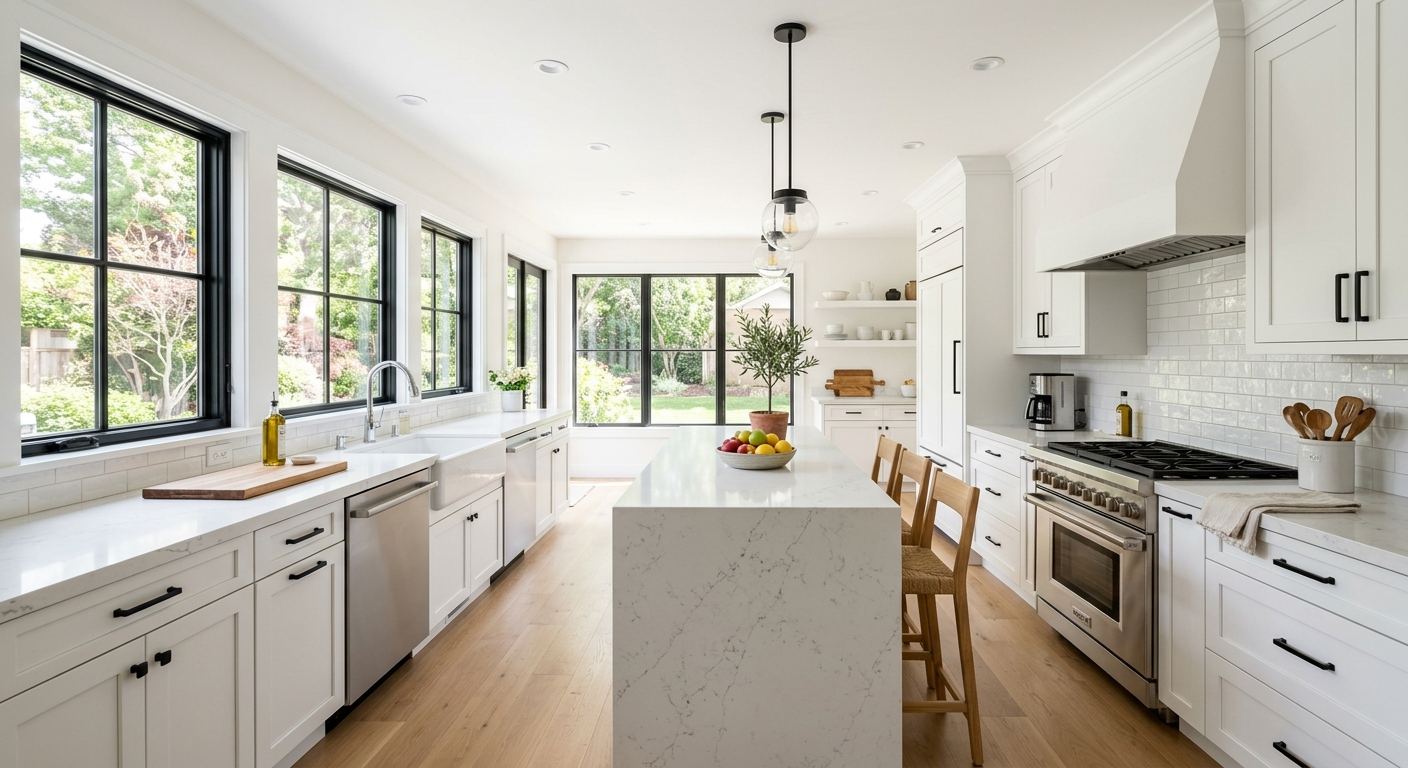
Kitchen renovation options and costs in Puntledge
Puntledge homeowners usually start with a simple question—“what will it cost?”—but the answer depends on how much you want to change and the finish level you choose. In the Lower Mainland–Southwest, expectations are strongly influenced by the broader housing market: with a small-town population of 1,387 (Statistics Canada, 2021 Census) living within an income-and-value-driven region, many renovations are geared toward what buyers notice first—cabinet style, countertops, and the overall layout. That’s why two kitchens with the same footprint can land far apart on price when one is treated like a refresh and the other like a design-led rebuild.
Climate in British Columbia isn’t usually the main driver of kitchen costs (it’s not like coastal flooding or freeze–thaw that destroys foundations), but it does affect day-to-day logistics: winter humidity swings, schedule changes around busy trade windows, and how quickly materials acclimatize before installation. Contractor availability can also be tighter in peak seasons in the Lower Mainland–Southwest, which can influence labour pricing and lead times for cabinetry and stone. In Puntledge, trade demand is especially steady in pockets tied to the Comox Valley commuter flow and broader renovation activity—so booking early matters if you want mid-range or high-end installs without pushing the timeline.
To compare your options clearly, use the tiers below as a baseline before you request an itemised quote.
| Renovation Tier |
What's Included |
Typical Duration |
Price Range |
| Cosmetic refresh (paint, hardware, new appliances only) |
Prep and repaint walls/ceiling, replace cabinet hardware, new appliance set (like-for-like), basic caulking/trim touch-ups |
3–7 days |
$12,000–$25,000 |
| Mid-range full renovation (new cabinets, counters, sink, tile) |
New stock or semi-custom cabinets, countertops (quartz/laminate), sink + faucet, backsplash tile, flooring spot repair/refinish, electrical allowance |
3–6 weeks |
$40,000–$75,000 |
| High-end full renovation (custom cabinets, stone counters, island) |
Fully custom cabinetry, premium stone (quartz/stone), island build with upgraded plumbing/electrical, full-height backsplash option, upgraded finishes |
6–12 weeks |
$85,000–$120,000 |
| Cabinet refacing only (new doors + drawer fronts, same boxes) |
Refacing materials, new doors/drawers, hardware updates, alignment/trim work; boxes remain in place (where condition allows) |
2–4 weeks |
$8,000–$35,000 |
| Countertop swap only (laminate to quartz or stone) |
Removal and disposal, new countertop fabrication/install (quartz/stone), sink cut-out allowance, basic backsplash trim changes |
1–3 weeks |
$10,000–$40,000 |
| Backsplash tile installation only |
Tile supply allowance, install labour, grout/seal, surface prep; may include minor outlet finishing |
3–10 days |
$2,500–$8,000 |
Prices are estimates only and vary by project scope, site access and material selection.
What affects the price of kitchen renovation in Puntledge
In the Lower Mainland–Southwest, the same kitchen can receive quotes that differ by 30–50% once you compare how contractors price labour risk, material lead times, and the finish tier your neighbours usually expect. That spread isn’t mainly a “BC climate” issue; it’s largely driven by local home values and typical household income levels, which influence whether homeowners plan for a laminate/stock approach or for quartz/stone and semi-custom cabinetry that plays well on resale. In higher-value pockets of the region, buyers often treat countertops and cabinetry as “must-not-look-cheap” features, and those upgrades get priced into the project quickly. In more modest markets, laminate surfaces and stock cabinets dominate because they offer a better ROI per dollar.
Layout changes are the biggest wildcard regardless of finish level. Removing a wall, adding an island, or moving a gas line/plumbing can push costs beyond what people expect, because you’re paying for demo, framing, waterproofing/line work, and rerouting trades. For example, upgrading from a mid-range full renovation scope in the $40,000–$75,000 band to a true “high-end” package in the $85,000–$120,000 band often comes down to whether the kitchen footprint is staying put and whether your contractor includes island-grade electrical/plumbing and custom cabinetry.
In Puntledge, two common cost drivers tied to local housing realities are older cabinet boxes that may or may not be salvageable (affecting refacing viability) and the way current electrical planning matches modern needs—like under-cabinet lighting or additional countertop circuits. When you have to open up walls to correct outdated wiring or adjust conduit routes, that labour risk can add thousands even if your finish selections stay mid-range. For countertops, selecting quartz vs. laminate also changes costs immediately, but the bigger swing is whether you’re reworking sink cut-outs and edge profiles during the swap.
| Price Factor |
Why It Matters |
Cost Impact |
| Cabinet tier — stock vs. semi-custom vs. fully custom millwork |
Tier affects material quality, door/drawer design complexity, hardware options, and lead time |
Typically shifts total cabinet scope by about $10,000–$45,000 |
| Countertop material — laminate vs. quartz vs. granite vs. stone |
Material cost, fabrication complexity, and edge/detail choices drive pricing |
Often ranges from $3,000–$12,000 for install-level differences and more for premium stone |
| Layout change — wall removal, island add, plumbing/gas move |
Reroutes trades, increases demo/framing and inspection requirements |
Can add $10,000–$30,000 depending on how far lines and supports must move |
| Appliance package tier — builder vs. mid-range vs. pro-grade |
Pro-grade models cost more and may require electrical/gas spec changes |
Commonly changes appliance allowance by $3,000–$15,000 |
| Flooring — refinish existing vs. full replacement |
Kitchen demo creates transitions; matching textures/adhesion matters |
May add $1,500–$8,000 based on whether you spot-repair or replace |
| Backsplash — ceramic tile vs. marble vs. full-height slab |
Labour intensity rises with detailing, height coverage, and heavy materials |
Usually $1,500–$6,000 for backsplash & tile installation differences |
| Electrical — new circuits for island, under-cabinet lighting |
New outlets, dedicated circuits, and lighting add labour and coordination time |
Frequently $1,500–$7,500 depending on complexity |
| Permit fees and licensed trade requirements |
Anything beyond like-for-like can trigger permits and inspections |
Often $500–$5,000 plus scheduling impacts |
Permits & regulations in British Columbia
In British Columbia, some kitchen work is truly “no-permit” when you’re only swapping like-for-like surfaces and fixtures. Generally, cabinet and countertop swaps do not require permits—if you’re removing and reinstalling without relocating plumbing, gas lines, or major electrical connections. Likewise, many backsplash and paint-only refresh jobs are typically treated as non-permitted renovations.
Permits and licensed trades are commonly required when you change a system, not just the finish. That includes moving plumbing supply or drain lines, relocating a gas stove/range, changing a gas line route, removing a load-bearing wall (or altering structural supports), and adding electrical circuits—such as new outlet drops for an island, dedicated circuits for large appliances, or new lighting runs that require circuit changes. Gas work must be completed by a licensed gasfitter, and electrical work by a licensed electrician; both typically require inspections once the work is finished.
To verify a contractor in Puntledge before signing, take these steps: (1) ask for their licence details and check the relevant provincial online registry for active status; (2) request a current certificate of insurance for liability; (3) confirm workers’ compensation coverage (WCB/WSIB coverage depending on employer structure) and obtain proof; and (4) keep an eye out for a clear written statement of who pulls permits and schedules inspections. If the quote doesn’t clarify permit responsibility, treat that as a risk—permits and inspection scheduling can affect both cost and start dates.
Cabinets, countertops and layout decisions in Puntledge
In a Puntledge kitchen renovation, three decisions drive most of the outcome: (1) cabinet tier, (2) countertop material, and (3) whether you keep or change the layout. For cabinets, stock is the fastest and usually the cheapest, semi-custom is the most popular mid-range choice because you can tailor sizing and door styles without waiting for fully bespoke manufacturing, and custom is the highest cost—but it can solve awkward wall conditions and deliver a truly fitted look.
For counters, laminate is budget-friendly and acceptable for many homes, while quartz is the “sweet spot” for durability and cleanability with a realistic resale-friendly finish. Granite and other natural stones look premium, but require more care and can be costlier to fabricate and maintain depending on sealer and edge finishing. Butcher block can be a warm option, yet it needs routine sealing—fine for homeowners who want that maintenance rhythm.
Layout changes are where “good ideas” can become expensive. In the Lower Mainland–Southwest market, an open-concept feel and a functional island often help resale, but only if the space gain is real. If you’re just adding an island that forces awkward clearances, the added plumbing/gas routing and electrical costs can outweigh the benefit.
Here’s a practical dollar example: if you’re choosing between mid-range laminate counters and quartz, the counter swap alone can swing by several thousand. But if that upgrade is paired with no layout changes and you keep plumbing in place, the value stays focused. Conversely, if you upgrade to stone and also move a sink or add an island, you may be paying twice—once for premium materials and again for rerouted trades and additional labour.
| Option |
Durability |
Maintenance |
Best For |
Price Range |
| Stock cabinets (big-box) |
Good for standard dimensions; susceptible to finish wear at edges |
Low—mostly cleaning and hardware tightening |
Budget refreshes with fast lead times |
$8,000–$25,000 |
| Semi-custom cabinets (local dealer) |
Better fit and construction consistency; improved door/drawer stability |
Low to moderate depending on finish type |
Most Puntledge mid-range renovations aiming for resale-ready styling |
$18,000–$45,000 |
| Custom cabinets (local millwork shop) |
Highest fit and material options; built for irregular walls and premium hardware |
Low—requires normal care; finish and hardware drive maintenance |
Complex layouts, ceiling-height runs, and design-forward kitchens |
$35,000–$80,000 |
| Laminate countertop |
Decent for daily use; seams/edges can be more vulnerable |
Low—avoid prolonged heat and heavy cutting directly |
Cost-conscious upgrades where layout stays put |
$3,000–$7,000 |
| Quartz engineered countertop |
Very durable for stains and everyday impacts |
Low—routine cleaning only |
Resale-friendly “set it and forget it” kitchens |
$6,000–$12,000 |
| Granite / natural stone countertop |
Hard and durable, with natural variation |
Moderate—periodic sealing depending on stone |
Premium look where you want unique colour and veining |
$8,000–$14,000 |
| Butcher block countertop |
Good, but more sensitive to moisture and cuts than quartz |
Moderate—regular oil/seal maintenance |
Homes where cooking and patina matter more than zero-maintenance |
$4,000–$10,000 |
| Marble countertop |
Premium look; softer than quartz and can etch |
Higher—requires careful cleaning and sealing |
Design-led kitchens where owners accept maintenance for aesthetics |
$10,000–$20,000 |
How to choose a kitchen renovation contractor in Puntledge
Choosing the right contractor in Puntledge is mostly about verifying capability, not just comparing totals. Start by confirming British Columbia licensing: ask for the trades’ licence numbers (contractor, gasfitter, electrician as applicable) and check their active status in the provincial online registry. Then verify liability insurance by requesting a current certificate of insurance—ensure the coverage is in place for the renovation period. For workers’ compensation, request proof of WCB/WSIB coverage for their workers (and confirm subcontractors’ coverage as well). If a contractor can’t provide documentation quickly, that’s a red flag.
Get 2–3 itemised written quotes. You want a breakdown that separates labour from materials, lists cabinet supply/installs separately, clarifies countertop fabrication and edging, and shows allowances for plumbing/electrical where needed. Avoid lump-sum quotes that don’t state what happens if old ductwork wiring or framing issues are discovered.
Read the scope carefully: is permit pulling included, and who pays permit fees? Is disposal and debris handling included? Are you responsible for appliance delivery timing, or does the contractor coordinate? Ask about warranty—both workmanship warranty length and product/manufacturer warranty terms, and whether warranties transfer if you sell. For payments, use a schedule that keeps upfront costs to about 10–15% at most, with progress payments tied to completed milestones; keep a holdback until the final punch list is done. Finally, request a written start date and completion estimate that includes lead times for cabinets and stone.
- Confirm all relevant BC licences before work starts (and match names to the quote).
- Request liability insurance proof with policy dates covering your project window.
- Verify WCB/WSIB coverage for the contractor and any subcontractors.
- Demand itemised quoting for labour vs materials (no vague “includes” lines).
- Ask what’s included in demo, haul-away, and final cleanup.
- Confirm who pulls permits and schedules inspections.
- Clarify countertop templating timing and who is responsible for site measurements.
- Check cabinetry installation method: shimming/leveling plan for floors and walls.
- Review warranty terms in writing (workmanship, plus product warranties).
- Use a payment schedule with a 10–15% maximum upfront and a meaningful holdback.
- Require a written timeline including cabinet/stone lead times.
- Ensure the contract lists allowances clearly and states how upgrades are approved.
In Puntledge, specific red flags include quotes that omit permit responsibility, contractors who won’t provide insurance/WCB/WSIB proof, “cheapest” cabinet installs with no detail on door/drawer quality, vague change-order language that doesn’t define what triggers extras, and no written warranty terms for workmanship or product replacement.
Frequently asked questions — kitchen renovation in Puntledge
What's the most cost-effective kitchen upgrade?
If your goal is the biggest visual change per dollar in Puntledge, a cabinet refacing plus hardware update is usually the most cost-effective pathway—especially when your existing cabinet boxes are still solid. It can cost materially less than a full replacement, and it delivers a new face without paying for a complete rebuild. If your counters are dated but the layout is functional, consider a countertop swap on its own (for many homes, this sits in the $10,000–$40,000 neighbourhood depending on quartz vs. stone and sink cut-outs). For smaller budgets, a backsplash refresh and modern under-cabinet lighting can also elevate the look quickly.
Custom vs stock cabinets — is custom worth it?
Custom cabinets can be worth it in British Columbia when you have challenging measurements, want ceiling-height millwork, or need a layout that standard lines won’t fit neatly—those are common reasons Puntledge homeowners choose custom rather than forcing a compromise. If your walls and floor are reasonably straight and your priority is getting the kitchen done quickly, stock or semi-custom often gives better value. In typical pricing, stock may sit roughly in the $8,000–$25,000 range for the cabinet portion of a refresh/renovation, while custom can move substantially higher depending on scope. The key is matching “why you need custom” to your budget; if the only reason is aesthetics, semi-custom can deliver a very similar look with shorter lead times and less project risk.
How do I choose a kitchen contractor in Puntledge?
In Puntledge, start by verifying credentials rather than relying on photos alone. Ask for documentation: active BC licences for the trades involved, a certificate of liability insurance, and proof of workers’ compensation coverage (WCB/WSIB). Next, get 2–3 itemised quotes that separate labour from materials, clarify what’s included (permits, disposal, electrical/plumbing allowances), and list exclusions that could trigger change orders. A contractor should also be able to explain how they’ll protect your home during demo and how they schedule cabinet templating and countertop fabrication. Finally, compare warranty terms in writing—workmanship duration and product warranty conditions—because those details often predict how the project feels when problems show up.
What order do kitchen renovation steps happen in?
A typical sequence in British Columbia is: (1) confirm measurements and finalize selections (cabinet styles, countertop material, backsplash plan); (2) schedule any permits and licensed trade rough-ins if you’re relocating plumbing/gas or adding circuits; (3) demo and prep (including electrical/plumbing modifications); (4) install cabinets and establish a level plane for doors/drawers; (5) do countertop templating and then fabricate/install counters; (6) complete backsplash tile and any trim finishing; (7) finish electrical and lighting fit-up; (8) reconnect appliances and do final caulking, cleaning, and inspection/punch list. If you’re doing a refresh (paint/hardware/appliances only), the order tightens and usually skips the rough-in and permit steps, which is why cosmetic projects can start and finish quickly compared with full renovations.
Can I live at home during a kitchen renovation in Puntledge?
Often yes, but it depends on scope and how the contractor sequences work. In Puntledge, many homeowners stay home during cosmetic refreshes or mid-range renovations where demolition is contained and dust control is managed. For full kitchen renovations—especially ones involving layout changes, new plumbing/gas routing, or major electrical—staying can be uncomfortable because the sink area is out of service and daily cooking may require an alternate setup. Plan for a temporary kitchen: a microwave, kettle, and fridge/freezer in a safe area away from dust. The best contractors communicate this clearly in the schedule, including when cabinets and counters go in (when the “usable kitchen” comes back). If your project is in the $40,000–$75,000 band and stays mostly cosmetic-to-midrange, many clients manage; if you move into higher-end rebuild complexity, consider temporary relocation for a short window.
Should I renovate my kitchen before selling in Puntledge?
Renovating before selling can make sense in British Columbia if your kitchen improvements match what local buyers expect: clean, modern finishes, good cabinet function, and counters that don’t feel dated. The question isn’t only “will it look better?”—it’s whether the renovation tier is aligned with the rest of the home and the resale market. In a region where many buyers look for durable surfaces, quartz or stone counters and updated hardware usually help you avoid discounting the listing for “needs renovation.” A full remodel can land in the $40,000–$120,000 range, so it’s worth focusing first on upgrades that deliver strong appeal with controlled risk: cabinets (often semi-custom for the best balance) and countertops. For homeowners with limited budget, a targeted refresh or cabinet refacing is often the safer pre-sale move, since it can improve appearance without overcommitting on high-ticket layout changes.