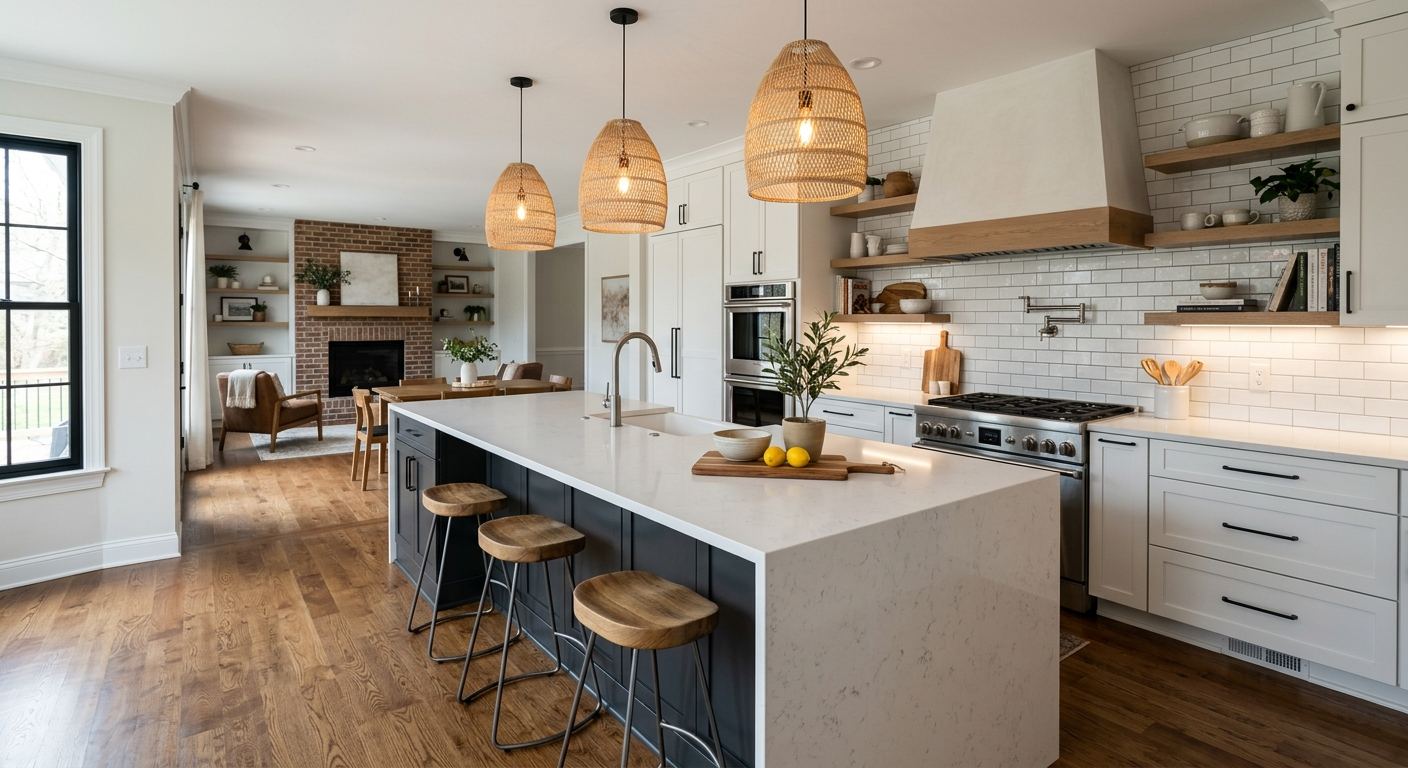
Kitchen renovation options and costs in Cumberland
Cumberland kitchen renovations range from simple refreshes to full remodels, and the best option depends on how much you want to change layout, finishes, and plumbing. With a median household income of about $86,000 (Statistics Canada, 2021 Census), many homeowners in Cumberland target a mid-range kitchen that delivers a “new-room” feel without going fully custom. Cumberland’s homeowner market is also sizable—72.0% of households own their homes—so renovations are often planned with resale in mind.
On Vancouver Island and the Coast, pricing is driven more by local home values and homeowner expectations than by climate severity. That means you’ll commonly see higher-end finishes (quartz or natural stone and semi-custom cabinetry) in pockets where buyers want a more premium look, while more modest budgets tend to use stock cabinets and laminate or entry-level quartz. Contractor availability can also influence timelines: after busy periods, scheduling can tighten, affecting labour rates and crew sequencing.
In Cumberland, trade demand is especially strong around the Courtenay/Riverway commuter corridor and nearby family neighbourhood pockets, where older homes (39.1% built before 1981) are more likely to need layout and service upgrades alongside new cabinetry. Those homes often have dated wiring or older plumbing runs, so “cosmetic-only” plans sometimes expand once site conditions are confirmed. Use the ranges below as your starting point when comparing estimates, and then we’ll break down the biggest cost drivers and what you can control.
| Renovation Tier |
What's Included |
Typical Duration |
Price Range |
| Cosmetic refresh (paint, hardware, new appliances only) |
Cabinet paint/finish (if applicable), new hardware, new appliance set, minor caulking/trim, basic cleanup |
2–4 weeks |
$16,000–$34,000 |
| Mid-range full renovation (new cabinets, counters, sink, tile) |
Stock or semi-custom cabinets, countertop (laminate or quartz), sink & faucet, backsplash tile, flooring transition/trim, plumbing refresh (no major relocation) |
5–8 weeks |
$40,000–$85,000 |
| High-end full renovation (custom cabinets, stone counters, island) |
Fully custom cabinets or upgraded millwork, stone counters (granite/stone), island with upgraded hardware, full-height or premium backsplash, higher-tier sink/faucet, possible service upgrades and lighting |
8–14 weeks |
$90,000–$150,000+ |
| Cabinet refacing only (new doors + drawer fronts, same boxes) |
Door/drawer replacement, new pulls/hinges, touch-up paint to surrounding areas, optional new toe-kick trim, backsplash prep only (tile may be separate) |
2–5 weeks |
$8,000–$35,000 |
| Countertop swap only (laminate to quartz or stone) |
Remove and replace existing countertop, new sink cut-out as needed, new countertop installed and sealed (sink reuse may vary) |
3–7 days plus scheduling lead time |
$3,000–$12,000 |
| Backsplash tile installation only |
Tile supply/installation, grout/seal, surface prep, caulking at edges (waterproofing details depend on wall type) |
1–3 weeks |
$2,500–$9,000 |
Prices are estimates only and vary by project scope, site access and material selection.
What affects the price of kitchen renovation in Cumberland
Even when two homeowners request “the same” kitchen renovation in Cumberland, Vancouver Island and Coast quotes can differ by 30–50% because the cost structure is driven by finish tier, cabinetry complexity, and how much the contractor must repair or upgrade once walls come open. In coastal British Columbia, people often equate a kitchen remodel with a long-term investment—especially in owner-occupied communities where upgrades can affect resale appeal. That’s why local home values and the median income of households (about $86,000, Statistics Canada, 2021 Census) typically push most mid-range jobs toward quartz and semi-custom millwork, while lower-cost refreshes stay closer to stock cabinets and laminate options. Climate affects drying time and moisture management, but it’s rarely the main reason for large budget swings.
Layout changes are the most unpredictable line item regardless of finish. Moving a sink, changing a cooktop to a gas/induction setup, or adding an island usually triggers additional plumbing/electrical work and extra framing, and that’s where costs can jump quickly. For example, adding an island often requires electrical rough-in for outlets or lighting and may need additional circulation space modifications. Similarly, removing a wall to open up the kitchen can introduce beam/structural work, which can substantially increase the price compared to a same-footprint renovation.
In Cumberland’s older housing stock—39.1% of homes built before 1981—hidden wiring upgrades and original drain runs can add thousands even if the final look is “just cabinets and counters.” If you’re staying within the mid-range budget (roughly $40,000–$85,000), it’s usually easiest to limit work to surface-level changes. If your goal is a high-end rebuild (often $90,000–$150,000+), plan for higher cabinet customization, stone counters, and more complex service coordination from day one.
| Price Factor |
Why It Matters |
Cost Impact |
| Cabinet tier — stock vs. semi-custom vs. fully custom millwork |
Custom sizing, internal options, soft-close hardware, and finish quality change labour time and material costs |
Often the biggest swing: stock can be roughly half the cost of fully custom for comparable coverage |
| Countertop material — laminate vs. quartz vs. granite vs. stone |
Material pricing and template/seaming complexity; natural stone can add extra fabrication and labour |
Typical range: $3,000–$12,000 for installation-based swaps, with stone often at the upper end |
| Layout change — wall removal, island add, plumbing/gas move |
Requires structural planning, new rough-ins, and inspection coordination |
Can add tens of thousands compared to keeping plumbing/electrical in place |
| Appliance package tier — builder vs. mid-range vs. pro-grade |
Cooking performance, venting requirements, and fit-and-finish affect trade time and cost |
Can shift budgets by several thousand depending on brands and venting/trim kits |
| Flooring — refinish existing vs. full replacement |
Kitchen renovations often expose damaged subfloors; replacement includes underlayment and transitions |
Replacement usually adds multiple line items (demo, prep, install, trim) |
| Backsplash — ceramic tile vs. marble vs. full-height slab |
Coverage height, specialty materials, and wall prep (flatness) affect labour and waste |
Typical tile installation-only budgets run $2,500–$9,000 |
| Electrical — new circuits for island, under-cabinet lighting |
Licensed rough-in, new outlets, lighting runs, and load planning |
Often one of the larger “surprise” costs when layouts change |
| Permit fees and licensed trade requirements |
Permits and inspections are required for certain plumbing/gas/electrical work |
Small-to-moderate fees, but major work can trigger multiple licensed disciplines |
Permits & regulations in British Columbia
In British Columbia, not every kitchen change needs a permit, but moving systems usually does. A cabinet swap and a countertop replacement (including changing from laminate to quartz or stone) typically do not require permits because you’re not altering plumbing, gas, or electrical systems. However, if your Cumberland project involves relocating plumbing supply or drain lines, moving a sink location, relocating a gas stove or changing how the range hood vents, removing a load-bearing wall, or adding electrical circuits (for example, for island outlets or under-cabinet lighting), you should expect permits and licensed trade involvement.
Step-by-step, here’s how a homeowner can verify contractor compliance in Cumberland before signing:
- Ask for copies of the contractor’s certificate of insurance (general liability) and confirm the named insured and coverage limits.
- For plumbing/gas/electrical scopes, request the specific licensed trades’ licence numbers and insurance certificates for those subcontractors.
- Verify the electrician and gas fitter are licensed through the appropriate provincial online registries (the contractor should provide licence details).
- Ask whether WCB/WCB coverage (or the applicable worker coverage documentation) is in place for the trade team performing the work.
- Confirm in writing who pulls permits (and that the contractor won’t shift responsibility after work starts).
- Request the timeline of inspections, so rough-in work is inspected before walls and cabinets are closed up.
Finally, make sure permit responsibility is clearly assigned in your contract, including what happens if additional inspections or corrections are required due to uncovered existing conditions.
Cabinets, countertops and layout decisions in Cumberland
When homeowners in Cumberland plan a kitchen renovation, three decisions control most of the outcome: (1) cabinet tier, (2) countertop material, and (3) whether you change layout. First, cabinet tier: stock cabinets are the fastest and cheapest path because they’re readily available in standard dimensions. Semi-custom (the most common mid-range choice on Vancouver Island) gives better fit, more door styles, and functional upgrades like interior organizers while staying in the $40,000–$85,000 renovation band for many full projects. Custom cabinets cost more, but they’re the right call when your room has awkward angles or you want a truly built-in look that matches an island and pantry wall.
Second, countertops: laminate is budget-friendly and good for basic use, but it can be more prone to wear at seams and around hot items. Quartz is the practical “upgrade sweet spot” in this market—low maintenance, durable surfaces, and fewer worries about staining than porous stone. Granite/natural stone looks premium and holds up well, but it benefits from proper sealing and care. In a kitchen where food prep and water exposure are daily realities, quartz and natural stone usually make sense at higher finish tiers and justify budgets closer to the high-end $90,000–$150,000+ range—especially if you’re pairing them with upgraded cabinetry and a better island plan.
Third, layout: open-concept wall removal or island addition can be worth it when it creates usable circulation, improves storage, or resolves a dated workflow. If you’re moving plumbing or gas lines, the cost is often justified by a meaningful space gain rather than cosmetic change alone—particularly in older homes where early inspection can uncover hidden service constraints.
| Option |
Durability |
Maintenance |
Best For |
Price Range |
| Stock cabinets (big-box) |
Good durability; limited custom fit and finish options |
Low maintenance; occasional tightening of hardware |
Speed and budget-focused renovations; straightforward layouts |
$8,000–$20,000 |
| Semi-custom cabinets (local dealer) |
Very good durability; better internal layouts and door options |
Low maintenance; soft-close hardware typically reduces wear |
Most Cumberland mid-range remodels seeking a tailored look |
$18,000–$40,000 |
| Custom cabinets (local millwork shop) |
Excellent durability; built for your exact room dimensions |
Low maintenance; depends on finish system and hardware selection |
Islands, pantry walls, awkward spaces, and high-end resale appeal |
$35,000–$75,000+ |
| Laminate countertop |
Moderate durability; seams and edge details need care |
Wipe clean; avoid cutting directly on the surface |
Refresh budgets and rental-friendly upgrades |
$3,000–$6,000 |
| Quartz engineered countertop |
High durability; consistent surface and strong stain resistance |
Low maintenance; minimal sealing compared with natural stone |
The most popular upgrade for mid-range to high-end remodels |
$6,000–$10,000 |
| Granite / natural stone countertop |
Very durable; beauty varies by slab and finish |
Typically requires sealing; avoid harsh cleaners |
Homeowners who want natural variation and premium aesthetics |
$8,000–$12,000 |
| Butcher block countertop |
Durable but can scratch; sensitive to standing water |
Regular oiling and prompt drying after spills |
Warm, traditional looks where owners maintain the surface |
$5,000–$9,000 |
| Marble countertop |
Can be durable with proper care, but more surface-sensitive |
Higher maintenance; requires sealing and careful cleaning |
Design-forward kitchens aiming for high-end “statement” finishes |
$10,000–$16,000+ |
How to choose a kitchen renovation contractor in Cumberland
Choosing the right contractor in Cumberland comes down to three things: compliance, clarity, and confidence. Start by verifying British Columbia licensing where applicable—especially for electrical and gas work. Ask for the electrician and gas fitter licence information directly, then check the licences through the provincial online registry. For liability, request a current certificate of insurance and confirm the coverage applies to the scope of work being quoted. Also confirm worker coverage documentation (WCB/WCB equivalent coverage) so you’re not left holding the bag if someone is injured on your site.
Next, get 2–3 itemised written quotes rather than one total number. Your quote should break labour and materials out (cabinet supply, countertop fabrication/installation, tile labour, demolition, electrical/plumbing line items, disposal, and any permit-related work). Carefully review what’s excluded: for example, does it include permit pull if plumbing/gas/electrical changes are required? Does it include disposal and dump fees? Will the contractor protect flooring and finish materials during installation?
Warranty matters in kitchens because cabinet doors, hardware, and tile are high-use components. Ask for the workmanship warranty length, the manufacturer warranty details for cabinets/countertops/appliances (and whether it’s transferable to future owners if you sell). Keep payment schedules practical: never pay more than 10–15% upfront, and hold back a portion until the job is complete and deficiencies are resolved. Finally, demand a written start date and a realistic completion window that accounts for countertop fabrication lead times.
- Provide licence details for every licensed trade involved (electrician, gas fitter, if applicable).
- Share insurance certificate for general liability and confirm additional insured language if offered.
- Confirm worker coverage documentation for the crew performing the work.
- Use an itemised quote with labour + materials, not lump-sum only.
- Verify permit pull responsibility in the contract for any gas/plumbing/electrical scope.
- Check disposal/dump fees inclusion in writing.
- Ask who handles site protection (floor protection, dust control, door protection).
- Confirm measurement and template process for countertops (who templates, when, and what changes pricing).
- Ask about cabinet installation tolerances and how out-of-level walls are handled.
- Review warranty terms for workmanship and product warranties, including transferability.
- Confirm payment schedule: limit upfront (10–15%), milestone payments aligned to completed stages.
- Get a timeline with major milestones: demo, rough-in, cabinet install, countertop install, final trim.
In Cumberland, I consider these red flags: (1) quotes that don’t list what’s included/excluded, (2) refusal to put permit responsibility in writing when plumbing/gas/electrical changes are discussed, (3) no proof of insurance or trade licences, (4) countertop timelines that assume immediate fabrication without lead-time allowances, and (5) requests for large upfront payments beyond 10–15%.
Frequently asked questions — kitchen renovation in Cumberland
What's the most cost-effective kitchen upgrade?
If your goal is the biggest visual change for the least disruption in Cumberland, a cosmetic refresh is usually the most cost-effective path—especially when your existing layout and cabinetry boxes are in good shape. Many homeowners start with cabinet paint or refacing plus new hardware and an appliance upgrade, then allocate the saved budget to lighting and a backsplash. In practical terms, a refresh-type project typically lands in the mid-to-high teens to mid-$30,000 range (depending on how far you go on appliances and prep), while a targeted “countertops only” swap can be a high-impact upgrade when the cabinets are already solid. If you’re sitting between options, ask contractors to price a refacing-only scope alongside a full mid-range renovation (often around $40,000–$85,000) so you can compare value before you commit to demolition.
Custom vs stock cabinets — is custom worth it?
Custom cabinets are worth it when your Cumberland kitchen has layout quirks that stock can’t address—like awkward corners, uneven walls from older construction, or a need for a specific island/pantry configuration. Stock cabinets are a great fit when the room is straightforward and you want speed and predictable pricing. Semi-custom is often the best balance in Vancouver Island and the Coast markets because it gives better fit and interior functionality than stock, while keeping you nearer the mid-range budget band ($40,000–$85,000). Custom can push budgets toward the upper end of full renovations (commonly $90,000–$150,000+), but that cost can be justified if you’re also upgrading countertops, adding an island, and planning for long-term use rather than a short-term facelift. Since 39.1% of local homes were built before 1981, custom or semi-custom can also help correct irregularities exposed during demo.
How do I choose a kitchen contractor in Cumberland?
Choose a kitchen contractor in Cumberland who can show compliance, not just photos. Start by confirming British Columbia licensing for the trades your job requires—electrical and gas work must be performed by licensed professionals, and your contractor should be able to provide licence information and their certificate of insurance. Request itemised quotes that separate labour and materials (cabinets, countertops, tile, plumbing/electrical line items) so you can compare apples to apples. Make sure the scope clarifies what’s excluded: permits, disposal, floor protection, and any work needed after concealed issues are discovered. Then review warranty terms: workmanship warranty length, product warranty coverage, and whether any warranties transfer on resale. Finally, watch the payment schedule—never allow large upfront payments beyond about 10–15%.
What order do kitchen renovation steps happen in?
A kitchen renovation typically follows a predictable sequence, and a good Cumberland contractor will manage it to avoid rework. First comes site prep and protection, then demolition and assessment of existing plumbing/electrical conditions. If your plan includes layout changes (moving a sink, adding an island, or modifying gas/electrical), rough-in work happens next—after permits are pulled and before walls are closed. Then comes cabinetry installation (including shimming/levelling), followed by countertop templating and fabrication scheduling. Countertop install is usually next, then sink/faucet connections, backsplash/tile work, and final electrical/lighting trim. Finish carpentry, caulking, and final inspection punch-list come last. If you’re choosing a countertop swap only, the process is faster, but you still need accurate templating to hit the right cut-outs and seam locations—especially for quartz.
Can I live at home during a kitchen renovation in Cumberland?
Often yes, but it depends on scope and layout. A cosmetic refresh or refacing-only project is commonly livable because disruption is limited to painting, doors/drawer fronts, and localized work. A mid-range full renovation ($40,000–$85,000) can still be workable if your contractor sets up a temporary kitchen area and you’re prepared for dust control and limited access to the work zone. For high-end rebuilds (often $90,000–$150,000+), living onsite is more challenging because cabinetry install, countertop fitting, and tile work can span multiple weeks and require careful protection and staging. In older Cumberland homes (many built before 1981), hidden issues like wiring or plumbing accessibility can also extend timelines, so ask for a living-at-home plan in the quote: dust management, wash access, and how meals will be handled.
Should I renovate my kitchen before selling in Cumberland?
If you plan to sell soon, renovate for what buyers in Cumberland and across Vancouver Island want to see—clean lines, modern lighting, durable surfaces, and a functional layout. Whether you should renovate before selling depends on how much you can recoup: in owner-occupied markets, kitchens tend to influence buyer decisions, but over-improving beyond your neighbourhood’s expectations can reduce return. A cost-effective upgrade is often countertop + backsplash + updated hardware/lighting, especially if cabinet boxes and layout are already decent. If your renovation budget is in the mid-range band ($40,000–$85,000), that’s typically aligned with buyers who expect quartz and upgraded finishes without the full custom premium. If you’re leaning toward high-end custom work, get pricing and timelines early and compare to recent comparable sales—since homeowners commonly value kitchens for resale, your design should match what’s already selling well nearby.