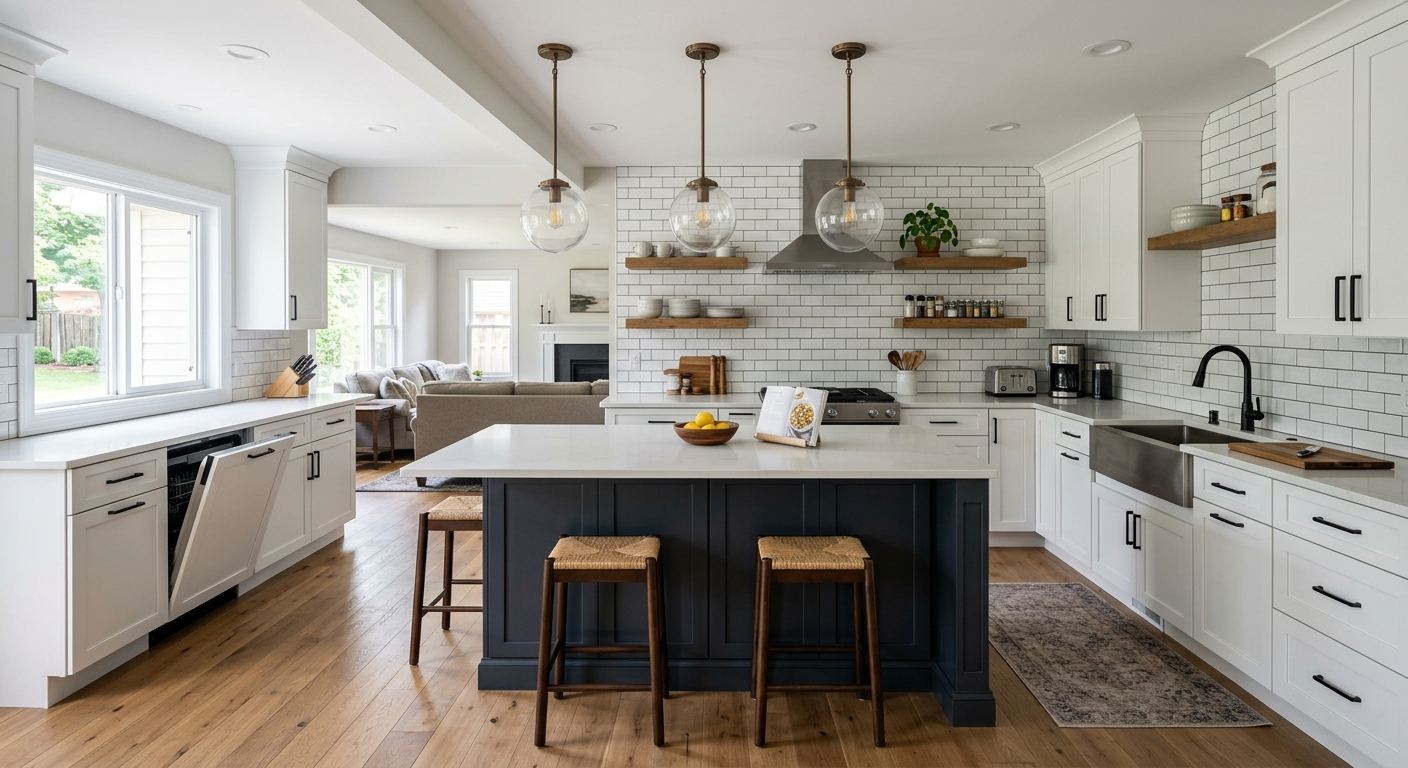
Kitchen renovation options and costs in Fruitvale
Fruitvale, in the Kootenay region, is a market where kitchen renovations are usually driven by homeowner expectations for resale value and the overall household budget, more than by weather alone. With a median household income of about $83,000 (Statistics Canada, 2021 Census), most projects in town aim for a refresh-to-mid-range outcome rather than a full “showroom” upgrade. The housing stock also matters: roughly 69.0% of homes were built before 1981 (Statistics Canada, 2021 Census), so many kitchens have older door styles, tired layouts, and dated electrical—meaning contractors often price in heavier labour for careful fit-and-finish and troubleshooting.
In the Kootenay market, cabinet and countertop choices often move in predictable steps. Lower- and mid-range homes tend to pair stock or semi-custom cabinets with laminate or entry quartz, because owners want a strong return without stretching to custom millwork. Higher-value properties (and higher-income households) more often justify quartz or natural stone and an island, especially where the new work can be marketed as “move-in ready.”
Climate still plays a supporting role: damp seasonal swings can make doors and trim more sensitive to humidity, so good installation, shims, and proper sealing around sinks and plumbing penetrations can reduce long-term issues. Labour availability also affects timelines in small communities—bigger, multi-trade scopes (cabinet changes plus electrical and tile) can cost more simply because scheduling becomes tighter. This trade demand is particularly common around the Fruitvale core and along the Highway 3 corridor, where many homeowners prioritize functional updates before seasonal hosting.
Below are typical tiers homeowners in Fruitvale use to compare quotes before materials selections.
| Renovation Tier |
What's Included |
Typical Duration |
Price Range |
| Cosmetic refresh (paint, hardware, new appliances only) |
Cabinet paint or staining (if offered), new hardware/pulls, new appliances, minor caulking and touch-ups; no cabinet box replacement |
3–7 days |
$3,000–$10,000 |
| Mid-range full renovation (new cabinets, counters, sink, tile) |
New cabinets (stock or semi-custom), new counters (laminate or entry quartz), sink and faucet, backsplash tile, base cabinet adjustments, plumbing tie-in, selective electrical allowance |
2–4 weeks |
$30,000–$50,000 |
| High-end full renovation (custom cabinets, stone counters, island) |
Custom cabinetry, premium quartz or granite/stone counters, island (often with electrical and plumbing), upgraded backsplash (tile or slab feature), higher-spec lighting, extended installation time |
4–7 weeks |
$55,000–$70,000 |
| Cabinet refacing only (new doors + drawer fronts, same boxes) |
Replace doors/drawers, new pulls, finish and alignment adjustments; reuse existing boxes where structurally sound |
1–2 weeks |
$8,000–$18,000 |
| Countertop swap only (laminate to quartz or stone) |
Remove and install countertops, new sink cut-outs as required, sealant and caulking, backsplash patching allowance |
3–7 days |
$6,000–$15,000 |
| Backsplash tile installation only |
Demo of existing backsplash (if needed), tile supply install, grout/seal, edge trims, caulking to meet wet-area standards near sinks |
2–5 days |
$1,200–$5,000 |
Prices are estimates only and vary by project scope, site access and material selection.
What affects the price of kitchen renovation in Fruitvale
In Kootenay and across British Columbia, it’s common to see quotes for the “same kitchen” land 30–50% apart. That gap usually isn’t because of temperature—it’s because of what the contractors are accounting for: labour availability, how many trades get pulled in (plumbing/electrical/tile), and how the home’s finish tier aligns with local buyer expectations. In higher-value BC markets, homeowners often default to quartz or natural stone counters and semi-custom cabinets, because the cost can be more easily recovered on resale. In more modest markets, laminate and stock cabinets stay popular because they provide a visible upgrade closer to the $25,000–$50,000 mid-range renovation reality.
In Fruitvale, you’ll see real drivers that swing budgets even before materials are chosen. First, layout changes are the most unpredictable: removing a wall, adding an island, or moving a gas line or plumbing supply can trigger additional rough-in work and inspection steps, which quickly outpaces finish upgrades. Second, older homes built before 1981 (a large share locally) often conceal out-of-date wiring or non-standard framing tolerances, adding time for safe rework.
Concrete examples: if your cabinets were originally set before modern venting standards, upgrading a range hood or aligning duct runs can add extra labour; if your kitchen has uneven subflooring, a full tile backsplash and new countertops may require more levelling and shimming. Conversely, if you keep plumbing where it is and only swap counters and backsplash, you can stay closer to the $2,500–$12,000 countertop band and avoid layout-driven cost spikes.
| Price Factor |
Why It Matters |
Cost Impact |
| Cabinet tier — stock vs. semi-custom vs. fully custom millwork |
Material quality, hardware, fit tolerances, and build-to-measure time |
Can swing a full renovation by roughly $10,000–$25,000 |
| Countertop material — laminate vs. quartz vs. granite vs. stone |
Thickness, edge profiles, fabrication complexity, and installation handling |
Often adds $2,500–$12,000 depending on material and supports |
| Layout change — wall removal, island add, plumbing/gas move |
Rough-in work, structural evaluation, new ducting/gas/plumbing runs |
Usually the biggest swing; can add $8,000–$25,000+ on complex jobs |
| Appliance package tier — builder vs. mid-range vs. pro-grade |
Delivery, cut-out requirements, ventilation needs, and power requirements |
Can vary $1,500–$8,000+ outside the core build |
| Flooring — refinish existing vs. full replacement |
Protection during demo, subfloor repair, and matching transitions |
Typically $1,200–$8,000+ depending on extent |
| Backsplash — ceramic tile vs. marble vs. full-height slab |
Labour intensity, waterproofing approach, and heavier material handling |
Often $1,200–$5,000+ and more with slab features |
| Electrical — new circuits for island, under-cabinet lighting |
Licensed work, load calculations, and wiring pathways |
Commonly adds $1,000–$6,000 depending on how much is added |
| Permit fees and licensed trade requirements |
Work involving gas, electrical, structural changes, and inspections |
Can add several hundred to a few thousand; also affects scheduling |
Permits & regulations in British Columbia
In British Columbia, simple cabinet and countertop swaps typically don’t require permits, especially when you’re keeping existing plumbing and gas connections in the same locations and you’re not changing electrical demand beyond like-for-like allowances. Cabinet installation and countertop installation are generally considered finish work, and homeowners can usually proceed without a permit for the “swap” portion. However, the permit line is crossed quickly when you change services or structure.
Work that does require permits and licensed trades commonly includes: moving plumbing supply or drain lines (even within the kitchen footprint), relocating a gas stove/range, modifying gas lines, removing a load-bearing wall, adding a new electrical circuit (for example, an island receptacle run, a new dedicated circuit for a microwave, or new under-cabinet lighting if it’s not being tied in to an existing circuit), and any electrical upgrades that aren’t like-for-like. Gas work must be carried out by a licensed gas fitter, and electrical work by a licensed electrician, with inspections required for permitted work.
To verify a contractor in Fruitvale before signing, follow this step-by-step: (1) ask for their liability insurance certificate (COI) and confirm it’s current and specific to the trade scope; (2) check the relevant licence details for gas work and electrical work through the provincial online resources used for trades credentials; (3) request proof of the required workplace coverage (WCB/WSIB coverage documentation) where applicable; (4) confirm in writing who is pulling permits—your contract should clearly state permit responsibility, inspection handling, and any associated fees.
Cabinets, countertops and layout decisions in Fruitvale
When budgeting a Fruitvale kitchen renovation, three decisions dominate the cost and the long-term satisfaction: (1) cabinet tier, (2) countertop material, and (3) whether you change the layout. Cabinet tier is the easiest lever to control, because it dictates how much carpentry and finishing time goes into your kitchen. Stock cabinets usually cost least and install fastest, semi-custom is the most common mid-range approach because you can improve fit and storage, and custom cabinetry is the highest cost because every piece is built for your space and tolerance.
Countertop material is the next big decision. Laminate can be cost-effective and visually modern, but it’s less tolerant of severe impacts than engineered stone. Quartz offers a strong balance of durability and low maintenance, and it’s commonly chosen for busy households where spills and daily use are routine. Granite/natural stone looks premium and each slab is unique, but it can need periodic sealing depending on the stone type. Butcher block can be warm and repairable if you embrace maintenance and food-safe care.
Layout changes are where budgets can jump regardless of finish. If you’re adding an island, moving plumbing, or relocating a stove to improve flow, the space gains can justify the cost—especially in older pre-1981 homes where kitchens may feel segmented or cramped. For example, if you keep the plumbing where it is and only upgrade cabinets plus quartz, you may land in the mid-range full renovation tier of about $30,000–$50,000. If you instead move plumbing and add a new island sink plus additional electrical, that same “nice” finish level often pushes you into the higher-end band of $55,000–$70,000 because of rough-in work, scheduling, and installation complexity.
| Option |
Durability |
Maintenance |
Best For |
Price Range |
| Stock cabinets (big-box) |
Good daily durability; best when measurements fit closely and boxes sit square |
Minimal—regular cleaning; handle/hinge adjustments as needed over time |
Fast, cost-controlled upgrades with straightforward layouts |
$8,000–$18,000 |
| Semi-custom cabinets (local dealer) |
Very good durability; improved storage and finishing options |
Low—same as stock; more options for pull-out systems and upgrades |
Mid-range renovations targeting a “new kitchen” feel |
$15,000–$30,000 |
| Custom cabinets (local millwork shop) |
Excellent durability; tight fit around unusual walls and ceilings |
Low to moderate—depends on finish type; hardware maintenance as normal |
Complex spaces, premium hardware, and maximum storage customization |
$25,000–$45,000 |
| Laminate countertop |
Moderate durability; avoid heavy impact points and excessive standing water at seams |
Low—routine cleaning; protect edges and keep seams sealed |
Best value when you want a fresh look without premium stone pricing |
$2,500–$6,500 |
| Quartz engineered countertop |
High durability; resistant to staining and everyday wear |
Low—no routine sealing for most quartz products; just clean normally |
Busy kitchens, resale-focused updates, and families who want “set it and forget it” |
$6,000–$12,000 |
| Granite / natural stone countertop |
High durability; heat resistant; unique patterns vary by slab |
Moderate—periodic sealing may be required depending on the stone |
Premium look with a classic, upscale feel |
$7,500–$14,000 |
| Butcher block countertop |
Moderate to high with care; can scratch but can be repaired/sanded |
Moderate—oil/condition regularly; use cutting boards |
Warm, casual style and homeowners comfortable with maintenance |
$4,000–$10,000 |
| Marble countertop |
Moderate durability; more prone to etching and staining than quartz |
Higher—requires careful cleaning and sealing discipline |
Low-to-moderate cooking households chasing a luxury look |
$9,000–$18,000 |
How to choose a kitchen renovation contractor in Fruitvale
Start with credentials. In British Columbia, the contractor may not do every trade, but you should verify that the right licensed trades are involved and that the contractor carries proper coverage. Ask for: (1) their liability insurance certificate of insurance (COI) and confirm the policy is active for the scope they’re bidding; (2) proof of workplace coverage (WCB/WSIB documentation where applicable); and (3) for any gas or electrical work, the licensed gas fitter and licensed electrician details, plus their inspection responsibility. You can also cross-check licensing/credentials through the provincial online registries for trades and licence status, using the names provided on the quote and contract.
Next, get 2–3 itemised written quotes. Don’t accept a single lump sum without line items—look for labour + materials breakdown for cabinets, countertops, tile, plumbing/electrical allowances, demo, disposal, and any allowance for site conditions. Make sure the scope is explicit: what’s excluded (old flooring removal, backsplash demo, drywall patching, deck screws/fasteners for tile backer), whether permits are included, and if waste disposal is part of the base price.
Warranty matters. Ask for workmanship warranty length, plus the manufacturer warranty details for cabinets, countertops, and hardware, and whether warranties are transferable if you sell the home. For payment scheduling, a safe rule is to keep upfront payments around 10–15% maximum, then hold back until major milestones are complete. Finally, request the timeline in writing: start date, key milestones, cabinet/counter fabrication lead times, and the estimated completion date.
- Confirm who pulls permits and who pays permit fees
- Ask whether demo and disposal are included in the price
- Request a written start date and a realistic completion estimate
- Ensure quotes are itemised (labour vs materials vs allowances)
- Get cabinet specs: brand/line, finish type, warranty terms
- Ask countertop details: edge profile, thickness, installation method
- Verify licensed trades for gas and electrical work before signing
- Review the protection plan for floors, stairs and nearby rooms during demo
- Clarify who repairs drywall and patches after openings
- Confirm backsplash scope: substrate prep, waterproofing, and grout type
- Confirm the under-cabinet lighting plan if you want new circuits
- Use a payment schedule with a holdback until completion and punch-list items are closed
If you’re comparing contractors in Fruitvale, red flags include: (1) no written, line-item scope; (2) avoiding questions about permits/licensing responsibility; (3) asking for large deposits beyond 10–15%; (4) skipping proof of insurance/coverage; and (5) vague start dates with no fabrication lead-time discussion for cabinets and countertops.
Frequently asked questions — kitchen renovation in Fruitvale
Should I renovate my kitchen before selling in Fruitvale?
Often, a smart kitchen refresh helps before selling in Fruitvale because buyers look for clean, functional basics: cabinet condition, countertop appearance, and whether the kitchen “works” for everyday life. That said, you don’t need the highest tier. Many homeowners land in the mid-range full renovation tier (often roughly $30,000–$50,000) because it’s easier to match what buyers expect without overspending. If your cabinets are structurally sound, cabinet refacing or a countertop swap can be a more cost-efficient path than a complete rebuild. Also consider your home’s age—many kitchens here are in pre-1981 layouts (Statistics Canada, 2021 Census), so layout fixes can be valuable, but layout changes plus plumbing/electrical moves can become expensive quickly if not planned.
What's the most popular kitchen style in Fruitvale right now?
Right now, the most common direction in Fruitvale is a clean, modern transitional look: shaker-style or simple slab-front cabinets, warm neutral colours, and low-fuss surfaces that stand up to daily use. On counters, quartz is a frequent “sweet spot” because homeowners want a durable, low-maintenance surface that still looks premium. In practical budget terms, most of these kitchens end up choosing semi-custom cabinets and a quartz or entry-quartz counter, paired with straightforward tile backsplashes. That fits well with the mid-range renovation pricing reality (commonly $30,000–$50,000 for full updates) while still reading as “new kitchen” to prospective buyers in the Kootenay market.
How do I know if I need to update my kitchen plumbing in Fruitvale?
Look for signs that plumbing updates are needed even if you can’t see it yet. Frequent leaks under sinks, slow drains, water staining near plumbing penetrations, or inconsistent hot water performance are common triggers. In older Fruitvale homes (a large share built before 1981), supply/drain piping and shutoff valves may be dated or poorly supported, and renovation demo can reveal hidden issues behind cabinets. If you’re moving the sink, adding a dishwasher line change, or installing a new island sink, you should assume the plumber will need access and may recommend updates. Even if your quote is in the $30,000–$50,000 mid-range band, plumbing changes can shift scope—so ensure your contractor includes a clear plumbing allowance and inspection plan where required by British Columbia rules.
What is the difference between a galley and open-concept kitchen?
A galley kitchen is typically a long, narrow layout with counters on two sides and a corridor through the space. It’s efficient, but it can feel closed in, especially in older homes where circulation is already tight. Open-concept usually means fewer partition walls and a visible connection to living/dining areas. In Fruitvale kitchens, the choice often comes down to how you want to use the space and how much layout work you’re willing to pay for. Moving a wall or removing a load-bearing element can require permits and licensed involvement in British Columbia, which raises costs. Many homeowners choose to keep a galley layout and focus on cabinet storage and counter upgrades to stay closer to typical bands like $30,000–$50,000 rather than pushing into high-end remodel pricing.
How do I get accurate kitchen renovation quotes in Fruitvale?
Accurate quotes start with scope clarity. Get 2–3 itemised written quotes that separate labour and materials and include allowances for site conditions like drywall patching, floor prep, disposal, and any electrical/plumbing adjustments. Bring measurements, photos, and a list of what you want changed: cabinets, counters, backsplash, appliances, lighting, and whether you’re changing the layout. If you’re keeping plumbing/gas where it is, say so—layout changes add unpredictability. For the quote process, confirm whether permits are included and who is responsible for them. Also verify that the contractor is using realistic fabrication lead times for cabinets and counters; in small markets, delays can affect your timeline. If you’re comparing countertop-only options, align them with typical countertop swap bands like about $6,000–$15,000 for quartz/stone installs.
What's the best countertop material for a busy Fruitvale kitchen?
For most busy Fruitvale households, quartz is the “best balance” choice: it’s durable, generally low-maintenance, and resists staining from day-to-day cooking. That matters in kitchens used for everything from quick breakfasts to seasonal entertaining. If you want the most budget predictability, laminate can work well for appearance and cost control, but it’s not as forgiving with impacts and seam protection. Natural stone like granite is excellent visually and can be very durable, though it may require periodic sealing depending on the stone type. Marble is beautiful but tends to be higher-maintenance for etching and staining, so it’s usually better for lighter-use kitchens. In terms of realistic budgeting, quartz is commonly priced within the countertop installation band roughly $6,000–$12,000, which often fits cleanly into mid-range full renovation budgets ($30,000–$50,000).