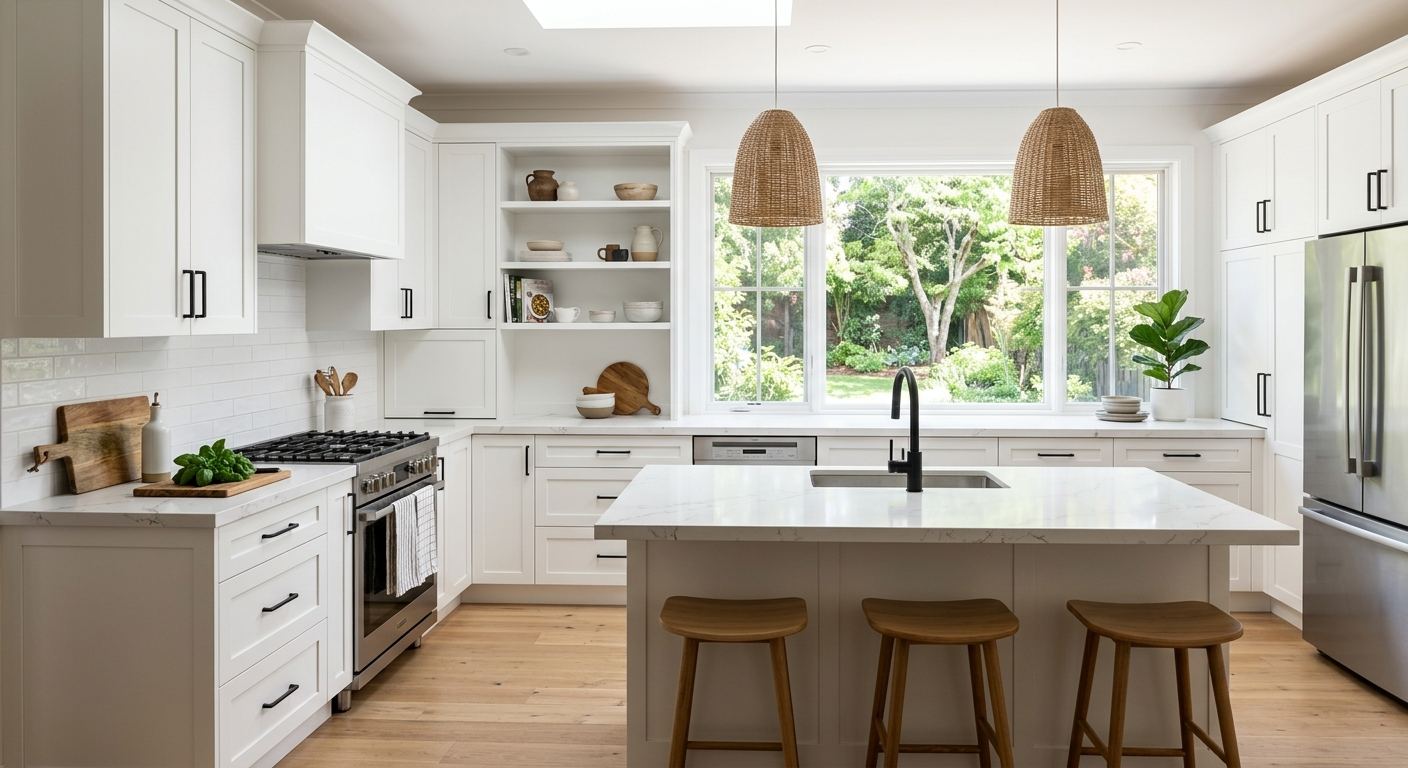
Kitchen renovation options and costs in Marshall-McCallum
Marshall-McCallum homeowners usually start by asking what a “kitchen reno” actually includes, because the same room can range from a tidy refresh to a full rebuild. With Marshall-McCallum’s population at 10,055 (Statistics Canada, 2021 Census), demand is steady but project selection often hinges on what buyers will notice when they walk through—especially finishes. In the Lower Mainland–Southwest, homeowners often choose higher-visibility upgrades because the market supports them; in many comparable Lower Mainland–Southwest areas, household income is strong enough that semi-custom cabinetry and stone or quartz countertops are common expectations on resale (Statistics Canada, 2021 Census).
Climate plays a smaller role in pricing than in much of Canada. You still see moisture and temperature cycling from rain, coastal humidity, and occasional heat spikes, so ventilation, cabinet sealing, and under-sink protection matter—but contractor availability and the finish tier tend to drive the biggest cost differences. In neighbourhoods around McCallum Road and the wider Marshall-McCallum residential corridor, kitchen trades stay busy due to frequent “move-in ready” renovations tied to upsizing and downsizing cycles. This is why you’ll often hear that the same kitchen size prices differently depending on whether it’s a refresh (paint/hardware/appliances) or a full custom rebuild (cabinetry, stone counters, and layout work).
Below is a practical way to compare options—then, once you pick your scope, we can tighten the numbers into a quote-ready plan.
| Renovation Tier |
What's Included |
Typical Duration |
Price Range |
| Cosmetic refresh (paint, hardware, new appliances only) |
Cabinet paint or refinishing, new hardware, appliance swap, minor caulking/trim, basic countertop cleaning/spot work |
1–3 weeks |
$8,000–$25,000 |
| Mid-range full renovation (new cabinets, counters, sink, tile) |
New semi-custom cabinets, new countertop installation, sink and faucet, backsplash tile, plumbing connections, flooring protection and tile prep |
4–8 weeks |
$40,000–$85,000 |
| High-end full renovation (custom cabinets, stone counters, island) |
Fully custom millwork, stone counters (often quartz/stone), island cabinetry and electrical planning, upgraded backsplash (often to full height), higher-end sink/faucet |
8–14 weeks |
$85,000–$120,000 |
| Cabinet refacing only (new doors + drawer fronts, same boxes) |
New doors/drawer fronts, new hinges/slides, veneer or laminate wrapping (where applicable), re-trim, hardware upgrade |
2–5 weeks |
$8,000–$35,000 |
| Countertop swap only (laminate to quartz or stone) |
Removal and install of new countertops, sink cut-out transfer/adjustment, basic backsplash touch-up, sealant and edge finishing |
1–3 weeks |
$3,000–$12,000 |
| Backsplash tile installation only |
Tile supply allowance, surface prep, tile install, grout/seal, edging and trim, cleanup |
3–7 days |
$1,500–$6,000 |
Prices are estimates only and vary by project scope, site access and material selection.
What affects the price of kitchen renovation in Marshall-McCallum
In the Lower Mainland–Southwest, quotes for what looks like the same kitchen can swing by 30–50% because contractors price by risk (hidden damage, schedule constraints), finish tier, and how much “value-add” the homeowner wants. Compared with other British Columbia markets, it’s often less about climate and more about the typical buyer expectation: in higher-value Lower Mainland neighbourhoods, renovations tend to include semi-custom or custom cabinetry, quartz/stone counters, upgraded hardware, and more complex builds. In contrast, more modest scopes still sell well when they’re practical and durable—so laminate and stock cabinets are more common there, keeping budgets closer to the middle band.
In Marshall-McCallum and the broader Lower Mainland–Southwest, local home value and household purchasing power shape the finish tier far more than weather. That’s why many owners move toward quartz or stone counters when the renovation cost is likely to be recovered on resale, while other homeowners prefer laminate to control total project spend. Either way, layout changes are the most unpredictable cost regardless of finish level: removing a wall, adding an island, or moving a gas line can require additional framing, venting planning, and licensed trade coordination, and those add cost even if you keep cabinets basic.
Two local examples we see often: (1) older homes with dated plumbing runs sometimes require extra chase work to tie into new sink locations cleanly, which can push you toward the top of the $40,000–$120,000 full-renovation band; (2) coastal humidity exposure can reveal cabinet base swelling around older leaks, turning a “countertop swap only” plan into an under-sink rebuild that costs more than the usual $3,000–$12,000 countertop range. When the layout is staying put and only surfaces are changing, costs usually stabilize.
| Price Factor |
Why It Matters |
Cost Impact |
| Cabinet tier — stock vs. semi-custom vs. fully custom millwork |
Build quality, fit tolerances, storage planning and specialty components (pantries, trays, corner pull-outs) |
$8,000–$60,000+ range shift within cabinetry portion |
| Countertop material — laminate vs. quartz vs. granite vs. stone |
Material cost, fabrication complexity, edge profiles, and required support at spans/island overhangs |
Can move the countertop line from the lower band to the upper band quickly |
| Layout change — wall removal, island add, plumbing/gas move |
Structural coordination, ventilation and permits, plus additional labour for framing, drywall, and re-routing services |
Often the biggest swing factor for total renovation totals (commonly 10–30%+) |
| Appliance package tier — builder vs. mid-range vs. pro-grade |
Electrical requirements, venting needs, installation tolerances and premium finish matching |
Typically $2,000–$15,000+ difference depending on package |
| Flooring — refinish existing vs. full replacement |
Underlayment, transitions, and whether cabinet removal exposes water-damaged subfloor |
Full replacement can add several thousand dollars |
| Backsplash — ceramic tile vs. marble vs. full-height slab |
Prep complexity, weight, sealing requirements and labour time for pattern matching |
Can shift the backsplash allowance within the $1,500–$6,000 range |
| Electrical — new circuits for island, under-cabinet lighting |
Licensed wiring, panel capacity checks, lighting layout and nuisance-tripping risk if circuits are undersized |
Frequently adds thousands when new outlets/lighting are planned |
| Permit fees and licensed trade requirements |
Work that touches plumbing/drain/gas, electrical circuits, or structural changes must follow BC requirements and inspections |
Small line items, but they add time and coordination costs |
Permits & regulations in British Columbia
In British Columbia, a cabinet or countertop swap is typically straightforward from a permitting standpoint, and it often does not trigger permits when you’re staying within the existing footprint and not changing services. Most projects like paint/refinishing, replacing cabinet doors, or swapping laminate for quartz can proceed without a permit because you’re not moving plumbing supply/drain lines, changing venting, or altering electrical circuits.
Where permits do come into play in the Lower Mainland–Southwest is when you change the infrastructure: relocating plumbing supply or drain lines for a sink or dishwasher, moving or adding gas appliances (including changes related to a gas stove or gas range hood), removing a load-bearing wall or making structural alterations, and adding new electrical circuits (for example, under-cabinet lighting, island receptacles, or new dedicated lines). Those steps generally require permits and work by licensed trades, plus inspections.
If you’re a homeowner in Marshall-McCallum, verify your contractor’s credentials before signing: (1) check the online licensing registry for the electrician and gas fitter names; (2) ask for a certificate of insurance showing general liability appropriate to the scope and, where applicable, relevant trade coverage documentation; (3) request proof of workers’ compensation clearance (commonly WCB/clearance documentation) and keep it for your records. Then confirm in writing who is pulling permits—this responsibility should be clearly stated in your contract, including timelines for inspections.
Cabinets, countertops and layout decisions in Marshall-McCallum
When you’re planning a kitchen renovation in Marshall-McCallum, the biggest “decision impact” usually comes from three areas: (1) cabinet tier, (2) countertop material, and (3) whether you’re changing the layout. Start with cabinet tier. Stock cabinets are the fastest and cheapest because sizing is standardized; semi-custom is the most popular mid-range route in this market because you get better fit and more storage planning without the full cost of custom millwork. Custom cabinets give the best fit and storage design for irregular spaces, but they carry higher labour and shop-build costs.
Next, choose countertops based on durability and maintenance. Laminate can be a budget-friendly option, but it’s more sensitive to heat and requires careful care around seams. Quartz is a practical “busy kitchen” choice—hard-wearing, consistent, and relatively low maintenance. Granite/natural stone looks premium and ages well, but it needs sealing and ongoing care. Butcher block offers warmth and is great for a traditional look, though it demands regular oiling and protection from moisture at seams—important in a coastal environment where humidity can expose small leaks.
Finally, layout changes are where costs can jump. If you add an island, move plumbing, or remove a wall, you’re paying for labour, sometimes structural work, plus the extra electrical and plumbing coordination. A concrete example: upgrading from laminate to quartz might add a few thousand dollars within the typical $3,000–$12,000 countertop band, but moving the sink to support an island can push the project toward the upper part of the full-renovation range (often where totals reach the $85,000–$120,000 scope). If the goal is resale appeal, it’s often easier to justify better finishes before paying for service relocations unless the space gain is significant.
| Option |
Durability |
Maintenance |
Best For |
Price Range |
| Stock cabinets (big-box) |
Solid for everyday use; limited sizing and fewer storage customizations |
Low—keep hardware adjusted and address humidity near sink quickly |
Budget-forward refreshes and shorter timelines |
$8,000–$25,000 |
| Semi-custom cabinets (local dealer) |
Better fit and storage options; durable finishes suitable for busy households |
Low to moderate; wipe spills promptly and ensure proper cabinet sealing |
Most resale-focused renovations in the Lower Mainland–Southwest |
$20,000–$50,000 |
| Custom cabinets (local millwork shop) |
Highest fit quality and specialty storage; best for complex layouts |
Low if properly finished; requires good moisture management around plumbing |
Homes needing tailored storage, premium detailing, and feature walls |
$35,000–$80,000+ |
| Laminate countertop |
Good daily performance; can be vulnerable at edges and to heat |
Low—avoid direct heat and keep seams sealed/clean |
Value upgrades when you want new counters without premium stone |
$3,000–$7,000 |
| Quartz engineered countertop |
Very durable for kitchens; resistant to staining and everyday wear |
Low—routine cleaning only; manage moisture around sink edges |
Busy households and resale-friendly upgrades |
$5,000–$12,000 |
| Granite / natural stone countertop |
High durability; natural variation can hide wear patterns well |
Moderate—needs periodic sealing and careful spill response |
Premium look with natural character |
$6,000–$14,000 |
| Butcher block countertop |
Durable with proper care; can show wear and needs conditioning |
Moderate to high—oil and protect regularly, especially in humid climates |
Family kitchens that want a warm, repairable surface |
$4,000–$10,000 |
| Marble countertop |
Premium but softer; can etch with acidic spills |
High—frequent sealing and careful cleaning discipline |
Design-led kitchens where owners will maintain the surface |
$7,000–$18,000+ |
How to choose a kitchen renovation contractor in Marshall-McCallum
Choosing the right contractor in British Columbia starts with verifying credentials. Ask for the licence numbers (or company details) for every required trade and check them using the appropriate BC online licensing registry. For insurance, request a certificate of insurance that shows general liability for the business and matches the scope (especially if they’re doing demolition or coordinating subcontractors). Also ask for workers’ compensation clearance documentation (WCB/clearance letter) so you’re not exposed if a worker is injured on your site. These checks matter in Marshall-McCallum because many kitchen projects involve multiple trades—electrical for islands and lighting, gas work when ranges change, and plumbing for sink/dishwasher tie-ins.
Next, get 2–3 itemised written quotes. You want a breakdown that separates labour and materials, identifies specific products, and lists assumptions (for example, cabinet box condition for refacing, whether floors are reinstalled or replaced, and whether old backsplash is fully removed). Confirm if permits are included in the contractor’s price and whether the quoted scope includes disposal and site protection (tarps, floor protection, and waste hauling). A good contractor will also state the workmanship warranty length, whether product/manufacturer warranties are included, and if warranties are transferable to future owners—important for resale.
For payment schedule, never let the job start with a large deposit: generally aim for no more than 10–15% upfront, then use milestone payments, holding back a portion until completion and punch-list items are done. Finally, require a start date and completion estimate in writing, including what happens if materials are delayed.
- Confirm each required trade is licensed in BC for their scope (electrical, gas fitting, plumbing where applicable).
- Request a certificate of insurance and verify the coverage is current.
- Ask for workers’ compensation clearance documentation and keep it with your contract.
- Get 2–3 itemised quotes with labour + materials lines (not one lump-sum number).
- Ensure the scope lists what’s excluded (demo, drywall patching, mould remediation, disposal, flooring repairs).
- Confirm who pulls permits and whether inspections are included in scheduling.
- Ask for a demolition plan and dust control method (plastic barriers, negative-air setup if needed).
- Verify warranty terms: workmanship duration, product warranty details, and transferability.
- Require a payment schedule with a holdback until punch-list completion.
- Request a timeline that includes cabinet/counter fabrication lead times.
- Review selections: exact cabinet model/finish, countertop thickness/edge profile, backsplash type and grout colour.
- Check references for recent Marshall-McCallum or nearby Lower Mainland–Southwest kitchen projects.
Red flags in Marshall-McCallum kitchens: (1) quotes that refuse to separate labour vs materials; (2) no clear permit responsibility when plumbing/electrical/gas changes are mentioned; (3) “we’ll figure it out later” language around electrical circuits or ventilation; (4) vague warranty wording or no written timeline; (5) requests for large upfront payments beyond 10–15% without a contract schedule and milestone plan.
Frequently asked questions — kitchen renovation in Marshall-McCallum
How do I know if I need to update my kitchen plumbing in Marshall-McCallum?
In Marshall-McCallum, you usually don’t need to replace plumbing solely because you’re installing new cabinets—especially if supply and drain lines are accessible and in good condition. The triggers are more practical: frequent under-sink moisture, slow drains, discoloured water, leaking shutoffs, or outdated plumbing connections that won’t match your new sink/dishwasher layout. During demo, we often find that older homes have supply runs that are difficult to re-route without opening more walls, and the humidity exposure can reveal small leaks around seals. If your scope stays within the existing sink position, plumbing updates may be limited. But if you’re moving the sink or dishwasher, plan for more labour and likely licensed plumbing work, and that can push your renovation toward the higher full-renovation band (for many projects, $40,000–$120,000).
What is the difference between a galley and open-concept kitchen?
A galley kitchen is a tight, two-wall layout where appliances and storage run along parallel counters, often with a narrow walkway. An open-concept kitchen removes a wall or reconfigures the space so the kitchen blends into living or dining areas, usually requiring more structural consideration, updated electrical planning, and better ventilation design. In the Lower Mainland–Southwest, open-concept is common because it supports how people live and entertain, and it can improve resale appeal—yet it’s also where costs are most likely to increase due to permitting, potential structural work, and trade coordination. If your goal is simply a fresher look and better function, a galley can be upgraded with cabinet refacing, new counters, and an appliance package without triggering the same level of service rework. A full open-concept rebuild frequently lands near the mid to upper end of the $40,000–$120,000 range.
How do I get accurate kitchen renovation quotes in Marshall-McCallum?
Accurate quotes in British Columbia come from scope clarity. Before you request numbers, decide what’s included: cabinets (reface vs new vs semi-custom/custom), counters (laminate vs quartz/stone), backsplash, appliances, and whether you’re changing the layout. When you contact contractors, ask for 2–3 itemised written quotes with labour and materials separated, including allowances for tile, disposal, and any necessary drywall patching. Confirm whether permits and licensed trade work are included in the quote when you’re moving plumbing or adding electrical circuits (like island outlets and under-cabinet lighting). Also ask about lead times for cabinets and countertops, because delays are common and affect staging costs. Finally, keep an eye on payment terms and holdback. With a well-defined scope, pricing usually stays within expected bands—like countertop installs in the $3,000–$12,000 range and mid-range full renovations in the $40,000–$85,000 range.
What's the best countertop material for a busy Marshall-McCallum kitchen?
For a busy kitchen in Marshall-McCallum, quartz is often the best balance of durability, stain resistance, and low maintenance. It handles everyday mess well, wipes down easily, and usually doesn’t demand the ongoing sealing that natural stone like granite may require. Laminate can work if you’re focused on cost control, but it’s typically less forgiving around heat and seam edges. Butcher block looks warm and can be great for food prep, but it needs regular oiling and moisture protection—especially important in a coastal climate where humidity can linger under-sink. Marble is beautiful, but it’s generally less ideal for busy households because acidic spills can etch the surface. If you’re budgeting, remember countertop installs commonly fall between $3,000 and $12,000 depending on size and material choice.
How do I add an island to my Marshall-McCallum kitchen?
Adding an island is usually justified when you can improve circulation and create real workspace—especially in kitchens that feel cramped or lack prep room. In Marshall-McCallum projects, the island decision drives electrical and, sometimes, plumbing. If you want an island sink or dishwasher, you’re moving supply/drain lines, which typically triggers permits and licensed trade work. Even without plumbing, you’ll often want new electrical circuits for island outlets and lighting, and that commonly requires an electrician and inspections. Layout planning matters: we check clearances so drawers and doors still function comfortably. Budget-wise, the island itself may push a project toward the upper middle of the full-renovation band, and when combined with premium cabinets and stone counters, projects often trend toward the $85,000–$120,000 scope. A careful plan can keep costs controlled compared with “moving everything,” but it’s rarely a low-cost add.
How much does a kitchen renovation cost in Marshall-McCallum?
In Marshall-McCallum, full kitchen renovation totals typically land in the $40,000–$120,000 range depending on cabinet tier, countertop material, and whether you change the layout. A cosmetic refresh (paint, hardware, and appliances only) is usually much lower, while cabinetry refacing can reduce cost compared with a full rebuild if the existing boxes are in good shape. Countertop-only projects commonly fall into the $3,000–$12,000 range, and backsplash tile installations often run from about $1,500–$6,000 depending on coverage and tile type. The biggest cost drivers in the Lower Mainland–Southwest are usually cabinet and finish choices and the complexity of any plumbing/gas/electrical changes. Climate matters for moisture management and ventilation, but pricing is more strongly tied to finish expectations and local market resale strategy than to weather alone.