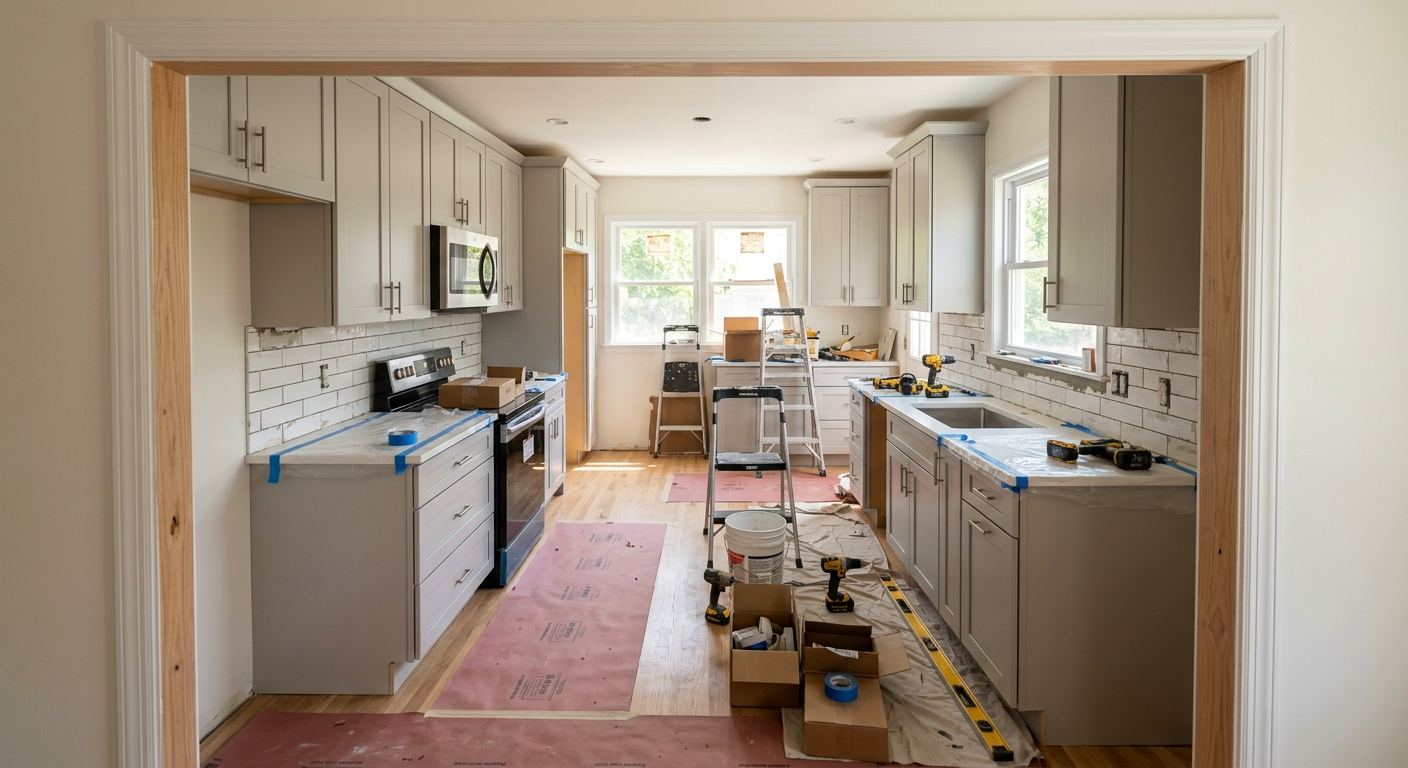
Kitchen renovation options and costs in Youbou
Youbou kitchen renovations typically start with a decision about scope: are you refreshing surfaces, or doing a full rebuild with updated cabinets, counters, and a new workflow? With Youbou’s small-town scale (population 1,302, Statistics Canada, 2021 Census), there’s strong reliance on a tight network of contractors who serve the broader Lower Mainland–Southwest. That matters for scheduling and pricing: when trades are booked, labour availability tightens and timelines stretch, which can nudge total cost up.
In the Lower Mainland–Southwest, kitchen pricing is driven more by home value and expected finish level than by climate. Even in British Columbia’s wetter coastal conditions, most homeowners focus on durable surfaces and easy-clean materials rather than weatherproofing the cabinetry itself. Owners in higher-value pockets often select semi-custom or custom cabinetry and quartz/stone counters because the improved kitchen supports resale confidence—especially when the project is planned around buyer expectations. The same kitchen size can land in a different tier simply by changing cabinetry package, counter material, and whether an island or layout changes are included.
For context, Youbou-area homeowners often treat a cosmetic refresh as the “lowest friction” option, while full renovations usually align with mid-range or high-end finish targets. If you’re in an older home stock situation (common across BC, even in smaller communities), expect more time for correcting out-of-square walls and matching inconsistent framing—this is one reason mid-range projects often cluster around the $40,000–$120,000 full-renovation backbone. Next, use the comparison table to map your scope to realistic costs and duration.
| Renovation Tier |
What's Included |
Typical Duration |
Price Range |
| Cosmetic refresh (paint, hardware, new appliances only) |
Cabinet/trim paint or refinishing, new hardware, appliance swap, minor caulking and touch-ups (no cabinet box changes) |
3–7 days |
$8,000–$20,000 |
| Mid-range full renovation (new cabinets, counters, sink, tile) |
Stock or semi-custom cabinets (pre-assembled where possible), new counters, new sink and tap, backsplash tile, flooring touch-ups, basic lighting updates, plumbing refresh |
3–6 weeks |
$40,000–$85,000 |
| High-end full renovation (custom cabinets, stone counters, island) |
Fully custom millwork, stone counters (quartz/stone), island with seating/lighting, upgraded backsplash (full-height or premium stone), more complex electrical and plumbing coordination |
6–12 weeks |
$85,000–$120,000 |
| Cabinet refacing only (new doors + drawer fronts, same boxes) |
Door/drawer replacement, new mouldings and hardware, surface prep and trim detailing; counters usually stay if still solid |
1–3 weeks |
$8,000–$35,000 |
| Countertop swap only (laminate to quartz or stone) |
Remove existing countertop, template, install new quartz/stone (new sink cut-out if needed), seal and polish where applicable |
5–10 days |
$3,000–$12,000 |
| Backsplash tile installation only |
Surface prep, tile setting and grouting, sealing (where required), caulking transitions at countertop/trim |
3–7 days |
$1,500–$6,000 |
Prices are estimates only and vary by project scope, site access and material selection.
What affects the price of kitchen renovation in Youbou
In the Lower Mainland–Southwest, the same kitchen can quote 30–50% differently across projects because the real drivers are finish tier, cabinetry complexity, and how much the layout and services need to change—not the general presence of rain or winter. Climate does play a supporting role in British Columbia (humidity and temperature swings can affect caulking and sub-surface conditions), but homeowners in Youbou typically pay for materials and labour coordination rather than “weatherproofing” the cabinets.
Home values and household income influence what finish tier people choose. In higher-value parts of the region, many owners default to quartz or stone counters and semi-custom cabinetry because upgrades are easier to justify on resale. In more modest markets, laminate surfaces and stock cabinetry dominate, delivering better ROI. For example, if you’re aiming for a full renovation in the $40,000–$85,000 mid-range, you’ll often keep the footprint stable and focus spend on cabinets and counters; if you push into $85,000–$120,000 high-end, the project typically includes an island and more custom millwork details.
Concrete Youbou-area examples I see in the field include: (1) older homes where the wall framing isn’t perfectly straight, increasing time for cabinet installation and filler/trim; (2) electrical upgrades for under-cabinet lighting and island outlets, which can add labour even when the finishes are unchanged; and (3) plumbing tie-ins when sink locations are moved—moving supply or drain lines adds unpredictable rough-in time. Layout changes—removing a wall, adding an island, or relocating a gas line—are the cost wildcards regardless of whether you choose laminate or stone counters.
| Price Factor |
Why It Matters |
Cost Impact |
| Cabinet tier — stock vs. semi-custom vs. fully custom millwork |
Custom sizing, specialty finishes, and complex drawer systems increase shop time and installation labour. |
$8,000–$60,000 |
| Countertop material — laminate vs. quartz vs. granite vs. stone |
Material and fabrication/templating costs rise sharply with thickness, edge profiles, and stone selection. |
$3,000–$18,000 |
| Layout change — wall removal, island add, plumbing/gas move |
These changes require additional framing, rough-in work, inspections (where applicable), and rework if tolerances don’t match. |
$5,000–$40,000 |
| Appliance package tier — builder vs. mid-range vs. pro-grade |
Premium models may need different electrical/GFCI placement, ventilation specs, and higher install time. |
$2,000–$15,000 |
| Flooring — refinish existing vs. full replacement |
Kitchen renovations often disturb underlayment and subfloor; alignment at cabinets and toe-kicks matters. |
$1,500–$12,000 |
| Backsplash — ceramic tile vs. marble vs. full-height slab |
Large-format stone and full-height installations add cut complexity, weight handling, and sealing. |
$1,500–$8,000 |
| Electrical — new circuits for island, under-cabinet lighting |
More outlets, lighting runs, and dedicated circuits mean extra rough-in, coordination, and inspection steps. |
$1,000–$7,500 |
| Permit fees and licensed trade requirements |
Work that changes plumbing/gas/electrical or involves structural elements triggers permit pathways and qualified trades. |
$300–$6,000 |
Permits & regulations in British Columbia
In British Columbia, not every kitchen update triggers a permit, but several common renovation actions do. Cabinet and countertop swaps typically do not require a permit when you’re keeping existing layout and services in place. Where homeowners often get surprised is when the job shifts from “finishes” into “systems.” Moving plumbing supply or drain lines, relocating gas (including changes to a stove setup), removing a load-bearing wall, or adding new electrical circuits are the kinds of work that usually require permits and licensed trades.
Gas work must be done by a licensed gas fitter, and electrical work must be done by a licensed electrician—both generally require inspections before you can close up walls or proceed to final surfaces. Always confirm permit responsibility with your contractor before you sign: the contract should state who pulls permits (and who pays permit fees) and how inspections are coordinated with the trades.
To verify a contractor’s legitimacy in Youbou, start by asking for their proof of licence and coverage in writing, then confirm it yourself. Check the applicable online licence registry for the relevant trade licence numbers, review the certificate of liability insurance (make sure it’s current and active for your project dates), and confirm workers’ compensation coverage (WCB/clearance letter for the contractor’s business). For any subcontractor they name, request the same insurance and licence details so the job stays properly covered from demo through installation.
Cabinets, countertops and layout decisions in Youbou
When you’re planning a kitchen renovation in Youbou, three decisions typically decide both budget and satisfaction: (1) cabinet tier, (2) countertop material, and (3) whether you change the layout. Start with cabinets. Stock cabinets are usually the fastest and most budget-friendly. Semi-custom cabinets (the most popular mid-range choice in the Lower Mainland–Southwest) balance lead times with better fit and more flexibility in drawer and door configurations. Fully custom cabinets cost more, but they let you solve awkward corners, ceiling heights, and non-standard wall conditions—important in older Youbou-area homes where surfaces can be slightly out of square.
Next, choose countertops. Laminate is cost-effective and easy to maintain, but it’s less impact- and heat-resistant than engineered or natural stone. Quartz is a strong “busy kitchen” middle-to-upper option because it resists staining and handles everyday wear well, while natural granite/stone offers a premium look and unique patterning at higher cost. In a coastal BC environment, the key is keeping edges sealed and using correct caulking—most failures are installation-related rather than weatherproofing-related.
Finally, layout changes. Adding an island, opening up space, or relocating plumbing/gas can be justified when it creates real usability—like improved clearances or better traffic flow. But if you’re only chasing cosmetics, layout changes are rarely the best ROI. For a dollar example: moving from laminate to quartz counters can be a relatively controlled jump within a countertop-focused scope (often within the $3,000–$12,000 band), whereas moving plumbing to support a new island can quickly push you from a mid-range full renovation into a higher band because rough-in work and trade coordination add cost regardless of finish tier.
| Option |
Durability |
Maintenance |
Best For |
Price Range |
| Stock cabinets (big-box) |
Solid for everyday use; durability depends on box construction and hardware grade. |
Low—regular cleaning; touch up chips and tighten hinges as needed. |
Fast timelines and budget-focused updates. |
$8,000–$25,000 |
| Semi-custom cabinets (local dealer) |
Better range of sizes, more layout flexibility; strong for long-term use. |
Low—wiping down; manage humidity to prevent edge swelling. |
Most homeowners who want better fit without full custom pricing. |
$20,000–$45,000 |
| Custom cabinets (local millwork shop) |
Highest build quality and exact fit; best for irregular spaces. |
Low to moderate—quality hardware and finishes reduce upkeep. |
Complex layouts, premium finishes, long occupancy plans. |
$35,000–$75,000 |
| Laminate countertop |
Good for normal use; can scratch and chip more easily than stone. |
Easy—use non-abrasive cleaners and avoid heat directly on the surface. |
Value-focused refreshes where appearance matters most. |
$3,000–$6,000 |
| Quartz engineered countertop |
High—very resistant to staining and everyday wear. |
Low—wipe and rinse; protect from extreme heat. |
Busy families and resale-friendly upgrades. |
$6,000–$10,000 |
| Granite / natural stone countertop |
Excellent—hard wearing, strong resistance to daily impacts. |
Moderate—may require periodic sealing depending on stone type. |
Premium look and unique veining. |
$8,000–$12,000 |
| Butcher block countertop |
Good—durable but vulnerable to standing water and deep gouges. |
Higher—oil as recommended; dry thoroughly after spills. |
Warm, cottage or farmhouse aesthetics. |
$5,000–$9,000 |
| Marble countertop |
Premium but softer than quartz/granite; more prone to etching. |
Moderate to high—needs careful cleaning and potential sealing. |
Design-led kitchens with gentler use patterns. |
$10,000–$16,000 |
How to choose a kitchen renovation contractor in Youbou
Choosing the right kitchen renovation contractor in Youbou is mostly about verifying coverage and reading the contract like a builder would. In British Columbia, confirm the contractor’s appropriate licensing for the work they directly perform or manage—then verify liability insurance is current. For coverage, ask for proof of workers’ compensation status (WCB clearance letter for the business) so you’re not exposed if there’s an onsite injury. How to check each: (1) request licence numbers and look them up on the relevant provincial online registry; (2) review the insurance certificate for active dates and adequate limits for your job; (3) ensure the WCB clearance letter matches the named contractor entity; and (4) confirm subcontractors also carry their own coverage, not just the prime contractor.
Next, get 2–3 itemised written quotes. You want a labour + materials breakdown (cabinet supply, installation, countertop fabrication, tile setting, electrical/plumbing allowances) rather than a single lump sum. Read the scope carefully: what’s excluded (appliance cost, cabinet hardware, flooring replacement), is permit pulling included, and is demolition/disposal part of the price? Clarify warranty terms: workmanship warranty length, manufacturer warranty details, and whether warranties are transferable to future owners if you sell. Finally, payment schedule matters—never pay more than 10–15% upfront, and use a holdback until the job is substantially complete and items like caulking, grout lines, and trim alignment are finished.
- Ask for a written start date and an estimated completion window.
- Confirm who pulls permits and who pays any permit/inspection fees.
- Require itemised pricing for cabinets, counters, tile, and key labour trades.
- Verify licensing and insurance for the contractor and any named subcontractors.
- Get a demolition and disposal plan in writing.
- Confirm site protection (floors, doorways, dust control) is included.
- Clarify what happens if materials arrive late (timeline adjustments).
- Ensure electrical/plumbing rough-in responsibilities are clearly assigned.
- Ask for backsplash and countertop template/installation process details.
- Check warranty length for workmanship and whether it covers rework due to installation.
- Use a payment schedule with milestones; keep a holdback until punch-list items are complete.
- Get change-order wording that prevents “verbal upgrades” from becoming hidden costs.
In Youbou, common red flags include: vague scope with no line items, no WCB/insurance proof or unwillingness to provide clearance documentation, quoting without measuring/template steps for counters, promising start dates without lead-time planning for cabinets, and offering to skip permits for any work that moves plumbing/gas or adds circuits.
Frequently asked questions — kitchen renovation in Youbou
Should I renovate my kitchen before selling in Youbou?
If you’re selling soon in Youbou or nearby in the Lower Mainland–Southwest, a smart kitchen refresh can help, but it depends on your buyer segment and what’s “dated” versus what’s “broken.” Cosmetic updates (paint, hardware, new appliances) are often the lowest-risk way to improve showability. If your layout and services are still functional, you may not need to push into a full rebuild; keeping within a smaller refresh scope can preserve budget for staging and closing costs.
That said, if cabinets are failing, counters are worn through, or plumbing is unreliable, buyers notice quickly. A mid-range full renovation often supports resale better when done with durable finishes and a practical layout—commonly landing in the $40,000–$85,000 band. In higher-value expectations, quartz/stone and semi-custom cabinetry may better match buyer choices, even in a smaller community.
What's the most popular kitchen style in Youbou right now?
In Youbou and across the broader Lower Mainland–Southwest, the most requested look tends to be modern transitional: simple shaker-style doors, warm neutrals (greige/soft white), and a clean backsplash that doesn’t compete with the counters. Quartz counters are especially common because they hold up well to daily use and are easier to care for than many natural stones. Cabinet hardware is usually updated to brushed finishes for a cohesive look.
When budgets stretch into higher finish tiers, many homeowners add islands with seating and upgraded lighting (like under-cabinet LEDs) to make the kitchen feel bright and functional. These decisions line up with projects that often fall into the higher end of the full-renovation backbone, such as $85,000–$120,000, where custom fit and premium stone are more typical.
How do I know if I need to update my kitchen plumbing in Youbou?
Start by checking what’s actually failing. If you have slow drains, frequent leaks under the sink, water pressure drops, or visible corrosion at supply lines, it’s usually time to update—especially if your kitchen renovation is opening walls for cabinets or an island. Even if the system isn’t visibly leaking, old shut-off valves, brittle connections, or dated rough-ins can complicate future repairs.
In practice, plumbing work becomes part of the renovation scope when you change sink locations, move dishwashers, relocate to an island, or add new fixtures. British Columbia requirements are more likely to come into play when you move supply or drain lines—so plan for permits and licensed trades as needed. A contractor can assess inside access during demo and confirm what must be changed, which helps keep your quote accurate.
What is the difference between a galley and open-concept kitchen?
A galley kitchen is a narrow, efficient layout with counters along two parallel runs, while an open-concept kitchen removes barriers to connect the kitchen to the living/dining area. In Youbou-area homes, galleys can be very functional for smaller spaces and can stay cost-controlled because plumbing and electrical runs often remain where they are.
An open-concept layout usually costs more because it can involve more structural considerations and finish work, plus potential movement of services. Even when the framing part is straightforward, coordinating electrical circuits (for islands and lighting) and plumbing tie-ins is where budgets can grow. If your goal is openness, it’s worth comparing total project value—moving into layout changes is often what separates mid-range renovations from higher-cost full renovations (for example, $40,000–$85,000 versus $85,000–$120,000).
How do I get accurate kitchen renovation quotes in Youbou?
Accurate quotes come from scope clarity. Before you ask for pricing, compile measurements, a list of what you want kept (like the existing footprint), and what you want changed (cabinets, counters, tile, lighting, plumbing/gas). If you’re unsure about layout changes, tell the contractor what outcomes you want—better storage, island seating, improved lighting—so they can estimate the real work.
Request 2–3 itemised quotes with labour and materials line items, not lump sums. Ensure quotes specify whether permits are included, whether disposal and demolition are included, and what selections are assumed for cabinetry, counters, and backsplash. This reduces surprise change orders later. If the quote skips detailing for countertops (template/installation) or tile (substrate prep), consider it a quality red flag.
What's the best countertop material for a busy Youbou kitchen?
For most busy Youbou households, quartz is the “best balance” choice. It’s engineered for everyday durability, resists staining well, and typically needs only basic cleaning. It also offers many looks—from subtle solids to patterns that resemble stone—without the sealing routines some natural options require.
Laminate can work for value refreshes, especially if your budget is focused on cabinets and appliances, often staying closer to the $3,000–$6,000 range for countertop swaps. Quartz usually fits better when you want a long-term, resale-friendly surface and are planning a mid-range renovation.
Marble can be beautiful, but it’s more susceptible to etching from acidic spills, which is why many homeowners prefer quartz in day-to-day cooking routines. Whatever you choose, insist on proper sealing and careful caulking at seams—British Columbia’s humidity swings can expose workmanship issues faster at kitchen joints.