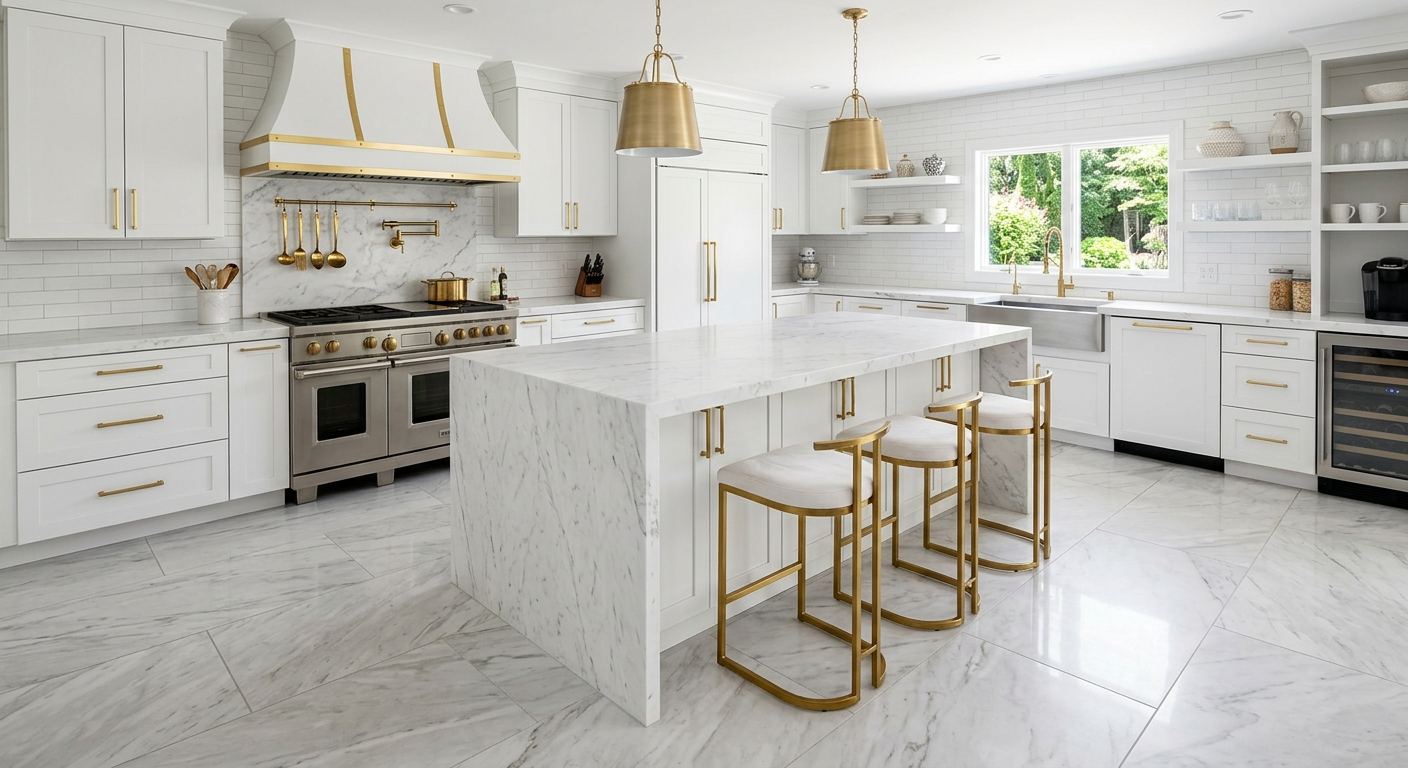
Kitchen renovation options and costs in Lantzville
Lantzville homeowners typically plan their kitchen work around day-to-day usability, resale value, and—most importantly for this part of Vancouver Island—what level of finish they want to live with for the next 10 to 20 years. With a median household income of $99,000 (Statistics Canada, 2021 Census) and a homeowner-dominated mix (1,325 homeowner households, 87.2% of households own), many renos here skew toward “comfortable upgrade” rather than budget-only changes. That said, the wider Vancouver Island and Coast market pushes some buyers toward quartz or natural stone and semi-custom cabinetry, especially in the Westwood/“south Lantzville” residential pockets where home values and buyer expectations run higher.
On the cost side, Vancouver Island and the Coast create pricing pressure mainly through market demand and labour availability rather than climate-driven material damage. Moisture control still matters (salt air and winter humidity can stress unsealed wood edges and caulking), but reputable builders price kitchens based on cabinetry, countertops, plumbing/electrical scope, and finishing tier. That’s why two neighbours in the same street can see quotes that differ by tens of thousands: one contractor budgets for a layout change and premium millwork, while the other stays closer to a cosmetic refresh.
Below are realistic renovation tiers for Lantzville, using the province-wide pricing bands commonly applied on Vancouver Island and the Coast.
| Renovation Tier |
What's Included |
Typical Duration |
Price Range |
| Cosmetic refresh (paint, hardware, new appliances only) |
Paint (walls/ceiling as scoped), cabinet hardware, appliance swap, minor trim touch-ups |
1–2 weeks |
$15,000–$35,000 |
| Mid-range full renovation (new cabinets, counters, sink, tile) |
New cabinets (stock or semi-custom), countertop install (laminate/quartz), sink + faucet, backsplash tile, new flooring repairs or select replacement, basic electrical updates as needed |
4–7 weeks |
$40,000–$85,000 |
| High-end full renovation (custom cabinets, stone counters, island) |
Custom millwork, premium countertop (natural stone), island build (or major rework), full backsplash feature, upgraded lighting, plumbing/electrical coordination for island, higher-end appliances allowance |
7–12+ weeks |
$90,000–$150,000+ |
| Cabinet refacing only (new doors + drawer fronts, same boxes) |
Refacing panels, new doors/drawers, hardware, re-aligning trim; countertop kept if compatible |
2–4 weeks |
$8,000–$28,000 |
| Countertop swap only (laminate to quartz or stone) |
Remove/replace existing countertop, new sink cut-outs if needed, re-seal edges, adjust caulking/trim; backsplash not included |
3–7 days |
$3,000–$12,000 |
| Backsplash tile installation only |
Tile supply (allowance), prep, install, grout/seal; includes cutting around outlets and finishing edges |
4–10 days |
$2,500–$9,000 |
Prices are estimates only and vary by project scope, site access and material selection.
What affects the price of kitchen renovation in Lantzville
Across Vancouver Island and Coast—and across British Columbia generally—you’ll often see kitchen quotes swing by 30–50% for the same “headline” scope because contractors price uncertainty differently. One team may include allowances for floor remediation, electrical upgrades, and hidden cabinetry repairs; another may price only what’s visible until demolition. The biggest drivers on the coast are local finish expectations (influenced by home values and household income) and the number of trades needed once you change plumbing or electrical. In higher-value Vancouver Island markets, homeowners default to quartz or natural stone counters and semi-custom cabinetry because the renovation cost is easier to recover on resale. In more modest or rental-leaning areas, laminate and stock cabinets dominate because ROI is achieved by improving function without pushing into the upper-tier spend. In Lantzville specifically, we also see older housing stock: 51.0% of homes were built before 1981 (Statistics Canada, 2021 Census), so “unknowns” like dated subfloor conditions, wiring age, and cabinet wall straightness can add cost even when the design looks simple.
Two practical examples that frequently change the budget in Lantzville: (1) adding an island often triggers a plumbing and/or gas-line decision. If your island needs a sink or hood ducting, you’re no longer in the $40,000–$85,000 mid-range band—you can jump into the upper end of the mid-to-high spectrum depending on cabinet tier and countertop weight/support requirements. (2) upgrading from laminate to quartz can be a predictable cost in the $3,000–$12,000 countertop band, but if the existing walls/backsplash aren’t square, you may need extra tile and shimming to get a tight seam line. The “layout” work is the most unpredictable cost regardless of finish level, because it changes how many hours, inspections, and material disruptions you face.
| Price Factor |
Why It Matters |
Cost Impact |
| Cabinet tier — stock vs. semi-custom vs. fully custom millwork |
Custom boxes, framing, hardware quality, and fit/finish change both materials and install time |
Can shift the total budget by tens of thousands; cabinets often represent 30–40% of the kitchen spend |
| Countertop material — laminate vs. quartz vs. granite vs. stone |
Material cost and install method vary; heavier stones may require extra measuring/support work |
Typically a predictable uplift for quartz/stone; can move the project into upper bands |
| Layout change — wall removal, island add, plumbing/gas move |
Trade coordination, demolition, patching, and rough-in work create uncertainty and schedule impact |
Usually the biggest swing factor (often 10–30% or more of the total budget) |
| Appliance package tier — builder vs. mid-range vs. pro-grade |
Rough-in requirements and allowances change; ventilation and trim kits can add cost |
Can add several thousand dollars quickly, especially for ventilation and matching panels |
| Flooring — refinish existing vs. full replacement |
Demolition can reveal uneven subfloors; matching patterns and levels is labour-intensive |
Refinish can be relatively cost-effective; full replacement can raise the budget mid-project |
| Backsplash — ceramic tile vs. marble vs. full-height slab |
Higher-end materials and full-height installs require more precise backing and finishing |
May move from a few thousand into the higher end of the backsplash band |
| Electrical — new circuits for island, under-cabinet lighting |
Additional circuits, lighting runs, and GFCI/AFCI coordination add licensed labour and shop drawings |
Often increases cost noticeably even if finishes stay basic |
| Permit fees and licensed trade requirements |
Permits and inspections affect scheduling and must be handled by qualified trades for certain scopes |
Usually manageable, but delays or omissions can create real cost overruns |
Permits & regulations in British Columbia
In British Columbia, a straightforward cosmetic update—like swapping cabinet doors, installing new countertops, or replacing finishes—typically does not trigger a permit. Cabinet and countertop swaps usually fall under “no permit required” work because they don’t change the building’s plumbing, gas, electrical, or structural safety. However, once you’re moving plumbing supply or drains, relocating gas components (such as a stove or a gas range hood), removing a load-bearing wall, or adding new electrical circuits (like for island outlets or under-cabinet lighting tied into new runs), a permit and licensed trades are commonly required.
For a Lantzville homeowner, the verification process should be simple and documented. First, ask the contractor to provide their licence information and the specific trade(s) that will pull permits if needed. Next, confirm liability insurance by requesting a certificate of insurance showing general liability coverage; if the job uses subcontractors, you still want to see proof tied to the company(s) entering your home. Finally, check workers’ coverage (commonly referred to through WCB/WSIB coverage documentation). You can also request their clearance letter or proof of coverage before work starts.
Step-by-step: (1) Get the scope in writing (what is being moved, added, or removed). (2) Ask which items require permits. (3) Confirm the licensed trade will perform and document the required inspections. (4) Verify licence, insurance, and workers’ coverage before signing. (5) Ensure permit responsibility sits clearly in the contract—don’t assume it.
Cabinets, countertops and layout decisions in Lantzville
For most Lantzville kitchens, the best results come from making three high-impact decisions early: (1) cabinet tier, (2) countertop material, and (3) whether the layout changes justify the added trades. Cabinet tier determines your fit, storage efficiency, and how quickly you’ll finish the reno. Stock cabinets are the fastest and cheapest, but semi-custom is where most homeowners land for a practical mix of style and storage upgrades. Custom cabinets deliver the tightest fit for older walls, tricky corners, and specific appliance dimensions, but they cost more and usually take longer.
Countertops should match both your lifestyle and your maintenance tolerance. Laminate is budget-friendly and easy to replace, but it’s less resistant to deep staining and impact. Quartz is a common “middle-to-upper” choice because it resists staining well, holds up to everyday use, and keeps maintenance simple. Granite/natural stone adds character and durability, but it’s not maintenance-free—sealing and careful care matter. Butcher block offers warmth and easy repair for minor wear, though it needs regular sealing and is best for homeowners who actually like maintaining surfaces. Marble looks premium and bright, but it’s softer and needs more diligence to avoid etching.
Layout changes are where kitchens often “either make sense or get expensive.” If you can keep plumbing in place and just reface or swap countertops, you can stay in a predictable scope like a $40,000–$85,000 mid-range renovation. But removing a wall, adding an island, or relocating a gas line can quickly require more rough-in work and coordination. For example, swapping cabinets plus quartz may be a controlled upgrade, while adding an island sink can add several thousand in plumbing and electrical coordination beyond the cabinet/countertop budget alone—yet it can be worth it if it improves circulation and creates real prep space.
| Option |
Durability |
Maintenance |
Best For |
Price Range |
| Stock cabinets (big-box) |
Solid for everyday use; limits on customization and special sizes |
Low; keep hinges/adjustments tuned |
Fast timelines and budget-conscious renos |
$8,000–$25,000 |
| Semi-custom cabinets (local dealer) |
Good durability; better drawer layouts and options for fit |
Low to moderate; routine hardware checks |
Most Lantzville mid-range remodels |
$18,000–$45,000 |
| Custom cabinets (local millwork shop) |
Very durable and best fit; ideal for irregular walls and tailored storage |
Low; follow manufacturer care for finishes |
High-end kitchens, unique layouts, and maximum storage |
$35,000–$75,000+ |
| Laminate countertop |
Good for light-to-moderate daily use; can chip at edges |
Low; avoid standing water at seams |
Value-focused renovations and rental suites |
$3,000–$7,000 |
| Quartz engineered countertop |
High resistance to staining and everyday impacts |
Very low; wipe clean and reseal isn’t usually needed |
Busy households wanting a “set it and forget it” surface |
$6,000–$12,000 |
| Granite / natural stone countertop |
Very durable; unique patterning and good heat resistance |
Moderate; periodic sealing may be required |
Homeowners who want natural character |
$8,000–$16,000+ |
| Butcher block countertop |
Durable but susceptible to dents and moisture if neglected |
Moderate to high; regular oiling/sealing |
Prep-focused kitchens and warmer aesthetics |
$5,000–$12,000 |
| Marble countertop |
Premium look; more prone to scratching and etching |
High; requires careful cleaning and maintenance |
Statement kitchens with lighter use or extra care |
$10,000–$20,000+ |
How to choose a kitchen renovation contractor in Lantzville
Choosing the right contractor in Lantzville comes down to verifying credentials, getting itemised pricing, and confirming what’s included before demolition. In British Columbia, you should confirm licensing for trades involved in your scope (especially gas and electrical), along with liability insurance and workers’ coverage (WCB/WSIB-related documentation). How to check: request licence proof from the contractor/subcontractor, ask for a certificate of insurance, and look for the WCB/WSIB clearance documentation or proof of workers’ coverage. If anything is missing, pause and ask—your kitchen involves cabinetry, stone, plumbing, and sometimes gas and new electrical circuits, so you want the right people on-site.
Next, ask for 2–3 itemised written quotes with a labour + materials breakdown. Look for line items for demolition, cabinet install, countertop fabrication/installation, tile/backsplash labour, electrical/mechanical rough-in allowance (if applicable), and disposal/recycling. Don’t accept vague inclusions like “materials and labour included” unless the materials specs are listed. Also confirm permit responsibility—if permits are required, who pulls them and who pays?
Warranty matters too: request the workmanship warranty length and confirm whether product warranties from manufacturers are provided and if they’re transferable to you. Finally, keep the payment schedule controlled: never pay more than 10–15% upfront, and use a holdback until the job is complete and punch list items are signed off. Timing should be in writing—get a start date and an estimated completion window, not just “as soon as possible.”
- Confirm the contractor’s British Columbia licence details and the licences of every major trade involved.
- Request certificate of liability insurance and verify coverage is active for the project dates.
- Provide workers’ coverage proof (WCB/WSIB documentation) before work begins.
- Insist on a written, itemised quote (labour + materials) rather than a single lump sum.
- Check what’s excluded: old cabinet haul-away, disposal, dust control, patching, and subfloor repair.
- Confirm whether permits and inspections are included and who is responsible for pulling them.
- Ask about countertop measurement, templates, and who handles re-cuts or errors.
- Review the schedule and lead times for cabinets and stone; ask who coordinates deliveries.
- Require a workmanship warranty and understand what triggers service callbacks.
- Verify that product/manufacturer warranties are provided in writing and are transferable.
- Use a payment schedule with 10–15% max upfront and holdback until punch list completion.
- Get a written start date and completion estimate with weather-sensitive contingencies.
Red flags I see in Lantzville: contractors who won’t show insurance/WCB documentation, quotes that exclude electrical/plumbing allowances while proposing an island, unclear scope on disposal and drywall/patching, pressure to pay large deposits upfront, and timelines that ignore cabinet/stone lead times.
Frequently asked questions — kitchen renovation in Lantzville
How do I add an island to my Lantzville kitchen?
To add an island in Lantzville, start by deciding what the island needs: seating only, or a sink and/or cooktop/hood. If you’re adding plumbing (for a sink) or gas/venting (for a range/hood), that’s where costs and scheduling change most—often the difference between a mid-range project and an upper-tier rebuild. A good contractor will measure clearance paths for safe circulation and confirm cabinetry layout with the appliance specs. If possible, keep existing plumbing in the same general area to reduce rough-in complexity. Island lighting (pendant + under-cabinet) can also require new electrical circuits. As a benchmark, many “island add” renovations land within the broader $40,000–$85,000 mid-range band if you keep moves limited; major plumbing/gas relocation pushes budgets higher.
How much does a kitchen renovation cost in Lantzville?
In Lantzville, kitchen renovation costs typically cluster into practical bands based on finish tier and how much you change the layout. A basic refresh (paint, hardware, and new appliances only) often sits around $15,000–$35,000. For a full mid-range renovation—new cabinets, countertops, sink, and backsplash—many projects fall into about $40,000–$85,000. High-end kitchens with custom millwork, natural stone counters, and an island can reach $90,000–$150,000+, especially when multiple trades are needed for rough-in changes. These bands are driven more by expected finishes and cabinetwork choices than by climate itself. Lantzville’s housing mix includes many homes built before 1981 (Statistics Canada, 2021 Census), so older framing, wiring age, or subfloor issues can add some variability even when the design stays similar.
How long does a kitchen renovation take in Lantzville?
Timelines in British Columbia are mostly determined by approvals, demolition sequencing, and—critically—cabinet and countertop lead times. A cosmetic refresh can often be finished in about 1–2 weeks since the work is mainly finish-level. Mid-range full renovations typically take around 4–7 weeks for cabinets, counters, tile, and coordination of trades. If you’re doing custom millwork, natural stone, or significant layout changes (like wall removal or island rough-ins), timelines commonly extend to 7–12+ weeks due to fabrication and inspection steps. Lantzville’s older housing stock can also add time for patching, leveling, and verifying wiring/plumbing conditions after demo. For planning, ask your contractor to give you a written start date, a realistic completion window, and a lead-time plan for cabinets/stone, not just a best-case schedule.
Quartz vs granite countertops — which is better?
Both quartz and granite can be excellent, but “better” depends on how you use your kitchen and how much care you want to provide. Quartz is engineered for consistent colour and is generally very resistant to staining and everyday wear; it’s usually a low-maintenance choice. Granite is natural stone with unique patterns and strong heat tolerance, but it typically needs periodic sealing and careful maintenance to keep it performing at its best. In coastal BC kitchens, the practical goal is to protect seams and edges and maintain a clean, properly caulked backsplash transition. If you want a simple-care surface that fits a busy household, quartz is often the safest bet. If you want natural variation and statement character—and you’re willing to maintain it—granite is a strong choice. Pricing-wise, granite/natural stone commonly sits above quartz, often moving you toward the upper end of the countertop swap bands.
Should I reface or replace my cabinets?
Refacing is usually best when your cabinet boxes are still structurally sound, the layout works, and you mainly want an updated look. It’s also helpful when you want to keep disruption lower and avoid some of the demolition surprises that can come with full replacement. Replacement makes sense when boxes are sagging, water-damaged, misaligned, or when you need significant storage changes (pull-out specs, new drawer sizing, or a different door style for blind corners). In Lantzville, we often find older cabinets that are still usable but need hinge upgrades, smoothing, or alignment. If the cabinet structure is solid, refacing can be a cost-effective middle step, often priced around $8,000–$28,000. If you’re pairing cabinets with a major layout change, it can be more efficient to replace so the new countertop support and backsplash lines fit correctly from day one.
Do I need a permit for a kitchen renovation in British Columbia?
Often, you don’t need a permit for simple swaps like cabinet door/drawer refacing or countertop replacement, because you’re not changing the building’s plumbing, gas, electrical, or structure. However, in British Columbia, permits are commonly required when you move plumbing supply/drain lines, relocate gas appliances or ventilation, remove a load-bearing wall, or add new electrical circuits (for example, powering additional island outlets or relocating major lighting circuits). Gas work must be completed by a licensed gas fitter, and electrical work by a licensed electrician, with inspections as required. The safest approach in Lantzville is to confirm permit responsibility in writing: ask the contractor what they will pull (if anything), who performs the licensed work, and what inspections are expected. Avoid assuming—make sure it’s in the contract before demolition starts.