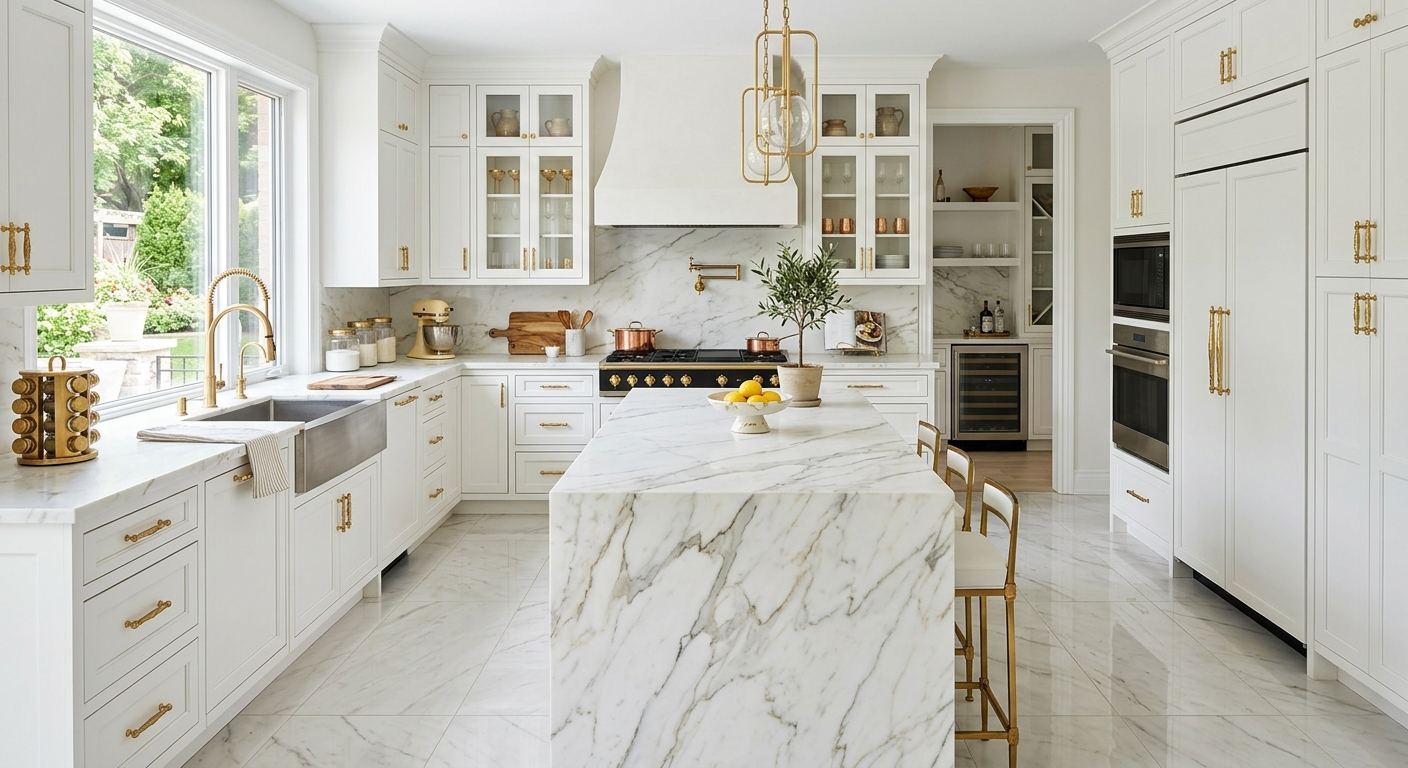
Kitchen renovation options and costs in Altamont
Altamont is a smaller community in British Columbia, and in practice that means kitchen renovation costs are shaped more by nearby Lower Mainland buyer expectations and resale psychology than by the town’s size. With a 2021 population of 1,064 (Statistics Canada, 2021 Census), there aren’t unlimited trades on standby, but projects still get scheduled quickly when contractors are available. In the Lower Mainland–Southwest, typical kitchen pricing is also strongly tied to household purchasing power and the market value of homes; higher-value areas tend to push homeowners toward semi-custom or custom cabinetry and quartz/stone counters, while more modest finish tiers can hold price down. (In larger Metro Vancouver contexts, those finish expectations tend to be more premium—closer to what homeowners can recover at resale.)
Weather matters too, but in this region it’s usually secondary to material and labour choices. Kitchens see daily moisture exposure, and BC’s coastal humidity can accelerate wear on cabinet finishes and hardware if products aren’t selected for real conditions. The region’s active construction market also affects labour availability; when cabinet installers and countertop crews are booked out, schedules can tighten and project timelines broaden.
In Altamont, trades are especially in demand along higher-traffic residential corridors—homeowners around the central residential pockets often combine kitchen work with floor or lighting upgrades to stay ahead of contractor lead times. From there, you can choose a scope that matches your goals—then compare realistic budget ranges in the table below.
| Renovation Tier |
What's Included |
Typical Duration |
Price Range |
| Cosmetic refresh (paint, hardware, new appliances only) |
Cabinet paint or refinish, new pulls/knobs, new faucet (if staying in same spot), appliance swap, basic caulking + trim touch-ups |
1–2 weeks |
$8,000–$25,000 |
| Mid-range full renovation (new cabinets, counters, sink, tile) |
New stock or semi-custom cabinets, countertops (quartz or laminate), sink + taps, backsplash tile, flooring protection/patching, labour for standard layout |
3–6 weeks |
$40,000–$85,000 |
| High-end full renovation (custom cabinets, stone counters, island) |
Custom cabinetry, quartz/stone counters with advanced edge profiles, island build (sometimes including electrical), upgraded backsplash (stone slab or premium tile), higher-end hardware |
6–12 weeks |
$85,000–$120,000 |
| Cabinet refacing only (new doors + drawer fronts, same boxes) |
Door/drawer replacement, new end panels, new hardware, surface prep, optional paint on adjacent trim |
1–3 weeks |
$8,000–$25,000 |
| Countertop swap only (laminate to quartz or stone) |
Remove old tops, template/measure, install quartz/stone or upgrade laminate, sink cut-out changes if staying in same position |
5–10 days (plus templating) |
$10,000–$35,000 |
| Backsplash tile installation only |
Tile supply + install (standard height), prep and waterproofing at wet-wall locations, grout + finishing |
2–5 days |
$1,500–$6,000 |
Prices are estimates only and vary by project scope, site access and material selection.
What affects the price of kitchen renovation in Altamont
In Altamont and across the Lower Mainland–Southwest, two quotes for the “same” kitchen can differ by 30–50% because the drivers aren’t just labour hours—they’re finish expectations, cabinetry complexity, and how many trades must touch the site. In British Columbia, the biggest swing usually comes from whether homeowners choose laminate/stock options or step up to quartz/stone and semi-custom or fully custom millwork. The region also tends to attract design-led upgrades (often in higher-value pockets of Metro Vancouver), which pushes material pricing and fabrication time higher even when the kitchen footprint is similar.
Importantly, it’s the local housing value and buying profile that steer the typical finish tier far more than climate. In higher-value Lower Mainland–Southwest markets, quartz or stone counters and semi-custom cabinetry are common because the renovation cost is more likely to be “absorbed” into resale value. In more modest-value markets, laminate and stock cabinets dominate because they deliver strong function per dollar—often aligning better with an ROI-focused budget.
Layout changes are the unpredictable cost regardless of finish level. For example, removing a wall to open the kitchen can trigger engineering review and structural work, while adding an island often means new electrical and potentially moving a gas line. If you already have older plumbing supply runs, a sink relocation can also uncover hidden water damage that requires extra carpentry and replacement. As a practical planning benchmark, a mid-range full renovation in this region can start around the $40,000–$85,000 band, but once you add an island and stone counters, you commonly move toward the $85,000–$120,000 high-end range.
Even within Altamont’s coastal-influenced conditions, humidity can affect cabinet hardware performance and paint durability—so the wrong finish choice can cost more later in repainting or rework. That’s why we price for the right product upfront rather than “hoping it holds.”
| Price Factor |
Why It Matters |
Cost Impact |
| Cabinet tier — stock vs. semi-custom vs. fully custom millwork |
Custom pieces take more labour, design time, and fabrication; higher tiers also improve fit for non-standard walls. |
Small kitchens can swing by tens of thousands depending on tier. |
| Countertop material — laminate vs. quartz vs. granite vs. stone |
Material cost + fabrication complexity (edges, seams) drives the change more than installation labour. |
Countertop-only budgets can move from the lower teens to mid-$30,000s depending on material and cuts. |
| Layout change — wall removal, island add, plumbing/gas move |
These require more trades, opening walls, and sometimes structural or engineering involvement. |
Often the single largest unpredictable line item, regardless of finish level. |
| Appliance package tier — builder vs. mid-range vs. pro-grade |
Brand tiers affect electrical requirements, ventilation specs, and installation complexity. |
Can add or subtract several thousand quickly. |
| Flooring — refinish existing vs. full replacement |
Keeping floors can reduce demo and dust; replacing can require transitions and subfloor checks. |
Replacement can add meaningful cost and schedule time. |
| Backsplash — ceramic tile vs. marble vs. full-height slab |
Premium stone and full-height coverage increase material weight, layout complexity, and fabrication needs. |
Backsplash-only can range from lower-end tile to premium slab pricing. |
| Electrical — new circuits for island, under-cabinet lighting |
More fixtures and outlets increase electrician time and permit/inspection steps. |
Common add-on in island upgrades; affects both cost and timeline. |
| Permit fees and licensed trade requirements |
Permits plus inspections are required when certain systems are moved/added. |
Varies by scope, but can add several hundred to over a few thousand. |
Permits & regulations in British Columbia
In British Columbia, a straightforward cabinet or countertop swap typically does not require a building permit. If you’re replacing cabinets in the same footprint and swapping countertops without moving plumbing or gas connections, you can usually proceed as a cosmetic/finish change. However, in an Altamont kitchen renovation, permits and licensed trade work are commonly required when you change the home’s systems.
Work that typically does require permits and licensed trades includes moving or altering plumbing supply/drain lines (for example, relocating the sink), relocating gas lines or changing gas-fired appliances/venting (such as moving a range or range hood that uses gas), removing a load-bearing wall, and adding new electrical circuits or significant electrical changes (like extra outlets for an island, moving the dishwasher circuit, or adding under-cabinet lighting that requires new runs). Gas work must be performed by a licensed gas fitter, and electrical work must be done by a licensed electrician—both typically require inspections after rough-in and/or completion.
To verify a contractor in practical steps: (1) request their licence numbers and confirm them through the relevant provincial online registry listings; (2) ask for a current certificate of insurance and confirm liability coverage limits and the project address is noted; (3) obtain proof of coverage for worker compensation (coverage is typically requested as part of contractor onboarding, and they should be able to provide the documentation); (4) ensure the contract states who is responsible for permits and who pulls them. Don’t leave that responsibility vague—confirm it in writing before signing.
Cabinets, countertops and layout decisions in Altamont
For most Altamont homeowners, three choices determine whether your renovation feels “worth it” or gets expensive fast: (1) cabinet tier, (2) countertop material, and (3) whether you change the layout. Cabinet tier is the fastest route to cost certainty: stock cabinets are the quickest and least expensive, semi-custom is the popular mid-range option when you need better sizing for real room geometry, and custom cabinetry is the highest cost but delivers the tightest fit around corners, ceilings, and off-square walls—especially helpful in older BC housing stock.
Countertops should be selected with both durability and maintenance in mind. Laminate is budget-friendly and installs quickly, but it’s more sensitive to impact and can show wear sooner. Quartz is a strong “middle” choice: it’s more heat and stain resistant than laminate, usually requires no sealing, and offers better long-term appearance—an important consideration in a coastal humidity environment where finishes and hardware get stressed. Natural stone (granite/other stone) looks premium and can be very durable, but fabrication, seams, and edge profiles can raise the price. Butcher block brings warmth and can age beautifully if maintained; it also needs more care near the sink.
Layout changes are when budgets tend to jump. If you move plumbing for a sink or relocate a gas stove, you’re paying for demolition, licensed trade work, and potential permit steps. A dollar-justified example: if your kitchen is cramped and an island addition creates clear circulation, spending toward the high-end full renovation band (often $85,000–$120,000) can make sense—because you’re buying functional space, not just surfaces. But if your goal is mainly aesthetic, staying closer to a mid-range renovation scope ($40,000–$85,000) usually delivers a better return than paying for system relocations you don’t truly need.
| Option |
Durability |
Maintenance |
Best For |
Price Range |
| Stock cabinets (big-box) |
Good for standard wall dimensions; doors and shelves can be less tailored for uneven or older rooms. |
Low; wipe clean and address hinge wear as needed. |
Quick refreshes and tighter budgets where the layout is staying put. |
$8,000–$25,000 |
| Semi-custom cabinets (local dealer) |
Very durable with improved sizing options; better fit reduces gaps and long-term drafts. |
Low to moderate; keep hardware tightened and monitor moisture near sink. |
Most Altamont renovations aiming for resale-ready finishes without custom pricing. |
$20,000–$55,000 |
| Custom cabinets (local millwork shop) |
Excellent fit and detail; best when you need unusual storage, ceiling height matching, or special layouts. |
Low; similar care to semi-custom, with more hand-finished details. |
Premium builds, complicated spaces, and homeowners prioritizing longevity and design. |
$40,000–$80,000 |
| Laminate countertop |
Decent for everyday use; can scratch or chip and may stain or lift at edges if water gets underneath. |
Low; avoid heat and standing water at seams. |
Budget-first remodels and quick upgrades with minimal demolition. |
$3,000–$8,000 |
| Quartz engineered countertop |
High durability against staining and daily wear; holds up well to routine cooking. |
Low; wipe clean, no sealing required for most products. |
Resale-ready finish at mid-to-high budgets in coastal BC homes. |
$7,000–$15,000 |
| Granite / natural stone countertop |
Very durable with strong resistance when properly installed and sealed as recommended by the supplier. |
Moderate; follow sealing schedule and protect from aggressive cleaners. |
Premium look where you want stone character and premium edges. |
$10,000–$22,000 |
| Butcher block countertop |
Durable when maintained; vulnerable at edges and seams if moisture is neglected. |
Moderate to high; requires regular oiling and careful sink-side maintenance. |
Warm, traditional styles and homeowners willing to maintain the surface. |
$6,000–$14,000 |
| Marble countertop |
Beautiful but softer than quartz; can etch if acidic substances contact the surface. |
Higher maintenance; use careful cleaners and wipe spills promptly. |
Design-led kitchens where the surface is treated more like a showpiece. |
$12,000–$25,000 |
How to choose a kitchen renovation contractor in Altamont
Choosing the right contractor in Altamont comes down to proof, clarity, and schedule control. Start by verifying British Columbia licensing for the trades involved in your scope—especially gas fitter and electrician if you’re altering gas or adding circuits. Ask the contractor for licence numbers and confirm them through the provincial online licence registries. Then request a certificate of liability insurance showing adequate limits for the job size and that coverage is current for the project term. For worker coverage, request confirmation of worker compensation coverage (often provided as documentation during onboarding). If a contractor can’t provide these details promptly, that’s a warning sign.
Next, get 2–3 itemised written quotes instead of one lump-sum number. You want a breakdown that separates labour and materials (including demolition, framing/patching, cabinetry installation, countertop template/installation, tile prep, disposal, and electrical/plumbing allowances if applicable). Read the scope for exclusions: Is permit pulling included? Is hazardous waste or concrete disposal included? Are appliances supplied or excluded? Does the quote include protection for floors and countertops during demo?
Warranty matters too: confirm the workmanship warranty length and whether it covers callbacks for installation issues. Also confirm product/manufacturer warranties for cabinets, countertops, and appliances, and whether those warranties transfer if you sell the home. Finally, payment schedules should protect you—never pay more than 10–15% upfront, and hold back a portion until key milestones are complete.
Timeline should be in writing: a realistic start date, material lead times, and completion estimate. Coastal scheduling can be impacted when stone fabrication slots fill quickly, so insist on dates plus contingencies.
- Ask for their BC trade licences relevant to your scope (gas/electrical) and confirm via online registry listings.
- Request a certificate of insurance and verify it matches the project location.
- Get proof of worker compensation coverage documentation.
- Demand an itemised quote with line-by-line labour and materials (not just totals).
- Confirm who pulls permits and who pays permit/inspection fees if plumbing/electrical changes are planned.
- Check disposal inclusion (construction debris, packaging, and any special handling).
- Confirm the starter timeline for cabinet/stone fabrication and when measurements/template are scheduled.
- Ensure the quote lists exclusions clearly (subfloor issues, hidden damage, structural engineering contingencies).
- Verify warranty terms for workmanship and product warranties, including transferability.
- Use a milestone payment plan and keep holdback until punch list items are corrected.
- Ask how change orders are priced and who authorizes them in writing.
- Confirm dust control, floor protection, and cleaning responsibilities during demo and install.
Common red flags in Altamont kitchens: vague scopes (“allowances” with no amounts), refusing to itemise disposal or permit responsibility, asking for heavy upfront payments, no clear warranty terms for labour, and missing proof of insurance or trade licensing documentation. If they can’t explain schedule dependencies (cabinet lead times and countertop templating), you’ll likely feel it in delays later.
Frequently asked questions — kitchen renovation in Altamont
What's the ROI on a kitchen renovation?
In Altamont and throughout British Columbia, kitchen renovations tend to perform best when they focus on durable, resale-friendly upgrades rather than purely cosmetic experiments. While exact ROI depends on your home’s condition and the finish tier you choose, the Lower Mainland–Southwest market expectations often reward kitchens that look current: functional layouts, solid cabinet hardware, and countertops that hold up well under daily use. If you choose a mid-range full renovation scope (commonly around $40,000–$85,000), you’re typically investing in the upgrades buyers expect to see—especially cabinetry and countertops. If you go high-end (often $85,000–$120,000), ROI can still be strong, but only when the space and materials justify the spend (for example, a well-designed island with proper electrical). In smaller communities like Altamont (Statistics Canada, 2021 Census), buyers may also value practical improvements that reduce future maintenance, not just aesthetics.
How do I budget for a kitchen renovation?
Budgeting starts with selecting a realistic tier and locking the scope before you chase finishes. A good approach is to decide whether you’re doing a cosmetic refresh, a mid-range full renovation, or a full high-end rebuild. For many homeowners, a mid-range project in the Lower Mainland–Southwest lands in the $40,000–$85,000 band, while countertop-heavy upgrades can move you quickly upward depending on stone, edges, and cutouts. Also plan for the “layout tax”: moving plumbing supply/drain lines or changing gas/electrical typically increases cost and timing more than materials alone. Finally, allow a contingency for older homes—hidden subfloor damage, outdated shut-offs, or cabinet wall irregularities are common when walls are opened. If you want the safest budget path, keep plumbing in roughly the same location and limit structural changes unless the space gain is truly worth it.
Can I move my kitchen sink or stove?
Yes, you can move a kitchen sink or stove in British Columbia, but you should expect it to change the permit and trade requirements. Moving a sink usually means altering plumbing supply and/or drain lines, which generally triggers permits and requires licensed plumbing work. Moving a gas stove or changing the position of a gas-fired range or appropriate venting typically requires permits and work by a licensed gas fitter; inspections are standard. If the stove is electric, electrical changes may still require a licensed electrician and permits depending on the circuit work. From a practical standpoint in Altamont renovations, moving these fixtures often increases demolition (accessing wall cavities), raises the risk of uncovering hidden issues, and adds time for inspections and rework. If your goal is a refreshed look, keeping the sink/stove in the same rough location usually controls cost more effectively.
What's the most cost-effective kitchen upgrade?
The most cost-effective upgrade is usually the one that delivers the biggest visual and functional impact without triggering system changes. Many Altamont homeowners get strong value by choosing a cabinet refacing or a countertop upgrade rather than replacing everything. For example, cabinet refacing (new doors and drawer fronts while keeping the boxes) often sits in the $8,000–$25,000 range, and it can dramatically update the look in less time than a full rebuild. If your layout and cabinet boxes are solid, a countertop swap to quartz or stone can also be a high-impact move; countertop-only scopes commonly start around $10,000–$35,000 depending on size, edge work, and sink cutouts. If you’re staying budget-focused, upgrades that don’t require moving plumbing or electrical circuits typically have the lowest risk of schedule overruns.
Custom vs stock cabinets — is custom worth it?
Custom cabinets can be worth it in British Columbia when your kitchen has non-standard wall lines, unusual ceiling heights, or you want a very specific storage design. But if your space is reasonably square and you mainly want a modern look, stock or semi-custom often provides better value. Stock cabinets are usually the fastest and least expensive option, while semi-custom is the popular mid-range choice for a close fit without custom lead times. Fully custom millwork is typically most justified when you’re also doing a high-end renovation and want integrated details (like specialty storage, perfect alignment, or complex island cabinetry). For budget planning in Altamont, custom typically pushes you toward the higher end of full renovation budgets (often closer to $85,000–$120,000), while mid-range full renovations can land around $40,000–$85,000 depending on counters, tile, and whether you change the layout.
How do I choose a kitchen contractor in Altamont?
Choose a contractor by verifying proof, reading the scope closely, and requiring itemised pricing. In British Columbia, confirm relevant trade licensing (especially if plumbing changes for a sink or electrical/gas work is involved) using the provincial licence listings, and ask for a current certificate of insurance for liability coverage that matches the project. Request documentation for worker compensation coverage as well. Then get 2–3 itemised written quotes that separate labour and materials and clearly state whether permits are included—because moving plumbing supply/drain lines, gas work, or adding electrical circuits changes requirements and inspection steps. Make sure the contract spells out disposal, protection, warranty coverage for workmanship, and product warranty terms (including whether warranties transfer if you sell). Finally, keep payments protected: avoid paying more than 10–15% upfront, and hold back until punch-list items are complete.