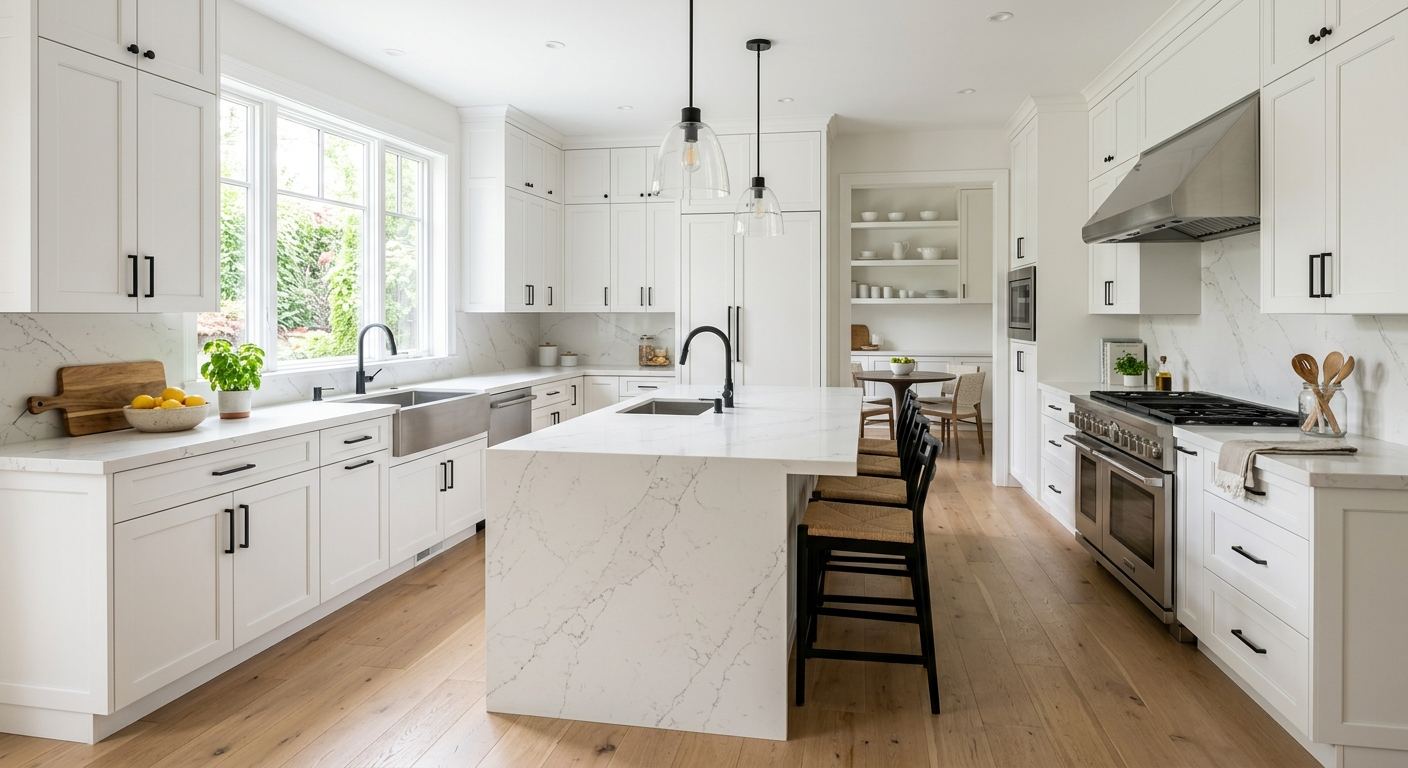
Kitchen renovation options and costs in Rockland
Kitchen renovation in Rockland, British Columbia, typically starts with what you want to change: whether it’s a quick refresh or a full rebuild. With Rockland’s population at 3,740 (Statistics Canada, 2021 Census), trades availability and project scheduling are usually steadier than in the busiest parts of Metro Vancouver, but finish expectations still track the broader Lower Mainland–Southwest market. Homeowners here often balance ROI with aesthetics, and local buying behaviour is influenced by regional household income and housing values—higher-value markets tend to favour semi-custom or custom cabinetry and quartz or stone counters because those finishes hold up on resale.
In the Lower Mainland–Southwest, the climate is a background factor rather than the main cost driver. Humidity and temperature swings can affect installation details (especially around tile, underlayments, and wood components), but the big quote swings usually come from market-driven finish tier and design choices. Labour rates and material delivery can also differ depending on whether you’re near higher-demand corridors in the region, which affects how quickly contractors can staff crews for cabinet installs, counter templating, and flooring/tile sequencing.
One area where kitchen work is consistently in demand is the Westwood/Oceanview area of Rockland, where many homeowners are planning updates around open-house staging and family layout needs. From there, you can compare options and quickly see where spending pays off—then decide which renovation tier matches your timeline and budget.
| Renovation Tier |
What's Included |
Typical Duration |
Price Range |
| Cosmetic refresh (paint, hardware, new appliances only) |
Cabinet paint or touch-up, new pulls/knobs, appliance swap (same footprint), caulking and basic trim, install of new range hood (no duct/gas changes) |
3–7 days |
$8,000–$18,000 |
| Mid-range full renovation (new cabinets, counters, sink, tile) |
Semi-custom or quality stock cabinets, countertop (quartz or granite-style stone look), sink and faucet, backsplash tile, under-cabinet lighting prep (as needed), flooring patching and grout/caulk |
3–6 weeks |
$40,000–$85,000 |
| High-end full renovation (custom cabinets, stone counters, island) |
Custom millwork, premium stone counters, island with upgraded base/casework, full-height or designer backsplash, higher-end hardware, coordinated lighting and more complex layout/finishes |
6–12 weeks |
$85,000–$120,000 |
| Cabinet refacing only (new doors + drawer fronts, same boxes) |
Refaced doors/drawers, new hinges and soft-close hardware, repaint of visible boxes if needed, basic trim updates, optional re-grout/caulk around perimeter |
1–3 weeks |
$12,000–$30,000 |
| Countertop swap only (laminate to quartz or stone) |
Remove existing surface, template, install new quartz/stone, sink and faucet transfer/adjustments (no major plumbing relocation), backsplash caulk and light edge detailing |
5–12 days |
$10,000–$25,000 |
| Backsplash tile installation only |
Demo of existing backsplash (if required), tile install (ceramic/porcelain), layout/set for outlets, sealing/grouting, final caulking and cleanup |
2–5 days |
$1,500–$6,000 |
Prices are estimates only and vary by project scope, site access and material selection.
What affects the price of kitchen renovation in Rockland
The same kitchen project can come in 30–50% apart across the Lower Mainland–Southwest and other parts of British Columbia, largely because quotes are driven by the finish tier homeowners choose, the complexity of the cabinetry package, and how much field labour is required—not by temperature alone. In high-value Lower Mainland–Southwest pockets, homeowners commonly default to quartz or stone counters and semi-custom cabinetry because the renovation cost is more easily recovered on resale. In more modest markets, laminate and stock cabinets dominate because they reduce upfront cost and still deliver a visible upgrade.
In Rockland, layout changes are where budgets surprise you. Removing a wall, adding an island, or moving a gas line (or even relocating a vented hood) can add weeks of planning and coordination. That unpredictability exists regardless of whether you’re targeting the mid-range band (often tied to quartz counters and tile) or the higher-end rebuild band where custom millwork and complex islands are typical.
Two or three local conditions tend to push costs up in Rockland. First, many homes have older plumbing and electrical runs routed behind existing cabinet walls; once we open the kitchen, we sometimes find undersized supply lines or outdated wiring that needs correction before new cabinetry goes in. Second, humid coastal conditions mean tile and grout lines must be detailed correctly around backsplashes and areas exposed to steam—worth it to avoid future cracking or loose edging. Third, if your kitchen has limited access for delivery trucks or tight turnarounds on driveways, cabinet and stone install logistics can add labour time, which affects the final total even when the material list looks unchanged.
| Price Factor |
Why It Matters |
Cost Impact |
| Cabinet tier — stock vs. semi-custom vs. fully custom millwork |
Casework complexity, fit tolerances, drawer/hinge systems, and lead times vary widely by tier |
$8,000–$60,000 |
| Countertop material — laminate vs. quartz vs. granite vs. stone |
Material cost, seam planning, edge profiles, and templating requirements change labour and waste |
$3,000–$12,000 |
| Layout change — wall removal, island add, plumbing/gas move |
Structural, venting, and rough-in trades must coordinate; rework is common if discovered late |
$5,000–$35,000 |
| Appliance package tier — builder vs. mid-range vs. pro-grade |
Electrical/venting specs and installation clearances differ; premium brands may require upgrades |
$2,000–$20,000 |
| Flooring — refinish existing vs. full replacement |
Whether floors are protected and reinstalled cleanly versus replaced across the kitchen/dining zone |
$1,500–$10,000 |
| Backsplash — ceramic tile vs. marble vs. full-height slab |
Material density and cutting complexity drive labour; full-height coverage increases square footage |
$1,500–$12,000 |
| Electrical — new circuits for island, under-cabinet lighting |
Licensed electrical work depends on load calculations and the distance to service panels |
$800–$6,500 |
| Permit fees and licensed trade requirements |
When plumbing, gas, electrical, or structural work changes, permits and inspections add cost and time |
$500–$7,500 |
Permits & regulations in British Columbia
In British Columbia, cabinet and countertop swaps typically do not require permits when you’re keeping the existing layout and service connections in place. That means replacing cabinet doors, drawer fronts, or full cabinets into the same footprint usually stays in the “no permit” lane. Similarly, swapping laminate for quartz or stone is commonly permit-free as long as you’re not relocating plumbing or changing venting routes.
Permits and licensed trades usually come into play when you move or alter core services. If you’re relocating plumbing supply or drain lines, moving a gas cooktop/range, changing a range hood that vents to the exterior (especially if gas-related changes are involved), removing a load-bearing wall, or adding new electrical circuits (for an island, under-cabinet lighting, or dedicated receptacles), plan for permits and inspections. Gas work must be done by a licensed gas fitter; electrical work by a licensed electrician—both require appropriate inspections after rough-in and before final close-up.
To verify a contractor in Rockland before signing, do three things step-by-step: (1) confirm their trade licensing and eligibility using the appropriate provincial/regulatory online registry for the trades they perform; (2) request a certificate of insurance and look for active general liability with proper project coverage; and (3) ask for proof of WCB coverage or clearance letter where applicable to their workers and subcontractors. Ensure the contract clearly states who is pulling permits and who is paying the licensed trades—don’t assume it’s “included” unless it’s written.
Cabinets, countertops and layout decisions in Rockland
In Rockland, the three most consequential kitchen renovation decisions are cabinet tier, countertop material, and whether you change the layout. Cabinet tier (stock vs. semi-custom vs. custom) affects speed, fit and the look of the finished room. Semi-custom is the most common “sweet spot” in the Lower Mainland–Southwest because it gives better sizing and internal features than basic stock, without the longer lead times and engineering-heavy details of fully custom millwork. For countertops, laminate can be an economical start, but quartz or natural stone is what most buyers expect at the mid-range to high-end price points—especially when the renovation includes visible backsplash detailing and an island.
Layout changes should be justified by space gain and daily use, not just aesthetics. Removing a wall to open the kitchen is often worthwhile if it improves sightlines and traffic flow, but it’s rarely the cheapest upgrade. Adding an island can be a practical upgrade if you can maintain comfortable clearances for circulation; when paired with new electrical for an island outlet set and under-cabinet lighting, costs can move toward the mid-range full renovation band.
Here’s a realistic dollar example: upgrading from laminate to quartz over the same cabinet layout is often “worth it” when your total renovation budget supports it—many homeowners see countertop-only swaps come in around the countertop band (for example, $3,000–$12,000 depending on size, edges and sink cut-outs). If you’re planning to repaint, add tile, and keep cabinetry in place, quartz delivers a clear, resale-friendly improvement. Conversely, moving plumbing and gas to create a new island sink when the layout already works can cost more than the buyer-recognizable value it adds.
| Option |
Durability |
Maintenance |
Best For |
Price Range |
| Stock cabinets (big-box) |
Solid for everyday use; limited custom sizing and fewer premium hardware options |
Low maintenance; wipe clean, avoid excessive moisture at seams |
Fast turnarounds and budget-focused refreshes |
$8,000–$25,000 |
| Semi-custom cabinets (local dealer) |
Better internal organization, more durable finishes, improved fit in typical BC home layouts |
Low maintenance; tighten/adjust hardware as recommended |
Most mid-range Rockland renovations that need a “finished” look |
$20,000–$55,000 |
| Custom cabinets (local millwork shop) |
Highest fit and finish; tailored storage and specialty features |
Low maintenance; long-term care matches finish type |
Complex layouts, built-ins, and premium resale presentation |
$45,000–$90,000 |
| Laminate countertop |
Decent surface but can be more vulnerable to edge impacts and heat over time |
Wipe clean; avoid cutting directly and protect seams from prolonged moisture |
Keeping costs down in a cosmetic or partial refresh |
$3,000–$7,000 |
| Quartz engineered countertop |
Very durable for daily cooking; consistent look and strong stain resistance |
Low maintenance; routine cleaning only, avoid abrasive pads |
Mid-range to premium renovations aiming for resale appeal |
$5,000–$11,000 |
| Granite / natural stone countertop |
Extremely hard and heat-resistant; unique patterning |
May require periodic sealing depending on stone choice |
Owners who want natural texture and higher-end visual impact |
$7,000–$12,000 |
| Butcher block countertop |
Good resilience; can dent—best with regular oil/finish care |
Needs oiling/sanding schedule; protect from standing water |
Warm, casual styles and frequent home cooking |
$4,500–$9,500 |
| Marble countertop |
Elegant but softer than quartz; can etch with acids |
Higher maintenance; seal and clean carefully |
Designer looks where homeowners will maintain properly |
$8,000–$14,000 |
How to choose a kitchen renovation contractor in Rockland
Choosing a kitchen contractor in Rockland starts with verifying they’re set up to legally and safely deliver the work in British Columbia. Ask for their business details and check licensing as applicable to the trades they perform (especially gas-related work and electrical). For liability, request a certificate of insurance and confirm the coverage limits are appropriate for renovations and that the certificate aligns with the project address and dates. For workers, ask for WCB coverage proof or a clearance letter where applicable—this matters because you want the responsibility for workplace injury handling to sit with the contractor’s coverage, not your household.
Next, request 2–3 itemised written quotes. You want labour and materials broken down—not a single lump sum—so you can see what’s included for demolition, cabinet install, countertop templating, tile labour, disposal, and any electrical/plumbing rough-in. Read the scope carefully: is permit pulling included if it’s required, is demolition hauling/disposal included, and what happens if the contractor finds hidden issues (rotted subfloor, outdated wiring, or mismatched plumbing shutoffs)?
Warranty matters too. Confirm the workmanship warranty length, the product/manufacturer warranties for cabinets and countertops, and whether warranties are transferable if you sell your home. Payment schedule should be conservative: never more than 10–15% upfront; keep a holdback until the job is complete and you’ve verified functionality (drawers, doors, lighting, sink and appliance fit). Finally, insist on a written timeline with a start date and completion estimate so delays don’t become a moving target.
- Request the contract to list who supplies and installs cabinets, counters, backsplash, and flooring transitions.
- Confirm countertop templating timing and responsibility (who pays if a measurement is off).
- Ask whether appliance hookups include new shutoffs, bonding/grounding checks, and test-and-verify.
- Verify disposal is included (dump fees, hauling, and minimum waste handling standard).
- Check whether under-cabinet lighting is included or requires a separate electrical allowance.
- Make sure labour includes caulking, grout sealing (when applicable), and final touch-ups.
- Get start and completion dates in writing, tied to material delivery milestones.
- Ensure permits (if needed) and inspections are clearly assigned to the contractor.
- Confirm warranty claim process and who you call for punch-list items.
- Ask for a protection plan for floors, stairs, and doorways during demolition.
- Look for a clear contingency approach for discovered issues in older kitchens.
- Request references from similar-scope kitchens in the Lower Mainland–Southwest if possible.
Red flags we commonly see in Rockland include: a quote that’s not itemised, promises of “no permits ever” (when plumbing/gas/electrical changes are proposed), taking large upfront deposits beyond 10–15%, vague warranty language (“as per manufacturer” with no workmanship term), and missing documentation such as insurance proof or WCB/clearance. If any of those show up, pause and require clarification in writing before work begins.
Frequently asked questions — kitchen renovation in Rockland
Custom vs stock cabinets — is custom worth it?
In Rockland and across the Lower Mainland–Southwest, custom cabinets are worth it when you need a truly tailored fit—odd wall angles, pantry built-ins, integrated appliance surrounds, or storage that you can’t get with stock. If your goal is speed and a clean upgrade, stock or semi-custom is usually the smarter ROI. A practical guide: if you’re trying to stay within a mid-range full renovation budget (often around $40,000–$85,000 depending on scope), semi-custom cabinets tend to deliver the biggest visual payoff. Custom makes more sense when the budget can support longer lead times and higher casework cost, and when the design choices are central to the home’s resale appeal. Also, custom doesn’t eliminate the need to plan for moisture-proofing around sink and dishwasher lines in a humid BC climate.
How do I choose a kitchen contractor in Rockland?
Start by confirming the contractor’s credentials for the specific work they’ll perform in British Columbia: gas work must be by a licensed gas fitter, and electrical by a licensed electrician. Ask for a current certificate of insurance tied to your address and request WCB coverage or a clearance letter for the workers involved. Then compare 2–3 itemised quotes so you can see labour and materials separately (demolition, cabinetry install, countertop templating, tile labour, and disposal). In Rockland, where projects can be smaller and scheduling can vary due to trades availability, a detailed timeline matters—make sure there’s a written start date and completion estimate, and that material lead times (especially cabinets and stone) are acknowledged. Finally, require that warranty terms for workmanship and products are clearly stated and—if possible—transferable on sale.
What order do kitchen renovation steps happen in?
Most Rockland kitchen renovations follow a predictable sequence, even when scopes differ. First is design finalisation and measurements, then demolition and rough-in work where required (electrical circuits, plumbing supply/drain adjustments, and any venting changes). Next, subfloor or wall repairs happen, followed by cabinet installation and leveling. After that comes countertop templating (or immediately after cabinets are in position), then countertop fabrication and install. Backsplash tile is usually installed after counters are set so the lines meet cleanly and caulking overlaps are correct. Flooring transitions are typically completed around cabinets/counters sequencing so you don’t trap debris. Finishing tasks—paint touch-ups, caulking/grout sealing, hardware installation, and final appliance setup/testing—close out the job. If you’re budgeting for countertop work (commonly $3,000–$12,000 by scope), confirm how that timing syncs with cabinet delivery.
Can I live at home during a kitchen renovation in Rockland?
Often yes, but it depends on scope and how your contractor stages the work. For a cosmetic refresh or backsplash-only job, many homeowners remain in the home with minimal disruption. For a mid-range full renovation, you may still live at home if you can set up a temporary kitchen area (microwave, kettle, and basic prep) and if the contractor protects the remaining pathways, floors, and utilities. Once cabinets and counters come out, access to the sink and stove can be limited for days. Full rebuilds that involve moving plumbing or adding circuits typically require longer disruption windows. In Rockland, plan for dust control and clear communication about when utilities are shut off. Your contract should specify what’s included for site protection, cleanup, and disposal, and it should be realistic about when you’ll regain normal cooking access.
Should I renovate my kitchen before selling in Rockland?
It can help, but only when the renovation aligns with what buyers expect for your home’s price point and layout. In the Lower Mainland–Southwest, many buyers respond to clean cabinetry lines, durable countertops (quartz or quality stone), and functional lighting—especially if the home already has a reasonable kitchen footprint. If your cabinets are worn but the boxes are serviceable, refacing can be a cost-effective way to refresh without a full rebuild; if you’re replacing counters and touching tile, your spend often tracks the mid-range bands rather than the premium end. A full renovation can land in the $40,000–$120,000 range depending on finish tier and whether you’re adding an island or relocating services—so make sure you’re not over-improving beyond what the neighbourhood will pay for. The Statistics Canada context also matters: with Rockland’s population at 3,740 (Statistics Canada, 2021 Census), your buyer pool can be smaller than a big city, so targeting broadly appealing, easy-to-maintain finishes usually performs best.
What's the most popular kitchen style in Rockland right now?
Rockland homeowners are still leaning toward modern transitional kitchens—clean shaker-style cabinetry, neutral colours, and bright, durable surfaces that photograph well and hold up to everyday use in BC’s humid coastal climate. In practice, the most common “look” is semi-custom or quality stock cabinets paired with quartz countertops and a simple backsplash tile that complements the hardware finish. Many projects also include an island with functional storage and upgraded lighting, because it works for both family life and entertaining. If you’re choosing where to allocate budget, this typically means spending on cabinetry presentation and counter/backsplash cohesion first, then addressing appliances and flooring. In cost terms, this style often falls into the mid-range full renovation band (commonly $40,000–$85,000 for many Rockland scopes), with the higher-end version pushing toward custom millwork and stone-driven details.