Kitchen renovation options and costs in Cranbrook
Cranbrook homeowners typically have two things driving the decision: what they can comfortably spend and what buyers will recognize as “updated” when it comes time to move. With a median household income of $80,000 (Statistics Canada, 2021 Census), many projects land in the refresh-to-mid-range tier rather than going straight to full custom millwork. In Cranbrook’s broader housing stock—where 56.3% of homes were built before 1981 (Statistics Canada, 2021 Census)—older framing, smaller room dimensions, and dated electrical or plumbing layout often require extra labour to make a modern kitchen work safely and neatly.
In Kootenay, climate matters, but it’s usually not the main reason prices swing. The bigger driver is local market expectations: in lower- and mid-priced homes, owners often choose stock or semi-custom cabinets with laminate or entry quartz, while higher-value upgrades tend to justify premium countertops and more labour-intensive installation. Contractor availability can also influence timelines; when trades are booked up for seasonal work, scheduling pressure can add cost.
In Cranbrook, the demand is especially steady in the West Hill and Marysville areas where older detached homes are common and owners frequently prioritize function—better lighting, safer storage, and more durable surfaces—before moving to resale upgrades. Once you’ve decided your target tier, the cost ranges below are a practical starting point for planning your scope.
| Renovation Tier |
What's Included |
Typical Duration |
Price Range |
| Cosmetic refresh (paint, hardware, new appliances only) |
Cabinet paint or refinishing, new hardware, appliance swap, light fixture refresh, minor caulking/grout touch-ups |
3–7 business days |
$6,000–$14,000 |
| Mid-range full renovation (new cabinets, counters, sink, tile) |
New stock/semi-custom cabinets, countertop (laminate or entry quartz), sink + taps, backsplash tile, new flooring within kitchen area, basic lighting updates |
2–4 weeks |
$30,000–$55,000 |
| High-end full renovation (custom cabinets, stone counters, island) |
Fully custom cabinetry, quartz/stone counters, island with added electrical/plumbing allowances, full-height backsplash option, upgraded lighting plan, higher-end trim/finishes |
4–8 weeks |
$60,000–$85,000 |
| Cabinet refacing only (new doors + drawer fronts, same boxes) |
New door/drawer fronts, new hardware, sanding/prep of existing boxes, repaint/finish, install of matching trim |
1–2 weeks |
$5,000–$20,000 |
| Countertop swap only (laminate to quartz or stone) |
Remove and dispose old counters, templating, install new quartz or stone (sink cut-out/transition pieces as needed) |
3–10 business days (plus material lead time) |
$2,500–$12,000 |
| Backsplash tile installation only |
Tile supply (ceramic/porcelain), prep, waterproofing where needed, grout/seal where applicable, finishing around outlets |
2–6 business days |
$1,200–$5,000 |
Prices are estimates only and vary by project scope, site access and material selection.
What affects the price of kitchen renovation in Cranbrook
If you get two quotes for what sounds like the same kitchen, it’s common to see a 30–50% difference across Kootenay and the broader British Columbia market. Part of that spread is simply scheduling and overhead, but most of it comes down to the “unknowns” hiding inside older walls—wiring condition, drain slope, and whether the existing cabinet boxes are salvageable. Another major driver is the finish tier owners choose based on local home values and household income, because the countertop and cabinet selections usually determine the resale “ceiling” for that reno.
In higher-value British Columbia markets (including many of the communities where homeowners expect quartz or natural stone), owners often default to semi-custom or custom cabinetry and durable counters because the project cost is easier to recover on resale. In more modest markets, laminate counters and stock cabinets dominate; they still look modern, but they keep the budget closer to typical mid-range full renovation pricing—often around $30,000–$55,000—without over-improving the home.
In Cranbrook specifically, 56.3% of homes built before 1981 (Statistics Canada, 2021 Census) means you’ll frequently deal with dated electrical and plumbing runs, which can lift labour even before you upgrade finishes. For example, adding an island or removing a wall to open circulation can trigger drywall, structural, and permit-driven trade coordination—layout changes can push budgets toward the $55,000–$70,000 band even with mid-range materials. Conversely, if your cabinet boxes are still square and stable, a cabinet refacing approach can keep you closer to the $5,000–$20,000 range while still improving the look dramatically.
Climate doesn’t usually “damage” kitchens directly, but the winter freeze-thaw cycle and dry indoor heating in BC can exaggerate expansion/caulking issues around sinks and countertops. That’s why I advise owners to plan for proper sealant work and to budget for careful countertop fit rather than assuming the existing install will remain perfect after demolition.
| Price Factor |
Why It Matters |
Cost Impact |
| Cabinet tier — stock vs. semi-custom vs. fully custom millwork |
Determines how much custom fitting, design time, and material cost goes into your cabinetry |
Can swing roughly 15%–40% of renovation cost |
| Countertop material — laminate vs. quartz vs. granite vs. stone |
Material pricing and installation complexity vary; premium stone often needs more template/handling time |
Typical countertop portion ranges from about $2,500 up to $12,000+ |
| Layout change — wall removal, island add, plumbing/gas move |
Changes require trade coordination, possible structural considerations, and more labour on finish carpentry |
Often the biggest unknown; commonly adds 10%–25%+ |
| Appliance package tier — builder vs. mid-range vs. pro-grade |
Higher tiers cost more and may require electrical and ventilation upgrades |
Usually shifts total project cost by several thousand dollars |
| Flooring — refinish existing vs. full replacement |
Demolition exposes subfloor condition; older homes may need patching/levelling |
Can add 5%–15% depending on subfloor repairs |
| Backsplash — ceramic tile vs. marble vs. full-height slab |
Complex patterns, premium stone thickness, and full-height coverage increase labour and material handling |
Typically $1,200–$5,000 for standard tile installs |
| Electrical — new circuits for island, under-cabinet lighting |
More outlets/lighting means rewiring work, inspections, and code-compliant placement |
Frequently adds noticeable cost—especially with moving locations |
| Permit fees and licensed trade requirements |
Any permit-driven work and required licensed trades add both administration and inspected labour time |
Varies by scope; can be several thousand dollars on larger changes |
Permits & regulations in British Columbia
In British Columbia, many “like-for-like” kitchen upgrades are straightforward, but the moment you change the function of the space, permits and licensed trades come into play. A cabinet swap or countertop change—when you are not moving plumbing or gas lines—typically does not require a permit. Similarly, a backsplash install is usually permit-free because it’s a finish work scope.
Where permits often are required is when you alter building systems: moving plumbing supply or drain lines, relocating a gas stove, changing a range hood that vents gas, removing a load-bearing wall, or adding new electrical circuits (for example, relocating outlets to match a new island layout or adding multiple under-cabinet lighting circuits). Gas work must be performed by a licensed gas fitter and electrical work by a licensed electrician; both require inspections tied to the permitted scope.
To verify a Cranbrook contractor properly, I recommend doing it in writing and in parallel:
- Confirm the contractor’s relevant licence/registration where applicable via the appropriate online registry.
- Request a current certificate of insurance (liability) and ensure the coverage dates cover your project period.
- Ask who holds coverage for workers’ compensation (WSIB/WCB equivalent coverage) and request evidence.
- Verify that the electrician and gas fitter names are included before work starts.
- Make sure the contract states who pulls permits (and what permits are needed) and what trades are included.
- Confirm inspections are scheduled—don’t rely on “we’ll handle it” without documentation.
Always confirm permit responsibility before signing; in practice, the written contract should clearly assign it to the correct party.
Cabinets, countertops and layout decisions in Cranbrook
Three decisions usually determine whether a Cranbrook kitchen renovation ends up feeling “right” or just expensive: (1) cabinet tier, (2) countertop material, and (3) whether you change the layout. Start with cabinetry because it sets your storage, sightlines, and resale appeal. Stock cabinets are the fastest and cheapest, semi-custom is the most popular mid-range option, and custom cabinetry is the highest cost—best when you’re dealing with an awkward footprint or want a tailored layout.
Next, choose your countertop based on durability and realistic maintenance. Laminate can be a strong value for a refresh-to-mid-range project, but it won’t wear like quartz or stone. Quartz offers consistent appearance and good stain resistance, while granite/natural stone can provide premium character but may require more careful sealing and maintenance planning. In Cranbrook homes—many built before 1981 (Statistics Canada, 2021 Census)—you often benefit from installing counters that can be properly sealed and fitted to protect against moisture creep around sinks during winter dry-out and spring humidity shifts.
Layout changes are where costs become unpredictable. Removing a wall, adding an island, or moving a plumbing or gas connection can justify the spend when you’re gaining usable circulation and counter space. If your goal is purely cosmetic, you’ll usually get better value staying within a refresh or mid-range scope—commonly around $30,000–$55,000—rather than paying for extensive rough-in work.
Concrete example: If you upgrade laminate to quartz, the countertop-only portion often sits in the $2,500–$12,000 band depending on square footage and edge details; that’s a visible upgrade without the full cost of a new layout. But if you also move the sink to an island for a “wow” layout, you may add thousands more for plumbing relocation and electrical changes, pushing you into the higher renovation tier.
| Option |
Durability |
Maintenance |
Best For |
Price Range |
| Stock cabinets (big-box) |
Good daily durability; performance depends on installation and door hardware quality |
Low—wipe clean; minor touch-ups if doors get chipped |
Budget-focused renos and quick turnarounds |
$12,000–$20,000 |
| Semi-custom cabinets (local dealer) |
Very good durability with better fit, more sizing choices, and stronger hardware options |
Low—typical cabinet cleaning; hinges and slides may be upgraded |
Most Cranbrook mid-range renovations |
$18,000–$32,000 |
| Custom cabinets (local millwork shop) |
Excellent durability; built for specific dimensions and long-term alignment |
Low to moderate—quality surfaces can be refinished if needed |
Irregular spaces, premium finishes, and buyers expecting higher-end trim work |
$28,000–$55,000 |
| Laminate countertop |
Moderate durability; edges and seams are where wear can show over time |
Low—avoid standing water at seams; use cutting boards to reduce surface scratching |
Cost-effective updates and tight budgets |
$2,500–$6,000 |
| Quartz engineered countertop |
High durability; very good impact and stain resistance for busy kitchens |
Low—clean with mild soap; no sealing required in most cases |
Families, resale appeal, and a balanced upgrade in Cranbrook |
$6,000–$10,500 |
| Granite / natural stone countertop |
High durability but varies by stone; can chip if abused on edges |
Moderate—often requires periodic sealing and careful staining prevention |
Premium look with unique natural patterns |
$8,000–$14,000 |
| Butcher block countertop |
High functional durability; surface wear can be sanded and renewed |
Moderate—regular oiling and protection from prolonged moisture |
Casual kitchens and homeowners who want a warm, repairable surface |
$4,500–$9,000 |
| Marble countertop |
Beautiful but softer; more prone to etching and staining without disciplined care |
Higher maintenance—sealing and careful cleaning are important |
Showpiece kitchens where the look matters more than heavy daily abuse |
$10,000–$18,000 |
How to choose a kitchen renovation contractor in Cranbrook
Choosing the right contractor in Cranbrook is mostly about proof, clarity, and control of the details. First, verify British Columbia licensing/registration where applicable, and request current liability insurance paperwork before anyone orders materials. For coverage, ask how workers’ compensation is handled (WSIB/WCB coverage evidence) and confirm there are no gaps for the trades assigned to your job. A contractor should also be able to provide certificate details that match your dates and job address, not generic documents.
Next, get 2–3 itemised written quotes. You want a labour and materials breakdown—not a lump sum—so you can compare apples to apples: cabinet supply, counter templating and install, plumbing rough-in allowances, electrical scope, tile labour, demolition, disposal, and any permit-related administration. Pay attention to exclusions like “existing condition not covered,” flooring patching, subfloor repairs, or what happens if a wall turns out to have knob-and-tube remnants or damaged chase work.
Warranty matters: confirm the workmanship warranty length, whether the product warranties are direct from the manufacturer/installer, and if warranties are transferable to a new owner (important for resale in Cranbrook). Keep payment conservative—never more than 10–15% upfront—and hold back a portion until the full job is complete and deficiencies are addressed. Finally, request a start date and an estimated completion timeline in writing, including material lead times for cabinets and stone or quartz.
- Confirm licensing/registration and trade credentials in writing.
- Request certificate of insurance and verify project dates and limits.
- Ask for workers’ compensation (WSIB/WCB) coverage evidence.
- Get 2–3 itemised quotes with labour and material line items.
- Confirm what’s included for demolition, disposal, and site protection.
- Check whether permits (if needed) are included and who pulls them.
- Verify cabinet installation method and what level of shimming/leveling is included.
- Ask about countertop templating, edge profiles, and cut-out inclusions for sinks and cooktops.
- Confirm electrical scope: outlets, lighting, island circuits, and any allowances.
- Ask about plumbing scope: shutoffs, line replacement, and connection approvals.
- Review warranty terms: workmanship, product, and transferability.
- Use a staged payment schedule with holdback until punch-list completion.
Red flags I see too often in Cranbrook: vague “allowances” with no limits, refusing to put permit responsibility in the written contract, no proof of insurance or workers’ compensation coverage, cash-only deposits beyond 10–15%, and timelines that ignore typical cabinet or stone lead times—then blaming the homeowner when deliveries slip.
Frequently asked questions — kitchen renovation in Cranbrook
Should I renovate my kitchen before selling in Cranbrook?
Usually, yes—if you can target the upgrades that buyers notice without over-improving for the home’s value. In Cranbrook, many homes are older (56.3% built before 1981, Statistics Canada, 2021 Census), so a kitchen refresh that improves safety and function can help more than a full luxury remodel. If your current layout is workable, consider a mid-range refresh (new cabinets/counters) rather than a major layout change. That commonly fits the $30,000–$55,000 band, which tends to be easier to justify at resale than pushing into full custom territory. The biggest “before listing” win is often better lighting, updated finishes, and durable counters that look clean in photos—especially when listing through British Columbia real estate markets where kitchen updates are a strong decision factor.
What's the most popular kitchen style in Cranbrook right now?
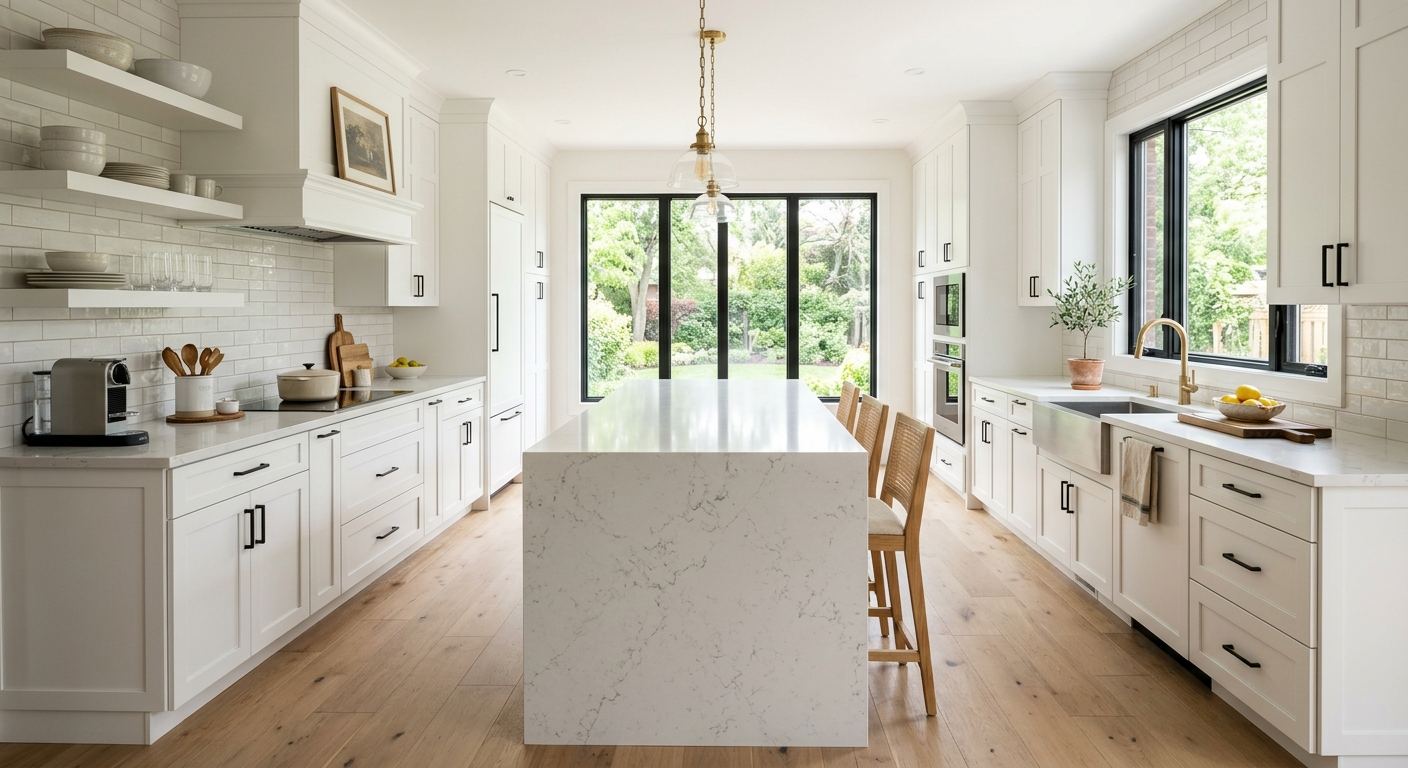
Right now, most Cranbrook homeowners gravitate to a clean, modern look with warm tones: white or light-wood shaker-style fronts, matte hardware, and quartz counters. That style performs well because it photographs well and pairs with the detached-home realities common in the region. Many projects land in the mid-range full renovation tier (often $30,000–$55,000), which naturally favors semi-custom cabinets and quartz rather than fully custom millwork and marble. You’ll also see a lot of “practical modern” layouts—reworking storage and lighting rather than drastically changing walls—because it controls permit-driven rough-in work. In older homes, that approach reduces surprises from hidden wiring and plumbing while still achieving a fresh, current feel for buyers.
How do I know if I need to update my kitchen plumbing in Cranbrook?
Look for signs like inconsistent water pressure, slow drains, recurring under-sink leaks, or shutoff valves that won’t fully close. In older Cranbrook houses (many built pre-1981), plumbing runs and connections may be harder to access without opening walls. If you’re staying “like-for-like” (same sink location, no moving supply or drain lines), a countertop or cabinet-only upgrade often doesn’t require plumbing changes. But if you plan to move the sink, add an island with new hookups, or replace a badly routed drain, budget for rough-in updates. Those changes can bring permit requirements in British Columbia. A good contractor will inspect shutoffs, confirm drain slope, and include a realistic allowance in the quote so you’re not surprised when demolition reveals deterioration.
What is the difference between a galley and open-concept kitchen?
A galley kitchen is a corridor-style layout with counters on opposite walls—efficient for space but often limited in seating and storage variety. An open-concept kitchen removes barriers between the kitchen and living area to create a shared sightline and more room for entertaining. In Cranbrook detached homes, you’ll find both, and the “best” choice depends on how you live and whether your space supports the change. Converting to open-concept often triggers higher labour due to structural considerations and additional finishes, and it may involve permit-driven trade work in British Columbia. If your goal is a quicker update, you can keep a galley feel but modernize with better cabinet storage, improved lighting, and a countertop refresh—often staying closer to the $2,500–$12,000 countertop-only band or a $30,000–$55,000 mid-range renovation.
How do I get accurate kitchen renovation quotes in Cranbrook?
Get quotes that are itemised and scope-specific. Ask each contractor to include labour and materials line items (not one lump number) and list what’s included for demolition, disposal, electrical, plumbing allowances, and any permit-related steps. Bring photos and your intended finish selections, and decide early whether you’re changing layout—removing a wall, adding an island, or relocating plumbing/gas is where prices swing the most. For accuracy, ask about countertop templating timing, cabinet installation method, and how they handle surprises in older homes (many Cranbrook properties are pre-1981). Confirm warranty terms and the payment schedule in writing. If one quote is far below the others and lacks detail, it often means important items are excluded, which can turn the project into a higher-cost change later—even if your starting budget is in the $30,000–$70,000 range.
What's the best countertop material for a busy Cranbrook kitchen?
For most busy Cranbrook households, quartz is the practical “best overall” choice. It balances durability, stain resistance, and low maintenance—especially helpful in a region with older homes where moisture control around sinks matters during seasonal swings. Quartz also tends to look consistently premium, which supports resale expectations. If you need a tighter budget, laminate can work well for a refresh, and it often fits within the $2,500–$6,000 countertop portion—just be mindful around seams and edges. Natural stone like granite offers unique character and durability, but it may require periodic sealing and more careful maintenance. Marble is beautiful but usually demands more disciplined care to avoid etching and staining. Match the material to how you cook: high-traffic families typically do best with quartz installed to a careful, well-sealed fit.