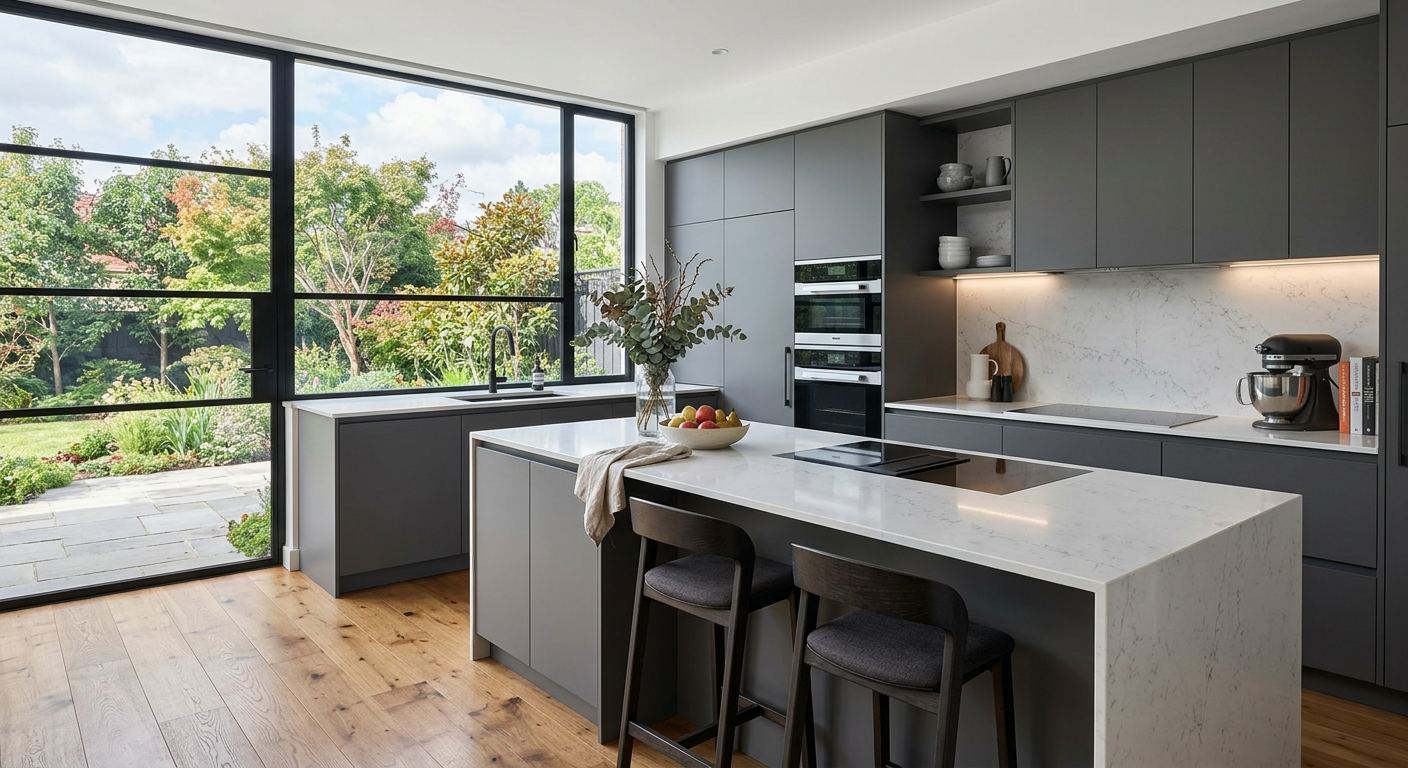
Kitchen renovation options and costs in McMillan
In McMillan, BC, kitchen renovations tend to price less on “weather” and more on what your home is worth and the level of finish buyers will pay for. With a population of 9,250 (Statistics Canada, 2021 Census), the Lower Mainland–Southwest market moves at a steady pace, and many homeowners align kitchen upgrades with resale value expectations. At the same time, the region’s household income levels (Statistics Canada, 2021 Census) strongly influence whether you’ll see laminate-and-stock refreshes or semi-custom cabinetry paired with quartz and upgraded hardware. In practice, that’s why you can get two kitchens of the same size that land far apart in total cost.
Lower Mainland–Southwest scheduling also matters: contractor availability is strongest in months when multi-trade projects are easiest to stack, so rush timelines can add labour premium. And because coastal humidity and temperature swings aren’t usually the main cost driver, most “climate-related” expenses show up as protection and detailing—like ensuring proper ventilation and sealing around sinks, backsplashes, and any exterior-facing wall. Neighbourhoods and nearby areas where demand is especially high for kitchen work tend to be the more transit-and-retail-accessible pockets of the Lower Mainland, including the Surrey–Abbotsford corridor that many McMillan homeowners compare against when budgeting.
To make comparisons simpler, here are realistic renovation tiers contractors typically quote in McMillan before we factor in layout complexity and product selections—then you can line up your plan with the right table.
| Renovation Tier |
What's Included |
Typical Duration |
Price Range |
| Cosmetic refresh (paint, hardware, new appliances only) |
Paint, cabinet hardware, new appliance set, minor touch-ups; no cabinet box or countertop replacement |
1–2 weeks |
$6,000–$18,000 |
| Mid-range full renovation (new cabinets, counters, sink, tile) |
New semi-custom or quality stock cabinetry, new quartz or comparable counters, sink/faucet, backsplash tile, basic plumbing reconnect |
3–6 weeks |
$40,000–$85,000 |
| High-end full renovation (custom cabinets, stone counters, island) |
Custom cabinetry, premium stone counters, island with upgraded storage, full-height backsplash option, enhanced finishes |
6–12 weeks |
$85,000–$120,000 |
| Cabinet refacing only (new doors + drawer fronts, same boxes) |
Replace doors/drawer fronts, new hardware, re-surface boxes as needed; counters may remain |
2–4 weeks |
$8,000–$35,000 |
| Countertop swap only (laminate to quartz or stone) |
Remove/install countertop, seam work where needed, dispose old material; assumes cabinet tops are in good condition |
3–7 days |
$3,000–$12,000 |
| Backsplash tile installation only |
Demolition and tile setting, grout/sealing as required, optional trim/edge details around outlets |
3–10 days |
$1,500–$6,000 |
Prices are estimates only and vary by project scope, site access and material selection.
What affects the price of kitchen renovation in McMillan
In the Lower Mainland–Southwest, two quotes for the same “new kitchen” can vary by roughly 30–50% because the biggest drivers aren’t the climate—they’re the home’s value and the finish level homeowners choose to match resale expectations. In higher-value parts of Metro Vancouver (and in many adjacent purchasing decisions McMillan homeowners reference), owners often default to quartz or stone counters and semi-custom cabinetry. That’s a resale-friendly upgrade, so the budget stretches more often. By contrast, in more modest value bands, laminate surfaces and stock cabinets can dominate because they deliver the best ROI per dollar.
Layout changes are the most unpredictable cost regardless of finish. Removing a wall, adding an island, or moving a gas line or plumbing stack can trigger additional framing, venting, electrical work and inspections, which commonly pushes labour and material usage beyond a “standard” renovation plan. Even when your finish tier stays mid-range, the layout decisions can still move you closer to the full-renovation bands—especially if you need new circuits for under-cabinet lighting and a dedicated island outlet.
In McMillan specifically, older housing stock can also influence pricing. When existing cabinetry is older and cabinet tops are uneven, countertop swaps alone can balloon into extra labour for shimming, re-levels and caulking—sometimes erasing savings you expected on a $3,000–$12,000 countertop-only plan. On the other hand, if your floor is already level and your existing plumbing locations are staying put, you can often keep a renovation nearer the $40,000–$85,000 mid-range band by focusing spend on cabinetry and countertops rather than structural rework.
| Price Factor |
Why It Matters |
Cost Impact |
| Cabinet tier — stock vs. semi-custom vs. fully custom millwork |
Determines how much fitting, labour, and premium materials you’ll use |
Can swing your total cabinet portion from budget to premium quickly (often the largest non-layout variable) |
| Countertop material — laminate vs. quartz vs. granite vs. stone |
Material and fabrication complexity affect both price and installation time |
Laminate keeps costs restrained; quartz/stone raises material and typically adds fabrication cost |
| Layout change — wall removal, island add, plumbing/gas move |
Triggers framing, electrical, and licensed trade coordination |
Most likely driver of 30–50% quote variance even with similar finishes |
| Appliance package tier — builder vs. mid-range vs. pro-grade |
Higher tiers may require different cut-outs, ventilation, and delivery logistics |
Mid-range is usually the best value; pro-grade can raise total but often less than cabinets/counters |
| Flooring — refinish existing vs. full replacement |
Floor removal/disposal and subfloor prep add trades and labour |
Keeping existing flooring can save time; replacement adds both labour and materials |
| Backsplash — ceramic tile vs. marble vs. full-height slab |
Premium surfaces increase cutting, patterning and sealing requirements |
Ceramic is relatively predictable; full-height slab raises cost and workmanship risk |
| Electrical — new circuits for island, under-cabinet lighting |
Kitchen circuits often need upgrades for modern appliances and code-compliant layout |
Can add labour and permit steps, especially when moving receptacles |
| Permit fees and licensed trade requirements |
Certain work requires permits, scheduling inspections, and certified labour |
Small on paper, but it affects timeline and coordination cost more than homeowners expect |
Permits & regulations in British Columbia
In British Columbia, homeowners don’t typically need permits for simple cabinet and countertop swaps. If you’re just replacing countertops, changing out sink fixtures, and keeping the same supply and drain locations, that’s usually treated as a straightforward renovation. Likewise, changing cabinet faces (refacing) or swapping doors/drawer fronts generally doesn’t require a permit because you’re not altering plumbing, electrical, structural elements, or gas routing.
Where permits and licensed trades come in is when the work changes the building’s systems or structure. Moving plumbing supply or drain lines, relocating gas appliances (including the stove) or adjusting gas routing, removing a load-bearing wall, and adding new electrical circuits all require permits and inspections. Gas work must be completed by a licensed gas fitter, and electrical work must be done by a licensed electrician—both trades should pull any required permits and book inspection windows.
For a McMillan homeowner, the verification process should be done before the contract is signed. Step 1: request the contractor’s certificate of insurance (liability) and confirm the trade subcontractors carry their own coverage where applicable. Step 2: ask for licence numbers or proof of current registration for gas fitting and electrical trades, then cross-check using the provincial online registries. Step 3: ask whether the contractor is set up for workers’ compensation coverage (WCB/WSIB equivalent) and request proof/clearance documentation. Step 4: confirm in writing who is responsible for permits—contractors should be explicit about whether they pull them or you do.
Cabinets, countertops and layout decisions in McMillan
Your three biggest decisions in a McMillan kitchen renovation are the cabinet tier, the countertop material, and whether you’ll change the layout. Cabinet tier affects speed, fit and cost: stock is typically the fastest and cheapest, semi-custom is the most common mid-range choice, and custom cabinetry is the highest-cost option that delivers the tightest fit and best storage planning. Countertops determine daily durability and long-term appearance: laminate is budget-friendly but less impact/heat tolerant, quartz is a strong “set it and forget it” option, and natural stones like granite or marble bring premium look and different maintenance requirements. Finally, layout changes—open-concept wall removal, adding an island, or relocating plumbing/gas—are what turn a refresh into a rebuild because they drive framing, venting, electrical circuits and licensed trade coordination.
In the Lower Mainland–Southwest resale market, buyers commonly expect modern lines and clean, low-maintenance surfaces. That’s why quartz and solid-staying layouts often make financial sense: they look current, tolerate everyday use, and reduce maintenance conversations at sale time. Climate plays a smaller role in cost than people assume, but coastal humidity makes moisture management important—especially around sink areas and any backsplash transitions, where proper sealing protects cabinets and substrate. If your layout stays practical and your plumbing locations are staying, you can often justify spending more on cabinets and counters rather than chasing layout changes. For example, upgrading from a budget laminate surface to quartz might move a countertop line item toward the upper end of typical countertop-only or small-scope pricing, yet it can be cheaper than adding an island where you’ll likely need new electrical circuits and possibly plumbing/gas adjustments.
Use that logic when choosing the option set: match the finish to the resale expectation you’re targeting, then keep structural/system changes to what the space gain genuinely requires.
| Option |
Durability |
Maintenance |
Best For |
Price Range |
| Stock cabinets (big-box) |
Good for everyday use; less tailored fit |
Wipe clean; minor touch-ups as required |
Budget-first refreshes and faster installs |
$8,000–$25,000 |
| Semi-custom cabinets (local dealer) |
Strong build quality; better storage configurations |
Normal cleaning; adjust/maintain hinges as needed |
Most mid-range renovations in McMillan |
$20,000–$45,000 |
| Custom cabinets (local millwork shop) |
Excellent fit and finish; engineered for your space |
Regular cleaning; maintain hardware and finishes |
Homes where design and storage are key selling points |
$45,000–$75,000 |
| Laminate countertop |
Moderate; can chip or scorch under abuse |
Simple care, but avoid heat and prolonged soaking |
Cost-sensitive renovations keeping plumbing in place |
$3,000–$6,000 |
| Quartz engineered countertop |
High; excellent everyday impact and stain resistance |
Low; wipe with standard cleaners |
Busy households and resale-friendly durability |
$5,500–$10,000 |
| Granite / natural stone countertop |
High strength; varies by stone type |
May need periodic sealing depending on the stone |
Premium look with natural variation |
$7,500–$12,000 |
| Butcher block countertop |
Medium to high; best with proper care |
Requires oiling and protective maintenance |
Warm, farmhouse-inspired kitchens where upkeep is acceptable |
$4,000–$9,000 |
| Marble countertop |
Beautiful but softer; more susceptible to etching |
Higher maintenance; stains and etching need prompt care |
Design-led kitchens where texture and appearance matter most |
$9,000–$14,000 |
How to choose a kitchen renovation contractor in McMillan
Choosing the right contractor in McMillan starts with verifying licensing and coverage, then tightening the scope so bids are truly comparable. In British Columbia, confirm your electrician and gas fitter are licensed for any electrical circuits, under-cabinet wiring, or gas appliance work. Ask for licence numbers and check them through the provincial online registries. For insurance, request a current certificate of liability insurance from the renovation contractor (and ensure it covers renovations, not just general business activity). For coverage of workers, ask for proof of WCB/WSIB-equivalent clearance or the contractor’s workers’ compensation status—then retain a copy for your records.
Next, get 2–3 itemised written quotes. A proper quote breaks out labour and materials rather than hiding everything in a single lump sum. It should clearly show what’s included (and what’s excluded): permits pull, demolition, drywall patching, disposal, countertop template and install scheduling, flooring tie-ins, and whether plumbing reconnection is part of the scope. Confirm warranty terms in writing: workmanship warranty length, product/manufacturer warranty coverage, and whether the warranty is transferable if you sell your home. Finally, payment scheduling should protect you—never pay more than about 10–15% upfront. Use a holdback until the job is complete and punch-list items are signed off. Make sure the schedule is in writing too: get a start date and a completion estimate with clear dependencies (like cabinet delivery lead times and countertop fabrication time).
- Confirm provincial licensing for any electrician and gas fitter involved, and request licence numbers.
- Verify contractor liability insurance via certificate of insurance before any work begins.
- Ask for workers’ compensation coverage proof/clearance and keep copies.
- Request 2–3 itemised quotes with line-by-line labour and materials (no vague allowances).
- Ensure demolition and disposal are explicitly included in the scope.
- Confirm who pulls permits, schedules inspections, and covers permit-related delays.
- Clarify countertop template timing and what happens if measurements change due to site conditions.
- Check whether drywall, painting, and caulking around tile are included or treated as extras.
- Confirm flooring prep expectations (subfloor leveling, underlayment, transitions at cabinets).
- Review warranty length for workmanship and whether product warranties carry over to you.
- Use a payment schedule that keeps 10–15% holdback until punch list completion.
- Get start date and target completion date in writing, including lead times for cabinets.
Concrete red flags I commonly see with kitchen reno contractors in McMillan include: (1) unwillingness to itemise labour and materials, (2) quoting electrical or gas work without naming licensed trades, (3) vague “permit included” wording with no responsibility spelled out, (4) requiring large deposits (more than 15%) before any measurable progress, and (5) avoiding written warranty terms or refusing to put scope exclusions in the contract.
Frequently asked questions — kitchen renovation in McMillan
Should I renovate my kitchen before selling in McMillan?
In McMillan and across the Lower Mainland–Southwest, a kitchen renovation can help, but only when the upgrade matches buyer expectations for your home value tier. If your cabinets are functional and the layout works, a refresh (paint, hardware and select appliances) is often the smartest move before a sale. If your counters are dated, moving to quartz is frequently the easiest “perceived value” upgrade without re-plumbing. For a true mid-range full renovation, budgets commonly land around $40,000–$85,000, which buyers can recognize immediately through new cabinetry, updated tile, and modern surfaces. If layout changes require moving plumbing or gas, the added risk and timeline can be harder to manage before a listing—so we often focus on cosmetics and counters unless the space gain is clearly worth it.
What's the most popular kitchen style in McMillan right now?
Right now in British Columbia—especially in the Lower Mainland–Southwest—homeowners most often choose clean-lined, modern transitional looks: flat or shaker-style cabinetry, neutral warm whites/greys, and countertops that read “solid” and low-maintenance (quartz). Hardware is usually brushed nickel or matte black, and backsplashes tend to stay simple: ceramic tile in a refined pattern or a clean slab-look option. The style preference ties directly to what buyers see during showings: kitchens that look tidy, bright, and easy to maintain photograph well and reduce “repair fear.” That means a lot of renovations target a semi-custom cabinet look and quartz durability rather than high-maintenance stone like marble in high-traffic households.
How do I know if I need to update my kitchen plumbing in McMillan?
The easiest way to decide in McMillan is to assess whether you’re only swapping finishes or changing systems. If you’re keeping the sink and dishwasher locations and only updating counters and cabinets, you may not need plumbing replacement—often you’ll just reconnect and verify shut-offs, supply hoses and drain connections. You likely need a plumbing upgrade when you see leaks around shut-offs, slow drains, corrosion at fittings, or outdated galvanized piping where accessible. Plumbing needs updating more often when you move the sink or add a dishwasher, because the contractor may open walls and floors to reroute supply/drain lines. Also remember: moving plumbing lines typically triggers permit and licensed trade coordination, so get a clear scope and decision early—before you choose a cabinet-and-counter package.
What is the difference between a galley and open-concept kitchen?
A galley kitchen is a long, narrow layout with cabinets and counters on two facing walls—efficient for workflow but limited for seating and natural light. An open-concept kitchen removes barriers (often by replacing or relocating walls) so the kitchen connects directly to living/dining space. In McMillan, open-concept renovations often cost more because wall removal can involve structural considerations and typically requires electrical/plumbing coordination depending on what’s being changed. From a budgeting standpoint, staying in a galley plan usually keeps you closer to cosmetic or mid-range scopes, while open-concept layouts can push you toward full renovation totals, especially when you add an island or relocate plumbing/gas. The upside is space gain and a layout that’s easier for entertaining, which can matter for resale buyer profiles in the Lower Mainland–Southwest.
How do I get accurate kitchen renovation quotes in McMillan?
For accurate quotes in McMillan, insist on itemised, line-by-line proposals rather than lump sums. You want labour and materials separated so you can compare the same cabinet tier, countertop material, backsplash coverage, and electrical scope. Ask whether permits and disposal are included, and confirm who is responsible for scheduling inspections. Provide the contractor with photos, approximate measurements, and a clear decision list—cabinet tier, countertop material, and whether any plumbing/gas movement is planned—because those choices drive most cost swings. If you’re comparing tiers, use realistic anchor numbers: for example, countertop-only swaps typically fall around $3,000–$12,000, while a mid-range full renovation commonly starts around $40,000–$85,000. If a quote is too far outside those ranges without a clear explanation, ask what’s missing or substituted.
What's the best countertop material for a busy McMillan kitchen?
For a busy kitchen in McMillan and across British Columbia, quartz is usually the best balance of durability and everyday maintenance. It resists stains well, handles daily impacts better than laminate, and doesn’t require periodic sealing like many natural stones. If you want a premium look and don’t mind maintenance, granite can be excellent, but you’ll still need to follow sealing guidance depending on the stone. Laminate can be a smart budget choice when you’re focused on a refresh, but it’s more vulnerable to heat damage and chipping—so it’s less forgiving for active households. Marble is beautiful but tends to need more careful treatment to avoid etching and staining. In most mid-range renovations, quartz tends to deliver the “real-life” performance that homeowners expect while staying within the typical countertop budget band.