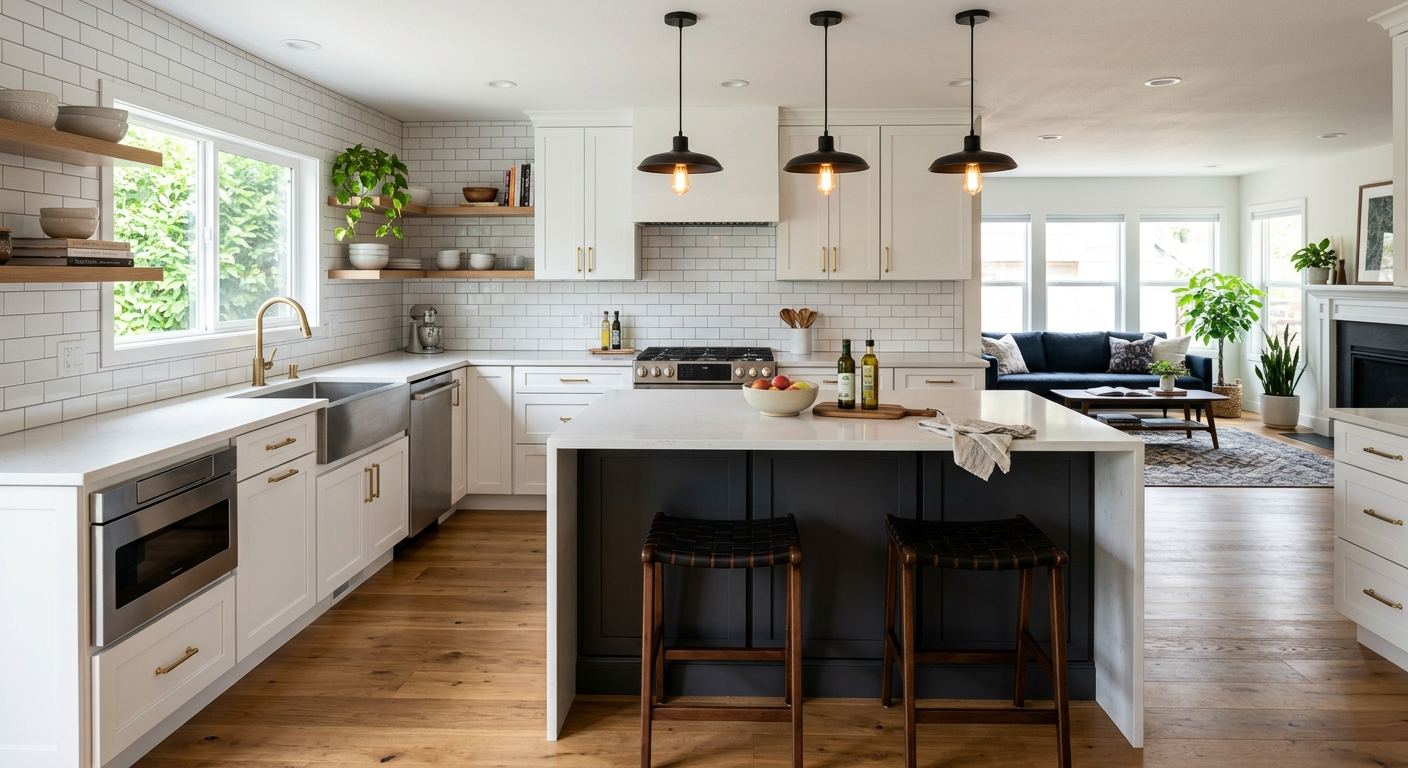
Kitchen renovation options and costs in Scott Creek
Kitchen renovation in Scott Creek typically follows the same pattern as the broader Lower Mainland–Southwest: first you decide how much change you want, then the finish level and cabinetry package decide the final number. Scott Creek’s population is 2,828 (Statistics Canada, 2021 Census), and in practice that size supports a steady flow of local contractors who can take on everything from quick refreshes to full rebuilds. Across the Lower Mainland–Southwest, pricing is driven more by the home’s perceived value and expected finish tier than by weather. Even though coastal humidity can be tough on wood over time, most cost differences come from design choices—what buyers will pay for on resale—rather than climate alone.
One reason quotes can land far apart is that many surrounding neighbourhoods in the Lower Mainland–Southwest skew toward “showroom-ready” kitchens, especially where owners anticipate longer-term resale value. In higher-value areas of Metro Vancouver, homeowners often choose semi-custom or custom cabinetry, quartz/stone counters, and upgraded hardware because the renovation cost is easier to recover. In Scott Creek, you’ll see demand concentrated where access and parking make larger crews worthwhile—typically in denser pockets close to the main roads and shopping corridors in the region—so full renovations can sometimes move faster than homeowners expect.
Use the table below to benchmark scope. If you’re not sure whether your project is a refresh or a rebuild, start with the scope you’re willing to live with for 5 to 10 years, then compare durations and price ranges.
| Renovation Tier |
What's Included |
Typical Duration |
Price Range |
| Cosmetic refresh (paint, hardware, new appliances only) |
Cabinet paint or touch-ups (no cabinet box changes), new pulls/knobs, appliance swap, minor caulking and trim, basic cleaning and re-sealing around sinks |
3–7 days |
$10,000–$25,000 |
| Mid-range full renovation (new cabinets, counters, sink, tile) |
New semi-custom cabinets or quality stock, new countertops, sink and faucet, backsplash tile, under-cabinet lighting prep, disposal/connection changes as needed |
3–6 weeks |
$45,000–$85,000 |
| High-end full renovation (custom cabinets, stone counters, island) |
Custom cabinetry (made-to-fit), quartz or stone countertops, island build-out, premium hardware/soft-close, higher-end backsplash treatment (selected tile or full-height feature), upgraded lighting and finishes |
6–12 weeks |
$90,000–$150,000 |
| Cabinet refacing only (new doors + drawer fronts, same boxes) |
Refaced doors/drawer fronts, new veneer panels where required, new hardware, new toe-kick and trim adjustments, countertop removal/reinstall as allowed by your plan |
1–3 weeks |
$18,000–$45,000 |
| Countertop swap only (laminate to quartz or stone) |
Removal and disposal of old countertop, new quartz/stone fabrication and installation, sink/faucet adjustments as needed, standard backsplash caulking reset |
1–2 weeks |
$8,000–$18,000 |
| Backsplash tile installation only |
Tile supply and install, prep, waterproofing where needed, finishing trims and caulking, electrical outlet rework as required |
3–7 days |
$1,500–$6,000 |
Prices are estimates only and vary by project scope, site access and material selection.
What affects the price of kitchen renovation in Scott Creek
In Scott Creek and across the Lower Mainland–Southwest, homeowners often see bids for the “same” kitchen come in 30–50% apart once you compare labour allowances, cabinet tier, and how much the layout changes. British Columbia pricing can also swing with demand: when trades are busy, installation schedules tighten and day rates for skilled carpenters, electricians, and plumbers effectively rise. But the biggest driver here isn’t coastal climate—it’s the finish tier owners choose based on what buyers expect in their price band.
Local home values and typical household income levels influence whether you default to laminate/stock cabinets or move up to quartz or stone counters and semi-custom cabinetry. In higher-value parts of Metro Vancouver, owners more commonly choose upgraded materials because the renovation is easier to justify on resale. In more modest market situations, laminate and stock options can deliver better ROI while still looking current. Layout changes add the most unpredictability regardless of finish: removing a wall, adding an island, or moving a gas line can trigger new framing, venting adjustments, and additional inspection steps that ripple through the schedule.
Concrete examples we see around Scott Creek: (1) older homes with narrower joist spacing can slow down electrical rough-ins for island lighting and can affect how under-cabinet LED runs are routed; (2) kitchens with dated plumbing runs sometimes require more demo and patching when the sink location shifts; and (3) if your current cabinets are solid but uneven from age and humidity swings, levelling and shimming can add labour even when you’re only upgrading counters. Even in a project that starts as a mid-range renovation (often in the $45,000–$85,000 band), those changes can push you toward the high-end scope if the plan also includes an island and premium stone.
| Price Factor |
Why It Matters |
Cost Impact |
| Cabinet tier — stock vs. semi-custom vs. fully custom millwork |
Cabinet tier dictates design flexibility, door styles, internal storage, and fit accuracy. Custom also affects shop drawings and lead times. |
$8,000–$60,000 swing depending on scope |
| Countertop material — laminate vs. quartz vs. granite vs. stone |
Material choice changes fabrication complexity, seam planning, and installation requirements (especially with stone). |
$3,000–$12,000 for typical installs; larger for complex islands |
| Layout change — wall removal, island add, plumbing/gas move |
Layout work drives framing, waterproofing/finishing, and licensed trade involvement; it’s the least predictable cost. |
$5,000–$35,000 common swing |
| Appliance package tier — builder vs. mid-range vs. pro-grade |
Pro-grade appliances often require different clearances, electrical needs, and venting details. |
$2,000–$12,000 variance |
| Flooring — refinish existing vs. full replacement |
Kitchen renovations often open floors during plumbing/electrical updates; matching existing finishes can be difficult. |
$1,500–$8,000 variance |
| Backsplash — ceramic tile vs. marble vs. full-height slab |
Premium stone and full-height applications demand extra layout, sealing, and more cutting and labour. |
$1,500–$10,000 variance |
| Electrical — new circuits for island, under-cabinet lighting |
Adding circuits triggers permitting/inspection and increases rough-in and trim-out time. |
$1,000–$6,000 typical range |
| Permit fees and licensed trade requirements |
Permits, inspections, and code-compliant work add admin time and can require schedule coordination. |
$500–$3,500 (plus trade scheduling impact) |
Permits & regulations in British Columbia
In British Columbia, many “surface” kitchen updates can be done without permits—for example, swapping cabinetry in place, replacing countertops, and installing a backsplash generally do not require a permit. A typical countertop swap also doesn’t automatically trigger permits because you’re not changing plumbing, gas, or electrical systems. However, permits and licensed trades become necessary when you change the building systems behind your kitchen.
Specifically, a permit is typically required for work such as moving plumbing supply or drain lines, relocating a gas appliance or making changes related to stove/range hood venting where gas is involved, removing or altering a load-bearing wall, and adding new electrical circuits (for example, new island receptacles or upgrading lighting where it requires new circuit work). Gas work must be completed by a licensed gas fitter, and electrical work must be completed by a licensed electrician; both require inspections where applicable.
Step-by-step, here’s how a homeowner in Scott Creek can verify a contractor before signing: (1) Ask for the contractor’s licence info and the licences of the electrical and gas trades they’ll use; confirm via the appropriate online registry; (2) Request a current certificate of insurance (liability coverage) and keep it on file; (3) For worker coverage, ask for proof of WCB/WSIB-style coverage for the trades involved and confirm it matches the scope—don’t accept a “we’re covered” statement; (4) Ensure the written contract clearly states who pulls permits, who schedules inspections, and what happens if scope changes mid-project.
Cabinets, countertops and layout decisions in Scott Creek
When you renovate a Scott Creek kitchen, three decisions usually determine 70% of your outcome: cabinet tier, countertop material, and whether you change the layout. Cabinet tier is about how quickly you can finish and how precisely the kitchen fits your room. Stock cabinets are the fastest and cheapest path, semi-custom is the most popular mid-range approach, and fully custom millwork offers the best fit and most storage—but it costs more and requires more design time.
Countertops are where buyers most often “feel” the quality. Laminate can look great at refresh budgets, but it’s typically less impact-resistant and has less premium resale pull. Quartz engineered countertops are a strong middle ground: they resist staining and are consistent in colour, which suits Lower Mainland–Southwest kitchens where buyers expect a clean, modern look. Natural stone (granite/other stone) is premium and durable, but seaming, edge profiles, and installation planning can raise costs—especially if you’re adding an island with multiple overhangs or complex corners. In coastal BC, sealing and maintenance habits matter more for natural stone than for engineered quartz.
Layout decisions are justified only when the space gain is meaningful. Adding an island can turn a narrow kitchen into a functional “work zone,” but moving plumbing or a gas line is the biggest cost lever—often outweighing the upgrade from laminate to quartz. For example, if a mid-range renovation sits around the $45,000–$85,000 band, choosing quartz instead of laminate might add several thousand dollars, while a plumbing move for a new island position can add a larger unpredictable premium and extend the timeline.
| Option |
Durability |
Maintenance |
Best For |
Price Range |
| Stock cabinets (big-box) |
Good everyday durability; fit may be less exact in older homes |
Low—wipe clean; hinges and runners depend on the brand tier |
Fast refreshes and practical upgrades with limited layout changes |
$15,000–$35,000 |
| Semi-custom cabinets (local dealer) |
Very good durability with better storage layouts and door options |
Low—standard care; better components often mean fewer adjustments |
Most Scott Creek homeowners balancing cost and “fit-and-finish” |
$25,000–$55,000 |
| Custom cabinets (local millwork shop) |
Excellent durability; best chance of perfect fit in irregular rooms |
Low—high-quality hardware and finishes typically last longer |
Design-led layouts, islands, and legacy homes with odd dimensions |
$45,000–$90,000 |
| Laminate countertop |
Moderate durability; susceptible to heat and deep gouges if abused |
Low—simple cleaners, but avoid cutting directly and hot pans |
Refresh projects where budget and speed are priorities |
$3,000–$7,000 |
| Quartz engineered countertop |
High durability; resistant to staining and everyday impacts |
Low—typical wipe-down; less sensitive to routine spills |
Modern resale appeal without the upkeep of natural stone |
$7,000–$12,000 |
| Granite / natural stone countertop |
High durability; unique patterns and heat resistance |
Moderate—often benefits from periodic sealing and careful maintenance |
Premium look for homeowners aiming for a longer “stay-put” timeline |
$9,000–$16,000 |
| Butcher block countertop |
Moderate to high durability; requires proper care to prevent swelling/warping |
Higher—oil regularly and manage moisture carefully |
Warm, rustic or transitional kitchens with attentive homeowners |
$6,000–$13,000 |
| Marble countertop |
Premium look; softer than many stones and can scratch or etch |
Higher—sealed, cleaned carefully, and maintained to prevent etching |
Design-forward kitchens where aesthetics outweigh heavy use |
$12,000–$22,000 |
How to choose a kitchen renovation contractor in Scott Creek
Choosing a contractor in Scott Creek comes down to proof, clarity, and control of risk. Start by verifying British Columbia licensing for the trades involved in your scope: electrical work should be completed by a licensed electrician, and any gas-related work by a licensed gas fitter. Ask the contractor for their liability insurance certificate and confirm coverage limits are appropriate for the job. For coverage of workers, request proof of WCB/WSIB-style coverage for the trades they bring onto site and ensure it matches the work being performed. Don’t rely on a verbal assurance—ask for documentation.
Next, get 2–3 itemised written quotes that separate labour and materials. A good quote shows cabinet line items, countertop fabrication and install, plumbing/electrical allowances, demolition, disposal, drywall/paint patching, and any permit handling. Review the exclusions: what’s not included for demolition, drywall finishing, subfloor repairs, or floor matching? If a contractor says “we’ll handle permits,” confirm whether it’s included in the price or treated as a separate cost.
Warranty matters in kitchens, where moisture and vibration can reveal workmanship issues early. Ask how long the workmanship warranty lasts, what it covers, whether product/manufacturer warranties are included for cabinets/counters, and if warranties are transferable if you sell. For payments, a sensible schedule is 10–15% upfront maximum, then progress payments tied to milestones, with a holdback until the job is complete. Finally, insist on a start date and a completion estimate in writing—kitchen projects in the Lower Mainland–Southwest often depend on cabinet and countertop lead times.
- Ask for itemised quotes (labour + materials) instead of a single lump sum.
- Confirm who pulls permits and who pays permit/inspection fees.
- Get proof of liability insurance before work begins; verify the policy is current.
- Request WCB/WSIB-style coverage proof for trades working on your site.
- Ensure electrical and gas scopes name the licensed trades responsible.
- Check cabinet inclusions: hinges/soft-close, toe-kick, interior accessories, and any levelling requirements.
- Clarify countertop scope: sink cut-outs, faucet drilling, seam locations, and edge profiles.
- Confirm disposal and site protection are included (dust control, tarp coverage).
- Ask who handles drywall finishing and painting touch-ups after electrical/plumbing changes.
- Review warranty length and what “defects” include; get it in writing.
- Set a payment schedule with a holdback until punch list completion.
- Require a timeline with key milestones (demo, rough-in, cabinet install, countertop templating, final trim).
In Scott Creek, watch for red flags: quotes that aren’t itemised, promises to “avoid permits” for electrical/gas/plumbing scope, missing insurance/coverage paperwork, a warranty that’s vague or doesn’t cover workmanship, and timelines that ignore cabinet/countertop lead times.
Frequently asked questions — kitchen renovation in Scott Creek
How do I add an island to my Scott Creek kitchen?
Adding an island in Scott Creek usually starts with checking your existing plumbing, electrical, and gas (if applicable). If the island can be placed where your current sink or cooktop area already services supply/drain and wiring, you can keep costs more predictable. If you’re moving a sink or changing a gas cooktop location, permits and licensed trades typically come into play, which can raise both cost and schedule. Practically, many homeowners plan for island add-outs in the mid-to-high range: if your base renovation is around the $45,000–$85,000 band, island work commonly pushes the project upward depending on whether plumbing/gas is moved. A contractor should provide a measured plan and a rough-in strategy before cabinet orders, so you avoid rework.
How much does a kitchen renovation cost in Scott Creek?
Kitchen renovation costs in Scott Creek commonly track the Lower Mainland–Southwest price bands, with the biggest swings coming from cabinetry tier, countertop material, and whether you change the layout. A cosmetic refresh (paint, hardware, appliances only) is often the lowest tier, while a mid-range full renovation typically lands around the $45,000–$85,000 range for new cabinets, counters, sink, and tile. If you’re aiming for custom millwork, stone counters, and an island, you should plan for the higher band, often around the $90,000–$150,000 range. Coastal BC’s humidity doesn’t usually set the price by itself, but older homes can require extra prep (levelling, patching, or subfloor repairs) that affects the final total. The best way to get a reliable number is an itemised quote with allowances spelled out.
How long does a kitchen renovation take in Scott Creek?
Timelines in Scott Creek depend heavily on product lead times and whether you’re making system changes. Cosmetic refreshes are often completed in about 3–7 days. Mid-range full renovations commonly take about 3–6 weeks, assuming cabinets and countertops are ordered early and rough-ins are scheduled smoothly. High-end builds with custom cabinets and stone counters more often land in the 6–12 week window. The key slowdowns are countertop templating/fabrication (especially for natural stone and complex islands) and inspection scheduling when plumbing, gas, or electrical changes require permits. A good contractor will give you a start date and an estimated completion date in writing, and will anchor the schedule around cabinet and countertop delivery—so you’re not surprised by re-order timelines.
Quartz vs granite countertops — which is better?
“Better” depends on how you use your kitchen and what finish you want. Quartz is engineered for consistency and generally offers very strong stain resistance with low maintenance—ideal for busy households who want predictable performance. Granite is natural stone with unique patterns and strong durability, and many homeowners love the premium look, but it often benefits from periodic sealing and careful cleaning to avoid etching in certain areas depending on the stone. In Scott Creek and the broader Lower Mainland–Southwest, quartz is a common choice because it aligns with the modern buyer expectations at mid-to-higher price points and reduces maintenance decisions. Price-wise, both can sit in the premium bands; quartz installs are often in the $7,000–$12,000 range, while granite or other natural stone may run higher depending on thickness, edge profiles, and complexity.
Should I reface or replace my cabinets?
Refacing can be a smart option when your cabinet boxes are structurally sound, the layout still works, and you mainly want a modern door style and updated hardware. It’s typically faster and often cheaper than full replacement. Replacement makes sense when boxes are damaged, sagging, or poorly fitted, or if you want to change storage configurations, widths, or the overall layout. In terms of budget, cabinet refacing is commonly in the $18,000–$45,000 range, while a full mid-range renovation with new cabinets is more often found around the $45,000–$85,000 band depending on counters, backsplash, and sink work. In older Scott Creek kitchens, a contractor should inspect box level, water exposure near the sink, and hinge/runner condition before recommending refacing.
Do I need a permit for a kitchen renovation in British Columbia?
Often, you do not need a permit for basic kitchen upgrades like swapping cabinetry in place, replacing countertops, or installing a backsplash, provided you’re not altering plumbing, gas, or electrical systems. You typically do need permits when you move plumbing supply/drain lines, relocate gas-related components (or change the gas setup), remove or alter load-bearing walls, or add new electrical circuits—such as new island receptacles. In British Columbia, gas work must be performed by a licensed gas fitter and electrical work by a licensed electrician, with inspections where applicable. For Scott Creek homeowners, the safest approach is to confirm permit responsibility in the contract: ask what requires a permit, whether the contractor will pull it, and request proof of licences and insurance before work starts. This reduces the risk of delays or rework later.