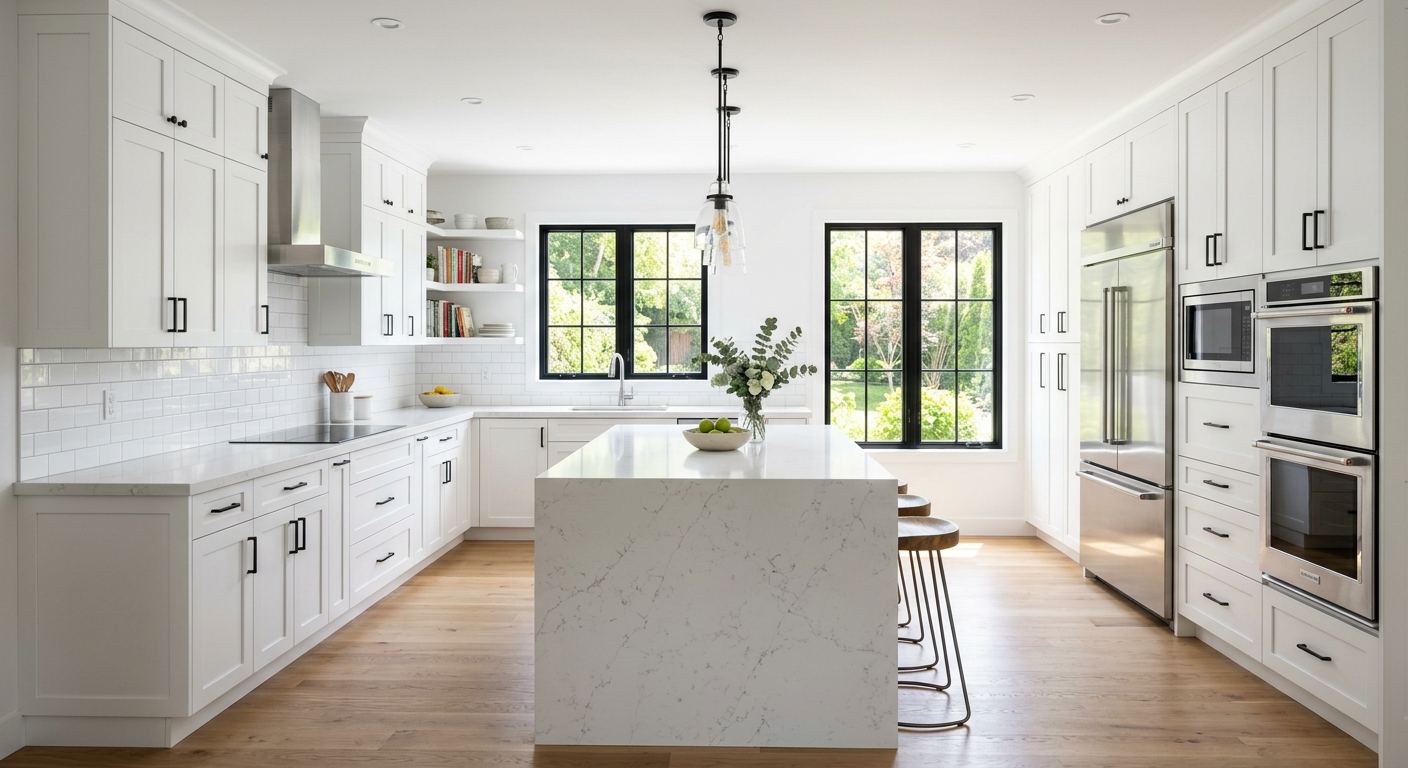
Kitchen renovation options and costs in Rutland
Renovating a kitchen in Rutland usually starts with deciding how bold you want to be—because the Lower Mainland–Southwest market rewards practical upgrades, and it also rewards the “finishes buyers expect” story when you’re planning to resell. With a population of 34,800 (Statistics Canada, 2021 Census), Rutland has enough active homeowners to keep cabinet and countertop installers busy, particularly around the central Rutland areas where older ranch-style homes are common. That housing mix affects demand: in many kitchens, homeowners are refreshing dated surfaces before they opt into a full rebuild.
Pricing in this region is less about climate damage and more about homeowner income and the expected finish tier at resale. In Metro Vancouver’s broader Lower Mainland–Southwest economic footprint, many owners prioritize semi-custom or custom cabinetry and quartz/stone counters because the renovation cost is easier to recover in resale than a purely cosmetic update. At the same time, markets outside the most expensive neighbourhoods can still land in a mid-range scope with stock cabinets, laminate options, and a sensible layout.
British Columbia’s mild, wet winters and the region’s humidity mean kitchens tend to experience more frequent condensation cycles around windows and exterior walls. That makes ventilation upgrades (range hood performance and proper ducting) a “quiet” cost driver, especially in homes with older ductwork. Labour availability can also shift with the busy season (spring through fall), so booking early helps stabilize your schedule.
Below are typical options contractors in Rutland will quote, so you can compare the scope apples-to-apples before you request itemised bids.
| Renovation Tier |
What's Included |
Typical Duration |
Price Range |
| Cosmetic refresh (paint, hardware, new appliances only) |
Cabinet paint or stain touch-up, new pulls/knobs, appliance swap (like-for-like), basic caulking and trim, removal & haul-away for old appliances |
1–3 weeks |
$8,000–$22,000 |
| Mid-range full renovation (new cabinets, counters, sink, tile) |
New cabinet installation (stock or semi-custom), new countertop (quartz or laminate), sink and faucet, backsplash tile, new flooring transition/repairs as needed, plumbing/electrical hookups where required |
4–8 weeks |
$40,000–$85,000 |
| High-end full renovation (custom cabinets, stone counters, island) |
Custom millwork, stone counters (granite/engineered stone premium), island with raised electrical/plumbing options, upgraded lighting, full-height or designer backsplash, upgraded finishes and trim packages |
8–14 weeks |
$85,000–$120,000 |
| Cabinet refacing only (new doors + drawer fronts, same boxes) |
Remove and replace doors/drawer fronts, new crown/trim options, hardware upgrades, align and adjust hinges, light prep/paint as required |
2–5 weeks |
$15,000–$35,000 |
| Countertop swap only (laminate to quartz or stone) |
Remove existing countertop, template and install new countertop, seam layout and sink cut-outs, basic backsplash re-connection to match |
1–3 weeks |
$3,000–$12,000 |
| Backsplash tile installation only |
Surface prep, tile installation, grout/seal where required, caulking to adjacent surfaces, disposal of tile debris |
5–10 days |
$1,500–$6,000 |
Prices are estimates only and vary by project scope, site access and material selection.
What affects the price of kitchen renovation in Rutland
Homeowners often see kitchen renovation quotes swing by 30–50% for the same basic plan across the Lower Mainland–Southwest and other British Columbia markets. In practice, the difference is rarely the weather—it’s the economics behind the finish tier. Higher-value areas tend to support more labour-intensive cabinetry builds and premium surfaces, while more restrained markets lean on laminate and stock cabinets because those choices pencil out better for ROI.
For Rutland specifically, local finish expectations track with the broader Lower Mainland–Southwest demand pattern: many homeowners default to quartz or stone counters and semi-custom cabinetry when they want a “move-in ready” look that photographs well and holds up on resale. In more modest scopes, laminate and stock cabinet packages remain common and can keep a full renovation closer to the lower end of the $40,000–$120,000 band. Layout changes are the wildcard regardless of finish—removing a wall, adding an island, or moving a gas line or plumbing can add unpredictable costs through additional framing, subfloor repairs, inspection requirements, and coordination between trades.
Two concrete Rutland examples contractors commonly run into: (1) older homes near the more established pockets of Rutland often have dated rough-in, so sink moves can require extra subfloor patching and unexpected shimming for cabinet level; and (2) kitchens adjacent to exterior walls can show moisture patterns that call for ventilation and careful sealing, which is extra time even if the visible work is “just” cabinets and tile.
That’s why you may see one quote in the mid-range and another that looks similar but lands higher once electrical circuits for an island, under-cabinet lighting, or upgraded backsplash detailing are included. The same goes for countertops: a simple swap like $3,000–$12,000 can expand once edge profiles, new sink cut-outs, or seam strategy are upgraded to match a more custom layout.
| Price Factor |
Why It Matters |
Cost Impact |
| Cabinet tier — stock vs. semi-custom vs. fully custom millwork |
Cabinet pricing is driven by sizing flexibility, warranty coverage, door/drawer build quality, and how much is made-to-fit vs ordered standard. |
Stock can keep projects near the mid-range; semi-custom/custom can add substantial cost to the overall renovation budget. |
| Countertop material — laminate vs. quartz vs. granite vs. stone |
Material cost, fabrication complexity (seams/edges), and installation method change labour time and waste factor. |
Laminate is the lowest; quartz/stone moves you into the higher portion of the countertop swap range. |
| Layout change — wall removal, island add, plumbing/gas move |
These work types trigger more framing, subfloor work, coordination, and inspections, and they’re where surprises show up. |
Often the biggest non-finish variable; can swing totals by tens of thousands in full rebuilds. |
| Appliance package tier — builder vs. mid-range vs. pro-grade |
Pro-grade units raise electrical/plumbing fit needs, ventilation requirements, and install labour coordination. |
Mid-range upgrades usually stay manageable; pro-grade can push budgets upward quickly. |
| Flooring — refinish existing vs. full replacement |
Kitchen demo can compromise adjacent flooring; replacing full sections is more expensive than patching and matching. |
Partial repairs reduce cost; matching across wider areas increases labour and material. |
| Backsplash — ceramic tile vs. marble vs. full-height slab |
Large-format, natural stone, and full-height walls require tighter tolerances and more skilled labour. |
Tile-only work can stay in a few thousand; premium stone can multiply the backsplash line item. |
| Electrical — new circuits for island, under-cabinet lighting |
New circuits and lighting plans require licensed work and careful load planning; older homes can need upgrades. |
Can add several thousand depending on circuit count and panel capacity. |
| Permit fees and licensed trade requirements |
Work involving plumbing/gas relocation, load-bearing changes, and electrical additions must follow the permit and inspection process. |
Even when materials are similar, permitting and trade scheduling raise total project cost. |
Permits & regulations in British Columbia
In British Columbia, replacing cabinets or countertops typically does not require a permit. A straight swap—new countertops, a cabinet installation, or a backsplash refresh—usually stays in the “no permit” zone because you’re not changing the building services or structural elements. However, Rutland homeowners should plan on permits and licensed trades when you move services or alter structure.
Work that typically does require a permit includes moving plumbing supply or drain lines, relocating a gas appliance or gas line (including work related to a stove/range hood with gas), removing a load-bearing wall, and adding new electrical circuits (for example, power to an island, relocating outlets, or adding a new lighting circuit). Electrical and gas work must be done by licensed trades, with inspections arranged as required by the permitting process.
Work that typically does NOT require a permit includes cabinet installation/refinishing where rough-in remains unchanged, countertop swaps where sinks and cut-outs are reinstalled in the same location, and backsplash tile installation where you’re not changing electrical boxes beyond like-for-like connections.
To verify your contractor before signing in Rutland, check three things step-by-step: (1) licence status for the relevant trade type using the provincial online licence/registry listing; (2) proof of liability insurance and confirm the certificate of insurance lists your project address or allows it to be added; and (3) coverage for worker injury protection (commonly handled through WCB/WSIB-style coverage in the trades). Ask for a “clearance” letter where applicable, and keep copies with your contract package so you’re covered if anything goes wrong.
Cabinets, countertops and layout decisions in Rutland
If you’re trying to control cost in a Rutland kitchen renovation, focus on three decisions that drive most of the budget: cabinet tier, countertop material, and layout changes. Cabinet tier choices are the fastest way to change the price while also shaping how long the kitchen will look “new.” Stock cabinets are typically the quickest and cheapest. Semi-custom (the most common mid-range choice) balances price with better fit for uneven walls and standard Rutland home layouts. Custom cabinets cost more, but they’re best when you want a built-in look—especially if your room has awkward corners, tall ceilings, or a specific storage plan.
Countertops are similar: laminate is cost-effective and easy to live with, but it’s more susceptible to staining and edge wear over time. Quartz is a practical middle ground—durable, low-maintenance, and a strong fit for busy households. Granite and other natural stones look premium and can be very resilient, but they may require sealing schedules depending on the stone. For butcher block, maintenance matters: moisture control and periodic oiling are part of the deal.
Layout is where renovations can lose money fast or pay it back. Removing a wall or adding an island can be justified when it creates real circulation and seating—especially in kitchens that feel tight today. But moving plumbing or gas lines is expensive regardless of whether you choose laminate or quartz; for that reason, I often recommend rethinking “relocate everything” plans unless the space gain is clear.
For example, if you upgrade from laminate to quartz, a countertop swap might still land around $3,000–$12,000. But if you choose quartz and you move the sink and add an island, you can easily see the same countertops take the back seat to the plumbing and electrical scope.
| Option |
Durability |
Maintenance |
Best For |
Price Range |
| Stock cabinets (big-box) |
Solid for typical household use when installed correctly |
Low—routine cleaning; hinges/hardware may require eventual replacement |
Fast timelines and value-focused refreshes |
$8,000–$25,000 |
| Semi-custom cabinets (local dealer) |
Better fit and hardware options; holds up well over years |
Low—basic cleaning; adjust doors/hardware as needed |
Most Rutland mid-range renovations seeking a “custom feel” |
$20,000–$55,000 |
| Custom cabinets (local millwork shop) |
Highest build flexibility and fit; ideal for complex layouts |
Low to moderate—keep hardware maintained; more options to manage |
Unique kitchens, built-ins, and homeowners prioritising finish longevity |
$40,000–$80,000 |
| Laminate countertop |
Good daily durability; edges and seams are the weak points |
Low—avoid standing water; protect edges |
Budget control and practical family use |
$3,000–$7,000 |
| Quartz engineered countertop |
Very durable; resists staining and everyday wear |
Low—routine cleaner only; wipe up spills promptly |
Most resale-friendly upgrades in the Lower Mainland–Southwest |
$6,000–$12,000 |
| Granite / natural stone countertop |
Extremely tough surface; depends on specific stone |
Moderate—periodic sealing may be required |
Premium look when you want natural variation |
$8,000–$15,000 |
| Butcher block countertop |
Durable but can dent/scratch; great for prep-focused kitchens |
Moderate—oil and sealing schedule; manage moisture carefully |
Warm, traditional style and households that maintain finishes |
$5,000–$11,000 |
| Marble countertop |
Premium and heat-resistant; can etch/stain if neglected |
Higher—requires careful cleaning and protective practices |
High-end statement kitchens with strict maintenance habits |
$10,000–$18,000 |
How to choose a kitchen renovation contractor in Rutland
Choosing the right contractor matters as much as picking cabinets, especially in Rutland where timelines can tighten during peak season. Start with licensing and insurance verification in British Columbia. Ask for the contractor’s licence details (for the trade they lead), a current certificate of liability insurance, and confirmation of worker coverage (commonly WCB/WSIB coverage or a clearance letter as applicable). If subcontractors are used, insist on paperwork for the subtrades too—gas work and electrical must be done by the right licensed trades.
Next, get 2–3 itemised written quotes that break labour and materials separately, not a single lump sum. Look for specifics like demolition allowance, cabinet install hours, countertop fabrication/templating coordination, plumbing/electrical line items, and how disposal is handled. The scope should say what’s included and what’s excluded (for example: subfloor repairs, drywall patching, old appliance removal, new baseboards, and whether permits are pulled by the contractor or by you).
Warranty is another big differentiator. Ask for the workmanship warranty length and whether it covers installation issues like cabinet alignment, seam failures, or caulking/grout defects. Also confirm product/manufacturer warranties and whether they’re transferable to subsequent owners—important for resale in the Lower Mainland–Southwest market.
For payment schedule, never pay more than 10–15% upfront. Hold back the remainder until key milestones are complete and verify everything in writing. Finally, require a start date and completion estimate in your contract, including allowances for cabinet and countertop lead times.
- Request proof of BC licence for the trades involved and confirm it matches the work described.
- Get a current certificate of liability insurance and verify coverage limits.
- Ask for worker injury coverage clearance (WCB/WSIB-style) or a clearance letter where applicable.
- Require itemised pricing: labour hours, materials, and separate allowances.
- Confirm permit responsibility in the contract before work begins.
- Clarify disposal/hauling: what gets removed and where debris is taken.
- Ask who verifies electrical and gas rough-in before drywall/cabinet install.
- Check if the quote includes subfloor leveling, drywall patching, and trim returns.
- Make sure countertop templating timing is included so delays don’t stall the project.
- Confirm warranty terms for workmanship and product warranties (including transferability).
- Set a payment schedule with no more than 10–15% upfront and a holdback.
- Get a written schedule with milestones (demo, rough-in, cabinets, countertops, finish).
Red flags to watch for in Rutland: vague scopes with no itemisation, contractors who won’t provide licence/insurance paperwork, quotes that bundle plumbing/gas/electrical without identifying licensed trades, overly large upfront payments, and refusal to put start/completion dates and permit responsibility in writing.
Frequently asked questions — kitchen renovation in Rutland
What's the ROI on a kitchen renovation?
Kitchen ROI varies by how close your finish level matches what local buyers expect, and by whether you keep the layout practical. In the Lower Mainland–Southwest, owners often recover more when they choose resale-friendly upgrades like quartz countertops, modern hardware, and a clean cabinet layout, rather than spending only on high-cost custom details that don’t improve function. That’s why a “mid-range full renovation” is commonly structured around the $40,000–$85,000 range with durable surfaces and thoughtful storage. Also remember the baseline: Rutland has a steady population of 34,800 (Statistics Canada, 2021 Census), and there’s strong day-to-day demand for kitchens that work well—buyers notice usability, not just materials. If you’re changing plumbing/gas, ROI is strongest when the new layout genuinely improves traffic flow or adds seating.
How do I budget for a kitchen renovation?
Budgeting starts with choosing your tier and then protecting your contingency for the work that can’t be predicted from photos: layout changes, subfloor repairs, and coordination of trades. For Rutland, a common approach is to define whether you’re doing a refresh, a mid-range full renovation, or a high-end rebuild, then allocate about the right proportion to cabinets and counters first. A mid-range full renovation often lands in the $40,000–$85,000 range, while a higher-end scope can approach $85,000–$120,000 once custom cabinetry and island electrical/plumbing are included. If you’re unsure, you can also phase: do a countertop swap (often $3,000–$12,000) and backsplash first, then cabinet decisions later. Whatever you choose, confirm what’s included for permits, disposal, and repairs—those line items can change your total quickly.
Can I move my kitchen sink or stove?
Yes, but you should plan for it to be one of the most expensive parts of a kitchen renovation in British Columbia. Moving a sink typically means new plumbing supply/drain runs, and moving a stove can involve venting and, in many cases, gas line work if it’s a gas appliance. That kind of service relocation usually requires permits and licensed trades in BC, with inspections. From a cost perspective, the “finish tier” matters less than the number of service runs and how far you relocate fixtures. In Rutland homes—especially older layouts—there can also be hidden constraints like subfloor condition, existing venting paths, or panel capacity. Practically, this is why many homeowners keep fixtures in the same zone unless the layout change justifies the added plumbing/electrical scope.
What's the most cost-effective kitchen upgrade?
For many Rutland homeowners, the most cost-effective upgrade is either a targeted surface refresh (hardware/paint plus a new appliance package) or a “high-impact, lower-disruption” upgrade like countertops or backsplash. If you want a visual upgrade without the full demolition, a countertop swap is often the best bang for your budget—typically within $3,000–$12,000 depending on material choice and sink cut-outs. A backsplash-only install can also modernize the space quickly, commonly in the $1,500–$6,000 band. If your cabinets are structurally fine, cabinet refacing can be more cost-effective than replacing everything, often landing in the $15,000–$35,000 range. The “best” option depends on whether your cabinet boxes are still sound and whether you need ventilation improvements for moisture control around cooking areas.
Custom vs stock cabinets — is custom worth it?
Custom cabinets can be worth it when you have a complex space—odd wall lengths, crown-moulding details, tall pantry runs, or a layout that demands made-to-fit storage. But if your goal is a strong ROI and a modern look, semi-custom or stock is often the smarter cost/value balance in Rutland’s renovation market. Stock cabinets are usually the fastest and can keep the cabinet portion of a full renovation lower, while semi-custom is a popular middle ground when walls aren’t perfectly straight. Fully custom millwork increases cost through design time, bespoke fabrication, and installation fine-tuning. In a practical budget, many homeowners find that the money is better spent on quartz counters and a sensible layout—especially if you’re already in a mid-range full renovation scope. If you’re targeting a high-end finish, custom can make sense, but only when it improves function, not just appearance.
How do I choose a kitchen contractor in Rutland?
Start by verifying British Columbia requirements: request the contractor’s licence and confirm they carry current liability insurance. For safety and coverage, ask how worker injury protection is handled (WCB/WSIB-style coverage) and whether they can provide a clearance letter where applicable. Next, insist on itemised written quotes with labour and materials broken out—so you can compare apples-to-apples rather than guessing what’s included. Confirm scope details in writing: permit responsibility, disposal/hauling, whether disposal and drywall patching are included, and what happens if lead times slip on cabinets or countertops. For timelines, get start and completion estimates in writing, not just “asap.” Payment should be conservative: never more than about 10–15% upfront and keep a holdback until the job is complete. If someone won’t put it in writing or won’t show proof of coverage, treat that as a red flag—especially for service work that can require permits.