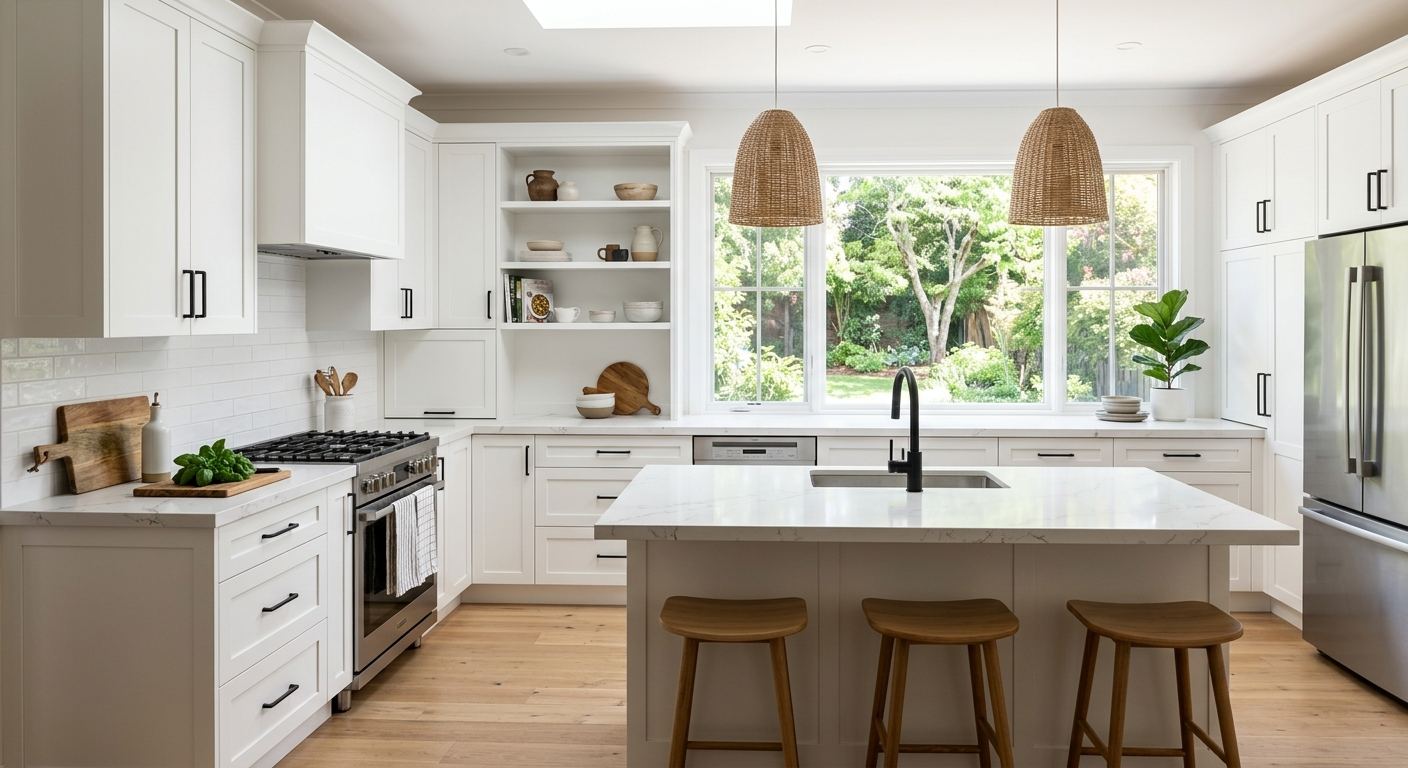
Kitchen renovation options and costs in Williams Lake
Kitchen renovation in Williams Lake is a practical mix of what your home can carry on value and what it can handle day-to-day—especially in a community where many houses were built before 1981 (62.8% of dwellings). With a median household income of $76,500 (Statistics Canada, 2021 Census), many homeowners choose a finish tier that balances resale appeal with sensible monthly budgeting. At the same time, Williams Lake sits in a Cariboo market where some neighbourhoods and larger homes lean into higher-end upgrades, so you’ll see a noticeable swing toward quartz and custom millwork when the project is resale-focused.
Cost drivers in the Cariboo aren’t dominated by “extreme weather,” the way you might expect—labour availability, material lead times, and the type of cabinetry and countertop you select matter far more. Still, local housing age changes the scope: older plumbing shutoffs, out-of-square walls, and dated electrical commonly mean extra prep work before the first cabinet goes in. Contractors are also busiest in the late spring through early fall, so start dates can tighten if you wait.
Where demand is especially strong tends to be around the denser parts of town where trades can stage materials and manage access efficiently—areas near downtown and the residential corridors along Hwy 97 typically see quicker scheduling for full renovations. Once you pick your target tier, the cost range becomes much easier to compare, which is why the table below groups common options into predictable bands—so you can budget confidently before you meet a contractor.
| Renovation Tier |
What's Included |
Typical Duration |
Price Range |
| Cosmetic refresh (paint, hardware, new appliances only) |
Cabinet paint or refinishing, new hardware, appliance swap, caulking/trim touch-ups, basic cleaning and alignment |
3–7 days |
$4,000–$12,000 |
| Mid-range full renovation (new cabinets, counters, sink, tile) |
Semi-custom or quality stock cabinets, new countertops (quartz or upgraded solid surface), new sink and faucet, backsplash tile, flooring transition/updates as needed |
2–5 weeks |
$28,000–$65,000 |
| High-end full renovation (custom cabinets, stone counters, island) |
Fully custom cabinets, natural stone or premium quartz, island with upgraded lighting, advanced backsplash, full appliance package, higher-end hardware and finishing details |
4–9 weeks |
$65,000–$95,000 |
| Cabinet refacing only (new doors + drawer fronts, same boxes) |
Refinished/retained cabinet boxes, new doors/drawer fronts, updated hardware, new trim pieces, optional filler and reconfiguration of small gaps |
1–3 weeks |
$5,000–$20,000 |
| Countertop swap only (laminate to quartz or stone) |
Remove old surface, install new quartz/stone (or solid surface), seam work as needed, re-attach sink/cooktop interfaces |
2–7 days |
$3,000–$14,000 |
| Backsplash tile installation only |
Tile layout and install, mortar/grout, caulking details, edge finishing, optional outlet adjustments (if required by electrical scope) |
2–5 days |
$1,500–$9,000 |
Prices are estimates only and vary by project scope, site access and material selection.
What affects the price of kitchen renovation in Williams Lake
Two quotes for the “same” kitchen in Williams Lake can land 30–50% apart because the scope details rarely match. In Cariboo and much of B.C., pricing is driven more by local market expectations around finish quality and resale value than by climate alone. Homeowners in higher-value pockets often choose quartz or natural stone and semi-custom cabinetry because the upgrade tends to show well on photos and inspections, and it’s easier to justify on resale. In more modest markets, laminate and stock cabinet packages dominate because they deliver a clean, updated look at a stronger value-per-dollar—helpful in a town where many homes are older and need extra prep.
Layout changes are usually the biggest swing item regardless of finish tier. Moving plumbing supply/drain, relocating a gas line, widening openings, removing a load-bearing wall, or adding an island can trigger trades, permits, and rework that push projects beyond the baseline. In practice, this is why a homeowner who starts at the “mid-range full renovation” level (often $28,000–$65,000) can quickly move toward the upper band if they add plumbing/gas moves or comprehensive electrical.
Concrete Williams Lake examples: (1) older homes frequently have awkward shutoff locations and dated venting, which can add time to sink and dishwasher hook-ups; (2) cabinets installed over out-of-square walls require additional shimming and trim, which can reduce speed; and (3) if your current countertop edges were made for laminate thicknesses, changing to stone/quartz may require profile adjustments and careful seam planning. Those are site realities, not “upgrade choices,” and they’re why material selection alone doesn’t explain the final cost—labour and reconfiguration do.
| Price Factor |
Why It Matters |
Cost Impact |
| Cabinet tier — stock vs. semi-custom vs. fully custom millwork |
Cabinet boxes, door styles, internal organizers, and fit tolerances change labour hours and material cost |
Largest swing; can shift a full renovation by roughly 20–60% |
| Countertop material — laminate vs. quartz vs. granite vs. stone |
Material cost and cutting/seaming complexity vary; heavier stone also affects template and install time |
Often adds $3,000–$14,000 depending on scope and edges; stone can push higher-end projects upward |
| Layout change — wall removal, island add, plumbing/gas move |
Triggers structural, plumbing, gas (if applicable), and electrical scopes; also affects inspection and rework risk |
Can add thousands quickly; commonly the difference between mid-range and high-end budgets |
| Appliance package tier — builder vs. mid-range vs. pro-grade |
Brand tier affects not just unit prices but also cut-out dimensions, ventilation requirements, and installation time |
Typically shifts budgets by several thousand dollars depending on model choices |
| Flooring — refinish existing vs. full replacement |
Existing subfloor conditions and matching patterns change demolition and installation time |
Replacement generally adds meaningful cost versus limited refresh; refinish can keep spend down |
| Backsplash — ceramic tile vs. marble vs. full-height slab |
Premium materials require more precise installation and may need additional substrate preparation |
Commonly ranges from $1,500–$9,000 depending on extent and material |
| Electrical — new circuits for island, under-cabinet lighting |
Changing receptacles, adding dedicated circuits, or upgrading lighting increases licensed time and inspection steps |
Often a key “hidden” cost driver when budgets assume plug-and-play |
| Permit fees and licensed trade requirements |
Work that involves gas, electrical circuits, plumbing relocation, or structural changes requires permitting and inspections |
Adds admin and scheduling time; budget impact varies by complexity and scope |
Permits & regulations in British Columbia
In British Columbia, you can usually replace cabinets and countertops without a permit—swapping finishes and fixtures in-place is typically straightforward. That said, kitchen renovations frequently cross into “regulated work” when you move plumbing, relocate gas, or change electrical layouts. In Williams Lake homes (many built before 1981), older supply lines, valves, and drain configurations can make “small changes” larger once the contractor opens the walls.
Work that typically DO require permits and licensed trades includes: moving plumbing supply or drain lines (including changing sink placement), relocating a gas stove/range, changing venting for a range hood where gas is involved, removing a load-bearing wall (or doing any structural modification), and adding new electrical circuits (for example, powering an island receptacle layout or upgrading to new under-cabinet lighting runs that require circuit work). Gas work must be performed by a licensed gas fitter, and electrical work must be performed by a licensed electrician; both require inspections.
How to verify contractor licensing in Williams Lake: (1) ask for the contractor’s licence details and check relevant online registries for the specific trade doing the work (not just the general contractor’s marketing page); (2) request a current certificate of insurance and confirm general liability is active for the project period; (3) ensure workers’ compensation coverage is in place (BC coverage is typically evidenced through the contractor providing proof of coverage/clearance documents); and (4) verify these items match the scope in the written contract.
Important: confirm in writing who pulls permits and who is responsible for inspections before you sign. It belongs in the contract, not in a verbal promise.
Cabinets, countertops and layout decisions in Williams Lake
For most homeowners in Williams Lake, three decisions shape both the look and the long-term satisfaction: (1) cabinet tier, (2) countertop material, and (3) layout change. First, pick cabinet tier based on how “permanent” you want the kitchen to feel. Stock cabinets are fastest and cheapest, semi-custom is the most popular mid-range sweet spot, and custom cabinetry gives the best fit for uneven older walls and a unique layout—especially useful where older homes were built with less standardized measurements.
Second, countertop choice should match how you live. Laminate is budget-friendly and can look sharp, but it’s more prone to wear at seams and edges. Quartz engineered countertops resist staining and daily abrasion better, which matters if you do a lot of cooking and cleaning. Granite/natural stone and marble offer premium aesthetics but require more careful maintenance and sealing routines, which some households are happy to manage and others aren’t.
Third, layout changes (open-concept wall removal, adding an island, or relocating plumbing/gas) should be justified by space gain and usability. In a Cariboo market, resale buyers often expect a practical, light-filled kitchen with clear sightlines—so an open layout can pay back. But if your budget is tight, moving a sink or gas line can remove the cost advantage of choosing laminate.
Example: upgrading from laminate to quartz might add several thousand dollars, but it’s often worth it when you’re already funding a mid-range full renovation (commonly $28,000–$65,000). If you’re planning only a refresh, the “countertop swap only” band (often $3,000–$14,000) can deliver the biggest visible improvement without triggering the heavier layout costs.
| Option |
Durability |
Maintenance |
Best For |
Price Range |
| Stock cabinets (big-box) |
Good for everyday use; limited sizes and finish options may require compromise |
Low; regular cleaning and careful hardware tightening |
Budget-focused refreshes and quick installs |
$5,000–$20,000 |
| Semi-custom cabinets (local dealer) |
Better fit and more internal organizers; durable hardware and improved build quality |
Low; maintain with non-abrasive cleaners and avoid standing water at seams |
Most homeowners aiming for a practical resale-friendly upgrade |
$15,000–$40,000 |
| Custom cabinets (local millwork shop) |
Highest tolerance to irregular walls and unique layouts; best for islands and specialized storage |
Low to moderate; quality hinges and pull systems typically reduce wear |
High-end renovations and homes where fit and function matter most |
$35,000–$70,000 |
| Laminate countertop |
Resilient to day-to-day mess, but edges and seams can show wear over time |
Low; avoid excessive heat exposure and protect seams from water intrusion |
Value-driven updates and rental-style budgets |
$3,000–$7,000 |
| Quartz engineered countertop |
Very durable surface; resistant to stains and typical household wear |
Low; wipe clean and keep caulked seams intact |
Busy households that want a premium look with less hassle |
$6,000–$14,000 |
| Granite / natural stone countertop |
Durable and heat-tolerant; variety of veining and thickness impacts performance |
Moderate; sealing and periodic maintenance are recommended |
Premium aesthetics and a long-life surface |
$9,000–$16,000 |
| Butcher block countertop |
Durable but can scratch; performs well with careful use |
Higher; requires oiling and mindful care around moisture |
Warm, casual kitchens and households comfortable with upkeep |
$4,500–$10,000 |
| Marble countertop |
Premium look but softer; can etch and stain if not protected |
Moderate to high; sealing and gentle cleaners are important |
Statement kitchens where aesthetics are the priority |
$10,000–$18,000 |
How to choose a kitchen renovation contractor in Williams Lake
Choosing a kitchen renovation contractor in Williams Lake starts with verification, not photos. In British Columbia, confirm the right licensing for the trades involved: licensed gas fitters for any gas work, licensed electricians for circuit changes, and appropriate certified professionals for any regulated scope. For each contractor, ask for proof of liability insurance for the project period and evidence of workers’ compensation coverage (commonly shown through clearance/proof documents). You can also request the company’s licence details and cross-check trade registration through the relevant online registry where applicable. If they can’t provide documentation quickly and clearly, that’s a red flag.
Then get 2–3 itemised written quotes. You want a breakdown that separates labour from materials, and identifies exclusions—like whether disposal, drywall patching, subfloor adjustments, and caulking/trim details are included. Confirm whether the quote includes permit pulling (when required), inspection scheduling, and any builder-grade appliance allowances. Avoid “all-in” numbers that don’t list what you’re buying.
On warranty, ask for two parts: workmanship warranty length (how long they stand behind the install) and product/manufacturer warranty (what the supplier covers). Also clarify whether warranties are transferable if you sell your home. Payment schedule matters: never pay more than 10–15% upfront, and use a holdback until the job is complete and deficiencies are corrected. Finally, get the start date and estimated completion date in writing so you’re not relying on verbal timelines.
- Ask for licence and proof documents before you review the quote
- Request an itemised scope: demolition, framing/patching, cabinet install, countertop template and install
- Confirm who pulls permits and who pays permit fees when required
- Verify disposal is included (dump fees and haul-away)
- Confirm electrical/plumbing/gas subcontractors are named (and licensed where needed)
- Check that the countertop template timing is scheduled before cabinetry is fully installed
- Get a written timeline with milestones (demo, rough-in, cabinet set, counters, final trim)
- Clarify product allowances for appliances, sinks, faucets, and lighting fixtures
- Review the warranty in writing: workmanship plus product warranties
- Ask how change orders are priced and who approves them
- Use a payment schedule aligned to milestones, with a holdback at completion
- Ensure site protection is included (floor coverings, dust control, clean-up plan)
Red flags to watch for in Williams Lake: (1) quotes that only list total costs with no line items; (2) promised “no permit needed” statements when you’re moving plumbing, doing structural work, or adding electrical circuits; (3) refusal to provide insurance or workers’ compensation proof; (4) pushing large upfront payments without a milestone schedule; and (5) vague timelines with no start/completion dates in writing.
Frequently asked questions — kitchen renovation in Williams Lake
Can I live at home during a kitchen renovation in Williams Lake?
Often yes, but it depends on how disruptive the scope is. In Williams Lake, many homeowners remain in the home during cosmetic work or cabinet/countertop swaps because the kitchen can be partially functional (for example, using a temporary sink and a short-term appliance setup). If you’re doing a mid-range full renovation—commonly in the $28,000–$65,000 band—expect a period where demolition and countertop scheduling reduce usability, typically over a couple of weeks. Full high-end projects with islands and more trades may be harder to manage day-to-day, but living-in is still possible with dust control, clear staging, and agreed work hours.
Should I renovate my kitchen before selling in Williams Lake?
Generally, yes if you’re updating what buyers will notice first—layout functionality, clean finishes, and durable surfaces. In a market where many homes were built before 1981 (62.8% of dwellings), buyers often expect modernized kitchens that look “inspection-ready,” especially around cabinetry alignment, countertop condition, and backsplash cleanliness. That doesn’t always mean you must go high-end: a refresh or a well-scoped mid-range renovation can deliver the best return. If you’re considering upgrades, think about the pricing tier: many homeowners target the $28,000–$65,000 range for a balanced outcome; going into the upper band ($65,000–$95,000) usually makes sense when you’re also improving layout usability and storage.
What's the most popular kitchen style in Williams Lake right now?
In Williams Lake, the most common direction is practical, bright, and timeless: modern shaker-style cabinets in neutral tones, paired with quartz-look or real quartz countertops and a simple tile backsplash. The exact style varies by neighbourhood, but resale-focused projects tend to avoid trendy “one-off” colours that can date quickly. Many homeowners choose semi-custom cabinets because they balance options and lead times—while still fitting the older home measurements more cleanly. When budgets allow, islands with pendant lighting are popular because they improve work space and connect the kitchen to the living area, which helps in homes that are older and have less open-flow plans.
How do I know if I need to update my kitchen plumbing in Williams Lake?
Watch for signs like slow drains, repeated leak repairs, water discolouration, or shutoff valves that don’t fully stop water. For many older Williams Lake homes (62.8% built before 1981), plumbing may still function but may be outdated in ways that complicate renovation—like valve locations, pipe routing, or venting. You’ll also want to evaluate plumbing needs if you plan to move the sink, dishwasher, or add an island. If the scope changes placement, plumbing relocation often requires permits and licensed work, so it’s better to assess early—before cabinets are ordered. A good contractor will inspect under-sink conditions and advise on what must be replaced versus what can be retained.
What is the difference between a galley and open-concept kitchen?
A galley kitchen is a narrow layout with counters on two parallel walls; it’s efficient for cooking but can feel closed in. An open-concept kitchen removes or reframes walls so the kitchen connects to the living/dining area, which usually improves sightlines and makes the space feel larger. In Williams Lake, open-concept renovations can be especially appealing for homes that feel separated or cramped, but they’re not always the cheapest route. If the change involves structural work or rerouting services, permits and licensed trades may be required. That’s why some homeowners start with a mid-range renovation ($28,000–$65,000) and keep plumbing where it is, then consider bigger structural changes only when the layout improvement clearly justifies the added cost.
How do I get accurate kitchen renovation quotes in Williams Lake?
Get accuracy by giving contractors the same information and demanding itemised quotes. Provide room measurements, photos, and a clear list of what you want to keep (like cabinet boxes, appliance locations, and whether you’re moving the sink or adding an island). Ask each contractor for a line-by-line breakdown of labour and materials, including demolition, electrical/plumbing/gas scopes where applicable, countertop templating timing, and disposal. Confirm whether permit pulling is included in the price when required. Also ask for clear product allowances so you can compare apples-to-apples. If your target is mid-range—often $28,000–$65,000—ensure the quote matches that tier in cabinetry and countertop quality, not just the total number.