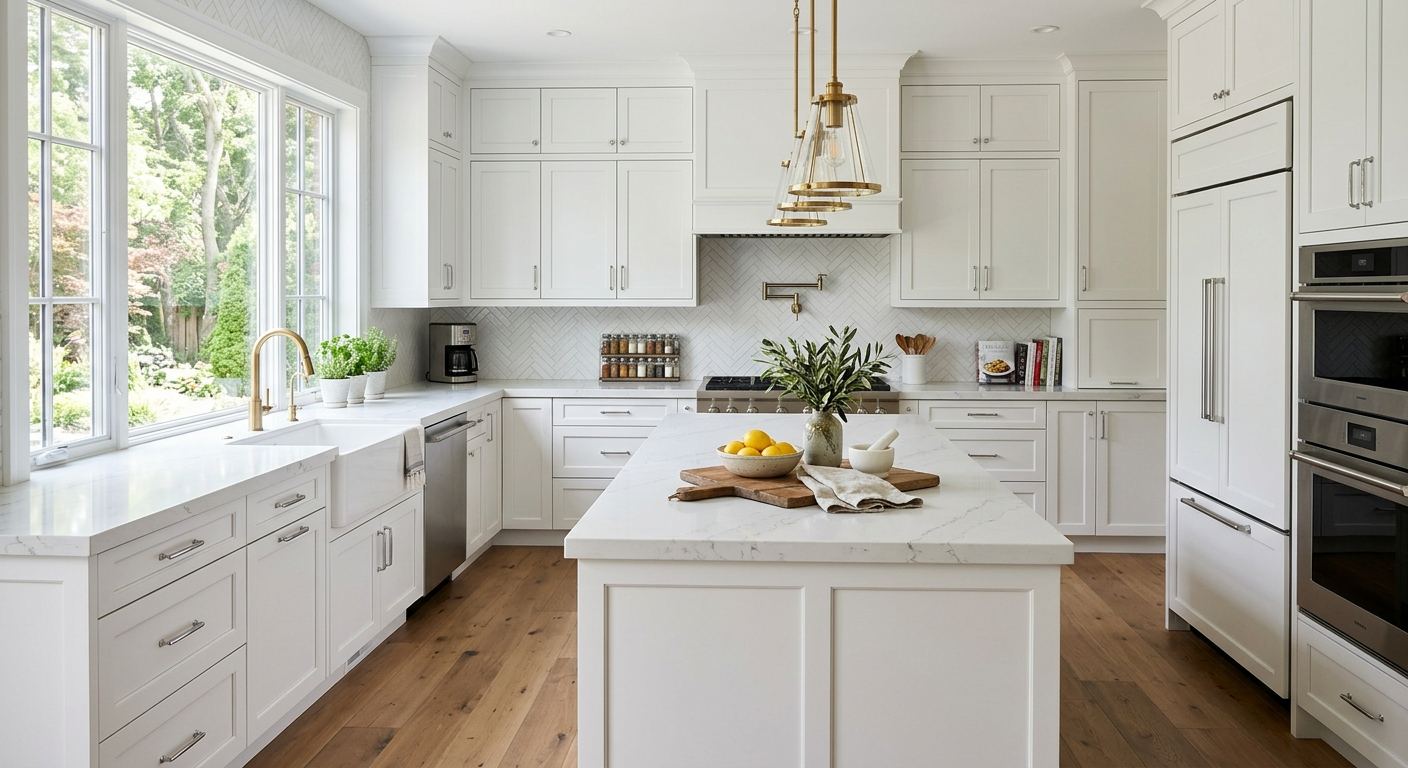
Kitchen renovation options and costs in Eastern Hillsides
In Eastern Hillsides, a kitchen renovation choice usually starts with how “finish-forward” you want the room to feel—because buyers in the Lower Mainland–Southwest often expect modern looks even in older homes. With a 2021 population of 3,450 in the area (Statistics Canada, 2021 Census), the local market is smaller and trade availability can tighten during peak renovation months. Just as important, homeowners in the broader Lower Mainland–Southwest market typically have higher expectations than in many other parts of B.C., and that pushes most projects toward upgraded cabinetry and durable surfaces when budgets allow. In this part of B.C., even when the kitchen footprint stays the same, the quote can swing based on whether you’re doing a practical refresh or moving into a full rebuild with layout changes, new electrical, and a premium countertop.
Weather in the Lower Mainland–Southwest is generally mild year-round with persistent humidity, so materials that resist moisture at seams and around sinks (and that clean easily) tend to perform better over time. That matters for backsplash grout, countertop edges, and under-cabinet finishes. Contractor demand also follows local home turnover: when more owners are planning resale-minded updates, mid-range and high-end scopes move faster—but pricing can rise with material lead times for stone, custom drawer systems, and appliances.
If you’re near Port Kells or other busy residential pockets where families renovate around school schedules, you’ll usually see steady interest in kitchen work, especially mid-range full renovations. Below is a straightforward comparison to help you map the scope to a realistic budget, then we’ll break down what drives the biggest price differences.
| Renovation Tier |
What's Included |
Typical Duration |
Price Range |
| Cosmetic refresh (paint, hardware, new appliances only) |
Paint (walls/ceiling), cabinet hardware, new appliances, basic caulking/trim touch-ups |
2–5 weeks |
$8,000–$25,000 |
| Mid-range full renovation (new cabinets, counters, sink, tile) |
New semi-custom or stock cabinetry, new countertop, sink/faucet, backsplash tile, flooring repairs, electrical allowances |
6–10 weeks |
$40,000–$85,000 |
| High-end full renovation (custom cabinets, stone counters, island) |
Fully custom cabinetry, quartz or natural stone counters, island (often with new plumbing/electrical), upgraded backsplash and finishes |
10–16 weeks |
$85,000–$120,000 |
| Cabinet refacing only (new doors + drawer fronts, same boxes) |
Door/drawer replacement, new veneer panels, hardware upgrades, updated trims; re-use existing box framework |
3–7 weeks |
$18,000–$45,000 |
| Countertop swap only (laminate to quartz or stone) |
Remove existing countertop, template, install new countertop, basic sink cut-out and reseal; no major plumbing relocation |
1–3 weeks |
$6,000–$12,000 |
| Backsplash tile installation only |
Tile supply allowance, install and grout, new trim where needed, sealant around edges/sink |
1–2.5 weeks |
$1,500–$6,000 |
Prices are estimates only and vary by project scope, site access and material selection.
What affects the price of kitchen renovation in Eastern Hillsides
In the Lower Mainland–Southwest, two homeowners can receive quotes that differ by 30–50% for the “same” kitchen because the biggest variables aren’t weather—they’re finish tier, cabinetry complexity, and how much the contractor needs to rework systems. Across British Columbia, labour rates and trade scheduling affect timelines, but local home value and household income expectations typically determine whether owners default to laminate and stock options or move quickly toward quartz/stone counters and semi-custom cabinetry. In higher-value areas, the cost is often more readily recovered on resale, so design-led layouts and higher-spec hardware become common. In more modest scopes, the goal is usually better ROI: keep layout stable, choose durable mid-range finishes, and focus spend where it shows (counters, backsplash, hardware).
Lower Mainland–Southwest market realities also influence availability. Stone fabrication slots can be tight; when your desired quartz or natural stone pattern has a backlog, costs can rise due to scheduling changes and rework protection measures. Layout changes are the wildcard everywhere, but in Eastern Hillsides they’re especially noticeable because many existing homes have older plumbing runs and older electrical panels that may not neatly support modern island requirements.
Here are a few concrete examples: (1) a wall removal that exposes old subflooring can add underlayment, labour, and patching—sometimes turning a “mid-range” plan into a full renovation budget; (2) adding an island that requires a gas or water connection drives countertop, cabinet, and trade sequencing costs; (3) upgrading from laminate to quartz can be a relatively straightforward swap when plumbing doesn’t move, but if sink cut-outs or backsplash height need changes, the total rises quickly. Even within the typical bands—full renovations often land in the $40,000–$120,000 range and cabinets/installation commonly sit between $8,000–$50,000—your scope details decide which end you hit.
| Price Factor |
Why It Matters |
Cost Impact |
| Cabinet tier — stock vs. semi-custom vs. fully custom millwork |
Higher tiers add custom sizes, upgraded hardware, and more drawer/organizer options |
$10,000+ swing depending on size and detailing |
| Countertop material — laminate vs. quartz vs. granite vs. stone |
Materials differ in fabrication complexity, thickness, and edge/finish options |
Typically a $3,000–$12,000 range shift |
| Layout change — wall removal, island add, plumbing/gas move |
Triggers structural checks, new framing, revised plumbing/gas runs, and inspections |
One change can add $8,000–$25,000+ |
| Appliance package tier — builder vs. mid-range vs. pro-grade |
Pro-grade appliances often require more precise clearances and higher service expectations |
Commonly $2,000–$15,000 difference |
| Flooring — refinish existing vs. full replacement |
Kitchen renovations can damage adjacent flooring; matching existing finishes is not always possible |
$1,500–$7,000 depending on what’s underneath |
| Backsplash — ceramic tile vs. marble vs. full-height slab |
Premium tile/stone and taller coverage increases labour time and substrate prep |
$1,500–$6,000+ |
| Electrical — new circuits for island, under-cabinet lighting |
New lighting circuits and outlets require licensed work and careful routing |
$1,500–$8,000 depending on scope |
| Permit fees and licensed trade requirements |
Permits, inspections, and specialized trades add scheduling and compliance costs |
Often $500–$3,500+ plus trade minimums |
Permits & regulations in British Columbia
In British Columbia, not every kitchen task needs a permit, but several common renovation steps do. A cabinet or countertop swap—where you are not changing plumbing, electrical, or gas infrastructure—typically does not require a permit. That means replacing cabinets, swapping laminate for quartz, or reinstalling a backsplash on the same footprint usually falls under standard renovation work completed by the contractor and trades as needed.
Where homeowners in Eastern Hillsides need to plan ahead is when you change a service path. The work that typically does require a permit includes: moving plumbing supply or drain lines (sink/dishwasher changes that relocate water/drain runs), relocating gas (stove/range or certain gas-fired appliances, and related venting/hood configurations), removing a load-bearing wall, and adding new electrical circuits (for example, outlets for an island, new lighting circuits, or upgrading service capacity). Gas work must be done by a licensed gas fitter, and electrical by a licensed electrician, with inspections tied to that work.
To verify a contractor’s compliance step-by-step: (1) ask for their contractor licence details and any relevant trade numbers; (2) request certificates of insurance (liability) before work starts—your contractor should be able to provide a current certificate; (3) confirm workers’ coverage documentation (commonly referred to as WSBC/WCB coverage in B.C.) for the trades they sub-contract; (4) confirm whether they will pull permits for you, and that it’s written in the contract. If a contractor won’t put responsibilities clearly in writing, that’s a major risk for homeowners.
Cabinets, countertops and layout decisions in Eastern Hillsides
In an Eastern Hillsides kitchen renovation, three decisions tend to determine both your budget and your long-term satisfaction: (1) cabinet tier, (2) countertop material, and (3) whether you change the layout. The Lower Mainland–Southwest resale market generally rewards practical upgrades—people want storage, durable surfaces, and a layout that supports everyday use. That’s why stock cabinets are the fastest path when you want to control cost; semi-custom is the common mid-range sweet spot; and custom millwork is chosen when you need precise fit around older house quirks or want a “designed” look.
Countertops are where durability and resale expectations meet. In the Lower Mainland–Southwest’s humid coastal climate zone, surfaces and edges matter. Quartz often performs well without the need for sealing, and it resists staining better than many laminate options. Natural stone like granite or marble looks premium, but it brings higher maintenance expectations—especially for marble, which is more sensitive to acids and can be less forgiving for busy households.
Layout changes—like opening an area by removing a wall, adding an island, or relocating plumbing/gas—are the highest-variance costs. They’re justified when the space gain improves flow, seating, and storage, not when you simply “rearrange” without real functional benefit. For a concrete example: moving into a mid-range plan with semi-custom cabinets and quartz counters may land around $40,000–$85,000. However, adding an island that requires plumbing and electrical changes can push the project toward $85,000–$120,000 even if cabinetry choice stays mid-range.
Choose deliberately, then let the contractor confirm what can stay in place—because keeping plumbing and gas where they are is one of the easiest ways to avoid budget surprises.
| Option |
Durability |
Maintenance |
Best For |
Price Range |
| Stock cabinets (big-box) |
Good for most daily use; limited custom sizing |
Low; just protect from water at sink areas and reseal as needed |
Budget-controlled refreshes with simple layouts |
$8,000–$25,000 |
| Semi-custom cabinets (local dealer) |
Very strong; better drawer systems and adjustable configurations |
Low; more hardware options mean easier day-to-day organization |
Most Eastern Hillsides renovations targeting strong resale value |
$25,000–$50,000 |
| Custom cabinets (local millwork shop) |
Highest build quality; made-to-fit around your exact space |
Low to moderate depending on finish; keep seams protected in humidity |
Challenging layouts, older homes, and “design-led” kitchens |
$50,000–$80,000+ |
| Laminate countertop |
Practical but can be vulnerable at seams and edges |
Easy daily clean-up; avoid soaking at cut-outs |
Cost-conscious upgrades where plumbing stays in place |
$3,000–$6,000 |
| Quartz engineered countertop |
High durability; consistent pattern and strong stain resistance |
Very low; wipe clean, protect from extreme heat on seams |
Busy households wanting a premium look with simple upkeep |
$6,000–$12,000 |
| Granite / natural stone countertop |
Very durable and heat-tolerant; natural variation |
Typically requires periodic sealing depending on the stone |
Owners who want natural character and premium curb appeal |
$7,000–$13,000 |
| Butcher block countertop |
Strong but needs care to avoid water damage at edges |
Moderate: regular oiling and prompt cleanup for spills |
Warm, casual kitchens where you’ll maintain the surface |
$4,000–$9,000 |
| Marble countertop |
Beautiful but softer; can scratch and etch more easily |
Higher maintenance: seal, avoid acidic spills, clean carefully |
Lower-traffic kitchens or owners prioritizing appearance |
$10,000–$18,000 |
How to choose a kitchen renovation contractor in Eastern Hillsides
Choosing the right contractor in Eastern Hillsides is less about sales promises and more about proof: licensing, insurance, and a scope that matches your expectations. In British Columbia, confirm the contractor’s compliance for the trades they perform or sub-contract. For licensing, ask for the specific trade credentials relevant to your job (gas fitter for gas changes; electrician for new circuits; and any other specialized trades required by your scope). For insurance, request a certificate of liability insurance from each contractor and subcontractor they control. Also verify workers’ coverage documentation (WSBC/WCB) so you’re not left holding the bag if a worker is injured. Don’t rely on “we’re covered” verbal statements—ask to see documents.
Next, get 2–3 itemised written quotes. You want a labour and materials breakdown (not a single lump sum), with allowances clearly identified for cabinets, counters, tile, plumbing fixtures, electrical, and any demo/disposal. Read the scope carefully for exclusions: disposal included or not, permit pull responsibility included or not, patching and subfloor replacement included or not, and whether the quote includes cabinet install adjustments for out-of-square walls—common in older Lower Mainland–Southwest homes. Ask about warranty too: workmanship warranty length, product/manufacturer warranties, and whether the warranty is transferable if you sell. Payment schedules should be reasonable: never more than 10–15% upfront, and use a holdback until the job is complete. Finally, insist on a start date and completion estimate in writing, including milestones for cabinet installation, countertop templating, and inspection-dependent work.
- Ask for proof of relevant trade licences for any gas/electrical/plumbing changes.
- Request current liability insurance certificates before signing.
- Confirm WSBC/WCB coverage documentation for their workers and key subs.
- Get 2–3 itemised quotes with labour and materials separated.
- Ensure the quote states who pulls permits (and lists any inspection fees if applicable).
- Confirm what disposal/dump fees are included for demo and packaging.
- Check whether subfloor repair and patching are included if tiles/cabinets remove backer or flooring.
- Verify how changes are priced (change-order rate, not just “we’ll adjust”).
- Make sure cabinetry includes installation, shimming, toe-kick finishing, and hardware mounting.
- Confirm countertop templating timing and who covers remakes if measurements change due to site conditions.
- Ask about dust control and site protection (plastic containment, floor protection, ventilation).
- Review warranty terms in writing: workmanship, product coverage, and transferability.
Red flags we often see in Eastern Hillsides: contractors who won’t put permit responsibility in writing, quotes that exclude disposal but don’t clearly state why, “too good to be true” pricing that omits electrical/plumbing allowances, no written warranty details for workmanship, and payment requests that exceed 10–15% upfront or offer no holdback until completion.
Frequently asked questions — kitchen renovation in Eastern Hillsides
How do I add an island to my Eastern Hillsides kitchen?
Adding an island in Eastern Hillsides usually comes down to service routing and clearances. If the island is purely seating/storage (no sink or cooktop), you can often keep plumbing and gas untouched, which helps control costs and avoids the most inspection-heavy steps. If you want a sink or cooktop, you’re likely moving plumbing and possibly gas, which in British Columbia typically requires permits and licensed trade work. Practically, plan for countertop templating timing after cabinets are set, because islands require careful measurement and support. Budget-wise, an island often pushes you toward mid-range to full-renovation totals—commonly around $40,000–$85,000 for many mid-range builds, and higher if you’re changing gas/electrical runs.
How much does a kitchen renovation cost in Eastern Hillsides?
In Eastern Hillsides, pricing depends more on finish tier and scope than on climate. A cosmetic refresh (paint, hardware, and new appliances only) may stay near $8,000–$25,000. For a full renovation with new cabinets and counters, many projects land in the backbone range of $40,000–$120,000. The reason costs vary is usually cabinetry complexity, countertop material, and whether you change layout. Layout changes like wall removal, adding an island, or relocating plumbing/gas can add the most unpredictable dollars. Also, Lower Mainland–Southwest homeowners tend to invest in quartz/stone and better drawer systems more often because those upgrades are easier to market on resale, especially as home turnover rises.
How long does a kitchen renovation take in Eastern Hillsides?
Timelines in Eastern Hillsides typically range from a few weeks to several months depending on scope and lead times. A cosmetic refresh can be as quick as 2–5 weeks. A mid-range full renovation commonly takes about 6–10 weeks, largely because cabinets and countertops need scheduling and templating. High-end projects with custom millwork and stone can run 10–16 weeks, especially when fabrication slots tighten. The biggest time drivers are countertop templating and permit/inspection windows when plumbing, gas, or electrical circuits are changing. Weather in the Lower Mainland–Southwest can affect drying/curing periods for patching and finishing materials, but the bigger scheduling impacts are usually trades’ availability and material lead times rather than cold-weather delays.
Quartz vs granite countertops — which is better?
Quartz is often the most practical choice in British Columbia kitchens because it’s engineered for consistency, resists staining well, and usually requires less routine maintenance than many natural stones. Granite is also very durable and heat-tolerant, and it offers natural variation and a premium look. The trade-off is maintenance: depending on the granite, you may need periodic sealing, and you’ll want to treat it like a natural product with care around acids and harsh cleaners. In Eastern Hillsides, where humidity can linger, quartz’s performance around seams and edges is a common reason homeowners choose it for busy kitchens. If you want simpler upkeep with a modern look, quartz usually wins; if you love natural character and are willing to maintain it, granite is a strong option. Price varies, but quartz often fits the $6,000–$12,000 countertop installation band in many scopes.
Should I reface or replace my cabinets?
Refacing can be a smart option when your cabinet boxes are still solid and square, and you mainly want updated fronts, drawer faces, and hardware. It’s typically faster than a full replacement because the structure stays in place, so you often reduce demolition and rework. Replacement is the better choice if your boxes are water-damaged, sagging, out of square, or if you’re planning significant layout changes like adding an island or altering storage configurations. In Eastern Hillsides, we often recommend reface for a “refresh with minimal disruption,” and replacement for kitchens that need more storage or where plumbing/electrical changes will force you to open walls anyway. Refacing projects commonly sit around $18,000–$45,000, while full cabinet installs often climb higher depending on cabinet tier and custom features.
Do I need a permit for a kitchen renovation in British Columbia?
In British Columbia, many kitchens can be updated without permits—especially if you’re not changing services. A cabinet swap, a countertop swap, and many backsplash updates typically do not require permits. You generally do need permits (and licensed trade involvement) when your renovation changes plumbing supply/drain locations, relocates gas appliances or certain related venting, removes a load-bearing wall, or adds new electrical circuits (for example, outlets and lighting for an island). Gas work must be done by a licensed gas fitter and electrical by a licensed electrician, with inspections arranged for the permitting scope. For Eastern Hillsides homeowners, the key is to confirm in writing who pulls permits and what the permit scope covers—because that responsibility should be clear in your contract before you pay or order materials.