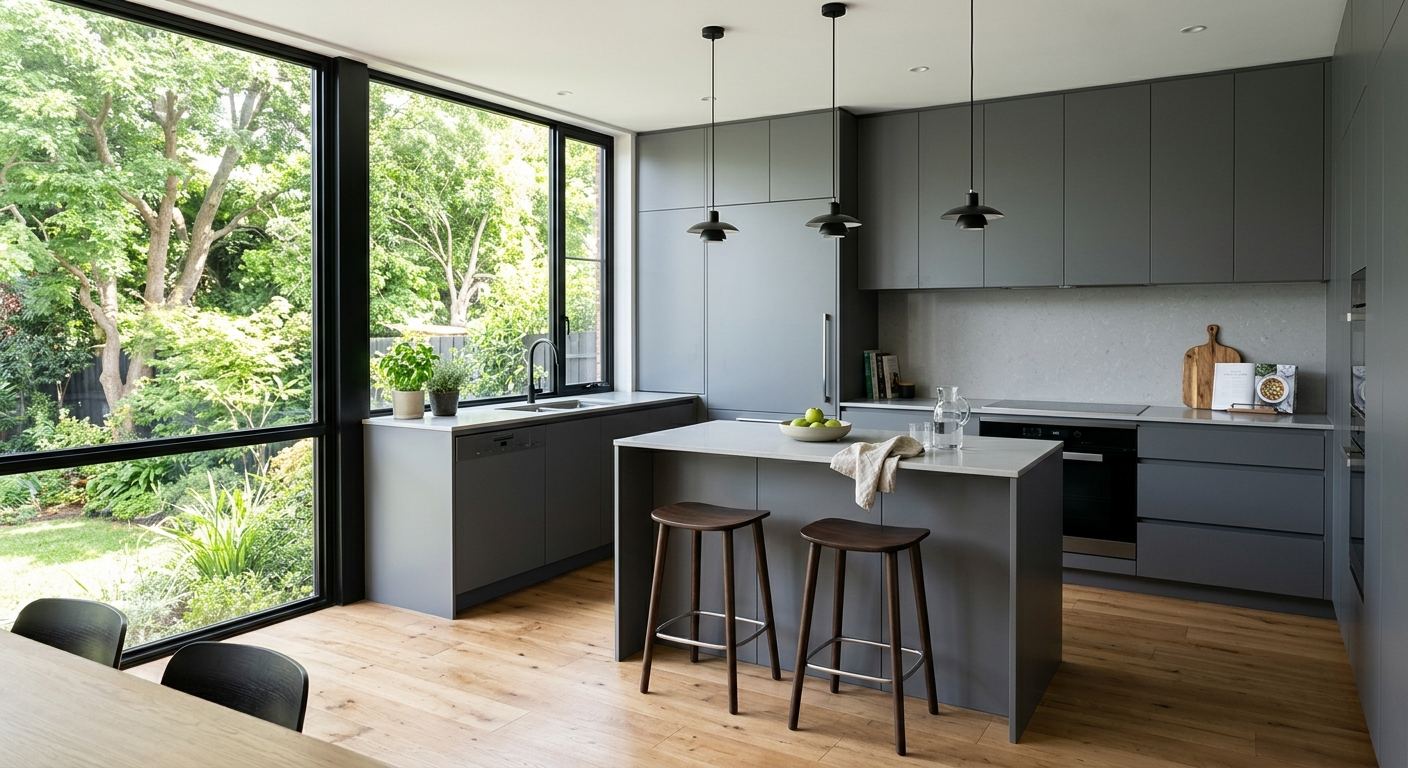
Kitchen renovation options and costs in Esquimalt
Esquimalt homeowners usually start kitchen planning with a simple question: “What will this cost?” In a community of 17,533 people (Statistics Canada, 2021 Census), many households are owner-occupied (48.9% of households own), which typically means renovations lean toward upgrades that hold value. With a median household income of $76,000 (Statistics Canada, 2021 Census), most projects land in either a practical refresh or a mid-range remodel that feels materially nicer without going fully custom. On Vancouver Island and the Coast, the main cost driver isn’t climate—it’s the local finish expectations tied to home values and the availability of trades for scheduled work.
Because many homes in Esquimalt were built before 1981 (70.3%), you’ll often see dated plumbing/electrical runs and slightly tighter kitchen footprints. That age factor can add labour even when finishes stay modest. Coastal conditions also influence how cabinets and tile assemblies are detailed: crews pay extra attention to ventilation, caulking, and moisture-resistant underlayment—especially around sinks, dishwashers, and exterior-facing walls.
In the Prospect Lake and West Bay Esquimalt areas, kitchens are frequently reconfigured to maximize storage and create brighter sightlines—exactly the kind of work that keeps skilled installers in demand. From builder-grade updates to stone-and-custom cabinetry builds, your “tier” is the fastest way to compare bids and understand what’s actually different between quotes. Use the table below as your starting point before you compare scope and measurements.
| Renovation Tier |
What's Included |
Typical Duration |
Price Range |
| Cosmetic refresh (paint, hardware, new appliances only) |
Cabinet paint/repairs as needed, new hardware, appliance swap (no plumbing/gas moves), vanity-touch-ups if required |
1–3 weeks |
$8,000–$25,000 |
| Mid-range full renovation (new cabinets, counters, sink, tile) |
New semi-custom or upgraded stock cabinets, countertop, sink + faucet, backsplash tile, flooring patching/trim, basic lighting updates (as included) |
4–8 weeks |
$45,000–$85,000 |
| High-end full renovation (custom cabinets, stone counters, island) |
Fully custom cabinetry, quartz/stone counters, island with electrical, upgraded appliance package, full backsplash (premium), more extensive plumbing/electrical coordination |
8–14 weeks |
$90,000–$150,000+ |
| Cabinet refacing only (new doors + drawer fronts, same boxes) |
New door/drawer fronts, updated hardware, new trim/crown pieces, repaint/repair of existing boxes, limited countertop allowance |
2–4 weeks |
$8,000–$35,000 |
| Countertop swap only (laminate to quartz or stone) |
Remove/replace existing tops, under-mount sink re-set (if applicable), new countertop install, edge profile updates, backsplash patch or light refresh |
3–7 days |
$3,000–$12,000 |
| Backsplash tile installation only |
Tile supply + install, waterproofing/membrane at wet areas, grout/seal where needed, cleanup, minor outlet trim adjustments |
3–10 days |
$2,500–$9,000 |
Prices are estimates only and vary by project scope, site access and material selection.
What affects the price of kitchen renovation in Esquimalt
In Esquimalt, two homeowners can receive quotes that differ by 30–50% for what looks like the “same” kitchen. On Vancouver Island and the Coast, that gap usually comes from finish tier decisions and how much hidden work the older home materials require—not from the weather itself. Local home values and median income strongly shape what buyers expect at resale, so many projects that start as “just cabinets and counters” end up including better stone, upgraded hardware, and tighter cabinet detailing. With a median household income of $76,000 (Statistics Canada, 2021 Census), the common path is often a mid-range remodel near the $40,000–$85,000 bracket, while higher-value pockets tend to push toward stone and custom millwork and the upper end of the full renovation band.
Climate affects the details, but not the big-ticket structure: coastal humidity and temperature swings are why installers prioritize ventilation and moisture-resistant assemblies around sinks, dishwashers, and exterior-adjacent walls. You’ll also find that older (pre-1981) homes may need extra patching and shimming to get cabinets level and aligned—labour that shows up whether you choose laminate or quartz. Layout changes are where costs become most unpredictable: removing a wall to open the room, adding an island, or relocating a gas line can add trades, scheduling complexity, and inspection requirements.
Here are a few Esquimalt-specific examples: (1) a “simple” backsplash upgrade can cost more if the existing wall behind the tile is damaged from past leaks around the sink; (2) an island addition often increases the scope for electrical and ventilation clearances, pushing the project toward mid-range full renovation pricing; (3) replacing countertops can be more labour-intensive when the base cabinets are older and not perfectly square, which is common in homes built before 1981 (70.3%). Use these factors to understand why one bid lands closer to $35,000–$90,000 full remodel territory while another moves toward the high-end band.
| Price Factor |
Why It Matters |
Cost Impact |
| Cabinet tier — stock vs. semi-custom vs. fully custom millwork |
Custom doors/boxes, better materials and tighter tolerances; also impacts lead times |
Can shift the budget by tens of thousands; cabinets often consume ~30–40% of total |
| Countertop material — laminate vs. quartz vs. granite vs. stone |
Materials differ in cost, thickness, edging, and installation labour |
Laminate keeps you closer to refresh pricing; quartz/stone commonly pushes into mid-range or high-end |
| Layout change — wall removal, island add, plumbing/gas move |
Structural work, new openings, and re-routing services add complexity and inspection steps |
Often the biggest swing factor regardless of finish level |
| Appliance package tier — builder vs. mid-range vs. pro-grade |
Pro-grade appliances require more venting/clearances and can change electrical specs |
Can add several thousand dollars quickly, especially with installation of larger units |
| Flooring — refinish existing vs. full replacement |
Kitchen demo creates dust and subfloor risk; full replacement costs more but can prevent future issues |
Partial patches are often less expensive than full replacement but require careful matching |
| Backsplash — ceramic tile vs. marble vs. full-height slab |
Premium tile/stone adds material cost, fabrication, and longer install time |
Full-height or premium materials can double backsplash labour/membrane requirements |
| Electrical — new circuits for island, under-cabinet lighting |
Additional circuits need licensed work, panels, and inspection coordination |
Commonly adds “unseen” costs that separate good quotes from complete ones |
| Permit fees and licensed trade requirements |
Any required permits and inspections add administration and scheduling time |
Small in absolute terms compared to cabinets, but can delay start/completion |
Permits & regulations in British Columbia
In British Columbia, some kitchen changes are straightforward and don’t need a permit—for example, swapping cabinets in place, replacing a countertop, or updating hardware and paint. Likewise, a countertop swap is typically considered a non-structural finish change. However, once you move services or change the structure, permits and licensed trades usually come into play.
Work that typically does require a permit and licensed trades includes: moving plumbing supply or drain lines (sink relocation, dishwasher line changes), relocating a gas appliance or changing the gas line route, removing a load-bearing wall or altering structural framing, and adding new electrical circuits (such as dedicated power for an island or new outlets beyond what’s already present). Gas work must be done by a licensed gas fitter, and electrical work must be performed by a licensed electrician—both require inspections for safety sign-off.
To verify contractor readiness in Esquimalt, ask for documentation before work starts:
- Licence proof: check the contractor’s credentials through the appropriate provincial online registries (and confirm the specific trade licence for gas/electrical).
- Certificate of insurance (liability): request a current COI and confirm kitchen-renovation or general contracting coverage limits.
- Worker coverage (WCB/clearance): ask for a current clearance letter or proof of workers’ coverage.
- Written scope: confirm in the contract which permits the contractor pulls (and who pays the fees).
Always confirm permit responsibility in writing—whether it’s the contractor’s duty to apply, or your duty as the owner to arrange—before signing a quote.
Cabinets, countertops and layout decisions in Esquimalt
The three decisions that move an Esquimalt kitchen renovation the most are: (1) cabinet tier, (2) countertop material, and (3) layout changes. In a coastal BC market with a lot of pre-1981 housing stock, buyers also notice practical fit—door alignment, drawers that open smoothly, and the way the kitchen stays functional as the home ages.
Cabinet tier: stock cabinets are the fastest and cheapest because they’re pre-manufactured and typically have shorter lead times. Semi-custom cabinets (a common mid-range choice near the $40,000–$85,000 remodel band) let you pick better storage layouts and sizes. Fully custom cabinets are pricier, but they’re worth it when you need unusual dimensions or want a built-in look that feels “designed,” especially if you’re adding an island.
Countertops: laminate is budget-friendly and fine for light wear, but it can be less forgiving with hot pans and can chip at edges over time. Quartz is the popular middle ground—durable and low maintenance, with realistic upgrade value for resale. Granite/natural stone look premium and age well, while butcher block adds warmth and can be sanded/refinished, which appeals to homeowners planning to maintain it. Marble is elegant but needs more care to keep it looking crisp.
Layout changes: opening up with a wall removal or adding an island can be justified when it improves traffic flow and adds seating/storage. For instance, if you’re already in the mid-range zone and can keep plumbing/electrical moves limited, shifting from standard counters to quartz might be a high-value upgrade. But if you’re planning to relocate plumbing and gas plus add multiple new circuits, that’s when costs quickly shift toward the high-end band—even if the materials stay “average.”
Because coastal kitchens experience more day-to-day moisture exposure around sinks and dishwashing, choose materials and assemblies that manage moisture well (proper sealing, ventilation, and water-resistant backing behind splash zones).
| Option |
Durability |
Maintenance |
Best For |
Price Range |
| Stock cabinets (big-box) |
Solid for everyday use; limited sizing flexibility |
Low; minor adjustments as needed for older walls |
Fast timelines and budget-focused refreshes |
$8,000–$25,000 |
| Semi-custom cabinets (local dealer) |
Better internal options (drawers, organizers); dependable build quality |
Low to moderate; hardware choices affect upkeep |
Most Esquimalt mid-range renovations |
$20,000–$55,000 |
| Custom cabinets (local millwork shop) |
Highest fit and longevity; best for complex layouts |
Low; quality hardware and proper installation matter most |
Island builds, unusual dimensions, built-ins |
$45,000–$100,000+ |
| Laminate countertop |
Moderate; can be vulnerable at seams/edges |
Low; use care with heat and impact |
Budget refreshes and rental-friendly updates |
$3,000–$6,000 |
| Quartz engineered countertop |
High; resists stains and is generally very durable |
Very low; simple cleaning and routine care |
Best all-around value in coastal BC |
$6,000–$12,000 |
| Granite / natural stone countertop |
High; strong and long-lasting with the right sealing |
Moderate; periodic sealing depending on stone type |
Premium look with lasting character |
$8,000–$16,000 |
| Butcher block countertop |
Moderate to high with proper oiling; susceptible to knife marks if neglected |
Moderate; needs regular oiling and mindful water protection |
Homeowners who will maintain and love warmth |
$5,000–$12,000 |
| Marble countertop |
Moderate; shows etching/chips more readily than quartz |
Higher; consistent sealing and careful cleaning needed |
Statement kitchens with lighter wear |
$10,000–$18,000+ |
How to choose a kitchen renovation contractor in Esquimalt
When hiring a kitchen renovator in Esquimalt, start with proof—not promises. In British Columbia, confirm the contractor’s licensing where applicable, and request documentation for liability insurance and workers’ coverage (WSIB/WCB equivalent). Ask for the certificate of insurance (COI) and verify it includes general liability for renovation work. For workers’ coverage, get a current clearance letter or proof that their employees are covered—this matters for your protection as the homeowner if an accident occurs on site.
Next, demand 2–3 itemised written quotes. The best bids break out labour and materials separately (cabinets, countertops, tile, plumbing/electrical allowances), rather than hiding everything in a single line. Read the scope carefully: what’s excluded (permits, disposal, old cabinet removal, drywall patching, matching flooring), and what’s included (permit pull, protected protection of countertops and floors, vacuuming and dust control)? For a kitchen, disposal and debris management are often where “cheap” quotes become expensive.
Look at warranty terms. Confirm the workmanship warranty length, whether it covers rework for a defined period, and whether product warranties are direct with the manufacturer and transferable if you sell the home. Also confirm payment scheduling: never pay more than 10–15% upfront, and hold back a portion until critical milestones are complete. Finally, insist on a start date and completion estimate in writing, with allowances for lead times on cabinets and stone.
- Ask for licence/registration numbers and confirm trade licences for gas/electrical work.
- Request a current COI and check coverage limits and renovation endorsement.
- Get proof of workers’ coverage (clearance letter) before work begins.
- Require itemised quotes with labour vs. materials lines, not a lump sum.
- Confirm who pulls permits and who pays permit fees.
- Check if demolition and disposal are included (and where the waste goes).
- Verify dust control and protection plans for floors, stairs, and adjacent rooms.
- Require a written finish schedule (cabinet colours, countertop slabs/edge profiles).
- Confirm plumbing/electrical allowances are either specified or excluded clearly.
- Get warranty details in writing: workmanship term, exclusions, and remedy.
- Use a milestone-based payment schedule with a holdback for final inspection.
- Confirm lead times for cabinets and stone and include them in the timeline.
Red flags in Esquimalt: contractors who won’t provide COI/WCB proof; quotes that omit disposal or permit responsibility; “allowances” that are unrealistically low; pressure to pay large deposits upfront; and vague timelines that ignore material lead times for cabinets and quartz/stone.
Frequently asked questions — kitchen renovation in Esquimalt
How do I choose a kitchen contractor in Esquimalt?
Start by verifying proof of coverage and capability, not just photos. In British Columbia, ask for the contractor’s liability insurance COI and proof of workers’ coverage (clearance letter) before any work begins, and request licence details—especially if the scope includes gas or electrical. Then compare 2–3 itemised bids (labour and materials separated), so you can see what’s included: permits, disposal, demolition, tile backer and underlayment, and any electrical allowances for an island. A solid contractor will also explain realistic lead times for cabinets and stone. For reference, a mid-range full renovation in the Vancouver Island/Coast pricing bands often sits around $45,000–$85,000; if one quote lands far below this without scope detail, it’s usually under-specifying key items.
What order do kitchen renovation steps happen in?
In Esquimalt, the usual sequence is: design/measurements and ordering, then demolition, then rough-in work (plumbing and electrical) if any locations change. Once rough-in is approved and, where required, inspected, the team proceeds with drywall patching/finishing, waterproofing membranes for tile areas, and flooring readiness. Cabinets go in next, followed by countertop templating and installation. After the tops are set, installers complete backsplash and final trim, then re-connect appliances and do a final clean, caulking, and punch-list. If you’re staying within a cosmetic refresh—paint/hardware/appliance only—the timeline is shorter and doesn’t require rough-in changes, which keeps costs closer to the refresh tier.
Can I live at home during a kitchen renovation in Esquimalt?
Often yes, but it depends on scope and your tolerance for dust and access. Many homeowners remain in the home during a cosmetic refresh or cabinet refacing because demolition is limited and the kitchen can be partially functional. For a mid-range full renovation (commonly $45,000–$85,000), living in place is possible if the contractor sets up a temporary kitchenette, protects floors and pathways, and schedules disruptive demolition earlier in the week. Homes built before 1981 in Esquimalt (70.3%) may have older wiring/plumbing that takes longer during rough-in, which can extend “no-cooking” windows. If you add an island with new electrical or relocate plumbing/gas, the downtime tends to be longer, even when the final finish is beautiful.
Should I renovate my kitchen before selling in Esquimalt?
Generally, you should renovate to the level of finishes buyers expect in your segment—otherwise you may pay for upgrades you can’t fully recover. In Esquimalt and nearby Victoria/Saanich-style markets, homeowners commonly look for durable counters (quartz or stone) and reliable storage layouts; that aligns with the region’s tendency toward mid-range and premium finish choices. If your goal is resale speed and broad appeal, a smart path is to target cabinetry and countertops without overhauling everything. A full remodel band can be broad (for example, full kitchen renovations often fall in $35,000–$90,000), so spend on what improves function and appearance, not on “nice-to-have” features that don’t change how the kitchen works. Your realtor and contractor should both review comparable listing photos in your immediate area to calibrate the finish tier.
What's the most popular kitchen style in Esquimalt right now?
Across Esquimalt renovations, the most requested look is a clean, modern transitional style: lighter or neutral cabinet colours, simple shaker or slab door fronts, and countertops that read bright (often quartz in warm whites, creams, or subtle greys). Hardware is commonly upgraded to brushed nickel or matte black, and many homeowners add under-cabinet lighting to brighten the working surfaces. Because many kitchens here are in older homes (70.3% built before 1981), a layout refresh—better storage and a more open visual flow—tends to feel “new” without requiring a complete rebuild. When budgets stretch toward high-end renovations with islands, the same style keeps appearing, but with custom millwork details and stone counters for a more integrated, built-in feel.
How do I know if I need to update my kitchen plumbing in Esquimalt?
Update plumbing when you see performance issues or when you’re changing layouts/services. In older Esquimalt homes (many built before 1981, 70.3%), supply lines, shutoffs, and under-sink drains may be aging, corroded, or hidden behind dated finishes. Signs include slow drains, recurring leaks under the sink or dishwasher, inconsistent hot water temperature at the faucet, and loose or failing shutoffs. Also, if you’re moving the sink, adding a dishwasher in a new location, or doing a major layout change, plan to replace or re-route lines to match the new countertop and base cabinet layout. That’s the scenario where quotes can rise quickly because moving supply/drain lines usually triggers permit and licensed-trade requirements in British Columbia.