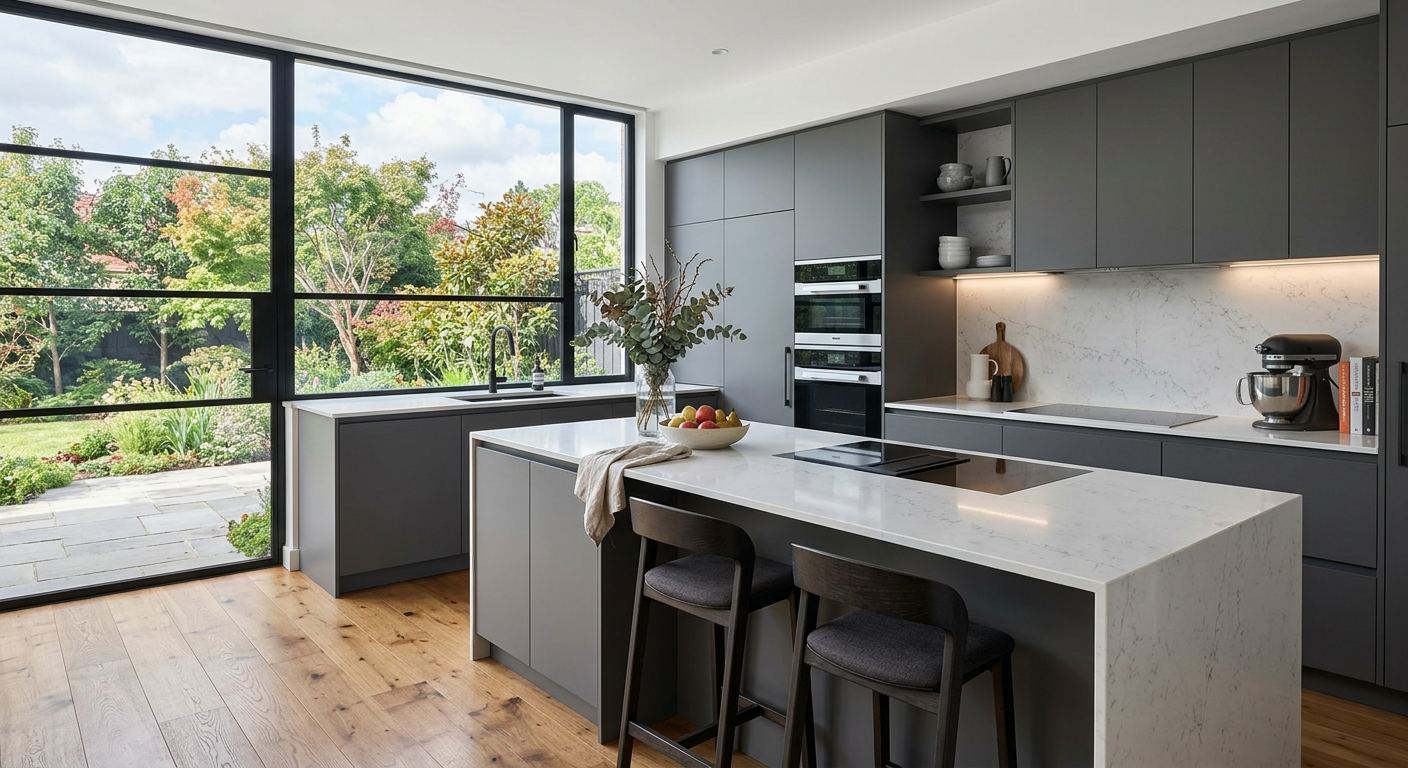
Kitchen renovation options and costs in Fernie
Fernie homeowners typically price kitchen renovations by what a buyer will pay when they resell—not by the weather itself alone. With a median household income of $107,000 (Statistics Canada, 2021 Census), many households can comfortably target a mid-range finish tier, especially in neighbourhoods where homes are older and benefit from refreshes before listing. It also helps that 72.1% of households are homeowners (Statistics Canada, 2021 Census), so renovation decisions are more often about long-term enjoyment and resale appeal than short-term flips. In Fernie and the broader Kootenay area, contractors still follow British Columbia market pricing: modest refresh-to-mid-range jobs are common, with stock or semi-custom cabinets plus laminate or entry quartz, while higher-end remodels move into custom woodwork and premium stone surfaces that lift the total project materially.
Climate matters more indirectly here. Fernie’s damp winters and freeze–thaw conditions are hard on grout lines, caulking, and poorly sealed backsplashes, so tile prep and waterproofing can add cost versus “cosmetic only” assumptions. Labour availability can also affect timelines: many local trades prioritize full renovations in peak season (late spring through fall), which can raise labour pricing if you schedule late or require material backorders.
In Fernie’s East Fernie area, kitchen demand is especially strong because older housing stock makes updates frequent, and buyers expect modern storage and durable countertops. From there, the table below helps you compare renovation tiers side by side before you start getting quotes.
| Renovation Tier |
What's Included |
Typical Duration |
Price Range |
| Cosmetic refresh (paint, hardware, new appliances only) |
Paint/trim touch-ups, new pulls/knobs, appliance swap (like-for-like), basic cleaning and minor caulk/finish work |
1–3 weeks |
$5,000–$12,000 |
| Mid-range full renovation (new cabinets, counters, sink, tile) |
Semi-custom or quality stock cabinets, new counters (laminate or entry quartz), sink + faucet, backsplash tile, new disposal if applicable, installation and finishing |
4–8 weeks |
$30,000–$55,000 |
| High-end full renovation (custom cabinets, stone counters, island) |
Fully custom cabinetry, premium quartz/stone, island (if feasible), upgraded backsplash (stone/tile detailing), upgraded hardware, deeper prep and finishing |
8–14 weeks |
$55,000–$70,000 |
| Cabinet refacing only (new doors + drawer fronts, same boxes) |
New door/drawer fronts, veneer/laminate refacing, reinstalled hardware, optional new rollout/organizers if boxes are in good shape |
2–5 weeks |
$8,000–$20,000 |
| Countertop swap only (laminate to quartz or stone) |
Removal and install of countertop, sink cut-out adjustments where needed, edge finishing, basic sealing/caulking, disposal of old material |
3–7 days plus scheduling |
$2,500–$12,000 |
| Backsplash tile installation only |
Tile supply allowance, substrate prep, waterproofing/setting, grouting and sealing, trimming around outlets and hood/sink boundaries |
3–10 days |
$1,200–$5,000 |
Prices are estimates only and vary by project scope, site access and material selection.
What affects the price of kitchen renovation in Fernie
In Fernie and across Kootenay, you’ll often see the same “new cabinets + counters” concept quoted with a 30–50% spread. The biggest driver is usually not temperature swings; it’s the finish tier homeowners choose, which is tied to local home values and household income, and then the contractor’s real costs for labour, scheduling and materials. In higher-value British Columbia pockets, homeowners lean toward quartz or natural stone and semi-custom cabinetry because they can more easily recover the upgrade on resale. In more modest tiers, laminate counters and stock cabinets dominate because they still deliver a strong visual refresh without pushing the project into the upper end of the budget range.
Layout changes are the most unpredictable cost regardless of finish level. Removing a wall, adding an island, or moving a gas line can trigger extra framing, new plumbing or gas fitting, electrical work, and inspection steps—so even a “mid-range” renovation can creep toward the higher band quickly.
Here are a few Fernie-specific examples that commonly move the needle. First, older homes built before 1981 are common in the area (59.6%), and dated subfloors and wall framing can add labour for reinforcement and patching before cabinets can be levelled. Second, because Fernie winter air is often dry indoors but humid outdoors, kitchens with previous water/steam exposure can reveal grout or caulking failure behind existing backsplashes, increasing tile-prep and waterproofing needs. Third, if you’re switching from laminate to quartz, the new slab weight and sink cut-out tolerances can require additional cabinet bracing or adjustments.
As a planning anchor, a typical mid-range full renovation in Fernie commonly lands around the $30,000–$55,000 neighbourhood, while a high-end move into custom millwork and stone with an island can push into the $55,000–$70,000 band. The better you define scope and layout early, the less those spreads surprise you.
| Price Factor |
Why It Matters |
Cost Impact |
| Cabinet tier — stock vs. semi-custom vs. fully custom millwork |
Determines material quality, door styles, interior organizers, fit-and-finish tolerances and lead times |
Often drives the largest swing; can shift a job from mid-range to high-end pricing |
| Countertop material — laminate vs. quartz vs. granite vs. stone |
Material cost per square foot plus edge profiles, sink cut-outs and fabrication complexity |
Countertops can add several thousand dollars; premium stone pushes total budget upward |
| Layout change — wall removal, island add, plumbing/gas move |
Creates hidden scope: framing, venting, rough-in adjustments, and more trade coordination |
Frequently the source of 10–25% surprises even when cabinet and counter choices stay the same |
| Appliance package tier — builder vs. mid-range vs. pro-grade |
Differences in venting requirements, power needs, finish matching and installation allowances |
Can add or remove several thousand dollars depending on brands and features |
| Flooring — refinish existing vs. full replacement |
Kitchen floors are tough; replacing may require subfloor checks and underlayment work |
Refinishing keeps costs closer to the mid-range; replacement can widen the gap toward high-end budgets |
| Backsplash — ceramic tile vs. marble vs. full-height slab |
Impacts prep, waterproofing, cutting complexity, and grout/seaming details |
Tile is relatively predictable; marble/slab can raise labour and material allowances |
| Electrical — new circuits for island, under-cabinet lighting |
More fixtures usually means more wiring runs, junction boxes and inspection time |
Unplanned electrical work can add quickly; it’s one of the most common scope creep items |
| Permit fees and licensed trade requirements |
Work involving plumbing/gas/electrical upgrades generally requires permit steps and inspection coordination |
Adds admin and trade costs; typically most noticeable on renovations that include layout changes |
Permits & regulations in British Columbia
In British Columbia, a simple cabinet and countertop swap usually doesn’t require a permit, especially when you keep plumbing, gas lines, and electrical locations unchanged. That means replacing cabinets with the same footprint, swapping like-for-like countertops, and installing a new backsplash typically fall under “no permit” work. However, in a Fernie kitchen renovation, the moment you move supply or drain lines, relocate a gas stove or make changes to a gas range setup, remove a load-bearing wall, or add new electrical circuits for things like an island sink or under-cabinet lighting, permits and licensed trades are typically required.
Gas work must be done by a licensed gas fitter, and electrical work must be done by a licensed electrician. Both trades generally require inspections after rough-in and/or before closing up, depending on the scope. Because permit responsibility can vary by contract structure, always confirm who pulls the permit with the contractor before signing—what matters for you is that the correct permit is in place and the work is inspected as required.
To verify a contractor in Fernie (BC), follow a simple checklist: (1) ask for their liability insurance certificate—make sure the coverage is active and matches the type of work; (2) confirm the licensed trade coverage for the sub-trades doing gas or electrical work; (3) verify where relevant that their workers are covered under provincial workplace requirements (commonly handled through WCB/WSIB coverage for trades); and (4) keep copies of all certificates in your project file. For licensed professionals, use the online registry information they provide and match the name and licence number to the job scope, then request the insurer’s clearance letter or proof documents when available.
Cabinets, countertops and layout decisions in Fernie
In a Fernie kitchen renovation, three choices determine most of the final cost and the “buyer feel” of the space: cabinet tier, countertop material, and whether you change the layout. Cabinet tier sets how quickly the job moves and how well the kitchen fits your daily routines. Stock cabinets are the fastest and cheapest, semi-custom is the most popular mid-range option for better sizing and storage, and custom cabinets deliver the tightest fit for odd walls and premium millwork—but at the highest cost. Countertop material then controls durability and maintenance. Laminate is budget-friendly and resilient to everyday use, quartz is the common sweet spot for stain resistance with low maintenance, granite/natural stone offers a premium look but needs periodic sealing, and butcher block needs more care to avoid water damage.
Layout decisions are where Kootenay budgets often swing. Opening a wall or adding an island can be worth the expense when it improves traffic flow and seating, especially in older homes where the original plan can feel tight. But if your plumbing/gas locations are hard to reach, relocating supply or venting can push costs beyond what buyers will pay back on resale. That’s why, in Fernie’s resale market, many projects stay in the refresh-to-mid-range tier—new cabinets and a quartz or laminate counter—unless the homeowners are fully committing to a new layout.
A practical dollar example: if your current layout is serviceable and you’re deciding between laminate and quartz, the incremental investment is often justified because quartz offers superior stain resistance with minimal day-to-day upkeep. In contrast, spending heavily on a custom island layout without upgrading cabinets and countertops usually doesn’t deliver the same perceived value as a coordinated package. If you want an island but need to keep budget in check, consider semi-custom cabinetry with quartz and hold premium stone for key visual surfaces.
Also remember Fernie’s older housing stock: homes built before 1981 (59.6%) may have less consistent wall surfaces, so cabinet installation sometimes needs extra shimming and fixing before you ever reach countertop fabrication—plan that into early decisions.
| Option |
Durability |
Maintenance |
Best For |
Price Range |
| Stock cabinets (big-box) |
Solid for everyday use; fit can be less precise on older walls |
Low; depends on door finish quality and hardware |
Fast timelines and the best value when the layout is staying put |
$10,000–$22,000 |
| Semi-custom cabinets (local dealer) |
Better sizing and stronger joinery; handles uneven walls more cleanly |
Low; easy to add organizers and soft-close upgrades |
Most Fernie mid-range renovations aiming for strong resale appeal |
$15,000–$35,000 |
| Custom cabinets (local millwork shop) |
Highest longevity; best fit for unique spaces and integrated storage |
Low to moderate; depends on finish and hardware selection |
High-end remodels, unusual layouts, and homeowners who want a tailored kitchen |
$25,000–$50,000 |
| Laminate countertop |
Good everyday durability; edges are the weak point if poorly installed |
Low; avoid prolonged standing water at seams |
Budget-focused refreshes that still look modern |
$2,500–$6,000 |
| Quartz engineered countertop |
Very durable and resistant to stains and most household wear |
Low; wipe clean and keep caulking tight around sinks and seams |
Most popular mid-range to higher-end choice for Fernie resale |
$6,000–$12,000 |
| Granite / natural stone countertop |
Extremely durable; variations are part of the character |
Moderate; typically requires sealing and careful cleaning |
High-end look where you want natural patterning |
$8,000–$16,000 |
| Butcher block countertop |
Durable when properly maintained; susceptible to water damage at joints |
Higher; periodic oiling and good drying habits required |
Casual, warm kitchens where you’ll maintain the surface |
$4,500–$10,000 |
| Marble countertop |
Beautiful but softer; more prone to etching and staining |
Moderate to high; needs disciplined care and prompt cleanup |
Premium aesthetic where the kitchen is treated like a showpiece |
$10,000–$20,000 |
How to choose a kitchen renovation contractor in Fernie
Choosing the right contractor in Fernie is mostly about protecting yourself from two risks: hidden scope and unqualified trade work. Start with licensing and insurance. For gas-related work, confirm the gas fitter is licensed; for electrical, confirm the electrician is licensed. Ask for a current certificate of liability insurance and keep it in your records. Also ask how workers are covered under provincial workplace requirements (commonly via WCB/WSIB coverage). If anything is unclear, ask for written proof—don’t rely on verbal assurances.
Next, get 2–3 itemised written quotes. You want a labour and materials breakdown, not a single lump-sum number. Look for details like cabinet supply allowances, countertop fabrication and edge profiles, demolition and disposal, electrical and plumbing allowances if included, and whether permits are handled by the contractor. For example, if your quote moves a gas line or adds circuits, you should see a clear line item for licensed trades and the permit step. Read exclusions carefully: ask what happens if they discover rotted framing behind an older backsplash or if your existing flooring needs patching after cabinet removal.
Warranty matters for both workmanship and product. Confirm workmanship warranty length, and whether the manufacturer’s warranty is transferable to you on resale. On payment, keep your deposit low: never pay more than 10–15% upfront, and set a holdback until completion or key inspections are done. Finally, insist on a written schedule with a start date and completion estimate so you can plan for family routines and temporary kitchen access.
- Request licence numbers (or trade verification) for any gas and electrical work included.
- Ask for liability insurance certificate and confirm the policy is active for your project dates.
- Confirm workplace coverage for workers (WCB/WSIB) and request documentation.
- Get quotes itemised by demolition, carpentry, cabinets, countertop fabrication, and install labour.
- Ensure the scope states whether permits are included and who pulls them.
- Confirm disposal is included (dump fees, hauling, and recycling where available).
- Ask how they handle site access in Fernie (driveway limits, staging area, and protection of floors).
- Require written start date, duration estimate, and milestones (demo, cabinet install, counter template, punch list).
- Clarify warranty: workmanship coverage length and what it covers after the job is complete.
- Ask whether warranties are transferable on resale and what proof you’ll receive.
- Set a payment schedule with no more than 10–15% upfront and a holdback for final completion.
- Insist on a detailed change-order process in writing (what triggers extra cost and approval steps).
In Fernie, red flags I watch for include contractors who won’t provide insurance proof, quotes that are not itemised (especially around countertops and permits), unusually low pricing that depends on “unknowns” later, no written timeline for cabinet and countertop lead times, and contracts that don’t specify disposal or what happens with hidden damage discovered during demo.
Frequently asked questions — kitchen renovation in Fernie
How much does a kitchen renovation cost in Fernie?
For Fernie, most homeowner projects land in the practical Kootenay range of $30,000–$70,000 for a full kitchen renovation, depending on whether you choose laminate or quartz, and whether you keep the layout simple. If you’re doing a mid-range full renovation (new cabinets, counters, sink, and tile), budgets often sit around $30,000–$55,000. If you go into a high-end package with custom cabinetry, stone counters, and an island, $55,000–$70,000 is common. Prices also respond to older home conditions—many Fernie homes were built before 1981 (59.6%), which can mean extra prep once cabinets come out. (Statistics Canada, 2021 Census)
How long does a kitchen renovation take in Fernie?
Timelines in British Columbia vary mainly because of cabinet and countertop lead times and trade scheduling. A cosmetic refresh can be as quick as 1–3 weeks. A mid-range full renovation often takes 4–8 weeks for demolition, cabinet installation, tile work, and then countertop templating and install. High-end jobs with custom millwork and an island can run 8–14 weeks. In older Fernie houses, plan for extra time if the contractor needs to correct wall flatness, deal with hidden water damage behind backsplashes, or coordinate electrical and gas work that requires inspections. The better the scope is defined early, the fewer delays you’ll feel.
Quartz vs granite countertops — which is better?
Quartz is usually the “best all-rounder” for Fernie kitchens because it’s low maintenance: it doesn’t require sealing like most natural stone, and it resists staining well for everyday cooking and cleaning. Granite and other natural stones look premium and offer unique patterns, but they typically need periodic sealing and you must be more mindful with acidic spills. If you want durability with less routine care, quartz often wins. If you want natural character and you’re willing to maintain it properly, granite can be a great choice. Cost-wise, quartz countertops commonly sit around the $6,000–$12,000 range, while granite/natural stone usually runs higher depending on slab selection and edging—often beyond that upper mid-range.
Should I reface or replace my cabinets?
Refacing is a smart option when your cabinet boxes are still solid, level, and structurally sound. If the frames are warped from moisture (a common risk around older backsplashes and sink areas), refacing won’t fix the root problem—replacement can be the better long-term solution. In many Fernie renovations, refacing is also a way to control cost while updating the look quickly; typical cabinet refacing work can fall in the $8,000–$20,000 range. Full cabinet replacement is usually higher—stock cabinets are often the fastest entry point, while semi-custom and custom increase both fit and resale appeal. A contractor should evaluate the boxes after demo and tell you what’s worth saving.
Do I need a permit for a kitchen renovation in British Columbia?
Often, a permit is not required for straightforward cabinet and countertop swaps and for backsplash work when you don’t change plumbing, gas, electrical, or structural elements. In British Columbia, you typically do need permits and licensed trade involvement when you move plumbing supply or drain lines, relocate gas (including work for the stove/range setup), remove a load-bearing wall, or add new electrical circuits. Gas work must be completed by a licensed gas fitter, and electrical must be done by a licensed electrician with required inspections. Before signing in Fernie, make sure the contract clearly states who is responsible for permits and inspection scheduling—don’t leave it vague.
What's the ROI on a kitchen renovation?
ROI depends on how closely your renovation matches what local buyers expect and how much you keep the project tied to durable, modern finishes. In Fernie’s older housing stock, kitchens that update cabinetry and countertops can improve perceived value—especially when you move within common finish tiers. A well-executed mid-range refresh-to-full renovation (often around $30,000–$55,000) can be easier to justify on resale because it aligns with what many households can budget for during purchasing. Pushing into a high-end remodel ($55,000–$70,000) with custom millwork and premium stone can pay off when the neighbourhood and buyer profile support that level of finish. The most ROI-friendly approach is usually keeping layout changes limited unless the space gain is clearly valuable, because complex plumbing/gas moves raise costs unpredictably.