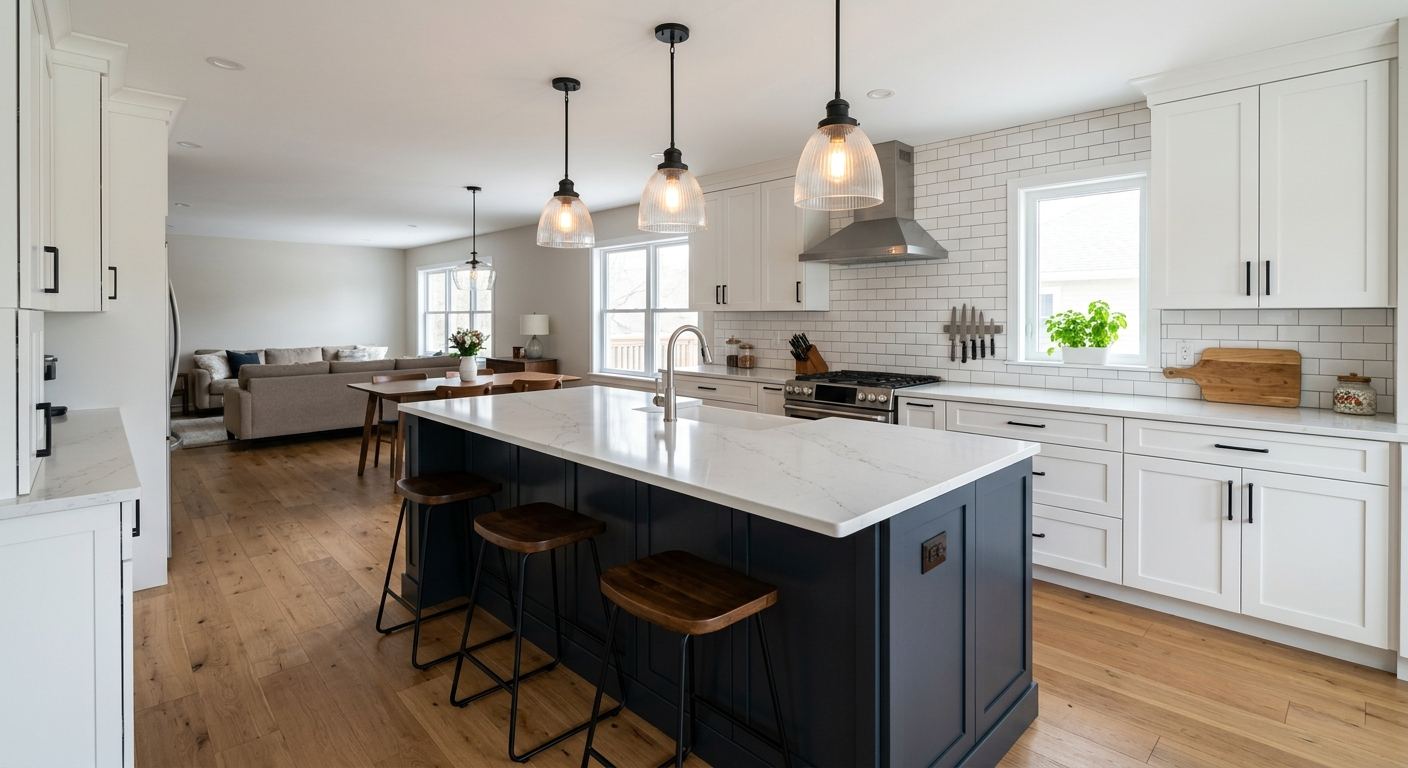
Kitchen renovation options and costs in Lyndhurst
Lyndhurst is a small community in British Columbia, and that often means kitchen renovations are planned carefully to balance budget, lead times, and resale expectations. With a population of 5,370 (Statistics Canada, 2021 Census), many projects draw on regional trades who routinely work throughout the Lower Mainland–Southwest. In this part of BC, pricing is driven more by the local housing market than by climate—owners in higher-value areas tend to choose semi-custom or custom cabinetry and quartz/stone counters because it helps the renovation “hold value” on resale. (Statistics Canada, 2021 Census) While Lyndhurst itself is not a big condo market, Lower Mainland–Southwest projects feeding buyers and finishes from nearby communities can still push premium materials into the mainstream.
Seasonality matters too, but it’s usually about scheduling: damp weather and temperature swings can slow drying for paint, caulking, and tile setting, and it can extend timeframes on jobs that involve exterior ventilation changes or extended drywall work. At the same time, the region’s steady demand for renovations keeps contractor availability relatively consistent compared with other provinces. In practice, you’ll feel the biggest cost shifts when you change the cabinet tier, countertop type, or layout—especially if plumbing or gas routing must be adjusted. Trades for cabinetry installs and countertop templates are especially in demand around the Fraser Valley corridor, and that demand can translate into different start-date options for Lyndhurst homeowners.
Below are realistic tiers contractors typically quote in the Lower Mainland–Southwest, and how they compare at a glance.
| Renovation Tier |
What's Included |
Typical Duration |
Price Range |
| Cosmetic refresh (paint, hardware, new appliances only) |
Cabinet paint or trim touch-ups, new hardware, new sink/faucet only if already compatible, appliance swap, basic caulking and re-seal |
3–7 days install + 2–5 days scheduling/curing |
$8,000–$22,000 |
| Mid-range full renovation (new cabinets, counters, sink, tile) |
Semi-custom or upgraded stock cabinets, new countertops, sink/faucet, backsplash tile, under-cabinet lighting where wiring exists, flooring refresh or limited replacement |
3–6 weeks (template → install) |
$40,000–$85,000 |
| High-end full renovation (custom cabinets, stone counters, island) |
Fully custom millwork, quartz/stone slabs, full backsplash, upgraded appliance package, island with electrical/plumbing coordination, premium lighting and trim details |
6–12 weeks (longer approvals and fabrication) |
$85,000–$120,000 |
| Cabinet refacing only (new doors + drawer fronts, same boxes) |
New door/drawer fronts, new hardware, repaint/finish refresh of cabinet frames as needed, basic cleaning/adjustments |
1–3 weeks |
$8,000–$35,000 |
| Countertop swap only (laminate to quartz or stone) |
Remove laminate tops, new quartz/stone slab templating, install, cut-outs, new sink set if specified |
1–3 weeks |
$12,000–$50,000 |
| Backsplash tile installation only |
Tile supply and install, surface prep, waterproofing measures where required, grout sealing (if applicable), caulking details |
3–7 days |
$1,500–$6,000 |
Prices are estimates only and vary by project scope, site access and material selection.
What affects the price of kitchen renovation in Lyndhurst
In the Lower Mainland–Southwest, you can see quotes for the “same” kitchen that differ by 30–50% because the finish tier, cabinet construction, and how much the layout changes don’t track climate—they track market demand and buyer expectations. Across British Columbia, higher-value areas tend to normalize quartz or stone counters, semi-custom cabinetry, and design-led layouts, so contractors price labour and materials accordingly. In more budget-focused scopes, laminate and stock cabinets dominate, and the renovation is positioned more as a functional refresh than a resale upgrade.
Local home values and household income strongly influence what homeowners choose, and that drives installer workflow and material sourcing. In higher-value {region} markets, homeowners often default to quartz or stone counters and semi-custom cabinetry because the cost is more readily recovered on resale; the same kitchen in a modest market may keep laminate and stock cabinets to protect ROI. In Lyndhurst specifically, older housing stock (common across many Fraser Valley communities) can add hidden costs during tear-out—uneven wall framing, dated plumbing rough-ins, and older subfloor conditions become visible once cabinets come off.
Two practical examples show how conditions raise or lower costs. First, if you upgrade from laminate to quartz, many projects land in the countertop swap band of $3,000–$12,000 for straightforward runs, but can rise quickly if you also replace a sink or modify cut-outs for taps. Second, if you keep cabinetry boxes and do refacing, you may stay in the cabinet installation/refacing range around $8,000–$50,000; however, if the existing boxes are out of level or water-damaged near sinks, the scope quietly expands. Layout changes are the biggest unpredictable swing—removing a wall, adding an island, or moving a gas line typically shifts cost far more than whether your doors are shaker-style or slab-style.
| Price Factor |
Why It Matters |
Cost Impact |
| Cabinet tier — stock vs. semi-custom vs. fully custom millwork |
Pricing changes with lead times, build quality, interior organizers, and whether sizes are made-to-fit |
Low to high swing; custom millwork commonly pushes the project into the upper full-renovation band |
| Countertop material — laminate vs. quartz vs. granite vs. stone |
Material cost plus complexity of edges, seams, and cut-outs affects fabrication and install time |
Laminate is lowest-cost; quartz/stone adds budget quickly once you include sink/feature cut-outs |
| Layout change — wall removal, island add, plumbing/gas move |
Triggers framing, inspections, electrical/plumbing coordination, and can uncover old rough-in issues |
Typically the largest unpredictable increase regardless of finish level |
| Appliance package tier — builder vs. mid-range vs. pro-grade |
Pro-grade models often require matching trim kits, venting specs, and more complex installs |
Can add thousands quickly; also affects electrical/plumbing coordination |
| Flooring — refinish existing vs. full replacement |
Some kitchens have transitions that must be preserved; full replacement increases labour and material waste |
Refinish keeps costs restrained; full replacement broadens scope and adds subfloor checks |
| Backsplash — ceramic tile vs. marble vs. full-height slab |
Premium materials increase both cutting complexity and labour time; full-height adds waterproofing |
Tile-only can be modest; full-height stone slab can become a major line item |
| Electrical — new circuits for island, under-cabinet lighting |
New circuits may require panel work, licensed electricians, and inspection scheduling |
Can add cost even in cosmetic scopes when island power/lighting is added |
| Permit fees and licensed trade requirements |
Some work is permit-requiring and must be done by licensed trades, adding admin and inspection steps |
Usually manageable, but it’s a real cost/lead-time factor once plumbing/gas/electrical is changed |
Permits & regulations in British Columbia
In British Columbia, a lot of kitchen “swap” work is straightforward from a permitting standpoint, but the moment you change services, the paperwork starts. Cabinet and countertop swaps typically do not require a permit, because you’re replacing finishes on existing rough-ins. Similarly, replacing appliances with like-for-like models usually stays in the refresh lane—provided venting and hookups don’t change beyond what the existing setup supports.
What does require permits and licensed trades includes: moving plumbing supply or drain lines (for example, relocating a sink), relocating gas lines or changing the gas stove/range hood configuration, removing a load-bearing wall, and adding new electrical circuits (like power drops for an island or new under-cabinet lighting if it requires new wiring). Gas work must be performed by a licensed gas fitter, and electrical work must be performed by a licensed electrician, with inspections where required.
For a Lyndhurst homeowner, the verification process is practical: ask the contractor for (1) their licence information, (2) certificate of liability insurance, and (3) proof of coverage letter for workers (the coverage is commonly handled through the WCB system in BC). Then confirm the details yourself: check the contractor’s licence status through the appropriate online registry for BC trades, review the insurance certificate dates and named insured, and ensure the coverage letter is current before work starts. Finally, make sure the contract clearly states who pulls permits and who pays for them—don’t assume it’s automatic.
Cabinets, countertops and layout decisions in Lyndhurst
For most Lyndhurst kitchens, three decisions control 80% of the outcome: (1) cabinet tier, (2) countertop material, and (3) layout changes. Cabinet tier is the backbone of your budget and timeline. Stock cabinets are fastest and typically cheapest, but their standardized sizing can leave awkward fit around older walls. Semi-custom cabinets are usually the sweet spot in the Lower Mainland–Southwest: you get better sizing flexibility and interior options without the full fabrication premium of custom. Custom cabinets create the tightest fit and best storage, but they carry longer lead times and higher labour for installation and finishing.
Countertops should be chosen with real daily use in mind. Laminate can be a cost-effective refresh, while quartz engineered slabs tend to be the most common upgrade in mid-range renovations because they’re durable, stain-resistant, and relatively maintenance-friendly in BC’s damp-driveways-to-indoor reality (humidity management is mostly about ventilation). Natural stone like granite looks premium and handles heat better, but marble is more sensitive to etching and acids.
Layout changes are where value can be either earned or wasted. If you have room to add an island or open an adjacent wall, the payoff is often stronger in resale markets because buyers expect smoother traffic flow. But moving plumbing or gas lines rarely “saves money,” even when the material tier is restrained. For example, upgrading your counters from laminate to quartz might be a straightforward jump within the countertop band (about $3,000–$12,000 for basic swaps), but if that swap requires re-cutting around a changed sink or added electrical for an island, the cost can escalate well beyond what homeowners budget for.
| Option |
Durability |
Maintenance |
Best For |
Price Range |
| Stock cabinets (big-box) |
Good for standard layouts; hinges and finishes vary by line |
Low routine care; occasional adjustment needed for older-wall installs |
Budget-first renovations and quick turnarounds |
$8,000–$25,000 |
| Semi-custom cabinets (local dealer) |
Very solid build; better options for drawers, organizers and sizing |
Low; easier to keep aligned and sealed in non-perfect spaces |
Most mid-range full renovations in the Lower Mainland–Southwest |
$20,000–$55,000 |
| Custom cabinets (local millwork shop) |
Highest fit and finish; tailored storage and stronger long-term design |
Low; finishes still require routine cleaning and moisture management |
Design-led kitchens and hard-to-fit older homes |
$45,000–$90,000+ |
| Laminate countertop |
Resists everyday wear but can chip at edges and scuff with heavy use |
Wipe clean; avoid standing water at seams and re-seal where needed |
Cost-conscious refreshes |
$3,000–$7,000 |
| Quartz engineered countertop |
High scratch and stain resistance; consistent performance |
Low maintenance; typical cleaner only, no sealing required |
Most popular upgrade for resale-friendly durability |
$7,000–$12,000 |
| Granite / natural stone countertop |
Very durable and heat-tolerant; natural variation in pattern |
Often requires periodic sealing and careful attention to spills |
Premium look with strong everyday performance |
$9,000–$15,000 |
| Butcher block countertop |
Great warmth and repairability; sensitive to prolonged moisture |
Oil periodically; keep sink sealing tight and manage humidity |
Homes that want a softer, artisan look |
$6,000–$12,000 |
| Marble countertop |
Luxurious appearance; more prone to etching and staining |
Requires sealing and gentler cleaning habits |
Low-scratch, design-forward kitchens with careful daily use |
$10,000–$18,000 |
How to choose a kitchen renovation contractor in Lyndhurst
Choosing the right contractor in Lyndhurst is mostly about verification and clarity. Start by confirming British Columbia licensing for the trades involved (general renovation contractors and specialty trades may vary by scope), then request proof of liability insurance with the policy active for the project dates. For worker coverage, ask for the current WCB/WCB clearance letter or proof of coverage and confirm it aligns with the company doing the work—not just a subcontractor. If anything feels vague, pause and ask for documents before signing.
Next, get 2–3 itemised written quotes that separate labour and materials—especially cabinetry, countertop fabrication, tile, demolition, and any electrical/plumbing allowances. A quote that’s only a single lump number often hides scope gaps (like whether disposal is included or whether permit pulls are the contractor’s responsibility). Read the schedule and exclusions carefully: are building permits included, is waste hauling included, and what exactly is not covered (hidden damage, subfloor repairs, drywall patching after cabinet installs)? Warranty matters too: confirm the workmanship warranty length, how long product warranties last, and whether any warranties are transferable to future homeowners.
On payment, keep it conservative: never pay more than 10–15% upfront. Hold back a portion until key milestones are complete—installation, inspection approvals, and final walkthrough. Finally, insist on a written start date and completion estimate so you can plan around lead times for cabinetry and countertops.
- Request BC licence details and confirm they match the company name on the contract.
- Verify liability insurance (active dates, coverage limits, and named insured).
- Ask for proof of WCB coverage or clearance letter for the project period.
- Get 2–3 itemised quotes (labour + materials), not lump sums.
- Confirm who pulls permits and whether inspection fees are included.
- Clarify demolition and disposal: what’s hauled away and what stays.
- Confirm cabinet warranty and countertop fabrication responsibility.
- Ask for workmanship warranty terms in writing (length and coverage).
- Check lead times for cabinets and slabs and whether the schedule allows for them.
- Set a payment schedule capped at 10–15% upfront; hold back until completion.
- Get a detailed change-order process so extras aren’t added informally.
- Ensure site protection and dust control are included for kitchens.
In Lyndhurst, red flags to watch for include: a quote that won’t itemise labour/materials, “no need for permits” claims when you’re moving plumbing or adding an island circuit, contractors asking for large upfront payments beyond 10–15%, vague warranty language, and crews that start demolition before templates/measurements are confirmed for cabinets and countertops.
Frequently asked questions — kitchen renovation in Lyndhurst
How do I budget for a kitchen renovation?
Budgeting in Lyndhurst usually starts with choosing a renovation tier, because the finish decisions drive most of the total. A cosmetic refresh (paint, hardware, and new appliances only) is often the most restrained path, while a mid-range full renovation typically moves into the $40,000–$85,000 zone once cabinets, counters, a sink, and tile are included. If you’re planning semi-custom or custom cabinets plus stone countertops and an island, you’re commonly looking at the upper full-renovation band up to $85,000–$120,000. Quotes can also move by 30–50% when layout changes require moving plumbing or gas and when electrical for an island is added. Ask for an itemised quote with allowances so you can see what’s truly included before you commit.
Can I move my kitchen sink or stove?
Yes, you can move a kitchen sink or stove in British Columbia, but whether it triggers permits and licensed trades is the key question. Moving a sink usually involves changing plumbing supply or drain lines, which typically requires permits and coordinated work by licensed plumbing trades. Relocating a gas stove or making changes to a gas range hood configuration generally requires permits and must be done by a licensed gas fitter. If you’re in Lyndhurst and you’re considering an open layout or island addition, it’s common to also add electrical circuits for lighting or outlets, which requires a licensed electrician and inspections. The practical advice: confirm the scope in writing—who is responsible for permits, inspection scheduling, and what happens if hidden plumbing rough-in issues appear during demolition.
What's the most cost-effective kitchen upgrade?
The most cost-effective upgrade is usually the one that improves how the kitchen functions without triggering major rework. In many Lower Mainland–Southwest kitchens, a cabinet refacing job is a strong value option because you can keep existing cabinet boxes and upgrade doors, drawer fronts, and hardware—often aligning with the $8,000–$35,000 refacing range. If your cabinets are already solid, a countertop swap from laminate to quartz can also be a high-impact upgrade with a relatively clear budget, often sitting in the countertop band like $3,000–$12,000 for straightforward installs (final pricing depends on seam complexity and cut-outs). For the best ROI, avoid pairing “low-cost” upgrades with layout changes—once you move plumbing/gas/electrical, the project stops being a cheap refresh.
Custom vs stock cabinets — is custom worth it?
Custom cabinets can be worth it when your kitchen layout is hard to fit or you want a very specific storage plan, but they aren’t always the best move in Lyndhurst for every homeowner. Stock cabinets are the fastest and least expensive path; they can work well for newer, square layouts. Semi-custom is commonly the popular mid-range choice in the Lower Mainland–Southwest because it offers better sizing flexibility than stock while keeping costs controlled. Fully custom is typically the most expensive because it requires made-to-fit fabrication and more detailed installation work. A useful way to decide: if you have older walls, uneven floors, or awkward alcoves, custom can prevent “filler-only” frustration and produce a cleaner look. If your layout is straightforward and resale buyers mostly want a modern, durable finish, semi-custom often delivers the best balance of cost and fit.
How do I choose a kitchen contractor in Lyndhurst?
Start with documentation and itemised clarity. In British Columbia, verify the contractor’s licensing details that apply to the scope, review their certificate of liability insurance, and confirm they have current WCB coverage or a clearance letter for the work period. Then insist on 2–3 itemised written quotes with labour and materials broken out—cabinet install, countertop templating and fabrication, tile, electrical/plumbing allowances, and disposal. Read the scope for exclusions like hidden damage, subfloor repairs, and whether permit pulls are included when you’re changing plumbing/gas/electrical circuits. Finally, check the warranty terms: workmanship warranty length, product warranty length, and whether warranties can transfer. Be cautious of contractors requesting more than 10–15% upfront or refusing to provide a written timeline for start and completion.
What order do kitchen renovation steps happen in?
Kitchen renovations in Lyndhurst typically follow a predictable sequence. First comes site measurement and design finalisation—cabinet and countertop templating can’t happen until rough planning is confirmed. Next is demolition and preparation: removing old cabinetry, disconnecting appliances as needed, and verifying subfloor and wall conditions. Then rough work is addressed early if you’re changing services—plumbing supply/drain moves, gas work, and electrical circuit additions—because walls must be closed before cabinets arrive. After rough work passes inspection (when required), the crew completes drywall/patching and surface prep, then installs cabinets, followed by countertops (templating before fabrication), then sink and hardware. Finally, install tile/backsplash, flooring transitions if included, finish painting, and appliance hookup. The critical scheduling note: countertop lead times can make or break your completion date, so always lock the template-to-install window in writing.