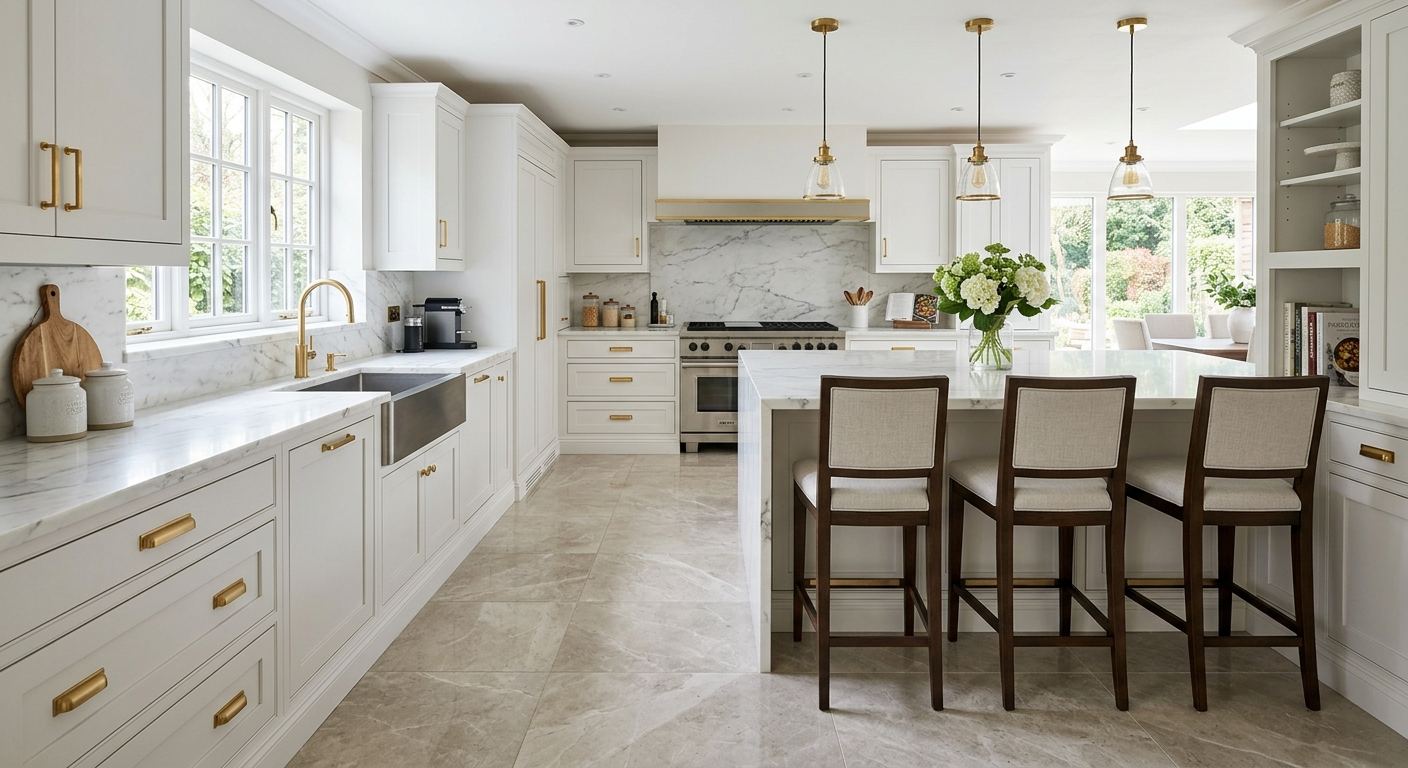
Kitchen renovation options and costs in Comox
Comox homeowners have several kitchen renovation paths, and the “right” one usually comes down to how far you want to go—and what finish level buyers will expect when you sell. With a median household income of about $83,000 (Statistics Canada, 2021 Census), many families in Comox plan a renovation that upgrades the heart of the home without overcapitalizing. At the same time, Comox’s mix of newer and older housing—39.6% of homes built before 1981 (Statistics Canada, 2021 Census)—often means existing layouts, wiring, and plumbing need a careful assessment before pricing can be locked in.
On Vancouver Island and the Coast, costs are driven more by local market expectations and home values than by weather itself. We still see island pricing hold closer to the provincial mid-range because contractors get booked steadily and stone/cabinet suppliers price according to the wider coastal demand. Neighbourhood-wise, trade activity is especially strong around the downtown Comox / Comox Valley edges (where many older homes and renovations cluster), and that can influence availability for demolition, cabinet installs, and tile work.
To help you compare quotes, below are the most common renovation tiers you’ll see in Comox, BC. Use these as a planning guide, then we’ll talk about what pushes the same scope up or down in Section 2.
| Renovation Tier |
What's Included |
Typical Duration |
Price Range |
| Cosmetic refresh (paint, hardware, new appliances only) |
Cabinet paint or refinish, new pulls/hinges, appliance swap (no major layout changes), light electrical refresh (e.g., switches/hood plug-out as needed) |
1–3 weeks |
$15,000–$35,000 |
| Mid-range full renovation (new cabinets, counters, sink, tile) |
New semi-custom or upgraded stock cabinets, new counters, sink swap, backsplash/tile, new faucet, disposal hookup, basic plumbing/electrical adjustments for fixtures |
4–8 weeks |
$40,000–$85,000 |
| High-end full renovation (custom cabinets, stone counters, island) |
Fully custom millwork, natural stone or premium engineered stone, island design/build, enhanced lighting, upgraded backsplash (often slab or full-height elements), appliance package tier upgrade |
8–14 weeks |
$90,000–$150,000+ |
| Cabinet refacing only (new doors + drawer fronts, same boxes) |
New cabinet door/drawer faces, new moulding/finishes, hardware upgrade, optional interior refinishing, minor adjustments for alignment |
1–3 weeks |
$8,000–$35,000 |
| Countertop swap only (laminate to quartz or stone) |
Remove existing top, new countertop install, sink cut-out changes as needed, standard undermount install, caulking and sealing where required |
3–10 days (plus templating lead time) |
$3,000–$12,000 |
| Backsplash tile installation only |
Surface prep, tile install, grout/seal, edge finishing and matching details around outlets |
3–7 days |
$2,500–$9,000 |
Prices are estimates only and vary by project scope, site access and material selection.
What affects the price of kitchen renovation in Comox
Even when two homeowners ask for the same “mid-range” kitchen, quotes on Vancouver Island and the Coast can vary by 30–50% across BC. The biggest drivers are usually local home values and the finish tier most buyers expect, not climate exposure. In higher-value coastal pockets of the region, homeowners often choose quartz or natural stone counters and semi-custom cabinetry because the renovation cost is easier to recover on resale. In more modest situations—like secondary suites or simpler layouts—laminate tops and stock cabinet packages keep ROI steadier and budgets more controlled. For Comox specifically, remember that many homes are older (39.6% built before 1981), so electrical panels, knob-and-tube history, or dated plumbing runs can trigger extra labour even if the visible kitchen looks fine.
Layout changes are where costs become hardest to predict: removing a wall, adding an island, or moving a gas line can add material, scheduling complexity, and permit scope that doesn’t show up in “apples-to-apples” comparisons. For example, a countertop swap only (often $3,000–$12,000) becomes a broader project if the new counter requires sink location changes or cabinet adjustments. Similarly, cabinet refacing ($8,000–$35,000) can rise if the existing box condition is poor—warped frames, moisture damage, or uneven walls may require repairs before doors will align.
Concrete Comox examples: (1) older walls may need additional blocking or shimming before cabinet installation to avoid misaligned fronts; (2) if you’re adding an island, electrical for under-cabinet or island lighting plus wiring runs often becomes its own cost line; (3) tiled backsplashes can climb quickly if your walls need flattening, especially in homes with older plaster/drywall transitions. These are the reasons your contractor’s site measurements and pre-renovation walkthrough matter as much as their estimate.
| Price Factor |
Why It Matters |
Cost Impact |
| Cabinet tier — stock vs. semi-custom vs. fully custom millwork |
Custom sizing, specialty storage, and finish craftsmanship change both material and install time |
Often the largest swing (commonly 30–40% of total budget) |
| Countertop material — laminate vs. quartz vs. granite vs. stone |
Material cost plus templating complexity and edge/undermount requirements |
Typically shifts projects by several thousand dollars; premium stone can escalate quickly |
| Layout change — wall removal, island add, plumbing/gas move |
Structural work, trades coordination, and permit scope drive unpredictable labour and schedule |
Can add significant cost and extend timelines regardless of finishes |
| Appliance package tier — builder vs. mid-range vs. pro-grade |
Electrical/gas requirements, venting, and fit/finish tolerances differ |
Often moves total budget by material and installation planning |
| Flooring — refinish existing vs. full replacement |
New underlay, subfloor repairs, and matching transition details |
May add mid-range cost or keep costs contained if you can re-use |
| Backsplash — ceramic tile vs. marble vs. full-height slab |
Complexity, wall prep, and labour intensity increase with larger-format premium materials |
Premium finishes can push this line item toward the upper end |
| Electrical — new circuits for island, under-cabinet lighting |
Licensed work and circuit extensions; impacts rough-in timing |
Usually adds cost and can affect schedule if discovered late |
| Permit fees and licensed trade requirements |
Permits, inspections, and compliance documentation add overhead and coordination |
Can increase total budget and slow start dates |
Permits & regulations in British Columbia
In British Columbia, not all kitchen work triggers permits. A cabinet and countertop swap (for example: replacing doors/drawer fronts or changing from laminate to quartz) typically does not require a permit on its own, because you’re not altering plumbing/drain lines, gas lines, structure, or adding new electrical circuits. However, the moment you change the “systems” behind the kitchen, permits and licensed trades usually become mandatory.
Work that typically does require a permit includes: moving plumbing supply or drain lines (sink relocation, adding a dishwasher where plumbing isn’t nearby), relocating gas (stove/range, changing gas line routing, or modifying a range hood system that’s gas-related), removing a load-bearing wall, and adding electrical circuits (for an island power bar, new under-cabinet lighting that requires circuit work, or relocating major outlets). Gas work must be done by a licensed gas fitter, and electrical work by a licensed electrician—both are subject to inspections.
For Comox homeowners, verify in writing before you sign anything. Step-by-step: (1) ask the contractor for their business number, then confirm their licensing and any trade subcontractors’ credentials; (2) request certificates of liability insurance and clearance/coverage documentation for workers—have them name the exact coverage provider and policy dates; (3) check product/install warranty terms in the contract; and (4) confirm which permits the contractor will pull versus what you must authorize. Permit responsibility belongs in the written scope so there are no surprises at rough-in or inspection time.
Cabinets, countertops and layout decisions in Comox
In Comox, there are three decisions that most strongly determine both the look and the final price: (1) cabinet tier, (2) countertop material, and (3) whether you change layout. Because many homes here are older (39.6% built before 1981), your starting point matters—existing wall straightness, subfloor condition, and wiring/plumbing locations can affect how quickly cabinets and counters can be installed without rework.
Cabinets: Stock is the fastest and usually the most budget-friendly, but semi-custom is the sweet spot for most renovations because it offers better sizing and storage while still staying within the $40,000–$85,000 mid-range band for full remodels. Custom cabinets give the best fit for awkward corners and true-to-your-life storage, but they’re the biggest driver of high-end projects that land in the $90,000–$150,000+ range. Countertops: laminate can be the most cost-effective entry choice, while quartz is a practical “lifestyle upgrade” for busy households—durable and low-maintenance. Natural stone (granite/stone) looks premium and ages well, but you pay more for slab material and installation care. Layout: opening a wall or adding an island is justified when it solves a real function problem (traffic flow, seating space, or work triangle). If you’re also relocating plumbing or gas, that cost can outweigh the benefit of a cheaper cabinet—especially if the space gain is modest.
Realistic dollar example: upgrading from laminate to quartz only is often a relatively contained change, commonly within the $3,000–$12,000 countertop-swap band—so it’s a high-impact choice without automatically triggering layout work. On the other hand, adding an island with electrical and plumbing coordination can push you into a broader remodel plan, where savings from choosing stock cabinets may disappear quickly once the new rough-in scope is accounted for. For resale on Vancouver Island, buyers typically expect clean lines, durable counters, and integrated storage at the mid-range finish level; island kitchens with premium stone and custom millwork are the “wow” tier.
| Option |
Durability |
Maintenance |
Best For |
Price Range |
| Stock cabinets (big-box) |
Good for standard dimensions; durability depends on construction quality |
Basic cleaning; adjustments may be limited if walls aren’t square |
Quick turnarounds and tighter budgets |
$8,000–$25,000 |
| Semi-custom cabinets (local dealer) |
Solid build with options for storage and better sizing flexibility |
Easy upkeep; hinges/drawers are typically built for daily use |
Most Comox mid-range remodels |
$20,000–$50,000 |
| Custom cabinets (local millwork shop) |
Highest fit and finishing; ideal for challenging layouts |
Care similar to premium wood finishes; best when cared for and sealed as specified |
Home-specific storage, premium aesthetics, long-term ownership |
$45,000–$90,000+ |
| Laminate countertop |
Susceptible to chips/heat marks if misused |
Wipe clean; avoid excessive heat and prolonged moisture at seams |
Value-focused refreshes |
$2,000–$4,500 |
| Quartz engineered countertop |
Highly durable surface; resistant to stains with proper care |
Low maintenance; typically no sealing like natural stone |
Busy households that want premium look without high upkeep |
$4,000–$10,000 |
| Granite / natural stone countertop |
Excellent heat and scratch resistance (varies by stone type) |
Often benefits from periodic sealing; clean spills promptly |
Premium, unique patterns for resale appeal |
$6,000–$14,000 |
| Butcher block countertop |
Strong for cutting surfaces; needs care to prevent warping |
Regular oiling/maintenance; protect from standing water |
Farmhouse/warm designs and daily cooking |
$4,500–$9,500 |
| Marble countertop |
Beautiful but more prone to etching/staining than quartz or many stones |
Requires mindful cleaning and sealing strategy |
High-end look where the kitchen is treated more like a showpiece |
$8,000–$18,000 |
How to choose a kitchen renovation contractor in Comox
Choosing the right contractor in Comox is mostly about verifying competence, not just getting a number. First, confirm British Columbia trade licensing for the relevant scopes. For example, ask who will be doing electrical and gas-related work; those trades should be performed by licensed professionals. Then verify liability insurance—request a certificate of insurance showing active coverage. For worker coverage, ask how the contractor handles worker compensation coverage and request the proof documentation they provide to clients. Don’t accept “we’re covered” as a statement—ask for the certificate or clear documentation and keep it with your contract file.
Next, get 2–3 itemised written quotes that break out labour and materials. A good estimate shows line items for demo, framing/cabinet install, counter templating, tile/backsplash prep, and electrical/plumbing allowances where applicable. Read the scope carefully: what’s excluded (old floor removal beyond X square feet, disposal, drywall patching), is permit pulling included, and what does disposal include (dump fees or just labour)? Warranty matters too—ask for workmanship warranty length, product/manufacturer warranty details, and whether warranties transfer if you sell the home. For payment schedule, never pay more than 10–15% upfront, and request a holdback until the job is complete and punch-list items are resolved. Finally, insist on the timeline in writing: start date, lead-time assumptions for cabinets/counters, and a completion target.
- Confirm licensing for all trade scopes involved and names of subcontractors
- Request certificate of liability insurance and confirm policy dates are current
- Ask for proof of worker coverage/WSIB/WCB-style documentation applicable in BC
- Require a detailed, itemised quote (not lump sum only)
- Check whether permit pulling is included or excluded
- Confirm what disposal/rubbish removal includes (dump fees vs labour)
- Verify who is responsible for unexpected subfloor/drywall repairs
- Ask about cabinet box leveling and wall prep standards
- Confirm counter templating date and who pays for re-templating if changes occur
- Get a warranty in writing (workmanship + manufacturer/product)
- Agree on a payment schedule with a holdback and defined completion criteria
- Require a written start and completion estimate, plus lead-time assumptions
Red flags in Comox kitchen renovations: (1) quotes that are unusually low without a detailed scope, especially on cabinets and counters; (2) promises of exact start dates without acknowledging cabinet/counter lead times; (3) missing or vague warranty terms; (4) reluctance to provide insurance/coverage documentation; and (5) payment requests beyond 10–15% upfront or no holdback until final sign-off.
Frequently asked questions — kitchen renovation in Comox
Should I reface or replace my cabinets?
In Comox and across Vancouver Island, the decision usually depends on box condition and how much you want to change the layout. Cabinet refacing (new doors and drawer fronts with the existing boxes) is often a strong option when the frames are sound, the cabinet boxes are straight, and you mainly want a new look. Typical pricing for refacing falls around $8,000–$35,000, which can free up budget for upgrades like quartz counters or better hardware. If your current boxes are warped, have water damage, or the layout needs major changes, replacement is usually the better long-term value—especially because older homes (39.6% built before 1981, Statistics Canada, 2021 Census) may hide issues behind the finishes. A contractor should inspect the box alignment and wall flatness before advising either route.
Do I need a permit for a kitchen renovation in British Columbia?
Often, no permit is required for straightforward cabinet and countertop swaps in British Columbia, such as replacing cabinet doors/drawer fronts (refacing) or changing laminate to quartz. However, permits are typically needed when the project changes building systems. If you move plumbing supply or drain lines (like relocating a sink), relocate gas (stove or range hood with gas), remove a load-bearing wall, or add/modify electrical circuits (common with island outlets or new lighting circuits), you should expect permits and licensed trade involvement. Gas work must be performed by a licensed gas fitter and electrical by a licensed electrician, with inspections. Before signing in Comox, ask the contractor to confirm in writing who pulls permits and what triggers them for your exact scope.
What's the ROI on a kitchen renovation?
ROI varies widely because buyers respond to layout, durability, and overall finish quality—but in Comox, a practical renovation that updates counters, cabinets, and lighting usually performs better than a “cosmetic-only” refresh when the rest of the home feels dated. Your starting condition matters a lot: upgrading aging surfaces and improving function can help a renovation feel worth the money during resale. In budget planning terms, many homeowners target the mid-range remodel band (commonly $40,000–$85,000) because it aligns with what many buyers expect for a modern kitchen without going fully custom. Fully custom rebuilds often exceed $90,000–$150,000+, which can be ROI-positive for certain buyers, but it’s best when the design truly fits the home and lifestyle. A good contractor can also align choices (e.g., quartz instead of laminate) with what’s most visible and valued at resale.
How do I budget for a kitchen renovation?
Budgeting in Comox starts with choosing a tier and then building contingency for real-world surprises. A typical full renovation planning range for kitchen work in your tier is often $35,000–$90,000, depending on cabinet/counter choices and whether you change plumbing or electrical. If you’re only doing a targeted upgrade, you can stay lower: countertop swaps commonly land in the $3,000–$12,000 band, and backsplash installation is often $2,500–$9,000. For layout-heavy work, allow for extra coordination costs and permits because moving gas/plumbing/electrical changes the scope and timing. Practically, ask for a quote that itemises labour and materials, then add a contingency for conditions you can’t see yet—especially in older homes where walls may not be perfectly flat and subfloor/plumbing runs may need corrections.
Can I move my kitchen sink or stove?
Yes, you can move a kitchen sink or stove in Comox, but whether it’s simple depends on what you’re moving and how far. Moving a sink typically involves routing plumbing supply and drain lines, which usually means permits and licensed plumbing coordination (and can require opening walls/floors). Moving a stove can be straightforward if it’s electric, but if it’s gas, relocating it generally triggers gas-line work performed by a licensed gas fitter plus permits and inspections. The quote should clearly state what’s included: demolition, rough-in, wall patching, any cabinet modifications, and how countertop cut-outs will be handled. A good approach is to decide on the new layout first, then let your contractor assess where the new plumbing/gas routes will run without making the kitchen feel compromised or costly.
What's the most cost-effective kitchen upgrade?
For many Comox homeowners, the most cost-effective upgrade is often “high-visibility, low-structure change.” A common example is swapping from laminate to quartz, which can usually be done as a standalone project and often lands in the $3,000–$12,000 countertop-swap band (assuming no major layout changes). Another strong option is upgrading hardware and fixtures, or a backsplash tile install in the $2,500–$9,000 range, because it transforms the look quickly without disturbing plumbing or major electrical. If your cabinet boxes are in good condition, refacing can also be cost-effective at $8,000–$35,000. That said, the best “value” upgrade depends on what’s currently driving the kitchen’s dated feel—if the cabinets are sagging or the layout is inefficient, you may get more satisfaction from a mid-range full remodel than from a single surface upgrade.