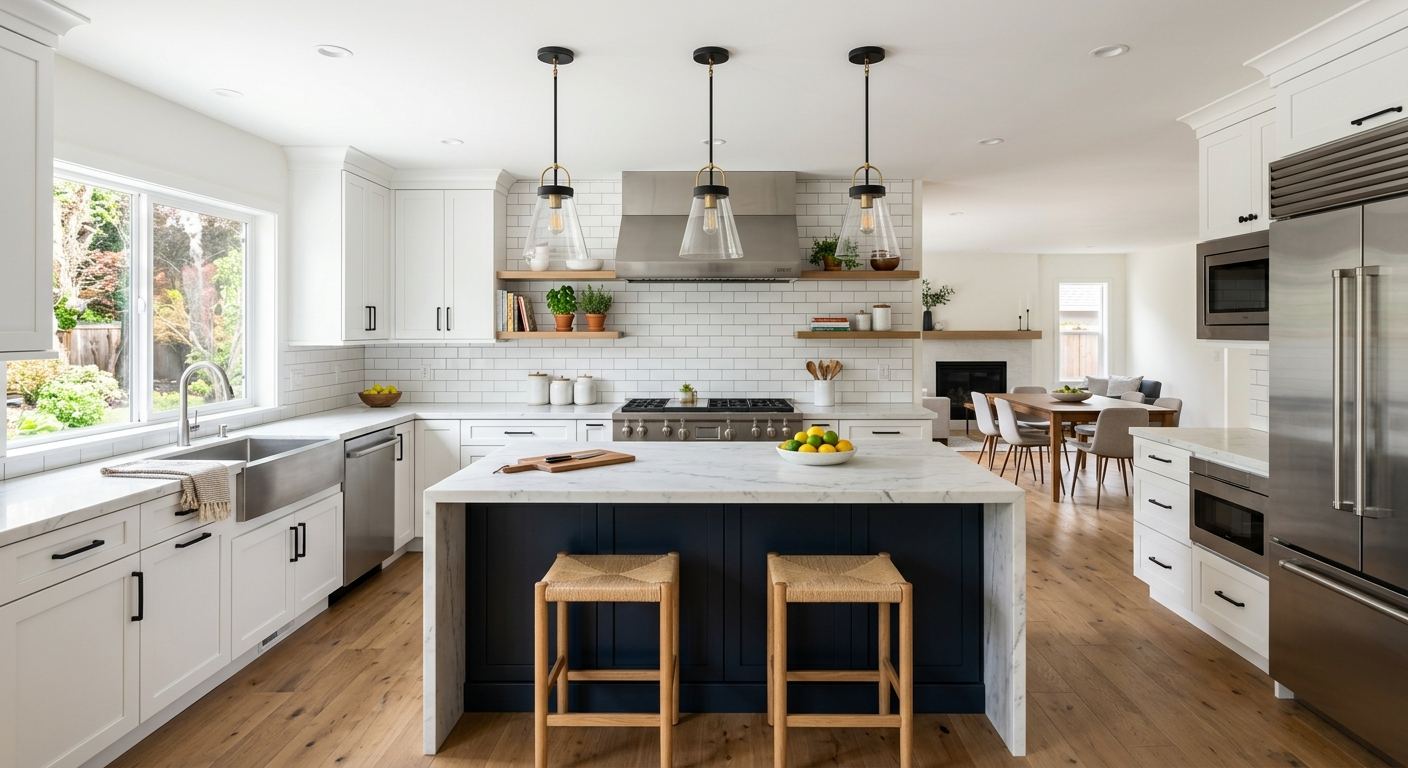
Kitchen renovation options and costs in Douglas-Gilpin
Douglas-Gilpin is a great example of how kitchen renovation pricing in the Lower Mainland–Southwest is driven more by buyer expectations and resale value than by “weather alone.” With a 2021 population of 10,234 (Statistics Canada, 2021 Census), the local work pipeline depends heavily on steady project flow from the broader Surrey–Abbotsford market, so scheduling and material lead times can shift when regional demand spikes. Home value and household purchasing power also matter; in higher-value Lower Mainland pockets, homeowners often choose semi-custom cabinetry and quartz or stone counters because the finish tier tends to be more recoverable at resale.
In British Columbia, the climate adds practical constraints—humidity swings, coastal moisture, and winter freeze/thaw around exterior penetrations mean we pay closer attention to ventilation, caulking details, and water line protection. That said, in this region the biggest cost drivers are still cabinetry complexity, countertop material, and whether you keep the existing plumbing and gas locations. A refresh can often be scheduled faster and priced lower because trades are limited to painting, hardware swaps, appliance installs, and limited finish work.
In Douglas-Gilpin’s older housing stock (common across the wider Lower Mainland), we frequently see kitchens where doors and drawer fronts are worn but the boxes are solid—making refacing a strong option. For neighbourhood-level demand, the trade is especially busy in the surrounding South Surrey / White Rock corridor, where families cycle through mid-range and premium remodels and require reliable lead times for cabinets and counters. With that context, here’s how the main renovation tiers typically compare.
| Renovation Tier |
What's Included |
Typical Duration |
Price Range |
| Cosmetic refresh (paint, hardware, new appliances only) |
Cabinet paint or repaint (or existing finish touch-ups), new pulls/knobs, appliance swap (same footprint), caulking at backsplash edges, minor trim repair |
3–7 business days |
$8,000–$20,000 |
| Mid-range full renovation (new cabinets, counters, sink, tile) |
New semi-custom or mid-range stock cabinetry, new countertops, sink + faucet, backsplash tile, updated trim/under-cabinet finishing, basic plumbing refresh if staying in-place |
3–5 weeks |
$40,000–$85,000 |
| High-end full renovation (custom cabinets, stone counters, island) |
Custom millwork, stone counters (quartz/stone), larger island with upgraded hardware, premium backsplash (often higher labour), expanded lighting/electrical, layout refinements |
6–12 weeks |
$85,000–$120,000 |
| Cabinet refacing only (new doors + drawer fronts, same boxes) |
New door and drawer fronts, new hardware, refinish/prepare existing boxes, optional new trim, re-seal joints, limited backsplash touch-up |
2–4 weeks |
$8,000–$35,000 |
| Countertop swap only (laminate to quartz or stone) |
Remove existing surface, install new quartz/stone, reinstall sink and faucet hardware (no layout move), edge profiling, seal at seams |
3–10 business days (plus templating) |
$12,000–$25,000 |
| Backsplash tile installation only |
Surface prep, tile supply/setting (ceramic/porcelain), grout, sealing at wet edges, caulking and finish trim |
3–7 business days |
$1,500–$6,000 |
Prices are estimates only and vary by project scope, site access and material selection.
What affects the price of kitchen renovation in Douglas-Gilpin
In Douglas-Gilpin and across the Lower Mainland–Southwest, the same kitchen size can come in 30–50% apart from one contractor to another, even when “upgrades” sound similar. The reason isn’t just labour—quotes swing based on assumed finish tier, how the contractor prices complexity (cabinet lead times, layout changes, specialty cut-outs), and whether the work includes allowances for permits, disposal, and electrical/plumbing updates. In higher-value parts of Metro Vancouver, buyers commonly step up to quartz or stone counters and semi-custom cabinetry, so contractors plan around premium material pricing and more detailed installation—pushing totals toward the upper end of the $40,000–$120,000 full-renovation band.
Across British Columbia, climate plays a smaller role in baseline cost than market-driven finish expectations, but it still affects how we build. Moisture management matters in coastal and winter conditions: ventilation upgrades, proper sealing around sinks, and protected water lines help prevent callbacks and delamination. That’s why a “like-for-like” refresh (paint + hardware + appliances) can stay relatively contained, while a layout change—removing a wall, adding an island, or moving a gas line—adds unpredictable trade coordination regardless of whether you choose laminate or quartz. Layout work also changes how long your kitchen is out of service, which tends to increase scheduling costs in busy Lower Mainland periods.
Here are concrete Douglas-Gilpin scenarios that commonly raise or lower the bill. First, if your current cabinets are true, straight boxes, refacing or a swap within the same footprint can keep cabinetry costs near the lower end of cabinet installs/refacing bands ($8,000–$50,000). Second, if you’re switching from laminate to quartz across an older counter run with uneven walls, you’ll often need more build-up labour and more templating time—pushing you toward the higher end of countertop installs ($3,000–$12,000, sometimes more once sink cuts and edge profiling are added). Third, if you’re located in an older home where wiring capacity is tight, adding under-cabinet lighting or an island circuit can add electrical costs quickly, even if finishes stay mid-range.
| Price Factor |
Why It Matters |
Cost Impact |
| Cabinet tier — stock vs. semi-custom vs. fully custom millwork |
Higher tiers mean more options for sizing, storage inserts, door styles, and better tolerance for awkward walls |
Can swing your cabinetry line by roughly $15,000–$45,000 on a full renovation |
| Countertop material — laminate vs. quartz vs. granite vs. stone |
Material cost plus templating complexity, seam placement, edge profiles, and installation labour |
Laminate tends to land near the low end; quartz/stone can add several thousand to $10,000+ depending on island and cut-outs |
| Layout change — wall removal, island add, plumbing/gas move |
Triggers trades coordination, structural considerations, and rework to electrical/plumbing/gas |
Typically the biggest variable; often adds $10,000–$30,000+ even when finishes are mid-range |
| Appliance package tier — builder vs. mid-range vs. pro-grade |
Rough-in tolerances, trim kits, ventilation needs, and power/gas requirements |
Can shift appliance allowance by $2,000–$15,000+ |
| Flooring — refinish existing vs. full replacement |
Removing cabinets affects flooring; full replacement adds demo/repair and moisture-mitigation work |
Refinish saves most labour; replacement can add $3,000–$12,000 depending on flooring type |
| Backsplash — ceramic tile vs. marble vs. full-height slab |
Labour intensity, substrate prep, and material fragility determine installation complexity |
Ceramic is usually lower; premium stone/full-height can double labour and material costs |
| Electrical — new circuits for island, under-cabinet lighting |
May require new breakers, routing wires, and additional fixtures/controls |
Often adds $800–$6,000 depending on scope and panel capacity |
| Permit fees and licensed trade requirements |
Permits and inspections apply to specific work; licensed trades schedule impacts costs |
Can add $500–$3,500+ plus scheduling overhead if work is complex |
Permits & regulations in British Columbia
In British Columbia, a straightforward cabinet and countertop swap typically does not require a permit, as long as you’re keeping the same plumbing and gas locations and you’re not changing structural elements. However, permits do come into play for the work homeowners often assume is “small,” like relocating supply/drain lines, moving a gas appliance setup, removing a load-bearing wall, or adding electrical circuits (for example, a new island receptacle run or under-cabinet lighting circuit).
Step-by-step, here’s how a homeowner in Douglas-Gilpin can verify a contractor’s coverage before work starts. First, confirm the contractor’s general licensing and business details through British Columbia’s online resources (then ask for the licence number in writing). Second, request a current certificate of insurance showing liability coverage, and verify the policy dates. Third, ask about workers’ compensation coverage (commonly referred to as WCB/WSIB in Canada)—the contractor should be able to provide proof of account coverage or clearance letter documentation upon request.
For specific regulated trades: gas work must be done by a licensed gas fitter, and electrical work must be done by a licensed electrician, both with required inspections. Always confirm who is responsible for permits in the written contract—so there’s no dispute after the fact about fees, inspections, or scope changes.
Cabinets, countertops and layout decisions in Douglas-Gilpin
When planning a Douglas-Gilpin kitchen renovation, there are three decisions that usually determine 80% of the outcome: (1) cabinet tier, (2) countertop material, and (3) layout changes. Cabinet tier drives speed, fit, and storage design. Stock cabinets are typically fastest and cheapest, semi-custom is the practical middle (especially for uneven older walls and common mid-range layouts), and custom millwork is the highest cost but can maximize storage and solve tricky dimensions.
Countertop material is where you feel “Lower Mainland taste.” In the Lower Mainland–Southwest resale market, buyers expect quartz or natural stone finishes at higher price points. Quartz is a balanced choice: durable for everyday use, lower maintenance than natural stone, and easier to keep looking consistent in the region’s humidity swings. Laminate is more budget-friendly and can look sharp with the right colour and edge, but it’s generally less resistant to heat and long-term wear than engineered and natural stone. Butcher block can be excellent in lifestyle homes if you’re willing to oil and maintain it—just note it needs a careful sealing approach around sink splash zones.
Layout changes are the most expensive because they force rework: removing a wall, adding an island, and moving plumbing or a gas line all require more trades and coordination. A simple example: if you keep the sink in place and only swap counters, many homeowners land within the countertop swap band (often around $12,000–$25,000 depending on the size and edge profile). If you move plumbing to relocate the sink, that same project commonly climbs toward the mid-range full-renovation band because you add licensed trades and re-planning, even if cabinet finishes stay mid-range.
For Douglas-Gilpin specifically, we also pay attention to how ventilation ties into your chosen layout. In older homes, upgrading range hood ducting and ensuring good airflow prevents lingering moisture around cabinets and backsplash—an important consideration even when the overall renovation budget is mid-range.
| Option |
Durability |
Maintenance |
Best For |
Price Range |
| Stock cabinets (big-box) |
Good for typical dimensions; durability depends on the finish and hardware quality |
Low; keep hinges adjusted and avoid standing water at seams |
Budget-conscious refreshes with straightforward wall lines |
$8,000–$25,000 |
| Semi-custom cabinets (local dealer) |
Very durable with better options for interior storage and fit |
Low; occasional hardware tightening |
Most Douglas-Gilpin homeowners aiming for a “real renovation” look |
$25,000–$60,000 |
| Custom cabinets (local millwork shop) |
Highest durability potential due to tailored construction and better tolerance for irregularities |
Low; maintain seals around moisture-prone areas |
Complex layouts, maximized storage, and premium finishes |
$60,000–$95,000 |
| Laminate countertop |
Moderate; can chip or wear with heat and sharp impacts |
Low; avoid prolonged heat exposure and re-seal at edges if needed |
Strong value when you want a refreshed surface quickly |
$3,000–$7,000 |
| Quartz engineered countertop |
High; resistant to stains and everyday wear |
Low; wipe clean, avoid cutting directly on the surface if possible |
Modern resale-friendly kitchens in the Lower Mainland–Southwest |
$7,000–$12,000 |
| Granite / natural stone countertop |
High; durable but varies by slab and finish |
Moderate; may require periodic sealing depending on the stone |
Premium look where you want natural variation |
$9,000–$18,000 |
| Butcher block countertop |
Moderate to high; great when maintained and protected |
Higher; oil/condition regularly and manage moisture at sink edges |
Warm, lifestyle-focused kitchens with attentive homeowners |
$5,000–$12,000 |
| Marble countertop |
Moderate; beautiful but more susceptible to etching and staining |
Higher; requires careful cleaning and periodic sealing |
High-end aesthetic kitchens with stricter care routines |
$12,000–$25,000 |
How to choose a kitchen renovation contractor in Douglas-Gilpin
Choosing the right contractor in Douglas-Gilpin is about verifying credentials and controlling scope risk. Start with licensing: ask whether the contractor is properly registered in British Columbia for the work they’ll perform, and confirm which licensed trades they’ll subcontract. Next, check liability insurance—request a certificate of insurance and ensure it’s current. For workers’ compensation coverage, ask for proof of WCB/WSIB clearance or account coverage documentation.
Then, get 2–3 itemised written quotes. You want labour and materials separated (cabinet supply vs install, countertop fabrication vs install, demolition/disposal, plumbing/electrical allowance, and any line-item allowances for tile or under-cabinet lighting). A lump-sum number hides the real risk: for example, whether disposal is included, whether the contractor allows for permit fees when plumbing/electrical triggers them, and whether backsplash substrate prep is priced.
Warranty and payment structure matter as much as price. Ask for the workmanship warranty length and whether the manufacturer’s warranty on cabinets/counters is included and transferable if you sell the home. Keep your deposit modest: never pay more than 10–15% upfront, and use a holdback until the job is complete and the deficiencies list is addressed. Also request a written timeline with start date and completion estimate, including cabinet/counter templating lead times.
- Request licence details and subcontractor information in writing.
- Verify liability insurance certificate is current and includes kitchen renovation work.
- Ask for WCB/WSIB clearance or proof of coverage before labour begins.
- Get 2–3 itemised quotes (not lump sums) with line-item allowances.
- Confirm who pulls permits and who pays permit/inspection fees.
- Confirm disposal is included (demo waste, packaging, and sweep-up).
- Ask who is responsible for site protection (floor protection, dust control).
- Verify countertop templating and change-order process.
- Confirm cabinet handling: delivery schedule, damage plan, and re-install policy.
- Get written start/completion dates and the plan for lead-time delays.
- Review warranty terms: workmanship coverage duration and exclusions.
- Use a payment schedule with ≤10–15% upfront and a holdback at near-completion.
For Douglas-Gilpin, common red flags I see are: quotes that omit permit responsibility for plumbing/electrical changes, no clear line-item allowances for tile and electrical work, a payment request larger than 10–15% without a written schedule, and vague “we’ll handle it” answers when homeowners ask for insurance and WCB/WSIB proof.
Frequently asked questions — kitchen renovation in Douglas-Gilpin
How long does a kitchen renovation take in Douglas-Gilpin?
A typical Douglas-Gilpin refresh (paint, hardware, and new appliances only) often finishes in about 3–7 business days, assuming appliances arrive on time. A mid-range full renovation with new cabinets and counters usually takes around 3–5 weeks from demo to final install, with cabinet and countertop templating as key timing gates. High-end builds that include custom millwork and an island commonly run 6–12 weeks because custom items and stone/quartz lead times stack up. If you’re moving plumbing/gas or adding electrical circuits, planning and inspections can add time regardless of material tier.
Quartz vs granite countertops — which is better?
For most British Columbia homeowners, quartz is the “easy best” for day-to-day use. It’s engineered, very consistent from slab to slab, and generally requires less maintenance than natural stone. Granite can be extremely durable and offers natural variation, but it may need periodic sealing depending on the stone and finish. In the Lower Mainland–Southwest market, quartz is a common choice in mid-range and higher-end renovations because it keeps its look with simple cleaning and tends to fit better within project timelines. If you’re budgeting around a countertop portion in the $3,000–$12,000 band, quartz often provides the best balance of performance and predictability.
Should I reface or replace my cabinets?
Refacing is usually worth considering when your existing cabinet boxes are solid, square, and not water-damaged—common in older Lower Mainland homes where the structure holds but doors and drawers look tired. Replacing is the better choice if boxes are warped, you need major storage redesign, or you’re changing layout details that refacing can’t fix. Budget-wise, cabinet refacing often fits roughly within the $8,000–$35,000 range, while a new cabinet install (mid-range to high-end) is commonly higher and can push a full renovation toward the $40,000–$120,000 totals depending on counters, tile, and any layout changes. A contractor should inspect for moisture issues at sinks and around plumbing before deciding.
Do I need a permit for a kitchen renovation in British Columbia?
In British Columbia, cabinet and countertop swaps alone typically do not require permits if plumbing/gas locations and structural elements aren’t changing. You generally do need permits and licensed trades when you relocate plumbing supply or drain lines, relocate or add gas work (like changing where a gas range sits or how it’s vented), remove a load-bearing wall, or add new electrical circuits. In Douglas-Gilpin, homeowners often underestimate electrical scope—an island circuit and under-cabinet lighting can trigger the need for permits/inspections depending on the work. Always confirm permit responsibility in the written contract so the responsibility for fees, inspections, and compliance is clear before signing.
What's the ROI on a kitchen renovation?
ROI in British Columbia is strongest when your renovation matches what local buyers expect for your home’s price point—function and durability generally matter more than going “over-premium” on finishes. In Douglas-Gilpin and the broader Lower Mainland–Southwest, a practical mid-range full renovation with quality cabinetry and quartz counters usually has better resale appeal than a short cosmetic refresh, especially if your layout is sensible and your materials are durable. That said, the exact ROI varies with your market timing and whether you added usable space (like better storage or an island) versus just updated surfaces. A realistic way to think about it is: cosmetic refreshes can improve daily value, while a full renovation in the $40,000–$120,000 band tends to align better with resale expectations when done thoughtfully.
How do I budget for a kitchen renovation?
Start by selecting the tier you actually want: a refresh, a mid-range full renovation, or a high-end rebuild. Then budget for the “unknowns” that hit more often in older homes—uneven walls for cabinetry installs, extra shimming/trim, and any electrical capacity issues. In Douglas-Gilpin, it’s smart to build allowances for backsplash prep and any floor adjustments because cabinet removal can reveal subfloor conditions. Keep an allowance for permits and licensed trade work when you’re moving plumbing/gas or adding circuits. As a planning reference, full renovations commonly land between $40,000 and $120,000, while countertops and backsplash can be significant line items even when the layout stays the same.