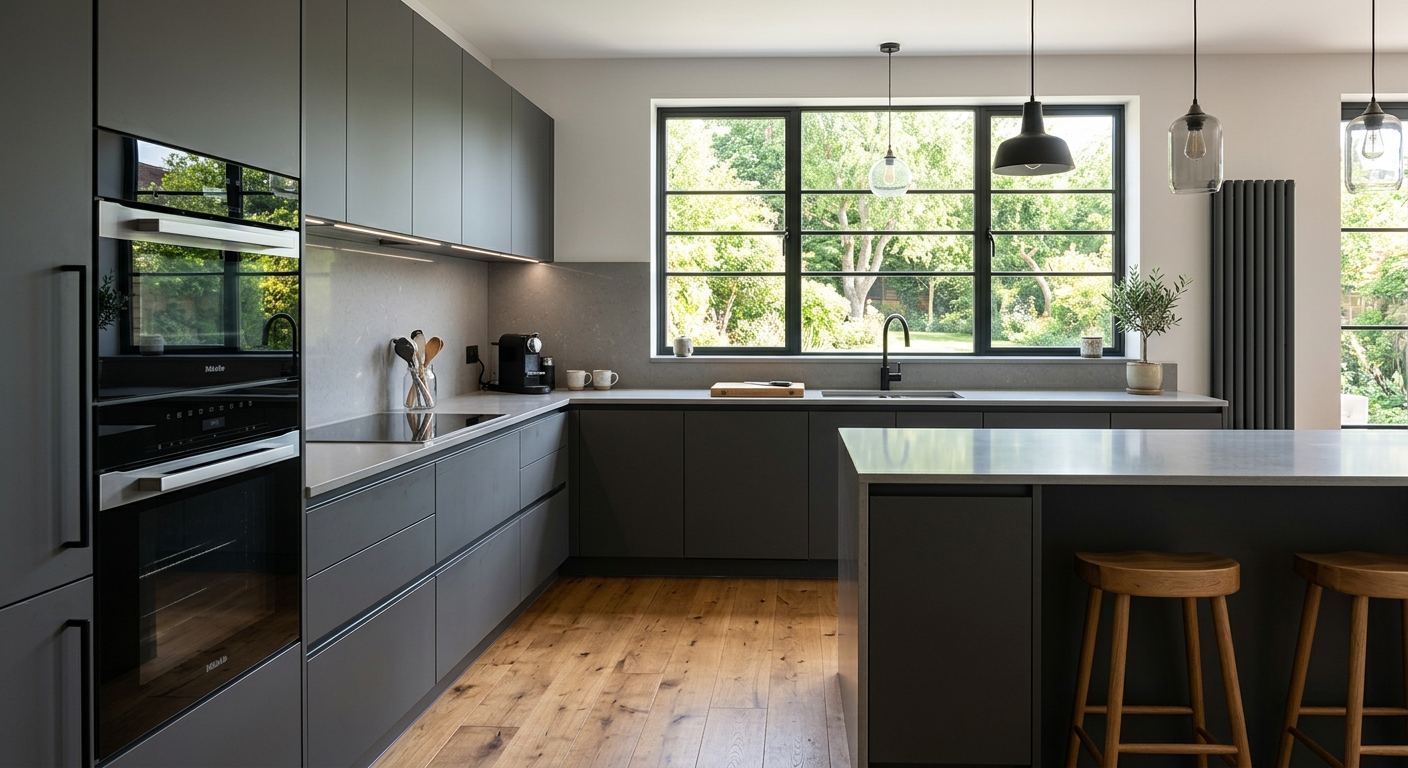
Kitchen renovation options and costs in Chartwell
Chartwell homeowners typically shop for a kitchen renovation by asking “what will it cost?” and the honest answer is that price depends first on finish expectations, not on the local weather alone. With a small population of 1,383 residents (Statistics Canada, 2021 Census), Chartwell’s market functions like a close-knit part of the Lower Mainland–Southwest where contractors are busiest when nearby Metro Vancouver demand is high. Because this region is strongly tied to housing values and household purchasing power (Statistics Canada, 2021 Census), many homeowners in higher-value pockets gravitate toward semi-custom cabinetry, quartz or stone countertops, and design-led upgrades that feel “move-in ready.”
In the Lower Mainland–Southwest, the climate plays more of a secondary role: humidity and frequent rain mainly affect how materials are installed and sealed—especially at window reveals, exterior-adjacent tile, and under-sink areas—rather than driving the major labour and material deltas. Costs are shaped more by the local trades pipeline and by the fact that Vancouver-area buyers often expect a cohesive, modern finish. That’s why the same kitchen can land as a practical refresh or as a full custom rebuild with an island and premium stone.
In Chartwell, demand is especially noticeable around the older housing stock near the Chartwell Village area, where owners commonly replace aging cabinets, update worn laminate tops, and rework lighting for a brighter kitchen. From there, the next step is choosing the renovation “tier” that matches your budget and how far you want to go—see the comparison table below.
| Renovation Tier |
What's Included |
Typical Duration |
Price Range |
| Cosmetic refresh (paint, hardware, new appliances only) |
Cabinet paint or stain touch-up, new hardware, new appliances (no cabinet/counter changes), basic caulking and hardware alignment |
2–5 weeks |
$8,000–$22,000 |
| Mid-range full renovation (new cabinets, counters, sink, tile) |
New semi-custom or quality stock cabinets, new counters, sink and faucet, backsplash tile, minor plumbing refresh, flooring refresh or patching, permit handling if needed |
6–12 weeks |
$40,000–$85,000 |
| High-end full renovation (custom cabinets, stone counters, island) |
Fully custom cabinetry/millwork, quartz or natural stone (including island), island framing, upgraded hardware and lighting, upgraded backsplash (tile accent or slab-style look), coordinated plumbing/electrical relocations |
10–16 weeks |
$85,000–$140,000 |
| Cabinet refacing only (new doors + drawer fronts, same boxes) |
New door and drawer fronts, new veneer/laminate where applicable, edge finishing, hardware swap, existing box modifications if needed |
4–8 weeks |
$14,000–$45,000 |
| Countertop swap only (laminate to quartz or stone) |
Remove and dispose of old surface, install new quartz or natural stone, cut-outs for sink/cooktop (keeping layout), backsplash join where applicable |
1–3 weeks |
$12,000–$28,000 |
| Backsplash tile installation only |
Tile supply and install, waterproofing and backer prep where needed, grout/seal, finish around outlets and venting spots |
1–3 weeks |
$3,500–$9,000 |
Prices are estimates only and vary by project scope, site access and material selection.
What affects the price of kitchen renovation in Chartwell
The same kitchen renovation can come in 30–50% apart across the Lower Mainland–Southwest and other parts of British Columbia because quotations reflect where a project sits in the housing market, not just the square footage. In Chartwell and nearby Metro Vancouver catchments, higher home values and higher finish expectations push homeowners toward semi-custom or custom cabinetry and quartz/stone counters, while more modest markets more often choose laminate and stock cabinets for better ROI. Climate is rarely the primary driver; it’s usually the installation conditions—moisture management at tile lines and sealing around exterior moisture paths—that add a bit of care.
Layout changes are the wildcard regardless of tier. Removing a wall for an open-concept sightline, adding an island, or moving a gas line and venting can add labour coordination and inspection time. Even when finish choices stay mid-range (for example, you’re still thinking around $40,000–$85,000 for a full renovation), the rough-in scope can make the project feel closer to a premium build.
Concrete Chartwell examples I see often: (1) older plumbing runs sometimes require selective valve/supply updates behind base cabinets before countertop install—this can add a day or two of trade time; (2) homes with limited in-suite access can increase handling/disposal costs, especially for stone slabs and full cabinet deliveries; and (3) kitchens with dated 120V electrical setups often need new circuits for island outlets and under-cabinet lighting, which raises pricing in the middle of the schedule.
For budget planning, think of it this way: a countertop swap alone might stay in the $12,000–$28,000 band, but adding cabinet changes and plumbing/electrical adjustments is where totals climb quickly once you’re beyond a “refresh” and into a true remodel.
| Price Factor |
Why It Matters |
Cost Impact |
| Cabinet tier — stock vs. semi-custom vs. fully custom millwork |
Material quality, door styles, internal storage upgrades, and how precisely it fits your walls and ceiling |
Can swing roughly $10,000–$45,000+ depending on how “custom” the layout becomes |
| Countertop material — laminate vs. quartz vs. granite vs. stone |
Different fabrication methods, edge profiles, seam planning and material cost per square foot |
Typical delta: $3,000–$12,000 between laminate and premium stone, plus install considerations |
| Layout change — wall removal, island add, plumbing/gas move |
Rough-in work, inspections, structural considerations, and coordination between trades |
Often the biggest jump; $8,000–$35,000 depending on complexity and whether utilities move |
| Appliance package tier — builder vs. mid-range vs. pro-grade |
Electrical/gas requirements, trim integration, ventilation specs and install allowances |
Common range shift $2,000–$12,000+ for labour/trade matching plus appliance pricing |
| Flooring — refinish existing vs. full replacement |
Uneven subfloors and traffic protection needs can add time; matching existing often reduces waste |
Can add $2,000–$10,000+ for replacement or significant rework |
| Backsplash — ceramic tile vs. marble vs. full-height slab |
Higher-end stone needs more precise prep and more complex finishing at corners and outlets |
Often $1,000–$6,000+ difference depending on material and height/coverage |
| Electrical — new circuits for island, under-cabinet lighting |
New circuits increase scheduling and permit/inspection time; wiring quality affects finish longevity |
Typically $1,500–$7,500+ if adding circuits and moving outlets |
| Permit fees and licensed trade requirements |
Permits, inspections, and licensed trade involvement are non-negotiable for certain work scopes |
Small line items individually, but overall coordination can add $1,000–$6,000 to the total |
Permits & regulations in British Columbia
In British Columbia, not every kitchen change needs a permit. Cabinet and countertop swaps typically do not require a permit because they’re considered finishing work when the plumbing, gas piping, structural elements, and electrical layout aren’t being altered. That said, the moment you change the kitchen’s “infrastructure,” the work usually triggers permits and licensed trades.
Work that commonly requires permits includes: moving plumbing supply or drain lines (for a relocated sink or dishwasher), relocating or modifying gas lines for the stove and the hood/venting, removing a load-bearing wall or making structural changes, and adding new electrical circuits (for island outlets, under-cabinet lighting tied into new wiring, or major appliance power requirements). Gas work must be performed by a licensed gas fitter, and electrical work must be performed by a licensed electrician—both require inspections before walls and finishes are closed in.
Here’s a practical step-by-step for a homeowner in Chartwell to verify a contractor before work starts. First, request the contractor’s current licence details (as applicable) and a copy of their liability insurance certificate; it should clearly list the insured party and coverage limits. Second, for subcontracted trades, ask for their own licence proof and insurance (the contractor should coordinate this). Third, confirm WSIB/WCB coverage appropriate to the trades involved by asking for the clearance letter or proof of coverage; don’t accept “we’ll handle it later.” Finally, verify permit responsibility in writing: who pulls the permits, who books inspections, and who pays fees. Always confirm these details in the contract—permit responsibility can be a hidden cost if it’s not spelled out.
Cabinets, countertops and layout decisions in Chartwell
Your three biggest decision points in a Chartwell kitchen renovation are cabinet tier, countertop material, and layout changes. In the Lower Mainland–Southwest resale market, buyers often reward kitchens that look cohesive and feel “built-in,” which is why cabinet and stone choices carry more perceived value than small paint upgrades. Stock cabinets are the quickest path to a refresh, semi-custom is the most popular balance for mid-range projects, and custom cabinetry shines when ceilings, corners, and wall conditions demand true made-to-fit planning.
Countertops should be chosen for realistic durability and maintenance. Laminate is budget-friendly and install-friendly, but it’s less resilient to heat and can show wear along edges. Quartz is a strong middle ground—low maintenance and consistent appearance—while granite/natural stone and marble provide premium aesthetics but may require more careful sealing and maintenance. Butcher block can be beautiful, but it needs ongoing oiling and protection to stay looking even, especially in humid coastal conditions where spills and ventilation matter.
Layout changes—open-concept wall removal, adding an island, or relocating plumbing/gas—are where costs jump, but they’re also the most transformative when the space gain matches how you live and how buyers assess usability. For a concrete example: upgrading from laminate to quartz might add a few thousand dollars, often keeping the project within a mid-range renovation budget, but adding an island plus moving a sink or gas line can push you into the higher-end full renovation band once rough-ins and inspections are included.
Because Chartwell homes can vary widely in age and original rough-in quality, the “right” decision is often the one that avoids expensive rework. If your layout change isn’t likely to pay back as a functional upgrade, a cabinet-and-counter focus usually gives the cleanest ROI.
| Option |
Durability |
Maintenance |
Best For |
Price Range |
| Stock cabinets (big-box) |
Durable for normal use; limited adjustment for out-of-square walls |
Minimal day-to-day care; hardware alignment may need fine-tuning |
Fast timelines and straightforward layouts |
$8,000–$25,000 |
| Semi-custom cabinets (local dealer) |
Very good durability; better fit and more storage options |
Low maintenance; hinges and drawer slides are typically easier to service |
Most homeowners targeting a modern look with good value |
$18,000–$55,000 |
| Custom cabinets (local millwork shop) |
Excellent durability; best fit for odd angles, ceilings, and panel finishes |
Low to moderate—generally straightforward cleaning, plus careful hardware care |
Layouts that require true built-ins and maximum resale appeal |
$35,000–$90,000+ |
| Laminate countertop |
Good for day-to-day use; edges can be the first wear point |
Wipe clean; avoid heat directly on surface and protect seams |
Budget upgrades and rental or “quick refresh” remodels |
$3,000–$7,000 |
| Quartz engineered countertop |
Very durable; resists staining and typical kitchen wear |
Easy—normal cleaners are usually sufficient; minimal sealing |
High-traffic family kitchens and buyers expecting a modern finish |
$7,000–$14,000 |
| Granite / natural stone countertop |
Highly durable; strong heat tolerance (varies by stone) |
Often benefits from periodic sealing; clean and wipe spills promptly |
Premium look with natural variation |
$9,000–$18,000 |
| Butcher block countertop |
Durable if maintained; sensitive to standing water |
Needs regular oiling and sealing; wipe immediately after spills |
Warm, traditional styles and kitchens with active prep-space habits |
$6,000–$12,000 |
| Marble countertop |
Beautiful but softer; can scratch and etch |
More careful maintenance—sealing and prompt cleaning for acidic spills |
Design-led kitchens where appearance is the priority |
$12,000–$25,000+ |
How to choose a kitchen renovation contractor in Chartwell
Choosing the right contractor in Chartwell starts with proof, not promises. In British Columbia, verify licensing for the trades involved and confirm the contractor’s liability insurance certificate (request the COI and check the named insured and coverage). For worker protection, ask for proof of WSIB/WCB coverage—most reputable builders can provide a clearance letter or coverage evidence upon request. If a contractor can’t provide documentation quickly, that’s a major scheduling and risk problem for you.
Next, get 2–3 itemised written quotes. Don’t accept “lump sum” only; insist on a labour + materials breakdown by major scope (demo, carpentry/cabinet install, countertop template and install, tile/backsplash, plumbing/electrical allowances, disposal). Then read the scope line-by-line: what’s excluded? Is permit pull included where required? Is job-site disposal included? Are there allowances for cabinetry adjustments due to out-of-square walls or ceiling lines? A properly scoped quote protects you from change-order surprises.
Warranty matters in kitchens—ask for the length of workmanship warranty and whether it covers callbacks for installation (not just manufacturing defects). Clarify the product/manufacturer warranty and whether it’s transferable if you sell. On payment, never pay more than 10–15% upfront; hold back a portion until completion and punch-list items are finished. Finally, request a start date and a realistic completion estimate in writing, including when countertop templates will happen and when inspectors need to visit.
- Request COI (liability insurance) and confirm active coverage dates.
- Confirm WSIB/WCB clearance/proof for applicable trades before work begins.
- Verify required permits are handled and spell out who pulls them.
- Ask which trades are subcontracted and request their licence/coverage evidence.
- Get itemised labour and material breakdowns (not just a single total).
- Ensure demolition, disposal and dump fees are clearly included or excluded.
- Check countertop scope: templating, seam planning, under-mount sink allowances.
- Confirm electrical scope: outlet relocation, island circuits, lighting integration.
- Clarify backsplash scope: waterproofing/backer prep, height, and cut-outs.
- Ask for a written warranty policy and define workmanship vs manufacturer coverage.
- Use a payment schedule with 10–15% max upfront and a holdback at completion.
- Lock an installation timeline with key milestones in the contract.
Red flags I hear about from Chartwell homeowners include: contractors who won’t provide insurance/licence proof, quotes that omit permits and disposal costs, unrealistic timelines that ignore countertop templating lead times, heavy reliance on vague “allowances” without ranges, and “change order only after materials are ordered” language that leaves you with no leverage.
Frequently asked questions — kitchen renovation in Chartwell
How do I choose a kitchen contractor in Chartwell?
Start by confirming the basics: liability insurance, proof of coverage for workers (WSIB/WCB where applicable), and that the right licensed trades are secured for plumbing/electrical/gas scope. In British Columbia, if your renovation involves relocating plumbing, adding circuits, or moving gas, you need the correct permits and inspections—so ask who pulls permits and how that’s handled. Next, compare 2–3 itemised quotes so you can see labour vs materials and the allowances used for cabinets, countertops, tile and fixtures. Even if your goal is a mid-range kitchen around $40,000–$85,000, a good quote will clearly show what’s included versus excluded. Lastly, verify workmanship and product warranties and whether they’re documented in writing.
What order do kitchen renovation steps happen in?
A typical sequence in Chartwell is: planning and measurements, then demo, then rough-in work, then insulation/drywall finishing, cabinet installation, countertop templating and fabrication, then countertop install and sink/cooktop fit. After that, backsplash and flooring transitions happen, and the final stages are electrical fixture installs, caulking/grout touch-ups, hardware alignment and final cleaning. If you’re moving plumbing or gas, the rough-in and inspection usually need to happen before cabinets and finished surfaces go in. Countertop timing matters: templates generally come after base cabinets are set and level, which is why a realistic schedule should list template dates and delivery/installation windows. A well-run project will also coordinate tile trades to avoid delays at the backsplash-to-countertop joints.
Can I live at home during a kitchen renovation in Chartwell?
Often yes, but it depends on how extensive your remodel is. A cosmetic refresh or backsplash-only project can usually be done with minimal disruption, but a full renovation (especially one involving plumbing/electrical changes) makes it hard to use the kitchen normally. Many Chartwell homeowners arrange a temporary setup: microwave, kettle, and a small prep area, while the main sink and cooking are temporarily offline. If you’re doing a high-end full renovation with an island, expect more dust-control and staged work. The key is how the contractor protects flooring, doorways and air quality, and whether you can secure a “clean route” for deliveries. In practice, projects that fall into the full renovation bands like $40,000–$120,000 usually require more planning for daily living than a refresh or countertop swap.
Should I renovate my kitchen before selling in Chartwell?
In Chartwell and the wider Lower Mainland–Southwest, kitchens are a major driver of buyer perception, but the “right” renovation depends on your current condition and what buyers in your price tier expect. If your kitchen has dated cabinets, worn counters, or tired lighting, a focused renovation can be worthwhile—particularly upgrades that look cohesive (cabinet and countertop alignment, modern hardware, and a clean backsplash). If you’re considering a full upgrade, many homeowners aim to land in a mid-range finish that reads modern without over-customizing. However, layout changes and premium stone only make sense when they improve function and usability, not just appearance. Avoid spending purely for trend coverage if the home’s overall layout still limits buyer utility. A good contractor can suggest a “sellable” scope that improves the kitchen without pushing the budget beyond what the market typically rewards.
What's the most popular kitchen style in Chartwell right now?
Based on what’s selling in the Lower Mainland–Southwest, the most popular direction is clean-lined, contemporary kitchens with warm neutrals: flat or soft-shaker cabinet fronts, quartz countertops, and a backsplash that reads as intentional but not busy. Many homeowners pair semi-custom cabinetry with simple hardware and integrated lighting to make kitchens feel brighter. Natural wood tones and matte black accents are also common, especially when paired with quartz that mimics stone veining. The reason is buyer familiarity: these looks photograph well, feel modern for years, and don’t require heavy maintenance. If you’re doing a cosmetic refresh only, new hardware and appliances can help, but most “style leap” projects are achieved through cabinets and counters. For budgeting, mid-range full renovations often land around $40,000–$85,000 with this approach.
How do I know if I need to update my kitchen plumbing in Chartwell?
You may need plumbing updates if you’re changing the sink location, adding a dishwasher where none exists, upgrading to a different faucet setup, or you notice leaks, slow drainage, or inconsistent water pressure. In older Chartwell homes, supply lines and shutoff valves can be outdated behind cabinet runs, and that can cause surprises once demo exposes the plumbing. Another trigger is countertop replacement: if your existing drain fittings and sink connections don’t match the new sink cut-outs cleanly, you’ll often end up with rework. A contractor should inspect supply valves and visible lines during the initial site visit and explain what’s functional vs what’s near end-of-life. If you are moving plumbing, remember it typically requires permits and licensed plumbing work in British Columbia, and those steps affect both the schedule and the total cost.