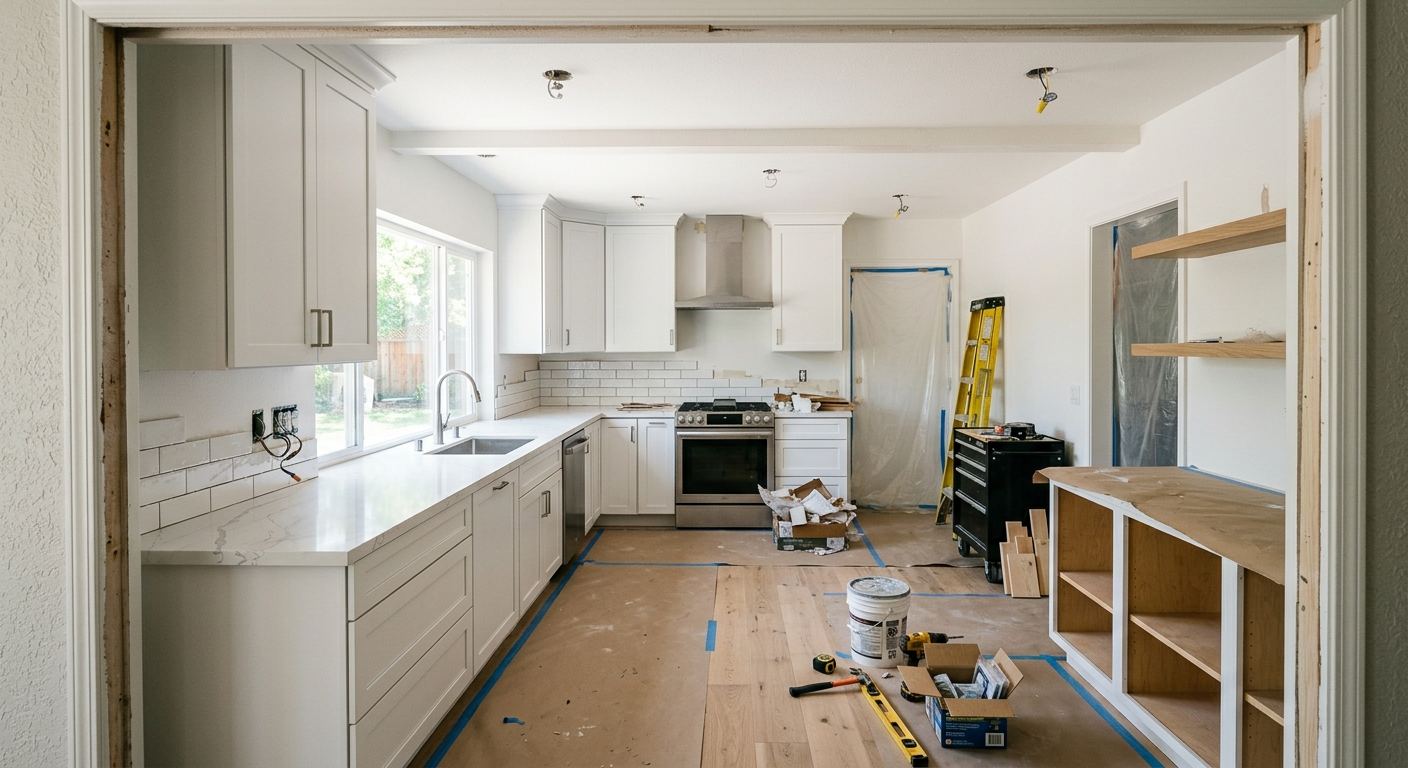
Kitchen renovation options and costs in Cove Cliff
Cove Cliff is a smaller community in the Lower Mainland–Southwest, so many kitchen quotes are shaped less by “remote” logistics and more by the finish expectations that typically track with nearby Metro Vancouver housing values. In the 2021 Census, Cove Cliff’s population was 1,778 (Statistics Canada, 2021 Census), and homeowners often plan renovations with resale in mind. In higher-value Lower Mainland pockets, buyers commonly expect quartz or stone counters, upgraded hardware, and cabinetry that fits the space cleanly—finish choices that push projects toward the upper end of the regional bands. Income and home value tend to influence that behaviour more than climate alone; British Columbia’s kitchen market is labour-rich, with plenty of cabinet and countertop suppliers that can support both refreshes and full rebuilds.
Climate still matters in practical ways: kitchens in coastal BC see high indoor moisture swings (from cooking and ventilation cycling), and that can affect cabinet installation tolerances, caulking, and flooring transitions. Good ventilation and proper sealing around the backsplash and sink help prevent premature wear, especially in older housing stock where subfloors and walls may be uneven. If you’re near the busier service corridors around Tsawwassen-area daily traffic routes, demand for installers and countertop crews can be steadier because trades are pulled across South Delta and surrounding communities.
Because the same kitchen can land anywhere from a fast refresh to a full rebuild, the easiest way to compare proposals is by “renovation tier,” which is exactly what the table below summarizes.
| Renovation Tier |
What's Included |
Typical Duration |
Price Range |
| Cosmetic refresh (paint, hardware, new appliances only) |
Cabinet/box touch-ups or re-paint, new pulls/knobs, install new appliances, minor caulking and basic trim touch-up |
3–7 business days |
$8,000–$20,000 |
| Mid-range full renovation (new cabinets, counters, sink, tile) |
New semi-custom cabinets, countertops, sink + faucet, backsplash tile, new flooring transitions (where needed), plumbing rough-in as required |
3–6 weeks |
$40,000–$80,000 |
| High-end full renovation (custom cabinets, stone counters, island) |
Custom millwork, quartz/stone counters, island build, upgraded hardware and lighting, upgraded backsplash (often slab or premium tile), more complex layout and trades coordination |
6–12 weeks |
$80,000–$120,000 |
| Cabinet refacing only (new doors + drawer fronts, same boxes) |
Door/drawer/front replacement, new pulls, updated finish, careful alignment work to existing boxes, optional under-cabinet updates |
1–3 weeks |
$8,000–$35,000 |
| Countertop swap only (laminate to quartz or stone) |
Remove/replace old surface, new quartz/stone install, sink cut-out and reseal, minor backsplash adjustments |
3–10 business days |
$3,000–$12,000 |
| Backsplash tile installation only |
Tile supply coordination, install and grout, edge trim and caulk detail at sink/range, sealing for relevant tile types |
2–7 business days |
$1,500–$6,000 |
Prices are estimates only and vary by project scope, site access and material selection.
What affects the price of kitchen renovation in Cove Cliff
In the Lower Mainland–Southwest, the same kitchen renovation can swing by roughly 30–50% when you compare proposals across British Columbia, mainly due to finish level and how “custom” the solution becomes—not because of weather. Local home value and household income affect what homeowners choose to recover on resale. In higher-value Metro Vancouver-leaning markets, people more often default to quartz or stone counters and semi-custom cabinetry, because buyers tend to reward those choices. In more modest scopes, laminate and stock cabinets dominate because the goal is a clean ROI without fully rebuilding millwork and trade openings.
Layout changes are the most unpredictable cost regardless of finish. Removing a wall, adding an island, or moving a gas line (and the related venting/clearances) can require additional rough-in labour, patching, and re-permitting—often pushing the project toward the mid-range or even high-end bands. For example, a refresh that’s mostly paint and hardware might sit near the lower part of the $8,000–$20,000 cosmetic tier, while a mid-range full renovation with new cabinets, countertops, and tile often lands in the $40,000–$80,000 band. If you add an island and premium stone, you can see totals move into the $80,000–$120,000 range quickly.
Two practical Cove Cliff examples: (1) older kitchens sometimes have uneven walls, so tile backer prep and cabinet scribing add labour even when materials stay “mid-range”; (2) coastal humidity makes moisture management around the sink and backsplash non-negotiable, and that can add sealing, upgraded caulking, and extra transition work. Contractor availability can also shift by season, but in BC it’s usually schedule timing—not climate exposure—that drives price volatility.
| Price Factor |
Why It Matters |
Cost Impact |
| Cabinet tier — stock vs. semi-custom vs. fully custom millwork |
Controls how much is made-to-fit, how precise the fit will be, and how many options exist for interior organizers and finishes |
Can shift the cabinetry component by several tens of thousands, often the biggest driver of total project cost |
| Countertop material — laminate vs. quartz vs. granite vs. stone |
Material and fabrication complexity affect labour time, template accuracy, and risk during install |
Typical countertop install band moves from about $3,000 toward $12,000+ depending on material and sink/cut-outs |
| Layout change — wall removal, island add, plumbing/gas move |
Requires more demolition, rough-in work, inspection coordination, and patching/refinishing |
Often adds the most unpredictable cost; can push projects from mid-range into high-end totals |
| Appliance package tier — builder vs. mid-range vs. pro-grade |
Controls fitting requirements, power/venting needs, and sometimes trim/clearance work |
Upgrades can add thousands, especially when venting or electrical changes are needed |
| Flooring — refinish existing vs. full replacement |
Existing subfloor condition determines how much prep is required under new cabinets and appliances |
Refinish is usually cheaper; full replacement adds demo, underlayment, and time |
| Backsplash — ceramic tile vs. marble vs. full-height slab |
Stone needs more careful measuring, different installation methods, and higher material costs |
Can move the backsplash-only scope beyond the $1,500–$6,000 band when slab or premium tile is selected |
| Electrical — new circuits for island, under-cabinet lighting |
More fixtures and receptacles require licensed electrical work and inspection |
Not usually the largest line item, but it can still add meaningful labour and permit coordination |
| Permit fees and licensed trade requirements |
Plumbing, gas, and electrical work trigger permit processes and inspections that can affect schedule |
Can add cost and time; schedule delays can compound labour costs |
Permits & regulations in British Columbia
In British Columbia, not every kitchen change needs a permit. Typically, cabinet and countertop swaps (for example, replacing laminate with quartz, or installing new cabinet doors and drawer fronts) do not require permits. However, if you’re moving plumbing supply or drain lines, relocating a gas stove/range, removing a load-bearing wall, or adding new electrical circuits (like extra receptacles for an island or dedicated lighting circuits), permits are generally required—and the work must be carried out by the appropriate licensed trades with inspections.
For Cove Cliff homeowners, a practical way to verify this before signing is to ask for the permit responsibility in writing. Then, confirm licences and coverage step-by-step:
- Check the contractor’s business: request a current certificate of insurance (liability coverage) and ensure the named insured matches the contracting entity.
- Verify licensed trades: ask who will do gas work, electrical, and any plumbing alterations. For each trade, confirm the licence status and that the person assigned to the site is actually the licensed party.
- Confirm worker coverage: request proof of workers’ compensation coverage (coverage documentation should be provided in the quote package or before work starts).
- Inspect permit handling: ask whether the contractor will pull permits (or coordinate with the licensed trade) and who pays permit fees.
Finally, make sure your written contract states exactly which tasks require permits, which trades will perform them, and that inspections are included—not “to be arranged” later.
Cabinets, countertops and layout decisions in Cove Cliff
Your biggest “value per dollar” decisions in a Cove Cliff kitchen renovation usually come down to three choices: cabinet tier, countertop material, and whether you change the layout. In the Lower Mainland–Southwest resale market, buyers often use visual cues to judge condition—straight cabinet lines, modern hardware, and a durable, cleanable counter surface. For that reason, stock cabinets are typically the fastest and cheapest route, semi-custom is the most popular mid-range choice when you need better fit and interior storage, and custom cabinetry is the highest cost but gives the most precise look where ceilings, corners, and soffits are tricky.
Countertop material matters for both daily life and maintenance. Laminate can be a budget win, but it’s more susceptible to chips and burns and typically doesn’t land as well with buyers compared to quartz. Quartz engineered surfaces are popular because they’re lower maintenance than natural stone and hold up well for busy kitchens. Natural stone like granite offers a premium look but usually costs more and demands more care than quartz. In wet coastal conditions, all countertops need proper sealing around the sink and careful caulk detail, especially in older homes with minor movement.
Layout changes are where budgets expand unpredictably. Adding an island or moving plumbing/gas can justify the spend when it truly improves workflow (for example, opening up traffic flow between dining and kitchen). But if you’re only chasing aesthetics, a counter + backsplash upgrade is often a better ROI. As a concrete example: upgrading from laminate counters to quartz is often within the broader countertop swap band (commonly around the $3,000–$12,000 range), while doing a full high-end rebuild with an island and custom millwork can quickly move into the $80,000–$120,000 band because of demolition, cabinetry, and added trades coordination.
| Option |
Durability |
Maintenance |
Best For |
Price Range |
| Stock cabinets (big-box) |
Good day-to-day durability; may show gaps if your room isn’t standard-sized |
Low; wipe clean and inspect hinges/alignments after installation settles |
Quick upgrades where the layout matches standard cabinet sizes |
$20,000–$40,000 |
| Semi-custom cabinets (local dealer) |
Very solid; better fit around ceilings/edges and more options for organizers |
Low; similar care to stock with improved hardware and fit |
Most Cove Cliff renovations aiming for a modern look without custom pricing |
$30,000–$65,000 |
| Custom cabinets (local millwork shop) |
Excellent fit and longevity; ideal for challenging corners and unique ceiling heights |
Low to moderate; requires quality installation and finishing |
High-end rebuilds where you want a built-in look that reads “intentional” |
$55,000–$95,000 |
| Laminate countertop |
Moderate; can chip at edges and is less forgiving to impacts |
Easy daily cleaning; avoid heat and cutting directly on the surface |
Budget refreshes and buyers who want a clean surface now |
$3,000–$6,000 |
| Quartz engineered countertop |
High; resists stains and daily wear well |
Low; wipe clean and keep seams sealed where applicable |
Mid-range to premium kitchens that need durability and modern appearance |
$6,000–$12,000 |
| Granite / natural stone countertop |
High; durable but depends on the specific stone and finish |
Moderate; may require periodic sealing and careful stain management |
Premium projects where you want natural variation and a luxury look |
$7,000–$14,000 |
| Butcher block countertop |
Moderate to high; solid wood but vulnerable to standing water and heat |
Higher care; regular oiling, and prompt wipe-down after spills |
Family kitchens that want warmth and can maintain the surface |
$5,000–$10,000 |
| Marble countertop |
Beautiful but softer; can etch with acids and scratch more easily |
Higher; sealing and careful daily cleaning to prevent etching/staining |
Showpiece kitchens with lighter wear patterns |
$10,000–$18,000 |
How to choose a kitchen renovation contractor in Cove Cliff
Choosing the right kitchen renovation contractor in Cove Cliff comes down to verification and clarity. First, confirm British Columbia licensing for each trade involved—especially gas and electrical—then verify coverage. Ask for proof of liability insurance (certificate of insurance showing coverage limits), and confirm workers’ compensation coverage for the crew. If the contractor uses subcontractors, request evidence for each trade that will enter your home. Where warranties depend on product registration or workmanship sign-off, get those details in writing before work starts.
Next, collect 2–3 itemised written quotes with a labour-and-materials breakdown rather than only a lump sum. A proper quote should show cabinet supply and install, countertop fabrication and install, plumbing or electrical labour where applicable, disposal, and any drywall/paint allowances. Read the scope carefully: what’s excluded (for example, patching beyond a certain depth, replacing damaged flooring beneath cabinets, or upgrading subfloor)? Is the permit pulling included where required? Is disposal and haul-away included, and where does it end? Also confirm the start date and completion estimate in writing, including lead-time assumptions for cabinets and countertops.
For payments, keep it controlled: never pay more than 10–15% upfront. Use a schedule tied to milestones, and hold back a final portion until the job is completed and inspected for workmanship. Warranty-wise, ask for workmanship warranty length, manufacturer warranty terms, and whether warranties are transferable to future owners (important for resale confidence in the Lower Mainland).
- Request a written scope that lists every included fixture, finish, and allowance item.
- Verify licence coverage for gas, electrical, and plumbing alterations before work begins.
- Get the contractor’s liability insurance certificate and confirm it covers the work on your address.
- Confirm workers’ compensation coverage is in place for the crew and subs.
- Use itemised quotes: line out cabinetry, countertops (fabrication + install), tile, labour, and demo.
- Ask what happens if cabinets arrive late—who pays for extended site labour and storage?
- Clarify disposal: demolition debris, packaging haul-away, and any recycling practices.
- Confirm permit responsibility for plumbing/gas/electrical changes and who books inspections.
- Ask how the contractor handles moisture protection at the sink and backsplash in coastal BC conditions.
- Review warranty documents: workmanship start date, length, exclusions, and service process.
- Set a payment schedule with a final holdback until punch list completion.
- Require a written schedule with milestone dates, not just a broad “estimated duration.”
Red flags to watch for in Cove Cliff: (1) quotes that don’t specify whether plumbing/electrical permits are included when you’re moving services, (2) no itemised breakdown for labour vs materials, (3) refusal to provide insurance/licence evidence or vague “we’re covered” statements, (4) pushing for large upfront payments beyond 10–15%, and (5) no written warranty terms or unclear product/manufacturer documentation.
Frequently asked questions — kitchen renovation in Cove Cliff
Can I move my kitchen sink or stove?
Yes, you can move a kitchen sink or stove in Cove Cliff, but the “can” depends on what you’re moving and what it triggers. Moving a sink usually involves changes to plumbing supply and/or drain lines; that typically means permit requirements and licensed plumbing work, plus inspection before closing walls. Moving a stove can involve electrical changes (for ignition/controls) and, if it’s gas, it often triggers gas permit needs with a licensed gas fitter. Even when the materials are straightforward, relocating these services usually affects your timeline because rough-in work must happen before drywall, cabinets, and countertop templating. If you’re comparing quotes, ask each contractor to list the exact rough-in scope and whether permits/inspections are included in their line items.
What's the most cost-effective kitchen upgrade?
In British Columbia, the most cost-effective upgrade is often a “high impact, low disruption” package: new hardware, a fresh paint finish, upgraded lighting, and a backsplash that modernizes the look—especially if your cabinet boxes are still solid. If you want the counter look to change without full demolition, a countertop swap is also one of the better value moves. Typical countertop installs for a direct replacement often land around the $3,000–$12,000 range depending on the material and sink cut-outs. Pair that with a backsplash tile install (often $1,500–$6,000) and you can transform the kitchen without the complexity of moving plumbing or gas lines. For a budget-controlled plan, ask for a scope that keeps your cabinet layout untouched unless you truly need a layout improvement for function.
Custom vs stock cabinets — is custom worth it?
Custom can be worth it when your room has challenging dimensions, off-standard corners, or you want a built-in look that reads “designed.” In Cove Cliff and across the Lower Mainland–Southwest, many homeowners choose semi-custom for the best balance: better fit than stock, with more options for interiors, usually at a lower cost than fully custom millwork. Stock cabinets can absolutely work well and are typically the fastest and cheapest route, but you may pay later in “finishing work” if gaps need more scribing, filler, or extra trim. If your total renovation is being compared across tiers, remember that cabinet tier alone can swing the project’s position inside the $40,000–$120,000 full renovation range. If you’re staying in a mid-range budget, semi-custom is often the sweet spot for appearance, storage, and resale appeal.
How do I choose a kitchen contractor in Cove Cliff?
Start with verification: confirm British Columbia licensing for the trades that will do gas, electrical, or plumbing alterations. Ask for the contractor’s certificate of liability insurance and proof of workers’ compensation coverage for the crew. Then get 2–3 itemised written quotes that split labour and materials, including disposal and any allowances for demolition, patching, or electrical/plumbing rough-in. A good contractor will clearly state what permits are required for your scope and who pulls them. Also confirm warranty terms: workmanship length, what’s covered, how claims are handled, and whether product warranties are registered and transferable. In a market like the Lower Mainland–Southwest—where finish expectations differ by neighbourhood—your contractor should also guide you on what buyers typically value at your likely price tier.
What order do kitchen renovation steps happen in?
A common, efficient order for Cove Cliff projects starts with design finalization, then demolition and rough-in work. If you’re moving plumbing or gas, those rough-ins happen first so drywall can close before cabinets and countertops. Next comes installation of cabinets (including base levels and wall hang points), followed by electrical/lighting trim work, and then countertop templating and fabrication lead time. Once counters are on, you install the sink, reseal at seams, and complete backsplash installation. Finally, finishing trades (paint/touch-ups, flooring transitions, caulking, and trim) come last. If you’re doing a smaller scope—like a refresh—your order compresses, but workmanship still matters: clean surfaces, correct prep, and careful sealing around wet areas. Always ask the contractor to provide a written sequence tied to their estimated dates.
Can I live at home during a kitchen renovation in Cove Cliff?
Often, yes—many homeowners in Cove Cliff live at home during a renovation, especially for cosmetic refreshes or countertop/backsplash-only scopes. However, for a mid-range or high-end full renovation (new cabinetry, tile, and sink changes), it’s common to plan temporary work-arounds because demolition creates dust and access issues, and rough-in work can temporarily limit water or appliance use. For example, a contractor-led mid-range renovation in the $40,000–$80,000 band typically runs several weeks, so you may need a “functional kitchen” setup in another room. If you’re doing plumbing or gas moves, the downtime is usually scheduled and localized, but it still requires planning. If staying at home, discuss dust control measures, a protected path, and how the contractor will manage deliveries and storage. Get it in writing so expectations are clear before the first day on site.