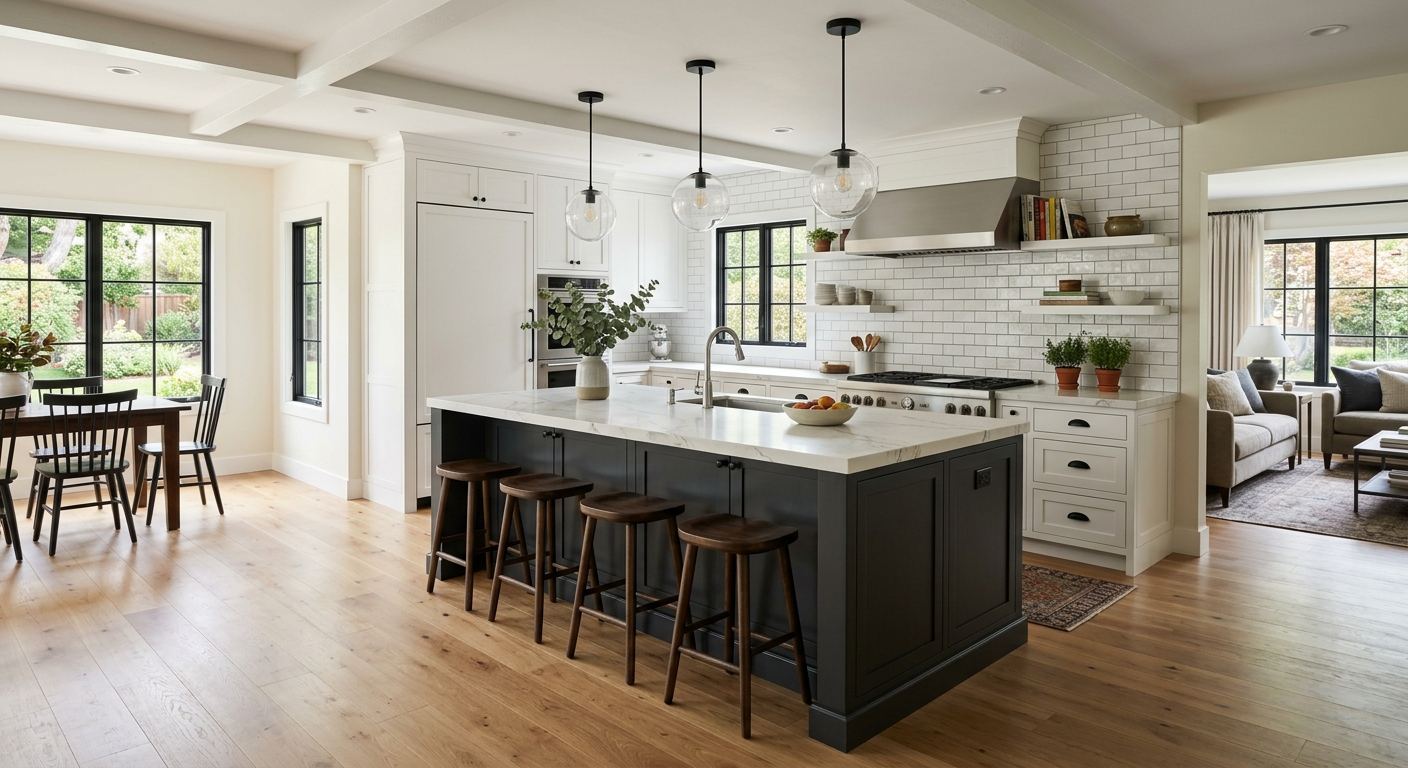
Kitchen renovation options and costs in Fort St. James
Fort St. James homeowners often ask what a kitchen renovation “should” cost, and the honest answer is that the right budget depends on how finish-focused you want the room to be. With a median household income of about $91,000 (Statistics Canada, 2021 Census), most renovations here land in practical mid-range upgrades rather than pure showpieces. There’s also a clear link to local buyer expectations: homeowner households make up 66.9% of households, so many projects are planned with long-term use and resale value in mind (Statistics Canada, 2021 Census).
In the Nechako economic region, the market tends to steer budgets based more on home value and the buyer profile than on climate alone. That said, our long winters and moisture swings mean kitchens see higher condensation and rapid wear on surfaces near sinks and exterior-facing walls. Contractors in and around town typically handle kitchen work year-round, with high demand especially in the downtown core and along Lakeside Drive where older housing stock concentrates.
In general, higher-value properties and owners willing to invest often choose custom cabinetry and quartz or natural stone counters—pushing total kitchen budgets toward the mid- to upper-range. Tighter budgets more commonly favour stock or semi-custom cabinets, laminate or entry-level quartz, and limited layout changes to keep spend closer to national renovation averages. From there, your “tier” largely determines everything: cabinet build quality, countertop material, how much tile and electrical work you add, and whether you relocate plumbing or gas lines.
Use the table below as a quick baseline for common scopes in Fort St. James, then we’ll break down what drives the final number in your quote.
| Renovation Tier |
What's Included |
Typical Duration |
Price Range |
| Cosmetic refresh (paint, hardware, new appliances only) |
Cabinet paint or touch-up, new hardware, appliance swap, minor trim/caulking |
3–7 days |
$8,000–$18,000 |
| Mid-range full renovation (new cabinets, counters, sink, tile) |
Semi-custom or quality stock cabinets, new countertop (laminate/quartz), sink + tap, backsplash tile, basic plumbing adjustments |
2–4 weeks |
$35,000–$60,000 |
| High-end full renovation (custom cabinets, stone counters, island) |
Custom millwork, premium quartz/stone counters, island build, full backsplash or feature wall, enhanced electrical (under-cabinet lighting) |
4–8 weeks |
$65,000–$90,000 |
| Cabinet refacing only (new doors + drawer fronts, same boxes) |
Door/drawer replacement, new hardware, light prep/paint where needed, optional backsplash patching |
1–2 weeks |
$8,000–$25,000 |
| Countertop swap only (laminate to quartz or stone) |
Remove existing top, install new quartz or stone, cut-outs for sink/cooktop, edge finishing |
3–7 days |
$3,500–$12,000 |
| Backsplash tile installation only |
Remove old backsplash (as needed), install new tile to chosen height, sealing/grouting, finish trim |
3–10 days |
$2,500–$12,000 |
Prices are estimates only and vary by project scope, site access and material selection.
What affects the price of kitchen renovation in Fort St. James
Even when two homeowners request the same “new cabinets and counters” in the Nechako region, quotes can differ by 30–50% because scope details are where cost hides: cabinet tier, countertop thickness and cut-outs, tile coverage, electrical upgrades, and whether plumbing or gas lines must be moved. In Fort St. James and across British Columbia’s interior, the biggest driver is usually not the weather—it’s what homeowners expect to recover on resale and what finish tier fits their household income and property value. In higher-value markets in the Nechako region, buyers more often expect quartz or stone and semi-custom cabinetry, so projects trend toward the mid- to upper-range. In more modest budgets, laminate or entry-level quartz and minimal layout changes help keep the total closer to national averages—often within the $35,000–$60,000 band for mid-range renovations.
Concrete Fort St. James examples I see often: (1) homes built before 1981 (60.2% of dwellings) usually have older subfloors and dated wall finishes, so cabinet installation may require additional prep and patching before tile goes in. (2) If your kitchen has exterior-facing walls, moisture exposure around sink runs can cause more drywall replacement than expected once the old backsplash is removed—shifting the budget even if you “aren’t changing the layout.” (3) Island additions or wall removals can trigger the most unpredictable cost. Moving drains, water lines, or a gas cooktop location can push you into higher labour hours and materials, even if cabinets and counters stay in the same tier.
As a rule of thumb, a countertop-only upgrade can sit in the $3,500–$15,000 range depending on material and sink/cooktop complexity, while a full high-end refresh with custom millwork and stone can climb toward the $65,000–$90,000 band when the scope includes island work and expanded electrical.
| Price Factor |
Why It Matters |
Cost Impact |
| Cabinet tier — stock vs. semi-custom vs. fully custom millwork |
Determines box quality, hardware options, door/drawer construction, and fit precision |
Biggest swing; often a 15–35% variance in total cabinet-related spend |
| Countertop material — laminate vs. quartz vs. granite vs. stone |
Material cost and fabrication complexity increase with thickness, edges, and cut-outs |
Can change countertop line items by several thousand dollars |
| Layout change — wall removal, island add, plumbing/gas move |
Trades coordination, demolition, framing, venting, and rerouting drive labour and permits |
Frequently adds the largest unpredictability (sometimes tens of thousands) |
| Appliance package tier — builder vs. mid-range vs. pro-grade |
Pricing, finish matching, and ventilation/clearances affect install details |
Usually shifts total project by a few thousand dollars to more |
| Flooring — refinish existing vs. full replacement |
Kitchen renovations often uncover subfloor issues and require transitions |
Can add moderate to major cost depending on repairs and finish tier |
| Backsplash — ceramic tile vs. marble vs. full-height slab |
Higher-end materials require tighter tolerances, more labour, and heavier panels |
Backsplash-only jobs can range broadly, from entry tile to premium walls |
| Electrical — new circuits for island, under-cabinet lighting |
Ensures safe load distribution and modern task lighting |
Common add-on; cost varies with wire runs and number of fixtures |
| Permit fees and licensed trade requirements |
Licensed trades and permits affect schedule, inspection coordination, and paperwork |
Not usually the biggest cost, but it can affect timeline and labour totals |
Permits & regulations in British Columbia
In British Columbia, many “swap-in” kitchen updates do not require a permit. For example, replacing cabinets in the same location and swapping countertop materials (including changing laminate to quartz or stone) typically does not require a permit. However, once your project involves changes to building services, you’re generally in permit territory: moving plumbing supply or drain lines, relocating a gas cooktop, removing a load-bearing wall, or adding new electrical circuits (such as for an island, additional outlets, or under-cabinet lighting where new circuits are needed) commonly requires permits and licensed trades.
Gas work must be completed by a licensed gas fitter, and electrical work must be completed by a licensed electrician. In practice, that means the trades pull the permits tied to their scope and arrange inspections as required—then you get the documentation you’ll want for resale and for your own records.
For a Fort St. James homeowner, the verification process is straightforward and should happen before signing anything: (1) Ask for the contractor’s licence details and check the public licence registry relevant to their trade; (2) Request a certificate of insurance showing liability coverage and confirm it’s active for the project dates; (3) Ask for evidence of workers’ compensation coverage (WSIB/WCB equivalent) for their employees and subcontractors; (4) Confirm who is responsible for permits in the written contract and whether the contractor coordinates them or just supplies contact information. If it’s not in the scope and paperwork, assume you’ll be the one coordinating it.
Cabinets, countertops and layout decisions in Fort St. James
For most Fort St. James renovations, there are three decisions that make or break both budget and daily satisfaction: (1) cabinet tier, (2) countertop material, and (3) layout changes. Cabinet tier is the foundation. Stock cabinets are the fastest and usually cheapest because they come ready-made; you get solid function, but limited sizing flexibility. Semi-custom cabinets are typically the best fit for Nechako homeowners—more choice in interior layouts (organizers, drawer depths, crown profiles) without the top-end cost of full custom. Custom cabinets are the highest cost option, but they shine when you have uneven walls, unusual dimensions, or you want an island and storage configuration that fits your lifestyle.
Countertops follow a similar pattern. Laminate is budget-friendly and quick to install, but it’s less heat- and scratch-resistant than higher tiers. Quartz is the most common “value upgrade” for mid-range projects because it’s durable, low maintenance, and forgiving in a busy kitchen—especially when you’re cleaning frequently during winter when kitchens are used more often. Granite/natural stone can add a premium look but may require different sealing and careful selection for your household’s maintenance habits. Butcher block is warm and practical but needs routine care to stay looking good. Marble is beautiful, yet it’s typically the most maintenance-sensitive choice for a high-traffic kitchen.
Layout changes are where cost gets justified—or not. In a home where you only want to refresh, skipping plumbing/gas moves keeps you closer to the $35,000–$60,000 mid-range band. If you add an island or change the sink location, the trade work and sometimes permit scope can push totals toward the high-end band like $65,000–$90,000. In older homes (60.2% built before 1981), expect that demolition can reveal extra patching needs, which makes planning and a clear scope so important.
| Option |
Durability |
Maintenance |
Best For |
Price Range |
| Stock cabinets (big-box) |
Good day-to-day durability with standard hardware |
Low maintenance; rely on careful installation for best results |
Fast timelines, budget-conscious refreshes, minimal layout changes |
$8,000–$20,000 |
| Semi-custom cabinets (local dealer) |
High durability with better interior options and fit |
Low; choose quality finishes and upgraded drawer systems |
Most renovations in Fort St. James aiming for durable mid-range quality |
$15,000–$35,000 |
| Custom cabinets (local millwork shop) |
Excellent durability; tailored construction and hardware options |
Low to moderate; maintenance follows finish type |
Unusual layouts, custom storage, islands, or resale-focused upgrades |
$30,000–$55,000 |
| Laminate countertop |
Solid for everyday use; can be sensitive to burns and impact |
Easy cleaning; avoid heat directly on the surface |
Entry budgets, rental-style durability needs, simple installations |
$3,500–$7,000 |
| Quartz engineered countertop |
Very durable and consistent; resists staining better than many materials |
Low maintenance; wipe clean and protect from heavy impact |
Mid-range “value upgrade” with a modern look that holds up |
$6,500–$12,000 |
| Granite / natural stone countertop |
High durability with natural variation in veining and hardness |
May need periodic sealing; clean with stone-safe products |
Premium look for homeowners who will manage basic stone care |
$9,000–$15,000 |
| Butcher block countertop |
Durable with proper sealing; surface wear is normal and manageable |
Needs oiling/conditioning and careful moisture handling |
Warm design preferences and households comfortable with upkeep |
$7,000–$13,000 |
| Marble countertop |
Beautiful but softer; more prone to etching and staining |
Higher maintenance; requires careful cleaning and protection |
Statement kitchens where owners prioritize aesthetics over heavy-use durability |
$12,000–$18,000 |
How to choose a kitchen renovation contractor in Fort St. James
Choosing the right contractor in Fort St. James is mostly about proof and clarity. In British Columbia, verify licensing and coverage before work begins: ask for licence information for relevant trades (or the main contractor’s registration where applicable), then check the public online registry for their status. Request a certificate of insurance (liability) showing coverage limits and ensure the certificate lists your project address or contains an acceptable general description of the work. Also confirm workers’ compensation coverage (WSIB/WCB equivalent) so you’re not stuck paying if someone gets hurt on site. For kitchen projects with multiple trades, get proof from each key subcontractor too.
Then get 2–3 itemised written quotes—not just a single lump sum. A proper quote breaks out labour and materials line-by-line (cabinets, hardware, install labour, countertop fabrication and install, tile materials, grout/sealers, electrical/plumbing work, disposal, and any repairs to drywall or subfloor). Read the scope carefully for exclusions: Is permit pulling included? Who pays for disposal and dump fees? Are appliance hookups included?
Warranty matters. Ask for a workmanship warranty term (and what it covers) and confirm the manufacturer/product warranty details for cabinets and countertops. Also clarify if any warranty is transferable if you sell your home. Payment should be staged—never more than about 10–15% upfront. Hold back a portion until cabinets are installed, counters are sealed, tile is complete, and punch-list items are corrected. Finally, ensure you receive a written start date and completion estimate tied to lead times.
- Provide written scope with itemised labour and materials (no vague “allowances” without amounts).
- Confirm who pulls permits and who pays for permit fees (if applicable to your scope).
- Get countertop fabrication and installation included (or clearly excluded) in the quote.
- Require a disposal/dump fee line item or explicit exclusion.
- Ask what happens if drywall or flooring damage is found during demo (change-order policy).
- Check insurance expiry date and ensure it covers the project duration.
- Verify workers’ compensation coverage for the contractor and key subcontractors.
- Confirm warranty length for workmanship and product warranty transferability.
- Make sure electrical/gas scopes are tied to licensed trade invoices where required.
- Request a cabinet installation method statement (shimming, fastening into studs, level checks).
- Get a schedule with milestones: demo, rough-in, cabinet install, counter templating, final install, tile, trim.
- Use a payment plan with a holdback until punch list completion and cleanup.
Red flags I see in Fort St. James: contractors who won’t provide insurance/coverage documents; quotes that don’t explain what’s excluded (especially disposal, subfloor repairs, or tile grout/sealer); vague countertop allowances that don’t specify edge profile and sink/cooktop cut-outs; pushing for large upfront payments (over 15%); or starting without a written timeline that accounts for cabinet and countertop lead times.
Frequently asked questions — kitchen renovation in Fort St. James
Custom vs stock cabinets — is custom worth it?
In Fort St. James, custom cabinets are “worth it” when your layout or walls demand flexibility or when you’re maximizing storage for everyday living. If you have an older home (60.2% built before 1981) you may run into uneven surfaces or unusual dimensions—custom can solve fit issues that stock can’t. If you’re aiming for the mid-range renovation path, semi-custom is often the best compromise, keeping you closer to typical kitchen budgets around $35,000–$60,000 while still improving drawer storage and cabinet interiors. Pure stock cabinets can be a good value for cosmetic upgrades or simple layouts, but if you want an island, specialized pantry pull-outs, or perfect alignment with modern flooring and trim, custom (or semi-custom) tends to justify the additional cost.
How do I choose a kitchen contractor in Fort St. James?
Start by verifying coverage and licensing in British Columbia before you compare “price.” Ask for a current certificate of liability insurance and proof of workers’ compensation coverage for their crew, then check the relevant online registry for their trade standing. Next, request 2–3 itemised quotes that separate labour from materials—especially for cabinets, countertop fabrication/install, tile, and any electrical or plumbing changes. A good contractor will also be explicit about permits: if your scope includes moving a sink, drain, gas cooktop location, or adding circuits, that needs licensed trades and permits. Finally, confirm their workmanship warranty details and ask what happens if concealed damage is discovered during demo. Clear communication usually correlates with fewer change orders.
What order do kitchen renovation steps happen in?
Typically in Fort St. James, we start with demo and site protection, then rough-ins (electrical/plumbing/gas) if you’re changing locations. After rough-ins pass inspection where required, we repair drywall/subfloor as needed and install cabinets. Next comes countertop templating—especially important for quartz and stone—followed by countertop fabrication and install. Tile (backsplash and any floor transitions) is usually done after cabinets are in place so the lines stay tight. Appliances are installed near the end, then trim and caulking/finishing come last. If you’re only doing a countertop swap, the sequence is shorter: protect the room, remove the old top, confirm cut-outs, template and install the new surface, then do any required plumbing connections and final sealing.
Can I live at home during a kitchen renovation in Fort St. James?
Many homeowners do stay at home, but it depends on the scope and the timeline. For a cosmetic refresh or backsplash-only work, living in the home is often manageable with a temporary kitchen setup. For mid-range full renovations (new cabinets, counters, sink and tile), you’ll usually want a workable “alternate cooking” area and clear access to a sink and fridge. High-end projects that include an island build and more extensive electrical/plumbing can disrupt the kitchen substantially for weeks. In Fort St. James, winter conditions make it especially important to plan for dust control, safe pathways, and weather-tight protection while walls are opened. If your project involves moving plumbing or gas lines, the disruption is usually longer, so it’s worth planning a short-term arrangement if you want a smoother experience.
Should I renovate my kitchen before selling in Fort St. James?
It depends on your target buyer and how dated the kitchen is. With a strong ownership share (66.9% of households own) and a median household income around $91,000 (Statistics Canada, 2021 Census), many buyers expect clean, modern finishes—particularly durable countertops and properly functioning storage. A thoughtful mid-range renovation can help a home feel move-in ready without over-improving compared to the rest of the property. If you’re considering full custom stone and major layout changes, you should be cautious about overspending relative to comparable homes. Where budgets matter, upgrading cabinets and countertops into the $35,000–$60,000 band can deliver more noticeable visual and functional impact than spending everything on the most expensive tier. If the layout is already solid, refacing or a countertop-only upgrade can also support better value for resale.
What's the most popular kitchen style in Fort St. James right now?
Across Fort St. James and the Nechako region, the most popular look is typically a modern farmhouse-to-contemporary “warm minimal” blend: shaker-style cabinet fronts, soft neutral colours, and durable countertops (often quartz). Homeowners like the clean lines because they pair well with both older housing finishes and newer flooring trends. In practical terms, the most requested upgrades right now are: semi-custom shaker cabinets with better drawer organization, quartz countertops that hold up to heavy use, and backsplashes that are easy to clean in a wet, cold climate cycle. Because many homes have older construction details, contractors often focus on cohesive lines and straightforward maintenance rather than extremely delicate materials. If you want a premium statement, a kitchen island with contrasting cabinetry or a stone accent wall is the usual “high-end” step—aligned with the upper budget ranges.