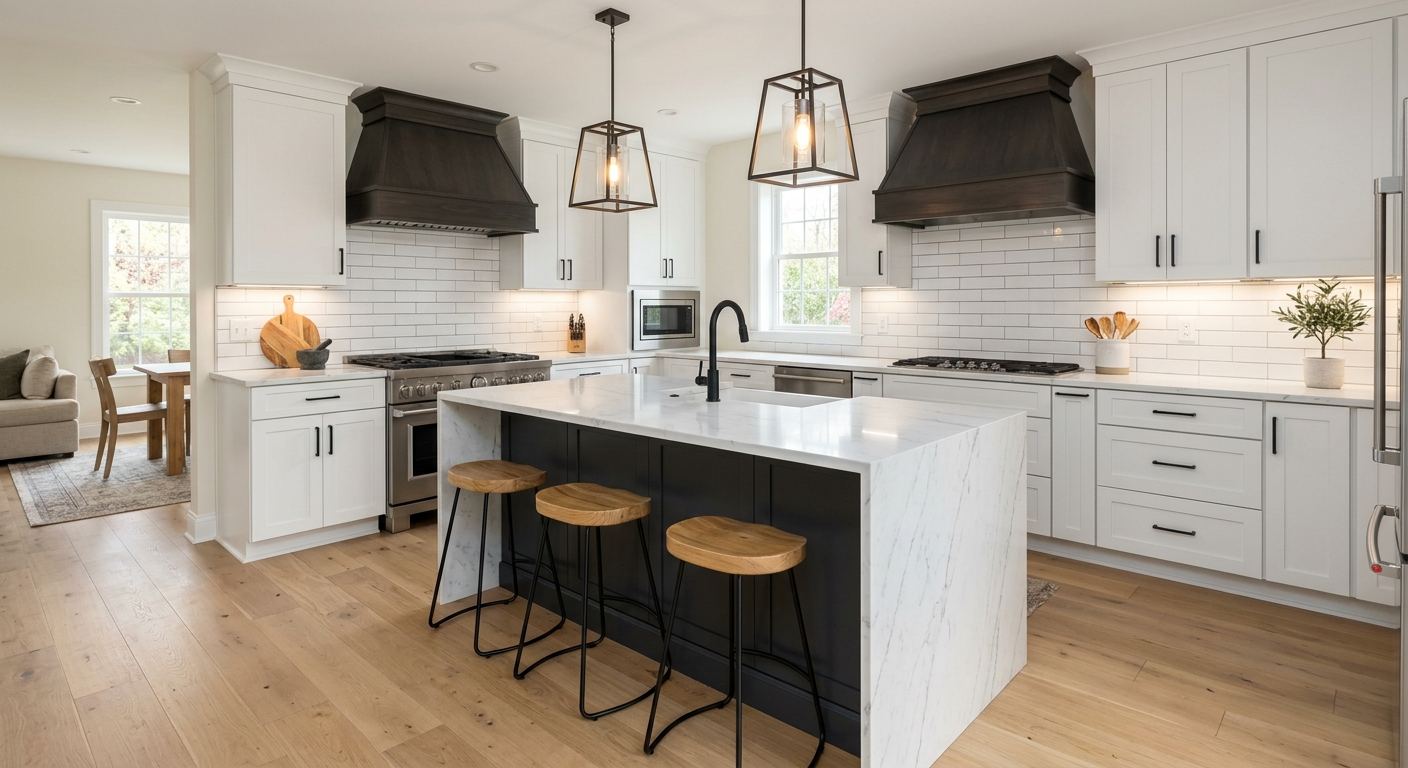
Kitchen renovation options and costs in Grousewoods
In Grousewoods, British Columbia, kitchen renovations tend to follow a predictable ladder: smaller, surface-level updates cost far less than rebuilds that touch cabinets, plumbing, and electrical. Even though Grousewoods is a small community (population 1,320, according to Statistics Canada, 2021 Census), the kitchen market is shaped by the broader Lower Mainland–Southwest pricing reality—homeowners often expect the project to “fit” resale values across the region. In practical terms, finish expectations and willingness to pay track with household purchasing power, which is why a higher-tier renovation can pencil out differently here than in lower-cost areas of the province.
That said, the Lower Mainland–Southwest cost picture isn’t driven as much by climate as you might think. British Columbia’s coastal-influenced conditions don’t generally force extra kitchen construction costs the way freeze–thaw can in colder provinces, but they do influence material selection and installation details (moisture-tolerant products, careful sealing, and strong ventilation). Labour availability is also steadier around the Lower Mainland, which helps keep contractor lead times reasonable—though premium cabinet and stone schedules can still stretch.
In Grousewoods, trades are especially in demand where older homes are common—near the older residential pockets of the community—because many kitchens were built with simpler cabinetry and dated electrical runs. Once you factor in that typical kitchen backbone pricing ranges from refreshes to full rebuilds, it becomes clear why two homeowners can receive quotes that differ widely for what looks like a “similar” job. Below is a realistic comparison to help you line up scope with budget.
| Renovation Tier |
What's Included |
Typical Duration |
Price Range |
| Cosmetic refresh (paint, hardware, new appliances only) |
Wall/ceiling repaint, hardware swaps, faucet swap (if not moving plumbing), appliance replacement, basic caulking and trim touch-ups |
1–3 weeks |
$10,000–$25,000 |
| Mid-range full renovation (new cabinets, counters, sink, tile) |
New stock or semi-custom cabinets, new countertops, sink and faucet, backsplash tile, new flooring under/around cabinetry (as needed), updated lighting hardware (no major rewiring) |
4–8 weeks |
$40,000–$85,000 |
| High-end full renovation (custom cabinets, stone counters, island) |
Custom cabinetry, stone counters (quartz/stone), island (and cabinetry to match), upgraded hardware, higher-end backsplash (including larger-format tile/slab), enhanced lighting plan and more complex layout work |
8–16 weeks |
$85,000–$120,000 |
| Cabinet refacing only (new doors + drawer fronts, same boxes) |
Door/drawer-front replacement, new handles/pulls, interior upgrades (soft-close where applicable), resurfacing, updated toe-kicks and trim details |
2–5 weeks |
$8,000–$30,000 |
| Countertop swap only (laminate to quartz or stone) |
Old countertop removal, new quartz/stone install, sink cut-out and basic sealing, edging upgrades, backsplash top trim adjustments |
1–2 weeks (plus template/ordering) |
$10,000–$20,000 |
| Backsplash tile installation only |
Tile supply and install (ceramic/porcelain), backer prep, grout/seal, clean-up, minor outlet cover/caulk refinishes |
5–10 days |
$1,500–$6,000 |
Prices are estimates only and vary by project scope, site access and material selection.
What affects the price of kitchen renovation in Grousewoods
In the Lower Mainland–Southwest, it’s common to see quotes for the “same” kitchen differ by 30–50% across British Columbia. The biggest drivers aren’t climate—they’re local housing value, household buying expectations, and the finish tier you choose. In higher-value Lower Mainland–Southwest pockets, homeowners more often default to quartz or stone counters and semi-custom cabinetry because the cost can be recovered more easily on resale. In more modest markets, laminate surfaces and stock cabinet systems are still popular because they deliver the best value per dollar.
For Grousewoods specifically, two local realities push costs in practical ways. First, many renovations start in older kitchens, where you often uncover dated subfloors, inconsistent clearances, or wiring that wasn’t designed for modern loads—especially island outlets and under-cabinet lighting. Second, Lower Mainland–Southwest availability means contractors can keep labour moving, but premium cabinetry and stone lead times can still add staging costs and schedule pressure. Those factors rarely change the base “full renovation” band of $40,000–$120,000, but they change how quickly you reach it.
Concrete examples I see often: (1) swapping laminate for quartz may sound like a “countertop-only” job, but if the existing wall is out of level, you may pay extra for prep and refinishing—pushing you toward the upper end of the $3,000–$12,000 countertop installation band; (2) adding an island in a working galley can require relocating plumbing or running new electrical—layout work is usually the largest unpredictable line item regardless of finish tier; and (3) if you need a full floor replacement rather than a refinish/patch, you can add meaningful labour and material costs even with the same cabinet scope. That’s why the decision to keep the layout stable is often the best way to control budget before you pick finishes.
| Price Factor |
Why It Matters |
Cost Impact |
| Cabinet tier — stock vs. semi-custom vs. fully custom millwork |
Changing the manufacturing approach changes design options, fitting time, hardware choices, and installation effort |
$10,000 swing is common between stock and semi-custom, with bigger increases for custom |
| Countertop material — laminate vs. quartz vs. granite vs. stone |
Material cost, templating complexity, and edge/finish options affect both supply and labour |
Typical difference can range roughly $3,000–$8,000+ depending on slab type and edging |
| Layout change — wall removal, island add, plumbing/gas move |
Structural changes and re-routing services add trades, inspections, and contingency |
Often adds $5,000–$25,000 beyond a refresh, even if finishes are mid-range |
| Appliance package tier — builder vs. mid-range vs. pro-grade |
Pro-grade appliances can require ventilation, electrical considerations, and more precise fit |
Can shift $2,000–$15,000 depending on what you replace |
| Flooring — refinish existing vs. full replacement |
Cabinet removals expose subfloor conditions; replacement restores the whole system |
Patch/refinish may stay $1,000–$3,000, while full replacement can reach $5,000–$12,000 |
| Backsplash — ceramic tile vs. marble vs. full-height slab |
Install difficulty and material fragility determine labour and waste rates |
Backsplash-only work typically ranges $1,500–$6,000, with slab-style options higher |
| Electrical — new circuits for island, under-cabinet lighting |
New lighting and outlets can trigger permit/inspection requirements and longer scheduling |
Often adds $1,500–$8,000 depending on circuit count and complexity |
| Permit fees and licensed trade requirements |
Regulatory steps add direct fees and coordination time |
Most “service moves” can add $500–$3,500+ in admin/permit costs and scheduling overhead |
Permits & regulations in British Columbia
In British Columbia, many kitchen upgrades are straightforward from a permitting standpoint, but service moves are where the rules kick in. A typical cabinet or countertop swap—doors, drawer fronts, and new counters set on the existing base—does not require a permit. Similarly, a backsplash installation is usually a permit-free finish upgrade. The moment you move plumbing supply or drain lines, relocate a gas appliance connection (including changes related to a range or range hood tied to gas), remove a load-bearing wall, or add new electrical circuits for island outlets or under-cabinet lighting, you’re generally in permit-and-inspection territory. Gas work must be performed by a licensed gas fitter, and electrical work must be done by a licensed electrician.
Here’s how a homeowner in Grousewoods can verify a contractor’s compliance step-by-step: (1) Ask for their business licence and the specific trade licences for the scope (gas fitter and electrician where relevant). (2) Check licence status using the appropriate online provincial registry for trades—then confirm the name matches the quote and invoice. (3) Request a certificate of insurance (liability) and confirm coverage limits are current and include renovation activities. (4) Ask about workers’ compensation coverage (WSIB/WCB) for all labour working on your site. (5) If permits are required, confirm who pulls them and whether your contract states the contractor is responsible.
Before you sign anything, make sure the contract clearly states permit responsibility and inspection scheduling. In renovations, clarity here is what prevents delays and cost overruns.
Cabinets, countertops and layout decisions in Grousewoods
The three most consequential decisions in a Grousewoods kitchen renovation are (1) cabinet tier, (2) countertop material, and (3) whether you change the layout. Start with cabinets: stock options are typically the fastest and cheapest, semi-custom is the “most popular” mid-range choice for a tighter fit without custom lead times, and fully custom millwork delivers the best fit and detailing but comes with higher labour and design time. For countertops, laminate offers solid value and easy maintenance, while quartz is the go-to for durability with minimal upkeep. Natural stone (granite/other stone) looks premium and wears well, but it benefits from correct sealing routines and careful installation. Butcher block can add warmth, yet it needs more regular oiling and moisture-conscious sealing, especially in a coastal setting where indoor humidity can swing.
Layout decisions are the budget swing factors in the Lower Mainland–Southwest resale market. Buyers often respond to a functional island, good circulation, and modern storage—so adding an island can be worth the cost if your space supports it. But the moment you remove a wall, move plumbing, or relocate a gas line, you’re paying for trades, inspection coordination, and a bigger schedule window regardless of finish tier.
A dollar example: if you keep your existing plumbing and choose quartz, you might stay near the lower end of the full kitchen renovation band, but if you add an island and move sink plumbing, that “countertop upgrade” becomes a full service coordination job. In many cases, owners end up shifting from the mid-range $40,000–$85,000 band toward the upper end because the labour and coordination dominate the incremental material savings.
| Option |
Durability |
Maintenance |
Best For |
Price Range |
| Stock cabinets (big-box) |
Good daily durability; fit depends on your wall condition |
Low—wipe clean; minor adjustments may be needed if floors/walls are uneven |
Speed and budget control |
$8,000–$25,000 |
| Semi-custom cabinets (local dealer) |
Very durable hardware options; better variety of sizes and layouts |
Low to moderate—choose quality hinges and soft-close if you want longer wear |
Most Grousewoods homeowners balancing cost and fit |
$20,000–$50,000 |
| Custom cabinets (local millwork shop) |
Excellent durability; tailored to your space and storage plan |
Low—once installed correctly, upkeep is straightforward |
Design-led layouts, difficult spaces, and premium resale finishes |
$40,000–$80,000+ |
| Laminate countertop |
Decent for everyday use; can be less resistant to chipping at edges |
Low—avoid standing water at seams/edges and use gentle cleaners |
Budget refreshes and rental-friendly upgrades |
$3,000–$7,000 |
| Quartz engineered countertop |
High durability; resists staining and daily wear |
Very low—routine cleaning only; no sealing |
Busy households wanting a “set it and forget it” surface |
$7,000–$12,000 |
| Granite / natural stone countertop |
Premium durability; strength varies by stone type |
Moderate—typically requires sealing and careful care for longevity |
Premium look with long-term wear |
$9,000–$16,000 |
| Butcher block countertop |
Durable with proper care; can show wear and need refinishing |
Higher—regular oiling/surface maintenance; protect from water |
Warm, casual designs where you want tactile character |
$6,000–$12,000 |
| Marble countertop |
Luxury material; can etch/stain if not maintained |
Higher—seal properly and treat spills promptly |
Low-traffic kitchens or homeowners who love upkeep |
$12,000–$20,000 |
How to choose a kitchen renovation contractor in Grousewoods
Choosing the right kitchen contractor in Grousewoods is mostly about proof and process. Start with British Columbia compliance: verify the company’s trade qualifications where needed, and confirm they carry liability insurance that covers renovations at your address. For coverage that protects you and their workers, confirm WSIB/WCB status for the crew doing demolition, framing, and finish work. How to check: ask for a current certificate of insurance, then verify the stated insured party and policy dates; request proof of workers’ compensation clearance; and keep it in your project file.
Next, get 2–3 itemised written quotes, not a single lump sum. You want a clear labour-and-materials breakdown: who supplies cabinets, who installs them, what countertop edge profile is included, and whether removal/disposal is included. Read the scope carefully—many disputes happen when a quote excludes permit pulling, appliance disconnects, or demolition disposal. Confirm whether drywall repairs, subfloor leveling, and underlayment are part of the scope.
Warranty matters: ask for the workmanship warranty length and whether it applies to installation failures (like cabinet alignment) and not just product defects. Also confirm product/manufacturer warranty terms and whether warranties are transferable to subsequent owners—this is valuable in the Lower Mainland–Southwest resale market. On payment schedule, never pay more than 10–15% upfront; a holdback until completion protects both sides. Finally, insist on a written start date and completion estimate that accounts for cabinet and stone lead times.
- Confirm licence and trade coverage for any permit-triggering work (gas, electrical).
- Request insurance certificate and workers’ compensation proof before work starts.
- Use itemised quotes with line-by-line labour and material costs.
- Confirm who pulls permits and whether fees are included or extra.
- Clarify demolition/disposal: dump fees, recycling, and site protection.
- Ask what floor prep is included (level, underlayment, repairs).
- Confirm countertop template responsibility and who pays for re-template if changes occur.
- Check electrical scope: outlets, lighting, and island circuit assumptions.
- Get cabinet specs: finish, soft-close hardware, and warranty term.
- Require a detailed schedule: ordering lead times and installation dates.
- Ensure measurements are included (on-site verification before fabrication).
- Ask for references on similar Grousewoods/Lower Mainland kitchen scopes.
In Grousewoods, red flags I watch for include: quotes that aren’t itemised, a refusal to show insurance/workers’ coverage, no written permit plan when plumbing/gas/electrical is touched, vague warranty language (especially on cabinet installation), and payment terms that ask for large deposits upfront without a signed schedule.
Frequently asked questions — kitchen renovation in Grousewoods
What's the ROI on a kitchen renovation?
Kitchen ROI in British Columbia is strongest when you modernize the parts buyers notice most: a functional layout, good lighting, durable surfaces, and storage that feels intentional. In Grousewoods and across the Lower Mainland–Southwest, premium upgrades like quartz/stone counters and well-fitted cabinetry can support resale appeal, but the ROI still depends on how much of your project is “high-value visible finish” versus behind-the-wall rework. As a rule of thumb, refresh-style work tends to recoup more predictably because you stay closer to your baseline cost. If you’re moving into a full renovation scope (often in the $40,000–$120,000 range), you should focus on layout and materials that feel current to buyers rather than over-upgrading beyond the neighbourhood’s typical expectation (Statistics Canada, 2021 Census). If you’re unsure, align your design choices to the resale tier you’re competing with.
How do I budget for a kitchen renovation?
Budgeting starts by choosing your tier and protecting the “unknowns.” For a typical Grousewoods homeowner, that means deciding whether you’re doing a cosmetic refresh, a mid-range full renovation, or a high-end rebuild. Use the local bands as anchors: for example, a countertop installation might land in the $3,000–$12,000 range, while a full renovation commonly sits within $40,000–$120,000 depending on cabinetry and layout work. Then add a contingency for the real cost drivers: electrical updates, subfloor repairs, and any service moves (especially if you’re adding an island). The Lower Mainland–Southwest market can swing quote totals by 30–50% when homeowners change finish tier and scope; it’s not just materials, it’s trades and fitting time. I recommend setting a realistic contingency and keeping layout changes to what you truly need.
Can I move my kitchen sink or stove?
Yes, you can move a sink or stove in Grousewoods, but it’s where permitting and licensed trades usually become necessary in British Columbia. Moving plumbing supply/drain lines generally triggers permit requirements and must be coordinated with licensed plumbing work. If you’re dealing with a gas stove or relocating a gas connection (or changing a hood setup that vents to gas systems), gas work must be performed by a licensed gas fitter and typically requires inspections. If you move the stove, plan for safe ventilation and correct clearances. If you want a budget-friendly approach, keep plumbing where possible and focus on cabinet/counter upgrades first. Many homeowners find that shifting from a countertop-only upgrade to a service-move project quickly pushes the budget toward the upper end of the full kitchen renovation range due to coordination time, inspection scheduling, and labour.
What's the most cost-effective kitchen upgrade?
The most cost-effective upgrade is usually one that delivers a visible transformation without triggering heavy permits or major service work. In many Grousewoods kitchens, that’s either a cosmetic refresh (hardware, paint, and a modern appliance package) or a targeted countertop upgrade when your cabinetry layout still works. For example, a backsplash-only installation often falls around the $1,500–$6,000 range and can update the entire room’s look quickly. If you want a bigger “feel” change with manageable complexity, a countertop swap (for instance, laminates to quartz) can be a high-impact move while typically staying closer to the countertop installation band rather than full rebuild pricing. The key is to choose upgrades that don’t force you to open walls or re-route plumbing/electrical, because those layout-driven costs tend to dominate.
Custom vs stock cabinets — is custom worth it?
Custom cabinets can be worth it in Grousewoods when your space has challenging dimensions, you want a very specific layout, or you’re aiming for a design-led look that improves usability. Stock cabinets are typically faster and cheapest, while semi-custom often lands in the best balance for most homeowners. Fully custom often increases cost because you’re paying for design time, fabrication precision, and longer installation. In practical budget terms, cabinet pricing can swing widely across tiers: cabinet installation/refacing projects commonly fall in the $8,000–$50,000 range, and custom millwork can push you toward the higher end of that band depending on scope. If you’re keeping the layout stable, you can get a strong upgrade by choosing semi-custom and durable hardware. But if you’re also adding an island, changing dimensions, or reorganizing storage, custom can justify itself because the fit and functionality improve day-to-day use and resale appeal.
How do I choose a kitchen contractor in Grousewoods?
In British Columbia, choosing the right contractor is about verifying compliance and demanding clear documentation. Start by requesting proof of liability insurance and workers’ compensation coverage, and confirm the scope that needs licensed trades. If the work touches gas appliances, gas fitter certification and inspections are required; if electrical circuits are added or modified, only a licensed electrician should do that work. Ask for itemised written quotes that separate labour and materials, and confirm whether permits and disposal are included. Your contract should clearly state who pulls permits and who is responsible for inspections. Don’t agree to large upfront payments: aim for no more than 10–15% initially, with a holdback until completion. Finally, confirm warranty terms for workmanship and products, and ensure the timeline includes realistic cabinet and stone lead times. This approach helps prevent surprises in a market where quote totals can shift quickly as scope changes.