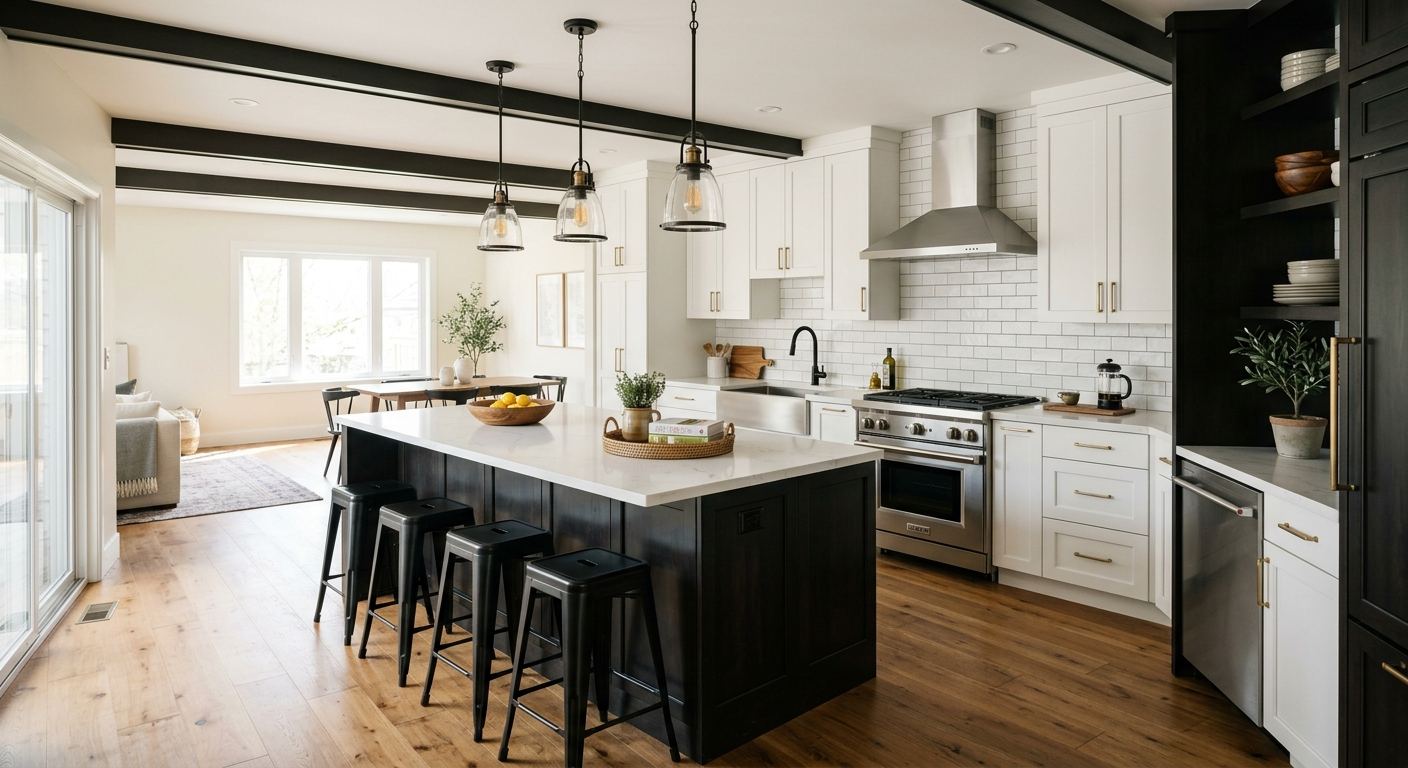
Kitchen renovation options and costs in Koksilah
Koksilah, British Columbia is a small community (population about 4,000, Statistics Canada, 2021 Census), and that shapes how kitchen renovations get priced: local jobs tend to be scoped tightly, with contractors spending more time on site planning and less time on “big-city” design-build complexity. At the same time, the broader Lower Mainland–Southwest market influences finish expectations. In the region, homeowners often refresh with resale-ready looks rather than long-term-only choices, and many upgrades track with household purchasing power and housing values across the Lower Mainland–Southwest (Statistics Canada, 2021 Census). That’s why the same kitchen size can land in very different price tiers depending on whether you’re doing a practical refresh or building a more design-led, made-to-fit kitchen.
Climate adds a different kind of pressure: Koksilah’s coastal-influenced weather means indoor humidity swings can show up around caulking lines, grout, and the edges of countertops and cabinet boxes. In practice, it’s not “weather damage” that drives the bill—it's how carefully tradesmen detail sealing, ventilation, and durable surfaces so the renovation holds up. Labour availability can also affect timing and cost, especially when carpentry and tile work are scheduled around other ongoing builds in the Surrey–Abbotsford orbit. For homeowners near Shawnigan Lake Road and the broader Koksilah area, we typically see strong demand from families upgrading kitchens before selling or upgrading for multigenerational living.
Below is a practical comparison of renovation tiers to help you translate quotes into scope and outcomes.
| Renovation Tier |
What's Included |
Typical Duration |
Price Range |
| Cosmetic refresh (paint, hardware, new appliances only) |
Cabinet paint/stain (or partial repaints), new hardware, appliance swap, minor caulking and touch-ups |
1–2 weeks |
$8,000–$25,000 |
| Mid-range full renovation (new cabinets, counters, sink, tile) |
New cabinets (stock or semi-custom), countertop install, sink + tap, backsplash tile, basic electrical/plumbing tie-ins |
4–7 weeks |
$40,000–$80,000 |
| High-end full renovation (custom cabinets, stone counters, island) |
Custom or fully custom cabinetry, stone counters, island with power, upgraded lighting, more complex tile/stone backsplash |
7–12 weeks |
$80,000–$120,000 |
| Cabinet refacing only (new doors + drawer fronts, same boxes) |
New door/drawer fronts, new veneer where applicable, hardware swap, re-seal joints, reuse existing boxes |
2–4 weeks |
$8,000–$35,000 |
| Countertop swap only (laminate to quartz or stone) |
Remove existing surface, fabricate + install new quartz/stone, edge changes, basic sink/tap adjustments as needed |
3–7 days (plus template time) |
$3,000–$12,000 |
| Backsplash tile installation only |
Surface prep, tile supply and install, grout/seal (where required), caulk at counters and corners |
3–10 days |
$1,500–$6,000 |
Prices are estimates only and vary by project scope, site access and material selection.
What affects the price of kitchen renovation in Koksilah
Homeowners in Koksilah can see quotes for the “same” kitchen that differ by 30–50% across the Lower Mainland–Southwest and other parts of British Columbia. The reason is usually not the weather—it’s the market finish expectations tied to home value and income, plus how complex the cabinetry and trades scope becomes once you touch layout, plumbing, and electrical. In higher-value Metro Vancouver-oriented buying areas, many homeowners default toward quartz or stone counters and semi-custom cabinetry because those finishes read as “replacement-level” on resale. In more modest scopes, laminate and stock cabinets dominate simply because the return is strong when the layout stays put. Those same materials still matter in Koksilah, but the decision often comes down to how owners want buyers (or family) to perceive the kitchen.
Layout changes are the cost wild card. Removing a wall, adding an island, or moving a gas line can reshape the whole schedule and add permit complexity. Even in a mid-range renovation in the $40,000–$80,000 band, an island that needs electrical and ducting can push costs toward the upper end. Conversely, a countertop swap only typically lands in the $3,000–$12,000 band if the sink cut-outs and plumbing connections don’t change.
Two common Koksilah-specific examples we see: first, older homes often have dated supply lines and mismatched shutoffs, so “just changing the sink” can uncover plumbing work behind the walls. Second, kitchens with poor range hood venting can force additional work—upgrading ventilation and sealing transitions—because tradesmen prefer not to cover performance issues with new finishes. Those items can raise labour and inspection time even when cabinet and countertop tiers are controlled.
| Price Factor |
Why It Matters |
Cost Impact |
| Cabinet tier — stock vs. semi-custom vs. fully custom millwork |
Custom sizing, better finishes, and more complex carcass build drive material and labour time |
Can swing overall cost by 15%–40% |
| Countertop material — laminate vs. quartz vs. granite vs. stone |
Material price, fabrication complexity, and edge/overhang requirements affect labour and waste |
Typically adds 10%–30% depending on selection |
| Layout change — wall removal, island add, plumbing/gas move |
Changes require carpentry, trades coordination, and often permits/inspections |
Most unpredictable; can add 20%–60% |
| Appliance package tier — builder vs. mid-range vs. pro-grade |
Size, power requirements, venting needs, and installation accessories differ |
Often changes appliance spend by $2,000–$10,000+ |
| Flooring — refinish existing vs. full replacement |
Subfloor condition, transitions, and match to new cabinet base affect prep and finish |
Can add $3,000–$15,000+ |
| Backsplash — ceramic tile vs. marble vs. full-height slab |
Stone slabs increase weight, measuring precision, and install labour |
May add $1,000–$5,000+ |
| Electrical — new circuits for island, under-cabinet lighting |
Additional circuits and lighting require certified work and inspection timing |
Can add $1,500–$8,000+ |
| Permit fees and licensed trade requirements |
Permits influence scheduling; licensed trades prevent rework and failed inspection delays |
Varies, but typically adds $500–$3,000+ and time |
Permits & regulations in British Columbia
In British Columbia, the rule of thumb for kitchen renovations is that simple swaps usually don’t require permits, while moving services and structural elements often does. Cabinet and countertop swaps generally do not require permits. That means replacing cabinets, reinstalling countertops, or changing a backsplash surface finish is typically “no permit” work. However, if your plan includes relocating plumbing supply or drain lines, moving gas for a stove/range setup, removing a load-bearing wall, or adding new electrical circuits (like dedicated power for an island or under-cabinet lighting), you should expect permits and licensed trade involvement.
Step-by-step, here’s how a homeowner in Koksilah can verify before signing: (1) ask the contractor to list which permit(s) they will pull and which trades will do the work; the answer should be in writing. (2) verify the electrician and gas fitter are licensed via their online registry entries (the contractor should provide licence numbers). (3) request a current certificate of insurance for liability coverage from each relevant trade, and confirm the general contractor’s coverage if they are coordinating everything. (4) confirm workers’ compensation coverage (WSIB-style coverage is commonly referenced as WCB in practice in BC; the contractor should provide clearance documentation if required by the job). (5) insist on an inspection schedule in the written scope where applicable—especially for electrical and gas-related changes.
Never assume responsibility is “automatic.” In BC kitchens, who pulls permits and who performs licensed work needs to be explicit in your contract.
Cabinets, countertops and layout decisions in Koksilah
In Koksilah, three decisions drive both your day-to-day satisfaction and your final budget: (1) cabinet tier, (2) countertop material, and (3) whether you change the layout. Cabinet tier affects speed and fit. Stock cabinets are usually the fastest and cheapest because they come in standard sizes and require less in-room adjustment. Semi-custom cabinets are the most popular mid-range option in the Lower Mainland–Southwest because they offer better height/width flexibility and more style choices without fully custom pricing. Custom cabinets deliver the best fit for awkward corners and specific storage goals, but they cost more and take longer.
Countertop choice is where maintenance and durability become real money. Laminate is easiest on the budget, but it’s more vulnerable around seams and to heavy use at hot/cutting areas. Quartz is a practical “busy kitchen” choice because it’s consistent, less porous than natural stone, and typically easier to maintain with routine care. Granite and natural stone look premium, but require more attention to sealing habits and can be more sensitive to certain cleaners. In Koksilah’s coastal-influenced humidity, proper sealing at joints and good ventilation around cooking areas matter for all countertop types—especially near the backsplash line and sink.
Layout changes can be justified when the space gain improves flow: removing a wall for openness, adding an island for prep, or relocating plumbing/gas when you can’t otherwise get proper cabinet alignment. For example, moving plumbing to support an island might be justified if it creates a clear work triangle and seating, but it’s rarely “worth it” if you’re only trying to change aesthetics—those moves can push a mid-range project above the typical $40,000–$80,000 range even when finishes are controlled.
| Option |
Durability |
Maintenance |
Best For |
Price Range |
| Stock cabinets (big-box) |
Solid for everyday use; limited adjustment for unusual spaces |
Easy; keep hinges tuned and edges sealed |
Short timelines and budget-first refreshes |
$8,000–$25,000 |
| Semi-custom cabinets (local dealer) |
Better fit and upgrade options; good long-term wear |
Low; treat like a finished wood product |
Most Koksilah renovations targeting resale-ready upgrades |
$20,000–$55,000 |
| Custom cabinets (local millwork shop) |
Built for your room; strongest for corner and storage design |
Low to moderate; finish care as recommended |
Owners who want a precise layout and unique storage |
$40,000–$90,000 |
| Laminate countertop |
Moderate; seams can be a weak point if stressed |
Wipe clean; avoid abrasive pads and standing water at seams |
Budget refresh where layout stays the same |
$3,000–$6,000 |
| Quartz engineered countertop |
High; consistent surface with good everyday resistance |
Simple routine cleaning; resealing usually not required |
Busy households that want a premium look with less upkeep |
$5,500–$10,000 |
| Granite / natural stone countertop |
High, but varies by slab; heat resistance depends on finish |
Seal and maintain per stone recommendations |
Statement kitchens and homeowners willing to maintain |
$7,000–$12,000 |
| Butcher block countertop |
Good impact resistance; can show wear with heavy misuse |
Needs periodic oiling and careful water management |
Food-prep focused kitchens (with good drying practices) |
$4,000–$9,000 |
| Marble countertop |
Elegant but more susceptible to etching/staining |
Higher care; protect from acidic spills and seal as advised |
Lower-traffic “showpiece” kitchens or conservative use |
$9,000–$14,000 |
How to choose a kitchen renovation contractor in Koksilah
Start by verifying British Columbia licensing, not just a company name. Ask for the licence numbers for any work that needs them—electricians and gas fitters must be licensed for their scopes, and the contractor should coordinate the right trades. To check: (1) look up licences through the relevant online registry for the trade (use the licence number on their certificate or invoice), (2) confirm liability insurance by requesting a current certificate of insurance naming appropriate parties, and (3) verify workers’ compensation coverage documentation (commonly referenced as WCB in BC) and that the contractor is eligible/covered for the work. You’re protecting yourself from delays and liability if something changes during demolition or inspection.
Next, get 2–3 itemised quotes that separate labour and materials, instead of one lump sum. You want line items for demolition, cabinet install, countertop template/fabrication (or allowance), tile prep, electrical tie-ins, plumbing adjustments, and disposal. Read the scope carefully: what’s excluded (old appliance disposal, underlay removal, subfloor repair, permit fees, or rework if walls are out of square)? Ask whether permits are included and who pulls them. Warranty matters too—confirm workmanship warranty length, product/manufacturer warranty coverage, and whether warranties transfer if you sell.
For payment, never pay more than 10–15% upfront. Hold back a portion until key completion milestones are met. Finally, insist on the start date and completion estimate in writing, including time buffers for countertop fabrication and inspection scheduling.
- Request licence numbers and trade certificates before deposit.
- Confirm liability insurance and ask for the coverage date range.
- Ask for WCB clearance documentation for the contractor and subs.
- Use itemised quotes with allowances clearly labelled.
- Confirm who pulls permits and which inspections apply.
- Get a demolition plan and dust-control approach in writing.
- Confirm disposal/recycling is included (not just “haul away”).
- Ask how they handle hidden damage in old kitchens (water, rot, wiring).
- Check cabinet delivery lead times and what happens if delays occur.
- Verify backsplash and flooring transitions are included in scope.
- Confirm warranty terms: workmanship duration and how claims are processed.
- Insist on a clear payment schedule tied to milestones.
Common red flags in Koksilah include: quotes that aren’t itemised (especially for cabinets/counters), vague wording on permits and licensed trades, schedules that ignore countertop fabrication time, unusually high deposits, and missing warranty details (or a warranty that’s only “verbal”).
Frequently asked questions — kitchen renovation in Koksilah
What's the most popular kitchen style in Koksilah right now?
In Koksilah and the surrounding Lower Mainland–Southwest buying pattern, the most common “go-to” look right now is a clean, contemporary style with warm neutrals: slab or shaker-front cabinet doors, matte or satin hardware, and quartz counters in lighter tones or natural-looking veining. Homeowners also tend to choose practical layouts—good lighting, simple backsplash lines, and storage that feels “new” without making the kitchen feel overly trendy. The reason is resale-minded practicality: buyers often respond to quartz and well-fitted semi-custom cabinetry as dependable upgrades. If you’re budgeting in the mid-range full renovation tier (roughly $40,000–$80,000), you’ll usually find the best value by focusing spend on cabinet function, countertop selection, and lighting—rather than chasing expensive custom-only details.
How do I know if I need to update my kitchen plumbing in Koksilah?
You may not need full plumbing replacement, but you likely do need an update if you have symptoms or hidden risks. In Koksilah, older homes sometimes show age around shutoffs, supply line fittings, and drain assemblies—especially if there’s been any prior leak history under the sink or dishwasher. Signs include slow drains, recurring odours from the sink trap, frequent drip at connections, loose or corroded shutoffs, or water hammer when taps are turned on. During renovation, plumbing often becomes visible after countertop and cabinet removal, and that’s when contractors assess whether to replace sections. A smart approach is to ask for a “scope confirmation” after the cabinets come out: keep costs aligned with your tier (for example, if you’re staying in the countertop swap only tier, $3,000–$12,000, you don’t want surprise plumbing scope unless truly necessary).
What is the difference between a galley and open-concept kitchen?
A galley kitchen is a narrow layout with cabinets and counters on two parallel sides, usually with an aisle down the middle. It’s efficient for workflow but can feel smaller and less social. An open-concept kitchen connects the cooking area to a living/dining space, often by removing or reworking a wall. In Koksilah, open-concept renovations are popular when homeowners want better sightlines and more usable space for family gatherings. The catch is that openness usually increases the odds of layout changes requiring licensed trades and, sometimes, permits—particularly if you touch plumbing/gas runs or electrical circuits. If you remain in a cosmetic refresh or simple countertop swap, $8,000–$25,000 or $3,000–$12,000 tiers are more predictable; if you go open-concept, budgeting toward the full renovation bands is safer (often $40,000–$120,000, depending on cabinet and stone choices).
How do I get accurate kitchen renovation quotes in Koksilah?
Accurate quotes start with consistent scope. In Koksilah, ask for 2–3 itemised proposals that separate labour from materials and clearly list allowances for cabinets, countertops, tile, appliances, and any electrical or plumbing tie-ins. Provide photos, a rough floor plan, measurements of the room, and note whether you want to keep the layout or change it. Also specify what’s included in demolition and disposal (many homeowners get surprised by excluded haul-away costs). For accuracy, decide your cabinet tier first (stock, semi-custom, or custom) and your countertop material (laminate vs quartz vs stone). Then confirm if permits are included and who pulls them. A good contractor will explain what work typically needs licensed trades in British Columbia and will align the schedule to countertop fabrication and inspections. If you compare only totals, you can end up comparing apples to oranges and misjudge the true difference between, say, a mid-range renovation and a high-end custom build.
What's the best countertop material for a busy Koksilah kitchen?
For most busy households in Koksilah, quartz is the best balance of durability, stain resistance, and everyday maintenance. It looks premium like stone, but it’s typically less fussy than marble and avoids the sealing routine that some natural stones require. If you cook frequently, have kids, or entertain, quartz usually holds up well to normal wear and is forgiving for routine cleaning. For budget-focused refreshes, laminate can still work—just be mindful that seam areas and edges are more vulnerable to moisture exposure over time. Natural stone (granite/other stone) is also excellent if you’re willing to maintain it properly, while butcher block suits prep-focused kitchens where you can oil and dry the surface consistently. In terms of budget alignment, homeowners often land quartz within the $5,500–$10,000 countertop swap range, whereas laminate commonly sits closer to the lower end of $3,000–$6,000, depending on size and edges.
How do I add an island to my Koksilah kitchen?
Adding an island is doable, but it must be planned around circulation and services. First, measure clearances so you don’t end up with a cramped aisle—especially in galley-like or older layouts. Next, decide whether the island is purely storage/prep or if it needs a sink and/or power. If you want electrical outlets, under-cabinet lighting, or a powered cooktop area, that triggers new electrical work and should be handled by a licensed electrician with proper permits/inspection. If the island includes a sink or changes plumbing, you’ll be dealing with plumbing supply/drain relocation and should expect permit involvement. For gas-based cooktops, gas line adjustments are licensed work and carry inspection expectations. Cost-wise, the island often nudges you from a tighter refresh into a full renovation scope; even if your project starts like a mid-range build, an island with power and potential plumbing/gas changes can push the job toward the upper end of the $40,000–$80,000 band or beyond, depending on cabinetry tier and countertop choice.