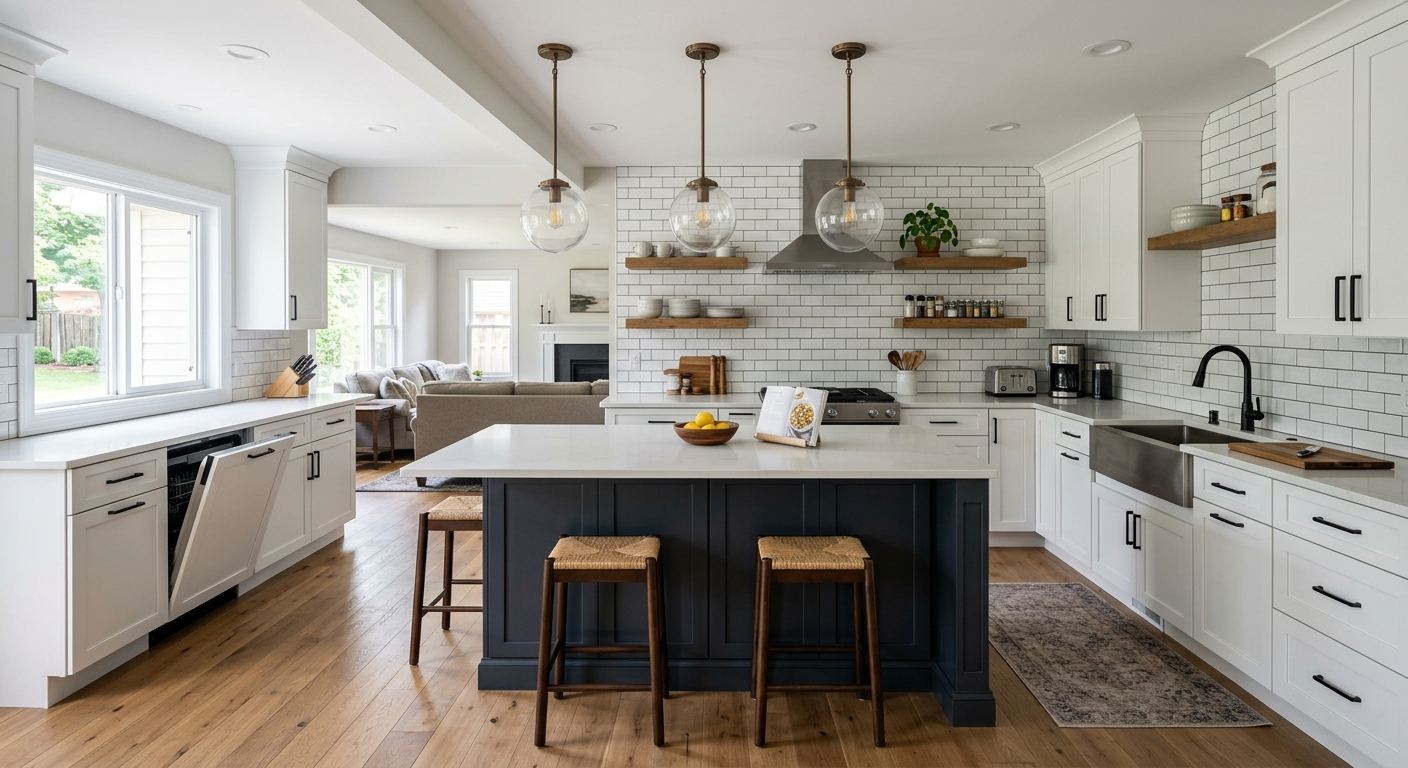
Kitchen renovation options and costs in Hope
Kitchen renovation in Hope, British Columbia typically starts with one practical question: are you refreshing surfaces, or rebuilding the kitchen from the floor up? With a median household income of $64,000 (Statistics Canada, 2021 Census) and 2,330 homeowner households in the area, many homeowners choose a plan that protects daily function while staying aligned with resale expectations. In Hope, that often means deciding early whether you’re aiming for a “clean and updated” finish or a full upgrade that brings cabinetry, counters, and layout closer to what buyers see across the Lower Mainland–Southwest.
Pricing in the Lower Mainland–Southwest is driven more by local home value and expected finish level than by weather. While Hope’s coastal climate brings high humidity and frequent temperature swings—both of which can stress finishes over time—the bigger cost swings come from how premium the package is. Contractors also have to plan around trade availability and logistics, especially when bringing in countertop crews and cabinetry installers for a tight schedule around other renovation jobs. In older housing stock (48.0% of homes built before 1981), you’ll also see more variation in how level the floors are and how complicated plumbing/electrical tie-ins can get.
In Hope’s downtown core and the surrounding residential strips where many homes are older and retrofits are common, demand is especially steady for cabinet installs, countertop work, and tile backsplashes. From there, the range of options usually splits into six common tiers, shown in the comparison table below.
| Renovation Tier |
What's Included |
Typical Duration |
Price Range |
| Cosmetic refresh (paint, hardware, new appliances only) |
Prep/paint for cabinets-walls (or walls only), new hardware, caulking, appliance swaps, basic cleanup |
3–7 days |
$8,000–$18,000 |
| Mid-range full renovation (new cabinets, counters, sink, tile) |
Semi-custom or mid-grade cabinets, countertops, undermount sink, faucet, backsplash tile, disposal/trim, standard lighting checks |
2–4 weeks |
$40,000–$75,000 |
| High-end full renovation (custom cabinets, stone counters, island) |
Custom millwork, premium stone counters, island build, upgraded hardware, more extensive backsplash, higher-end fixtures |
4–8 weeks |
$85,000–$120,000 |
| Cabinet refacing only (new doors + drawer fronts, same boxes) |
Refacing veneer/laminate, new doors/drawers, pulls/hinges, update to selected cabinet lighting |
1–2 weeks |
$8,000–$30,000 |
| Countertop swap only (laminate to quartz or stone) |
Remove old top, install new quartz/stone, re-seal edges, adjust backsplash interface, reinstall sink where needed |
3–7 days |
$3,000–$12,000 |
| Backsplash tile installation only |
Remove existing (if required), waterproofing/prep, tile installation, grout/seal, caulking |
4–10 days |
$1,500–$6,000 |
Prices are estimates only and vary by project scope, site access and material selection.
What affects the price of kitchen renovation in Hope
In Hope and across the Lower Mainland–Southwest, you can see quotes for the same kitchen vary by 30–50% because the “scope definition” is different. Two teams may both say “new cabinets and counters,” but one includes layout changes, electrical upgrades, and detailed prep while the other assumes a straightforward swap. Across British Columbia, this is compounded by regional buying preferences: in higher-value markets, homeowners more often choose quartz or stone counters and semi-custom cabinetry, while more modest scopes rely on laminate and stock cabinets for better value.
In Lower Mainland–Southwest home-price–oriented areas, buyers tend to respond to finish consistency—clean lines, durable surfaces, and updated hardware—so the typical mid-range full renovation can quickly move toward the higher end of the $40,000–$75,000 band once you add a functional island and upgraded countertop thickness. Conversely, in more budget-conscious projects, laminate tops and stock cabinet refits can keep totals closer to the refresh tier or the lower end of full renovations. For that reason, climate plays a supporting role: Hope’s humidity and coastal swings make good sealing and proper ventilation important, but they don’t typically drive the main labour and material totals the way cabinet complexity and layout do.
Layout changes are the most unpredictable cost. Removing a wall, adding an island, or moving a gas line usually adds demolition, framing, and service-line work—often regardless of whether you start with laminate or quartz. A practical example: upgrading cabinets alone might land you around the lower cabinetry range of a refacing or mid-tier renovation, but adding new plumbing under an island can push the project into the higher full-renovation totals (especially near the $85,000–$120,000 band) because of labour, materials, and inspection time.
Two Hope-specific cost drivers show up often: older homes (many built before 1981) can have out-of-square walls, and that increases the time needed for cabinet installation and for countertop templating and fit-up. Also, site access in and around older residential blocks can slow deliveries, which affects staging and scheduling for installers.
| Price Factor |
Why It Matters |
Cost Impact |
| Cabinet tier — stock vs. semi-custom vs. fully custom millwork |
Custom boxes, specialty storage, and tighter fit increase fabrication time and material usage |
Often shifts a full kitchen total by roughly 15–40% |
| Countertop material — laminate vs. quartz vs. granite vs. stone |
Material cost plus templating, edge profiles, and installation labour for heavier stone |
Can add $3,000–$30,000 depending on product choice |
| Layout change — wall removal, island add, plumbing/gas move |
Demolition, framing, and re-routing services require more trades coordination |
Most unpredictable; common swings of $8,000–$25,000+ |
| Appliance package tier — builder vs. mid-range vs. pro-grade |
Higher-grade units cost more and may need power/venting adjustments |
Typically $2,000–$12,000+ difference |
| Flooring — refinish existing vs. full replacement |
Matching subfloor and leveling affects cabinet installation quality |
Can range from minimal to $3,000–$10,000+ |
| Backsplash — ceramic tile vs. marble vs. full-height slab |
Stone and full-height coverage increase cut complexity and labour hours |
Often moves $1,500–$6,000 to the upper end or beyond |
| Electrical — new circuits for island, under-cabinet lighting |
New outlets, lighting, and code-compliant wiring add licensed trades time |
Commonly $1,500–$6,000+ |
| Permit fees and licensed trade requirements |
When services change, inspections and permit administration add direct and indirect cost |
Can add $500–$3,000+ depending on work |
Permits & regulations in British Columbia
In British Columbia, many “swap-in-place” kitchen updates are straightforward from a permitting perspective. Cabinet and countertop swaps typically do not require permits when you’re not changing plumbing, gas, load-bearing structure, or adding new electrical circuits. That means a countertop installation only (for example, laminate to quartz) usually falls into the no-permit category, as does installing a new backsplash over properly prepped surfaces.
However, a permit is commonly required when you move or alter building services. The work that typically does require permits and licensed trades includes: relocating plumbing supply or drain lines, relocating or adding a gas-fired appliance or changing gas piping, removing a load-bearing wall, and adding or changing electrical circuits for new outlets or island lighting. Gas work must be completed by a licensed gas fitter, and electrical work by a licensed electrician, with inspections for the permitted scope.
Step-by-step for homeowners in Hope: (1) Ask for the contractor’s licence details and request proof of liability insurance and coverage documentation before work starts. (2) Obtain certificate of insurance documents and confirm the policy is active for the project dates. (3) For labour coverage, request proof of the appropriate workers’ compensation coverage (WCB/WSIB coverage documentation, as applicable through the contractor’s registered status). (4) Verify the contractor’s licence information using the online provincial registry relevant to their trade category (the contractor should provide the correct link and licence number). (5) Ensure the contract clearly states which items include permits and which trade is pulling/handling them.
Always confirm permit responsibility in writing before signing—“included” in the estimate should be clearly tied to the scope.
Cabinets, countertops and layout decisions in Hope
When you’re planning a kitchen renovation in Hope, your cost and day-to-day satisfaction usually come down to three high-impact decisions. First is cabinet tier: stock cabinets are the fastest and typically the lowest-priced option, semi-custom is the most popular mid-range path, and custom millwork offers the tightest fit and the most storage tailoring (at the highest cost). Second is countertop material—laminate, quartz, granite, butcher block, or marble—each with different maintenance needs and realistic price differences. Third is layout: open-concept wall removal, island addition, or plumbing and gas relocation. Layout changes are the main “budget volatility” item because they can trigger additional trades, demolition, and permitting.
Because Hope’s housing stock includes a lot of older homes (many built before 1981), expect that floors and walls may not be perfectly level or square. That makes cabinet installation and countertop templating more labour-intensive, especially when choosing thicker stone edges or custom-sized cabinetry.
In the Lower Mainland–Southwest resale-minded market, finish durability tends to pay off. Quartz is a common sweet spot because it handles daily use well with minimal sealing, while still reading as a premium surface to buyers. For example, if you’re currently budgeting around the mid-range full renovation band ($40,000–$75,000), choosing quartz instead of laminate might increase your countertop and install line, but it can be justified if it allows you to keep cabinetry and the layout intact. Spending heavily on stone while also moving plumbing and adding an island can quickly stack costs into the high-end full renovation band ($85,000–$120,000), which isn’t always the best return if your existing layout already works.
The climate factor—humidity and coastal temperature swings—reinforces the need for proper cabinet ventilation and sealing at countertop seams, but it usually doesn’t outweigh the impact of cabinet complexity and service-line changes on total cost.
| Option |
Durability |
Maintenance |
Best For |
Price Range |
| Stock cabinets (big-box) |
Good general durability; less forgiving if your walls are out-of-square |
Simple cleaning; touch-ups as needed; limited customization |
Fast timelines and budget-first updates |
$8,000–$25,000 |
| Semi-custom cabinets (local dealer) |
Very good durability; better sizing and storage options |
Easy wipe-down; consistent maintenance |
Most Hope homeowners aiming for a strong look-to-cost balance |
$20,000–$50,000 |
| Custom cabinets (local millwork shop) |
Excellent durability; tight tolerances and built-for-your-space detailing |
Simple cleaning; custom components may require careful hardware adjustments over time |
Hard-to-fit layouts, specialty storage, and design-led kitchens |
$35,000–$80,000 |
| Laminate countertop |
Moderate; can chip or peel if seams aren’t well sealed |
Wipe clean; avoid prolonged standing water at seams |
Refinishing budgets and cosmetic refresh projects |
$3,000–$6,000 |
| Quartz engineered countertop |
High durability; consistent surface for busy kitchens |
Minimal—regular cleaning; no sealing required |
Strong resale appeal without the upkeep of natural stone |
$6,000–$12,000 |
| Granite / natural stone countertop |
Very durable; naturally resilient to wear |
Periodic sealing recommended; care varies by stone type |
Premium look where you want unique stone character |
$8,000–$16,000 |
| Butcher block countertop |
Good, but more sensitive to moisture and impacts than quartz/stone |
Requires oiling/maintenance; protect from water pooling |
Warm, casual style with an owner who’ll maintain it |
$5,000–$11,000 |
| Marble countertop |
Premium but softer than quartz; more prone to etching/staining |
Higher care—sealing and gentle cleaners recommended |
Design-forward kitchens that won’t get heavy “daily abuse” |
$10,000–$20,000 |
How to choose a kitchen renovation contractor in Hope
Choosing the right contractor is the fastest way to avoid budget creep in a Hope kitchen. Start by verifying British Columbia licensing for the trades involved in your scope. Ask who will do electrical, gas (if applicable), and any required permitted work—and then verify each trade’s licence using the provincial online registry. Request proof of liability insurance and confirm the coverage is active for the project duration. For workers’ compensation, obtain the contractor’s workers’ compensation coverage documentation (WCB/WSIB coverage as applicable based on their registered status) so you know the job is covered if there’s an incident.
Next, get 2–3 itemised written quotes. “Itemised” matters: you want a labour-and-material breakdown, not a single lump sum that hides assumptions about demolition, disposal, cabinet prep, wiring changes, or countertop templating. Read the scope for what’s excluded: permit pulls (if any), off-hours inspections, waste disposal, light fixtures replacement, plumbing changes, flooring patching, and whether the quote includes drywall repairs and paint. Warranty should also be clear: ask for workmanship warranty length, product/manufacturer warranty details, and whether warranties are transferable if you sell the home.
For payment schedule, keep deposits reasonable—never more than 10–15% upfront—and hold back a portion until the job is complete and cleaned. Finally, require a start date and a completion estimate in writing, including allowance time for countertop fabrication and cabinet lead times common to semi-custom or custom packages.
- Confirm licences for each trade in writing (electrical, gas where applicable, and any permitted scope).
- Request certificates of insurance before signing; verify dates and coverage limits.
- Ask for workers’ compensation coverage documentation (WCB/WSIB as applicable).
- Require an itemised quote with labour and materials separated.
- Ensure demolition/disposal is included and define what “disposal” covers.
- Clarify whether countertop templating is included and when it happens.
- Ask who is pulling permits and who pays permit/inspection fees (if required).
- Confirm fixture and appliance allowances (and whether you supply them).
- Check if plumbing/electrical adjustments are included when connecting new fixtures.
- Get warranty terms in writing (workmanship and manufacturer coverage).
- Use a payment schedule with a holdback until punch-list items are finished.
- Set milestones for cabinet delivery, demolition completion, and final install.
Common red flags in Hope include: a quote that’s only a lump sum with no exclusions listed, refusal to provide insurance/licence documentation, vague timelines that ignore cabinet/counter fabrication lead times, “cash up front” payment requests beyond 10–15% without a contract, and warranty language that only covers materials and not workmanship.
Frequently asked questions — kitchen renovation in Hope
What order do kitchen renovation steps happen in?
In Hope, a typical sequence starts with confirming layout and measuring for cabinets and countertops, then planning any service changes (electrical, plumbing, or gas where required). Day one often includes demolition (old counters, backsplash, sometimes cabinets), followed by rough framing/patching if any openings or wall changes are part of the scope. Next comes rough-in work by the licensed trades if you’re adding circuits or moving supply/drain lines, then drywall and subfloor corrections to get everything level. After that, installers set cabinets, then countertops get templated and fabricated, and countertops are installed last for best fit. Finally, tile backsplashes, flooring touch-ups, trim, paint, appliance hookups, and a punch-list clean-up happen near the end. The schedule matters more in older homes (many built before 1981) because leveling can take extra time.
Can I live at home during a kitchen renovation in Hope?
Often, yes—especially for a cosmetic refresh or a partial scope where the kitchen remains mostly functional. For example, a backsplash tile installation or cabinet refacing can usually be staged so you can still cook using a temporary setup. For a full renovation, living at home depends on how much demolition is happening and whether plumbing or electrical lines need to be opened. In older Hope homes, removing and replacing cabinetry can expose drywall and may mean short periods without sink access. If your scope is in the mid-range full renovation band ($40,000–$75,000), expect longer downtime during cabinet and countertop install windows. Many homeowners use a microwave, kettle, and a portable cooktop while trades complete the rough-in and cabinet stage. A contractor should propose a clear staging plan in writing, including dust control and how appliances will be handled.
Should I renovate my kitchen before selling in Hope?
It depends on your timeline and the condition gap between your kitchen and what buyers expect in Hope and the Lower Mainland–Southwest generally. With homeowner households representing a strong majority (79.3% of households own, Statistics Canada, 2021 Census), many buyers plan to move in and use the kitchen immediately—so durable surfaces and a clean layout often help more than purely trendy design. If your current kitchen is dated but structurally fine, consider a targeted approach such as countertop upgrade plus hardware and updated backsplash; even a single change can bring it closer to current buyer expectations. If you’re targeting the mid-range ($40,000–$75,000), buyers often notice cabinets/counters and lighting more than “custom-only” details. On the other hand, full custom rebuilds that fall into the $85,000–$120,000 range are usually justified when the layout is improved or when your existing kitchen has functional issues that buyers will point out.
What's the most popular kitchen style in Hope right now?
In Hope and the surrounding Lower Mainland–Southwest area, the most requested direction is typically a clean, modern transitional look: shaker-style or flat-panel cabinetry in warm neutrals, paired with quartz countertops and a simple, durable backsplash. Homeowners often choose quartz because it reads premium while staying low-maintenance for busy households in a humid coastal climate. Hardware is commonly updated from older styles to brushed finishes and more substantial pulls/knobs. Layout-wise, many people aim for a practical “work triangle” with improved storage—sometimes adding an island if space and services allow. In homes built before 1981, contractors often recommend updating finishes and light fixtures first, then deciding on layout after assessing what the plumbing and electrical can realistically support without major changes. The result is modern enough for resale without always going straight to the highest-end rebuild tier.
How do I know if I need to update my kitchen plumbing in Hope?
You may need plumbing updates if you notice slow drains, recurring leaks under the sink, corrosion at supply lines, or if shutoff valves don’t work reliably. It’s also common in older Hope homes (many built before 1981) to find plumbing that doesn’t align cleanly with new cabinet depths or undermount sink placements. If you’re moving a sink location or adding an island with a water supply, plumbing changes become part of the scope, and that’s where permits and licensed trades are typically required in British Columbia. Another clue is when your contractor plans to remove walls for electrical or to resolve unlevel cabinet bases—opened walls can expose aging connections. For your quote, ask your contractor to include a plumbing assessment step and specify whether they’ll replace supply lines, stop valves, and any questionable shutoffs as part of a standard package or as a separate allowance.
What is the difference between a galley and open-concept kitchen?
A galley kitchen is typically a corridor-style layout with counters and cupboards on one or both sides, often with a walkway through the centre. An open-concept kitchen removes or reduces barriers between the kitchen and living/dining areas, usually improving sightlines and how people move through the main living space. In Hope’s older housing stock, turning a galley into open-concept can be tempting, but it’s not always the cheapest move because it may involve load-bearing wall removal, significant electrical/plumbing changes, and—when applicable—permits and licensed trades. That’s why many homeowners start with a “refresh-to-function” plan: update cabinets/counters and improve storage while keeping the layout, then consider structural changes only if the space gain is truly worth the added labour. In the quotes, compare apples to apples: layout changes are where the largest swings usually happen relative to a basic refresh or a straightforward cabinet-and-counter replacement.