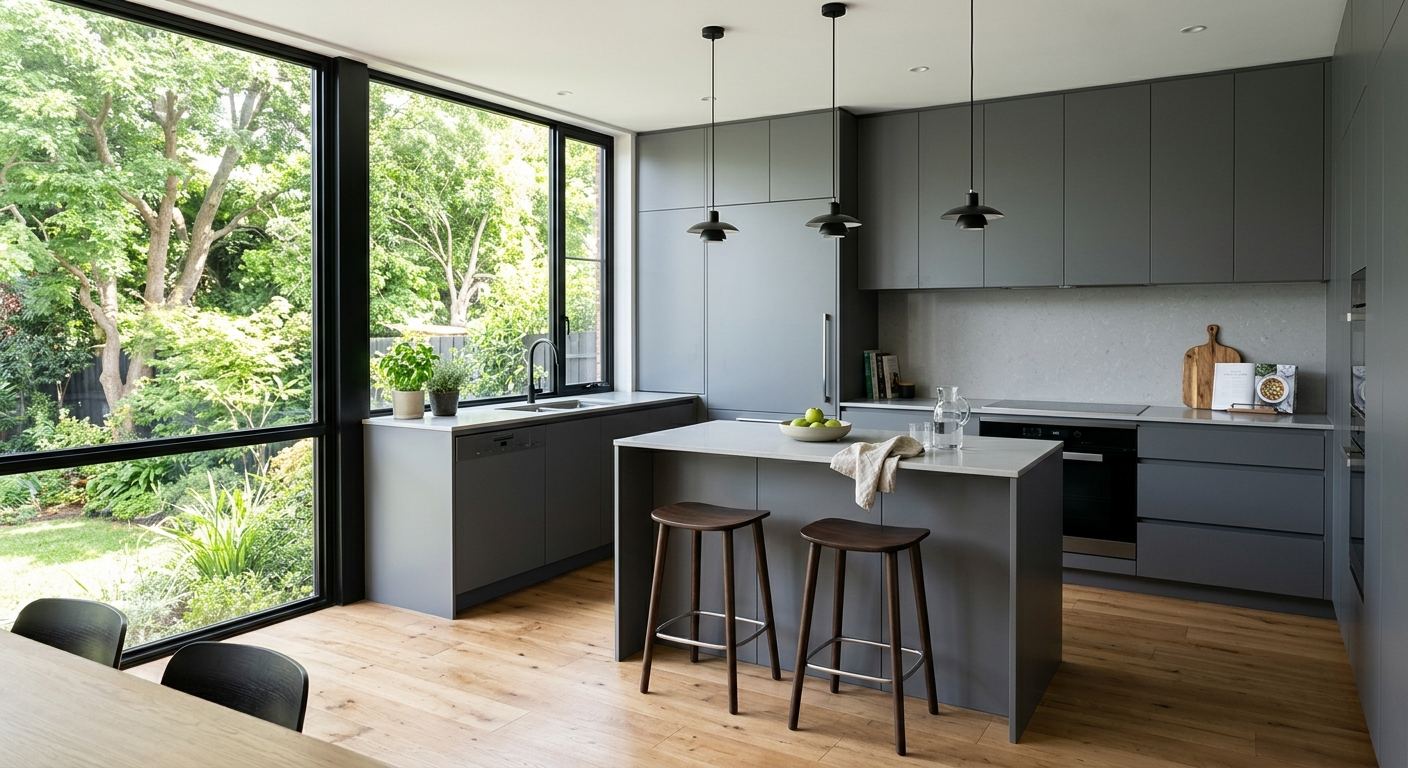
Kitchen renovation options and costs in Olympic Village
In Olympic Village, your kitchen renovation cost is usually less about the season and more about the finish level buyers expect in a Lower Mainland–Southwest, higher-value housing market. With a population of 9,423 (Statistics Canada, 2021 Census), the neighbourhood has a steady mix of newer infill homes and older Vancouver-era suites, so contractors often see both quick refreshes and full rebuilds. Local economic expectations also matter: when household purchasing power is strong, many homeowners choose quartz or stone counters and semi-custom cabinetry because the upgrade is easier to recover at resale. (Statistics Canada, 2021 Census.)
The Lower Mainland–Southwest market also shapes pricing because labour and scheduling are in demand—especially around the Burrard/Inlet corridor and the walkable townhouse pockets near False Creek—so availability can affect the final labour component. Climate plays a supporting role: West Coast humidity and rapid temperature swings can stress finishes if moisture management isn’t handled correctly, but it’s typically not the main driver of your quote. The bigger swing in totals comes from whether you’re staying a “refresh” (paint, hardware, appliances only) or changing cabinetry, moving plumbing/gas, and upgrading surfaces.
To compare your likely scope and budget, use the tiered options below as a baseline for Olympic Village. From there, your exact numbers tighten once we confirm layout, material selections, and what has to be permitted or disconnected.
| Renovation Tier |
What's Included |
Typical Duration |
Price Range |
| Cosmetic refresh (paint, hardware, new appliances only) |
Cabinet paint or refinish (no box changes), new cabinet hardware, appliance swap, minor caulking/touch-ups |
3–7 days (plus appliance lead time) |
$8,000–$18,000 |
| Mid-range full renovation (new cabinets, counters, sink, tile) |
New semi-custom or quality stock cabinets, countertop (quartz), sink/faucet, backsplash tile, new flooring prep/patching, basic lighting updates |
3–5 weeks |
$40,000–$85,000 |
| High-end full renovation (custom cabinets, stone counters, island) |
Fully custom millwork, premium stone counters, island build/trim, upgraded hardware, full-height backsplash option, upgraded electrical/lighting |
6–10 weeks |
$85,000–$120,000 |
| Cabinet refacing only (new doors + drawer fronts, same boxes) |
Door/drawer-front replacement, new drawer boxes or components where needed, hardware upgrade, matching trim/finish |
2–4 weeks |
$8,000–$35,000 |
| Countertop swap only (laminate to quartz or stone) |
Remove existing top, templating, new quartz/stone installation, sink cut-outs/re-seal, basic backsplash edge work |
1–2 weeks (lead time varies) |
$3,000–$12,000 |
| Backsplash tile installation only |
Demo of old surface where required, waterproofing prep, tile install, grout/seal, finishing trim to countertop/cabinets |
3–7 days |
$1,500–$6,000 |
Prices are estimates only and vary by project scope, site access and material selection.
What affects the price of kitchen renovation in Olympic Village
Homeowners in Olympic Village can receive very different quotes for the same kitchen because Lower Mainland–Southwest pricing is driven more by local home value, expected resale finish level, and the complexity of the cabinetry package than by weather alone. Across British Columbia, it’s common to see the same scope swing by 30–50% once you factor in labour demand, long-material lead times, and whether the contractor is building a “fit-and-finish” semi-custom kitchen or a custom millwork installation. In higher-value parts of Metro Vancouver, buyers often default to quartz or stone counters and semi-custom cabinetry because the cost is easier to justify at resale; in more budget-focused markets, laminate and stock cabinets dominate for ROI.
In Olympic Village specifically, two local conditions tend to push costs up or down. First, many homes sit in a mix of older layouts and tighter footprints; when you’re adding an island or opening a plan, trades need extra coordination for plumbing/gas rough-in and electrical routing—often the most unpredictable line item regardless of finish tier. Second, cabinet walls and older framing can be out of square, which affects how much labour goes into correcting and aligning new millwork. A “mid-range” job at $40,000–$85,000 can stay close to budget when you leave plumbing in place, but it can climb quickly toward the upper end of $85,000–$120,000 when layout changes trigger electrical upgrades, venting considerations, or stone fabrication adjustments.
For concrete examples: if you move a sink to chase better sightlines near a window, you may need additional drain work and drywall reconstruction; if you’re upgrading under-cabinet lighting, you’re typically buying new electrical circuits and labour. Conversely, keeping the same cabinet footprint and doing a countertop-only swap usually lands in the $3,000–$12,000 band—particularly when templating lines up cleanly with existing cut-outs.
| Price Factor |
Why It Matters |
Cost Impact |
| Cabinet tier — stock vs. semi-custom vs. fully custom millwork |
Material quality, fit tolerances, drawer/hinge systems, and the level of customization change both material and labour time |
Stock can hold a budget; semi-custom and custom commonly add several tens of thousands over a full renovation scope |
| Countertop material — laminate vs. quartz vs. granite vs. stone |
Fabrication complexity, weight, edge profiles, and installation labour vary significantly by material |
Quartz/stone typically costs more than laminate but can reduce long-term maintenance and replacement risk |
| Layout change — wall removal, island add, plumbing/gas move |
Changes require rough-in planning, structural review, and sometimes permits; access and patching drive labour |
Often the biggest unpredictable swing; can move a project from mid-range to high-end totals |
| Appliance package tier — builder vs. mid-range vs. pro-grade |
Power requirements, venting needs, finish matching, and trim kits differ by tier |
Appliances can add or subtract several thousand depending on venting and electrical compatibility |
| Flooring — refinish existing vs. full replacement |
Existing subfloor conditions and kitchen traffic wear can dictate whether you patch or replace |
Full replacement adds material and installation time; refinishing/patching can keep costs steadier |
| Backsplash — ceramic tile vs. marble vs. full-height slab |
Thickness, weight, and waterproofing requirements affect substrate prep and installation labour |
Full-height and natural stone typically increase both demo and install effort |
| Electrical — new circuits for island, under-cabinet lighting |
New runs, load calculations, and fixture installs are labour-intensive and require licensed work |
Can add noticeable cost even when materials are modest, due to trade time and inspection steps |
| Permit fees and licensed trade requirements |
Some scope triggers permitting and inspections, plus additional coordination with licensed trades |
Not usually the largest line item, but it can materially affect schedule and overhead |
Permits & regulations in British Columbia
In British Columbia, many kitchen “surface-level” upgrades do not require a permit—while changes to services, structure, or new electrical work often do. Typically, cabinet and countertop swaps don’t require a permit because you’re not altering plumbing, drainage, gas lines, load-bearing structure, or adding new circuits. Likewise, replacing fixtures like faucets (without moving the plumbing lines) is usually treated as a non-structural, like-for-like update.
Where permits are commonly required is when you move plumbing supply or drain lines, relocate gas appliances (for example, changing the stove/range location or work affecting a gas range/hood), remove a load-bearing wall or do any structural alteration, or add/relocate electrical circuits (such as new power for an island, adding multiple outlets, or upgrading under-cabinet lighting with new wiring). Gas work must be performed by a licensed gas fitter, and electrical work by a licensed electrician, with inspections required for permitted scope.
To verify a contractor in Olympic Village before signing, do three checks: (1) Licensing—ask for your contractor’s licence information and confirm the specific trade credentials through the applicable online registry, (2) Liability insurance—request a current certificate of insurance naming you and confirming adequate limits, and (3) Workers’ compensation coverage—confirm WCB/WSIB coverage (for the contractor’s employees and subcontractors) via the proof of clearance letter or coverage statement they provide. Then ensure the contract clearly assigns permit responsibility, inspection scheduling, and who covers overruns tied to discovery work.
Cabinets, countertops and layout decisions in Olympic Village
The three decisions that most affect how your Olympic Village renovation lands in the right price band are: (1) cabinet tier, (2) countertop material, and (3) whether you change the layout. In the Lower Mainland–Southwest resale market, buyers often expect a clean, contemporary finish with durable surfaces. That generally means semi-custom cabinets are the “sweet spot” for many homeowners—fast enough to schedule, but detailed enough to look built-in. Custom millwork is best when you need tight fit around angled walls, unique storage demands, or a bespoke island. If you want the lowest cost and shortest schedule, stock cabinets are the fastest route.
Countertops follow a similar logic. Laminate can be practical and budget-friendly, but it’s more susceptible to edge damage and moisture exposure over time. Quartz delivers a strong balance of stain resistance and consistent looks—especially helpful in a damp coastal climate where water management around sink areas matters. Granite and other natural stones add visual richness and premium appeal, but they may require more attention to sealing and joint detailing. Butcher block can warm a kitchen, yet it demands careful maintenance around spills to prevent swelling.
Layout changes are where costs become harder to control. Removing a wall to open the kitchen can be worth it if it creates a meaningful family-use zone, but it can also add structural review work, drywall/framing re-build, and dust-control challenges. A realistic example: if you’re considering a mid-range kitchen at $40,000–$85,000 but you move the sink and add an island, the plumbing and electrical rough-in can push you toward the higher end of $85,000–$120,000—even if your cabinet tier and countertop stay mid-range.
| Option |
Durability |
Maintenance |
Best For |
Price Range |
| Stock cabinets (big-box) |
Good durability with standard hardware; limited sizing flexibility |
Minimal—focus on keeping hinges aligned and protecting from standing water |
Budget-conscious refreshes and timelines where design can be more standard |
$8,000–$25,000 |
| Semi-custom cabinets (local dealer) |
High durability; better drawer systems and door options |
Low to moderate; maintain seals around sinks/dishwashers |
Most Olympic Village projects aiming for resale-ready finishes |
$20,000–$55,000 |
| Custom cabinets (local millwork shop) |
Excellent durability with tailored fit and premium joinery options |
Low when properly sealed; still requires moisture control in wet zones |
Unique layouts, built-ins, and statement islands |
$45,000–$90,000 |
| Laminate countertop |
Solid for everyday use, but edges can chip if impacted |
Wipe clean; avoid prolonged water at seams and edges |
Keeping costs predictable for shorter-stay homes or tight budgets |
$3,000–$6,000 |
| Quartz engineered countertop |
Very durable; resistant to staining and everyday wear |
Low—typical cleaning only; minimize heat exposure at surface |
Resale-friendly, low-maintenance kitchens in Metro Vancouver |
$5,500–$11,000 |
| Granite / natural stone countertop |
Durable and heat-tolerant; appearance varies by slab |
Moderate—periodic sealing may be needed and joints matter |
Premium look where homeowners want natural variation |
$7,000–$12,000 |
| Butcher block countertop |
Durable with proper care; susceptible to water damage if neglected |
Moderate to high—oil treatment and quick spill drying |
Warm, rustic styling and homeowners willing to maintain surfaces |
$4,500–$9,500 |
| Marble countertop |
Beautiful but softer; can scratch and stain more readily |
Higher—requires careful sealing and prompt stain treatment |
Statement kitchens where aesthetics matter more than heavy-use practicality |
$8,000–$15,000 |
How to choose a kitchen renovation contractor in Olympic Village
Choosing the right contractor in Olympic Village is mostly about verification and clarity. In British Columbia, confirm the trades required for your scope: licensed gas fitter credentials for any gas-related work, and licensed electrician credentials for circuit changes and new island power. Ask for proof of liability insurance and verify coverage through the certificate of insurance your contractor provides. For workers’ compensation, request proof of WCB/WSIB clearance or coverage documents so you’re not left holding the risk if labour is injured on site.
For pricing, get 2–3 itemised written quotes instead of a lump sum. You want a breakdown that separates labour from materials (cabinet package, countertops, hardware, tile, disposal, and any required demolition) and shows what’s included for site protection, patching, and electrical/plumbing coordination. Carefully read the scope for exclusions: is permit pulling included, or is it your responsibility? Is waste disposal included, or billed separately? If appliances are included, confirm the exact models and whether installs include plumbing connections and venting requirements.
On warranty, ask for two layers: workmanship warranty length and what manufacturer warranties cover products. Also confirm whether the warranty is transferable to you as the homeowner and what documentation you must keep.
Payment schedule should be conservative. Never pay more than 10–15% upfront; use milestone payments tied to completed stages, and hold back a final portion until punch-list items are complete. Finally, insist on a start date and a completion estimate in writing, because material lead times for cabinets and stone can shift timelines.
- Ask which licensed trades will be used and for which tasks
- Request certificates for liability insurance and proof of WCB/WSIB coverage
- Get itemised quotes with labour + material line items
- Confirm who pulls permits and who pays permit fees (if applicable)
- Clarify disposal and recycling of old cabinets/counters
- Verify appliance and plumbing connection assumptions
- Confirm countertop templating lead times and fabrication schedule
- Check warranty terms for workmanship and products (and transferability)
- Review change-order process and documentation requirements
- Ensure site protection (floor covering, dust control) is included
- Ask who handles any concealed conditions discovery (rot, mould, old wiring)
- Use a milestone payment schedule with a holdback
In Olympic Village, common red flags include: vague “permit handled by contractor” wording with no written responsibility, quotes that omit electrical/plumbing rough-in assumptions while still allowing layout changes, refusal to provide insurance/WCB/WSIB proof, unrealistic timelines that ignore cabinet or stone lead times, and lack of a formal warranty statement in the contract.
Frequently asked questions — kitchen renovation in Olympic Village
How much does a kitchen renovation cost in Olympic Village?
In Olympic Village, most kitchen renovations land in the broad range of $40,000–$120,000, depending on whether you’re doing a practical refresh or a full rebuild with premium finishes. A cosmetic refresh (paint, hardware, and new appliances only) often stays around $8,000–$18,000, while a mid-range full renovation with new cabinets and quartz counters typically sits near $40,000–$85,000. Higher-end projects—custom millwork, stone counters, and an island—are more likely to approach $85,000–$120,000. In this part of the Lower Mainland–Southwest, finish expectations and the resale market can push homeowners toward quartz/stone and semi-custom cabinetry even when the layout stays similar.
How long does a kitchen renovation take in Olympic Village?
Timelines in British Columbia vary mostly by demolition complexity and material lead times, not the weather itself. Cosmetic refreshes can be as short as 3–7 days, though appliance delivery can extend the overall schedule. A mid-range full renovation commonly takes about 3–5 weeks once cabinets and counters are templated and installed. High-end full renovations with custom cabinets and stone counters typically run 6–10 weeks due to fabrication and scheduling coordination. The key schedule risk in Olympic Village is when you add layout changes—moving plumbing/gas or adding electrical circuits—because rough-in inspections can add time. The fastest jobs keep plumbing where it is and avoid major electrical re-routing.
Quartz vs granite countertops — which is better?
For many Olympic Village homeowners, quartz is the easier “better” choice for day-to-day living. Quartz is engineered, typically offers strong stain resistance, and usually needs only routine cleaning, which fits well with a coastal climate where moisture management around the sink is crucial. Granite is also durable and heat-tolerant, but it’s natural stone with slab-by-slab variation; it may require periodic sealing and careful joint detailing. In typical Lower Mainland–Southwest pricing, quartz often fits the $5,500–$11,000 countertop band, while granite commonly sits in a similar but sometimes higher premium range, around $7,000–$12,000, depending on slab selection and edge profiles. If you want consistent performance with less maintenance, quartz is usually the pick; if you want natural character, granite is worth it.
Should I reface or replace my cabinets?
Refacing (new doors and drawer fronts while reusing the existing boxes) is a strong option when your cabinet boxes are structurally sound, your layout is staying the same, and you want to keep disruption lower. In Olympic Village, refacing can be a cost-effective path when the goal is style refresh without touching plumbing or electrical—often landing around $8,000–$35,000. Replacing makes more sense if your boxes are sagging, water-damaged near the sink/dishwasher, out of square, or you want major storage changes, new drawer systems, or an island/raised layout. If you’re already moving toward a full renovation scope in the $40,000–$85,000 band, replacement can streamline everything—especially if new countertops and backsplash are part of the plan.
Do I need a permit for a kitchen renovation in British Columbia?
In British Columbia, cabinet and countertop swaps generally do not require a permit because you’re not altering the building’s services or structure. You typically do need permits and licensed trade involvement if you move plumbing supply/drain lines, relocate a gas appliance or work affecting gas lines, remove a load-bearing wall, or add/relocate electrical circuits (such as new power and outlets for an island, plus substantial lighting rewiring). Gas work must be done by a licensed gas fitter and electrical work by a licensed electrician, with inspections for permitted scope. Before you sign, confirm permit responsibility in writing—don’t rely on verbal assurances. A good contractor will also tell you what’s covered, what inspection steps are required, and what documentation they will provide on completion.
What's the ROI on a kitchen renovation?
ROI in Olympic Village depends heavily on whether your renovation matches local resale expectations: durable, modern finishes (quartz/stone, well-built drawers, clean lighting) tend to hold value better than purely cosmetic updates. In higher-value Lower Mainland–Southwest pockets, renovations that look “built-in” and premium usually play better with buyers, while budget refreshes can be priced competitively but may recoup less if the rest of the home looks dated. The most cost-inefficient approach is upgrading fixtures while avoiding the underlying issues—if your existing cabinets or wet-zone materials are worn, buyers notice. Also, layout changes can improve daily function, but they cost more; if your project starts trending toward $85,000–$120,000, you want a plan that’s clearly beneficial for how the space is used and presented for sale. Your contractor should help you align scope with your expected resale price range.