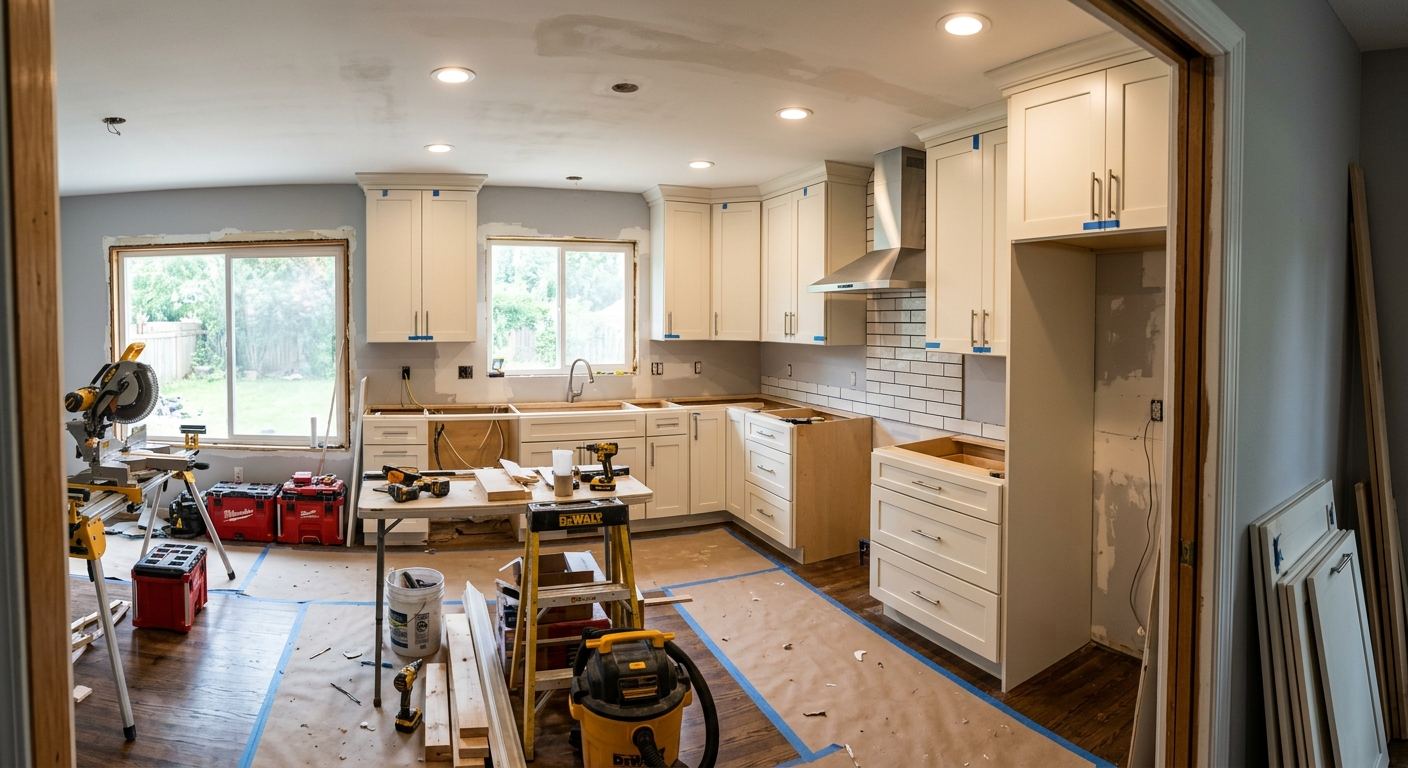
Kitchen renovation options and costs in Central Coquitlam
Central Coquitlam homeowners typically renovate kitchens with the long-term plan of keeping up with Lower Mainland tastes—bright, durable surfaces and layouts that feel open without sacrificing storage. In a community of 15,480 residents (Statistics Canada, 2021 Census), you’ll also find many households with purchasing power that supports mid-range to premium finishes; when incomes rise, buyers increasingly expect quartz or stone counters and semi-custom cabinetry rather than laminate and basic hardware (Statistics Canada, 2021 Census). That’s why the same kitchen can land very different numbers across Central Coquitlam: pricing here is driven more by expected finish level, not by weather alone.
Even though BC’s coastal climate is generally mild, kitchen projects still cost more when they involve frequent material handling, humidity-sensitive finishes, or older homes with dated framing that needs patching. Labour availability also matters in Metro Vancouver—high-demand months can push schedules and force tighter crew coordination, which affects labour lines in quotes. Finally, neighbourhood patterns play a role: trade demand is especially consistent around the North Coquitlam / Burquitlam area where many homes are older and buyers tend to upgrade kitchens during resale transitions.
If you want a quick baseline before meeting contractors, the table below compares the common renovation tiers you’ll see in Central Coquitlam and the realistic time frames to plan around.
| Renovation Tier |
What's Included |
Typical Duration |
Price Range |
| Cosmetic refresh (paint, hardware, new appliances only) |
Cabinet paint or refinishing, new cabinet hardware, new appliance set (dishwasher/range/microwave/hood or fridge), minor caulking, touch-up drywall, basic countertop cleaning/conditioning where applicable |
1–3 weeks |
$8,000–$18,000 |
| Mid-range full renovation (new cabinets, counters, sink, tile) |
Semi-custom or quality stock cabinets, new countertops, sink + faucet, backsplash tile, vanity-grade under-cabinet lights (where needed), flooring refresh (refinish or replace), standard plumbing adjustments |
4–8 weeks |
$40,000–$75,000 |
| High-end full renovation (custom cabinets, stone counters, island) |
Fully custom millwork, quartz/stone counters, island with upgraded storage, premium backsplash (tile feature or slab-like look), advanced lighting plan, more extensive electrical and plumbing coordination, higher-end hardware and finishing |
8–14 weeks |
$85,000–$120,000 |
| Cabinet refacing only (new doors + drawer fronts, same boxes) |
Refacing of existing frames, new doors/drawer fronts, hardware, optional paint/finish refresh, new hardware pulls, update of toe-kick details and trim |
2–5 weeks |
$12,000–$38,000 |
| Countertop swap only (laminate to quartz or stone) |
Removal and disposal, templating, new countertop installation, sink cut-out adjustments if needed, new backsplash starter strip (only if part of the scope) |
1–3 weeks |
$3,500–$14,000 |
| Backsplash tile installation only |
Surface prep, tile setting and grouting, edges and trims, caulking at change-of-plane points, clean-up and disposal |
3–7 days |
$1,500–$6,000 |
Prices are estimates only and vary by project scope, site access and material selection.
What affects the price of kitchen renovation in Central Coquitlam
You’ll often see kitchen renovation quotes in Lower Mainland–Southwest that differ by 30–50% for the same “size” and finish targets. The reason is simple: in British Columbia, home value, household income and expected resale outcome tend to push projects into different finish tiers—especially cabinets, stone selection, and the level of design-led layout changes. In higher-value markets, homeowners more commonly choose quartz or stone counters and semi-custom cabinetry because that spend is easier to recover on resale; in more modest markets, laminate and stock cabinets dominate because they deliver better ROI for the same functional upgrades.
In Central Coquitlam, two practical cost drivers show up repeatedly. First, many kitchens sit in older homes where wall conditions aren’t uniform—when we open up for tile backsplashes, appliance moves, or new cabinet runs, we sometimes find out-of-plane surfaces that require extra drywall patching and shimming before finish work. Second, coastal humidity and temperature cycling can affect how quickly trades can finalize finishes, particularly when there’s extended time between demolition and closing walls. That’s why a “quick” countertop swap can turn into a bigger job if the substrate or backsplash line needs correction.
For example, a mid-range renovation priced around $40,000–$75,000 can jump into the higher-end lane if you add an island with electrical/under-cabinet lighting and upgrade to stone counters, commonly pushing the overall project toward $85,000–$120,000. Conversely, if you keep the plumbing line where it is and avoid gas line moves, costs stay much more predictable even when you upgrade finishes. The biggest unpredictability still comes from layout changes—wall removal, adding an island, and moving a gas line or plumbing—because they require coordination across multiple licensed trades regardless of finish tier.
| Price Factor |
Why It Matters |
Cost Impact |
| Cabinet tier — stock vs. semi-custom vs. fully custom millwork |
Higher tiers cost more per linear foot due to construction quality, fit/finish, and interior organization; they also reduce rework when walls are not perfect |
Often shifts total spend by ~15%–35% |
| Countertop material — laminate vs. quartz vs. granite vs. stone |
Material cost, fabrication complexity, and edge detailing affect both material and install labour |
Typically adds ~$3,000–$12,000 depending on choice and scope |
| Layout change — wall removal, island add, plumbing/gas move |
New openings and rerouted services create hidden work: framing, drywall patching, subfloor and inspection steps |
Can swing a job by ~25%–60% regardless of cabinet tier |
| Appliance package tier — builder vs. mid-range vs. pro-grade |
Higher-end appliances may require different trim kits, venting performance, and electrical readiness |
Often impacts overall cost by ~5%–20% |
| Flooring — refinish existing vs. full replacement |
Protecting and reinstalling flooring (or matching heights) affects labour time and material wastage |
Usually adds ~$1,500–$6,000 when full replacement is required |
| Backsplash — ceramic tile vs. marble vs. full-height slab |
Complex patterns, heavier stones, and full-height coverage increase prep, setting time, and material handling |
Typically adds ~$1,500–$6,000 for tile installation scope |
| Electrical — new circuits for island, under-cabinet lighting |
New circuits and lighting layouts require licensed electrician time and coordination with cabinet installation |
May add ~$800–$3,500 depending on how many new points are added |
| Permit fees and licensed trade requirements |
Permits and inspection steps add lead time; licensed work also reduces schedule risk and rework |
Can add ~$500–$4,000 plus scheduling coordination time |
Permits & regulations in British Columbia
In British Columbia, simple cabinet and countertop swaps typically do not require permits. That includes replacing cabinets in the same general locations, changing countertops, or installing a backsplash if you’re not altering structural elements or moving services. However, permits and licensed trades come into play when you change the “systems” part of the kitchen. Moving plumbing supply or drain lines, relocating gas components (like the stove) or changing a gas line route, removing a load-bearing wall, and adding new electrical circuits for an island, new outlets, or under-cabinet lighting often require permits and inspections.
Gas work must be completed by a licensed gas fitter. Electrical work must be done by a licensed electrician. In practice, this means your contractor should build inspection milestones into the schedule—electrical rough-in and gas/plumbing rough-in typically happen before walls are closed. Before you sign, confirm permit responsibility: the contract should clearly state who pulls permits (and whether it’s included in the quoted price or an add-on).
To verify licensing and coverage in Central Coquitlam, do these steps: (1) Ask for the contractor’s licence details and check the applicable online registry entry for current status; (2) Request a certificate of insurance showing general liability (and any required endorsements for renovations); and (3) Confirm WSIB/WCB coverage where applicable—then ask for a clearance letter or proof of account status. If they can’t provide documentation promptly, that’s a major scheduling and risk red flag.
Cabinets, countertops and layout decisions in Central Coquitlam
In Central Coquitlam, three decisions drive most of your cost and most of your satisfaction: (1) cabinet tier, (2) countertop material, and (3) whether you change the layout. Cabinet tier determines your storage quality and how well the kitchen “fits” even when walls aren’t perfectly flat. Stock cabinets are the fastest and usually the cheapest because they’re standardized. Semi-custom cabinets are typically the most popular mid-range choice in Metro Vancouver because you get better options for widths, interiors, and finishes. Custom cabinets are best when you want precise alignment, special corner storage, or a true built-in look—these projects cost more because they’re made-to-fit.
Countertop material should match your everyday use and maintenance preferences. Laminate is budget-friendly and forgiving for minor impact, but it can be less resistant to heat and can show wear at edges over time. Quartz is a strong all-around choice for Lower Mainland kitchens—durable, consistent appearance, and easier daily care—while granite/natural stone adds premium visual variation and is still very durable but benefits from proper sealing practices. Butcher block and marble each have trade-offs: butcher block needs conditioning and sealing to prevent staining, and marble is more porous and can etch with acidic spills.
Layout changes often decide whether you stay near $40,000–$75,000 or move toward $85,000–$120,000. A wall removal or island addition may be worth it if it creates actual circulation and seating flow for your household—especially in smaller galley-style or dated layouts. But if you’re only chasing appearance, keep the plumbing/gas runs where possible; rerouting services adds labour, inspection steps, and drywall patching. As a dollar example: upgrading from laminate to quartz might add roughly several thousand dollars, but it’s often far cheaper than moving the sink position or relocating a gas stove—service relocation typically dominates the budget.
| Option |
Durability |
Maintenance |
Best For |
Price Range |
| Stock cabinets (big-box) |
Good everyday durability; hinges and drawer slides vary by brand |
Low—basic tightening and cleaning; limited ability to correct wall inconsistencies |
Fast timelines and budget-focused refreshes |
$8,000–$25,000 |
| Semi-custom cabinets (local dealer) |
Very solid build; better options for internal storage and door/drawer upgrades |
Low—regular cleaning; interior organization reduces clutter wear |
Most Central Coquitlam renovations aiming for a modern resale look |
$18,000–$55,000 |
| Custom cabinets (local millwork shop) |
Highest fit and finish; strongest solutions for awkward layouts and oversized features |
Low to moderate—depends on finish; custom hardware and special drawers need gentle care |
Design-led kitchens, built-in islands, or irregular wall/ceiling lines |
$40,000–$90,000 |
| Laminate countertop |
Decent for daily use; seams and edges are the main long-term wear points |
Easy cleaning; avoid heavy heat and prolonged moisture at seams |
Cost control when you want a clean look quickly |
$3,000–$6,000 |
| Quartz engineered countertop |
High durability; resistant to staining and everyday impacts |
Very low—typical countertop cleaning with non-abrasive products |
Busy families and homeowners wanting “premium without worry” |
$6,000–$12,000 |
| Granite / natural stone countertop |
Excellent scratch and heat resistance (varies by stone); natural strength |
Moderate—periodic sealing is usually recommended and requires correct products |
Premium appearance and unique natural veining |
$7,000–$14,000 |
| Butcher block countertop |
Good impact resistance; can dent if abused |
Higher—needs oiling/conditioning and careful drying to prevent staining |
Casual warmth and frequent food prep |
$5,000–$10,000 |
| Marble countertop |
Very durable as a stone, but surface can etch from acids |
Moderate to high—more careful cleaning and protective routines |
Low-gloss luxury look and a more decorative lifestyle |
$8,000–$16,000 |
How to choose a kitchen renovation contractor in Central Coquitlam
When choosing a kitchen renovation contractor in Central Coquitlam, start with verification: British Columbia licensing for the trades involved, liability insurance, and WSIB/WCB coverage where applicable. For licensing, ask each trade for their licence details and confirm status through the appropriate online registry before work begins. For insurance, request a current certificate of insurance and ensure it covers renovation activities (and any subcontractors they use). For WSIB/WCB, ask for proof/clearance documentation showing their account status—don’t rely on verbal confirmation.
Next, request 2–3 itemised written quotes that break labour and materials down—don’t accept a vague lump sum. Your quote should list scope elements clearly: cabinet supply and install, countertop fabrication and install, tile labour, electrical/plumbing allowances, and any demolition/disposal. Pay attention to what’s excluded: permit pull included or not, dumpster/disposal included or not, patching and painting included or not, and whether appliance installation (and old appliance disposal) is part of the scope.
Warranty matters too. Ask for the workmanship warranty length and what it covers (and for how long). Confirm the product/manufacturer warranty for cabinets and countertops, and whether warranties are transferable to you as the homeowner. For payment schedule, keep deposits reasonable—never pay more than 10–15% upfront—and hold back a final portion until punch-list items are complete. Finally, insist on a timeline with a start date and completion estimate in writing so you can plan around school/work disruptions.
- Ask for a detailed scope of work that matches the quote line-by-line.
- Confirm who pulls permits and who pays permit-related fees.
- Require itemised allowance amounts for stone, tile, and plumbing/electrical work.
- Verify cabinet and countertop lead times in writing before demolition.
- Get disposal and site protection (plastic sheeting, floor protection) spelled out.
- Confirm whether patching/drywall finishing is included after openings and service runs.
- Ask about dust control steps if you have occupied rooms nearby.
- Require proof of insurance and licence details for all subcontractors.
- Ensure warranty details include workmanship and start/finish dates for coverage.
- Review the payment schedule and keep the final holdback until completion.
- Ask for a project manager point of contact and expected update cadence.
- Demand a written schedule with inspections milestones if electrical/gas/plumbing is involved.
Concrete red flags in Central Coquitlam: (1) only providing one lump-sum number with no line-item labour/material breakdown; (2) refusing to confirm insurance or licensing documents in writing; (3) quoting electrical or gas-related work without specifying licensed trade responsibility; (4) asking for large upfront deposits (beyond ~10–15%); and (5) skipping clarity on disposal, drywall patching, and permit responsibility—those omissions reliably create change orders late in the job.
Frequently asked questions — kitchen renovation in Central Coquitlam
How do I choose a kitchen contractor in Central Coquitlam?
Start by verifying the contractor’s British Columbia trade licensing coverage and asking for proof of liability insurance before you sign. Then request 2–3 itemised quotes that show labour and materials separately (cabinets, countertops, tile labour, and allowances) so you can compare apples to apples. In Central Coquitlam, lead times can swing the schedule, so ask about cabinet and stone fabrication timing and confirm it in writing. Finally, check warranty terms for workmanship and product coverage, and confirm payment schedule expectations—avoid contractors pushing for large deposits. If you’re targeting a mid-range project budget around $40,000–$75,000, ensure the quote matches that tier, not just a “starting at” number.
What order do kitchen renovation steps happen in?
A practical sequence in Central Coquitlam is: planning and measurements first (including countertop templating schedule), then demolition and site protection, followed by rough-in work for plumbing/electrical/gas if anything is being moved, then inspections and wall close-up. After that, cabinets go in, countertops are fabricated and installed, and finally the finishing steps happen—backsplash tiling, trim, painting touch-ups, hardware installs and final appliance setup. If you’re not moving services, you can often skip the rough-in phase and compress the timeline. A typical mid-range kitchen around $40,000–$75,000 often lands in the 4–8 week window because cabinetry lead time and inspection scheduling still affect the critical path.
Can I live at home during a kitchen renovation in Central Coquitlam?
Many homeowners do live in the home during part of the renovation, especially if the scope is a refresh, cabinet refacing, or a countertop/backsplash project. For a full renovation with service moves, it’s more difficult because the sink area, cooking setup, and often electrical/gas access are disrupted. In Central Coquitlam, dust control is a big deal due to the number of occupied homes and older interior layouts—contractors should use barriers, protect floors, and stage work to keep debris contained. If you can set up a temporary cooking station (microwave/portable induction and a mini-fridge) and designate a clean area, living in place is often workable. For major remodels in the $85,000–$120,000 tier, many families plan to stay elsewhere for the highest-disruption weeks.
Should I renovate my kitchen before selling in Central Coquitlam?
It depends on your goal: targeted improvements that modernize the kitchen often help with buyer appeal, but you don’t want to overspend for your home’s market position. In Lower Mainland–Southwest, buyers frequently expect quartz/stone-looking surfaces and more refined cabinetry presentation when they’re comparing listings, which is why kitchen upgrades can support resale. If your kitchen is functional but outdated (worn finishes, tired hardware, dated backsplash), a mid-range renovation around $40,000–$75,000 can be a balanced way to refresh without triggering the biggest layout-change costs. If the plan is a full custom rebuild, consider whether the change aligns with the neighbourhood’s typical finish expectations—otherwise you risk a project that’s too premium for your buyer pool.
What's the most popular kitchen style in Central Coquitlam right now?
Right now, many homeowners in Central Coquitlam gravitate to clean, contemporary looks: flat or simple shaker profiles, warm neutral colours, and bright under-cabinet lighting that makes the room feel larger. Quartz countertops and durable backsplashes are popular because they photograph well and stand up to everyday use. Layout-wise, open-feel arrangements with better circulation remain common—especially when there’s enough space to justify an island or a more efficient work triangle. You’ll see styling choices that align with different budgets: stock-to-semi-custom cabinetry for mid-range homes, and custom millwork plus stone-led looks when the project is in the higher-end $85,000–$120,000 range.
How do I know if I need to update my kitchen plumbing in Central Coquitlam?
You may need updates if you’re moving the sink or dishwasher, replacing supply/drain lines, or noticing issues now—slow drains, leaks under the sink, corrosion at joints, or inconsistent water pressure. Even if you’re not moving plumbing, older homes sometimes have hidden fittings that don’t match modern valves or leak at connections once they’re disturbed during reno. In Central Coquitlam, kitchen renovations can coincide with opening walls for electrical and ventilation, so it’s smart to plan a plumbing inspection early so you don’t discover problems after cabinets are installed. If your contractor is proposing service moves, confirm the permit and licensed trade requirements are included in the scope.