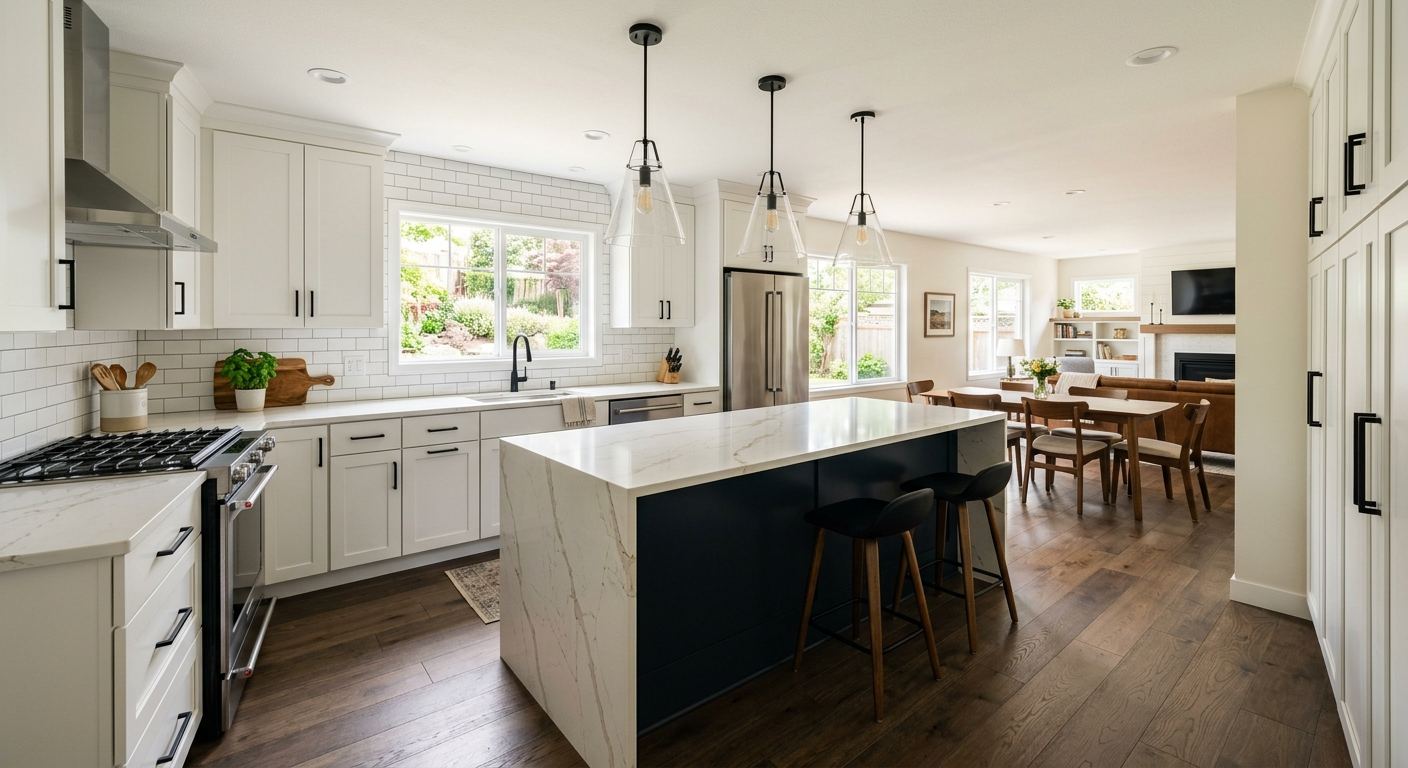
Kitchen renovation options and costs in Cedar
Cedar, British Columbia is a smaller community (2,836 people per Statistics Canada, 2021 Census), but kitchen demand is steady because many homes are older and periodically need functional upgrades—especially where families outgrow the original layout. In the Lower Mainland–Southwest, pricing is influenced more by local home value and what buyers expect on resale than by climate alone. In higher-value parts of Metro Vancouver, homeowners more often move toward semi-custom or custom cabinetry, plus quartz/stone counters and upgraded hardware, which is why the same “kitchen size” can land in very different price brackets. Home renovations also track income and buying power across the region, so expectations rise quickly as finishes get more design-led.
Contractor availability can matter too. When trades are busy (new builds, simultaneous renovations, or broader market upticks), labour rates and scheduling premiums can add cost even when the materials are straightforward. That said, Cedar’s projects typically fit into one of three common paths: a cosmetic refresh for a quick sell, a practical mid-range full renovation, or a high-end rebuild where layout, cabinetry, and stone surfaces are upgraded together. Because the Lower Mainland–Southwest market often supports resale recovery for upgraded kitchens, many homeowners prefer investing in durable fronts and counters rather than repeating short-lived upgrades.
Below are practical cost bands you can use to compare contractor quotes before you start picking finishes.
| Renovation Tier |
What's Included |
Typical Duration |
Price Range |
| Cosmetic refresh (paint, hardware, new appliances only) |
Cabinet paint or stain touch-ups (no box replacement), new pulls/hinges, appliance swap (fridge/range/dishwasher, excluding major gas/plumbing moves), basic surface cleaning and caulking, existing countertop retained |
3–7 business days |
$8,000–$20,000 |
| Mid-range full renovation (new cabinets, counters, sink, tile) |
New semi-custom or quality stock cabinets, countertop replacement, undermount sink and faucet, backsplash tile, new or reused lighting as-is, under-cabinet caulking and finish trim, labour for disconnect/reconnect of standard appliances |
3–6 weeks |
$40,000–$80,000 |
| High-end full renovation (custom cabinets, stone counters, island) |
Custom cabinetry or fully made-to-fit millwork, stone countertops (quartz/stone), island with integrated features (power where applicable), upgraded backsplash (tile or stone), sink/hardware upgrades, more complex trim, potential layout changes and additional trades coordination |
6–12 weeks |
$90,000–$120,000 |
| Cabinet refacing only (new doors + drawer fronts, same boxes) |
Removal and re-install of door/drawer fronts, new hinges and pulls, light prep/primer, existing box interiors retained, countertops and backsplash retained unless you choose to bundle an extra scope |
1–3 weeks |
$8,000–$30,000 |
| Countertop swap only (laminate to quartz or stone) |
Remove existing laminate/counter, fabrication and install of new quartz or stone, new edge profile (where feasible), reconnect of sink (if applicable) and basic resealing; backsplash not included unless you add it |
3–10 business days |
$18,000–$45,000 |
| Backsplash tile installation only |
Surface prep, tile supply and install for typical kitchen backsplash height, grout/seal, finishing at corners; existing outlets and countertop edges not moved |
2–6 business days |
$1,500–$6,000 |
Prices are estimates only and vary by project scope, site access and material selection.
What affects the price of kitchen renovation in Cedar
In Cedar and across the Lower Mainland–Southwest, the same kitchen can come back from contractors with totals that swing 30–50%—not because of weather, but because of how finish tier, layout complexity, and trade sequencing are priced. Across British Columbia, project totals rise quickly once cabinetry changes from stock to semi-custom to fully custom millwork, and when countertops shift from laminate to quartz or natural stone. In high-value Lower Mainland–Southwest markets, homeowners often “spend up” because the renovation can be recovered on resale; that same logic doesn’t always apply in more modest areas, where laminate and stock cabinets deliver better ROI.
Two local realities shape what people choose in Cedar: home-buying expectations and the density of renovations in the region (Statistics Canada, 2021 Census notes Cedar’s population at 2,836). When a kitchen upgrade is meant to appeal to typical regional buyers, quartz/stone counters and better cabinetry hardware become the default at mid-range and higher budgets. Climate still plays a role—Cedar’s coastal-influenced humidity can be harder on surfaces and seals—but most cost differences come from material and labour choices rather than temperature.
Concrete examples: (1) If your existing boxes are stable and you’re upgrading only fronts, refacing can keep you in the $8,000–$30,000 range instead of moving into a full cabinet replacement. (2) If your current laminate needs removal and you want quartz plus an integrated sink edge, countertop-only work often jumps into the $18,000–$45,000 band. (3) Layout moves—like adding an island or relocating a gas line—are where bids become unpredictable, because plumbing, gas, electrical, and ventilation must be coordinated and inspected regardless of cabinet tier.
These factors are why one quote for $40,000–$80,000 can feel “too low” to a second contractor if layout changes and stone selection weren’t fully scoped. The table below breaks down what typically drives the biggest differences.
| Price Factor |
Why It Matters |
Cost Impact |
| Cabinet tier — stock vs. semi-custom vs. fully custom millwork |
Different manufacturing complexity, fit-to-site requirements, and finish/door styles affect both materials and install time |
Largest variance; can shift a mid-range job toward the $40,000–$80,000 band or push high-end totals to $90,000–$120,000 |
| Countertop material — laminate vs. quartz vs. granite vs. stone |
Fabrication difficulty, edge profiles, weight, and seaming requirements impact labour and material cost |
Countertop-only can range widely (laminate retained vs. full quartz/stone swap typically adds substantial cost) |
| Layout change — wall removal, island add, plumbing/gas move |
Triggers extra trades (structural, plumbing, gas, electrical) and increases inspection and scheduling time |
Often the biggest unpredictable cost regardless of finish level |
| Appliance package tier — builder vs. mid-range vs. pro-grade |
Higher tiers cost more and may require different ventilation, trim kits, and power/gas configuration |
Can add thousands quickly; affects total more than many homeowners expect |
| Flooring — refinish existing vs. full replacement |
Removing cabinetry may damage flooring; matching new flooring to old can add complexity |
Full replacement adds labour and material; refinishing can reduce demo and install labour |
| Backsplash — ceramic tile vs. marble vs. full-height slab |
Material weight, pattern matching, and finish complexity drive labour time and risk |
Tile-only might sit near $1,500–$6,000, while premium stone increases beyond that |
| Electrical — new circuits for island, under-cabinet lighting |
Adding power needs licensed electrical work and may require panel capacity review |
Typical adders can move “refresh” scopes into renovation territory |
| Permit fees and licensed trade requirements |
Plumbing/gas/electrical/structural changes require permits and inspections |
Adds administrative cost and can extend timelines even when materials are unchanged |
Permits & regulations in British Columbia
In British Columbia, a straightforward cabinet or countertop swap typically does not require a permit. If you’re replacing cabinets “in kind” (same footprint) and swapping countertops without moving plumbing or gas fixtures, you can usually proceed without permits—your contractor should still follow safety requirements and handle any work that falls under trade licensing.
Permits and licensed trades are required when you change systems or structural elements. The work that usually does require a permit includes: moving plumbing supply or drain lines, relocating or adding a gas line for a stove/range, removing a load-bearing wall (or making structural changes), adding electrical circuits (for example, outlets/power for an island or additional lighting that requires new wiring), and any major changes to ventilation that affect combustion appliances. Gas work must be performed by a licensed gas fitter, and electrical work must be performed by a licensed electrician; both require inspections.
How Cedar homeowners verify a contractor’s credentials in practice: (1) Ask for the contractor’s licence details and confirm they match the trade scope; many businesses also provide documentation on their websites. (2) Request a certificate of insurance (liability) showing the effective dates and coverage limits. (3) Confirm worker coverage (WSIB/WCB) with a clearance letter or proof of coverage for the applicable province. (4) Ensure the contract clearly states who pulls permits and who pays for inspections—responsibility should be written before work starts.
Cabinets, countertops and layout decisions in Cedar
The three most consequential decisions in a Cedar kitchen renovation are: (1) cabinet tier, (2) countertop material, and (3) layout changes. Start with cabinet tier because it governs both the look and the long-term usability. Stock cabinets are the fastest and cheapest route, but semi-custom is usually the sweet spot in the Lower Mainland–Southwest resale market: better door/drawer options and more realistic filler and fit-to-site adjustments. Custom cabinets cost more, but they shine when your kitchen has unusual dimensions, older framing, or you want a truly integrated island.
Next, countertop material. Laminate is budget-friendly and can be practical in a cosmetic refresh, but it’s less forgiving for daily impact and heat. Quartz is a popular middle-to-premium choice because it resists staining and wears well with typical family use. Granite/natural stone offers prestige and unique patterning, but it may require sealing and extra care depending on the specific stone. Butcher block can add warmth, though it needs maintenance (oiling) to stay looking great, especially in a humid coastal environment. Marble is high-end and visually striking, but it’s not the best “set-and-forget” option for a busy household.
Finally, layout changes are where costs can jump quickly: removing an opening, adding an island, or relocating plumbing/gas can move you out of a simple $40,000–$80,000 renovation band into higher totals because coordination and inspections drive labour time. A $6,000–$12,000 island-related utility move can be justified if it improves traffic flow, seating, and workspace—otherwise, you may get better value keeping the existing plumbing wall.
One dollar example: if your quotes differ mainly because one contractor includes quartz plus a simple backsplash, and the other keeps laminate, it’s common to see the project drift toward a higher band (for example, from the mid-range range toward the $90,000–$120,000 end once cabinetry tier and island work are bundled).
| Option |
Durability |
Maintenance |
Best For |
Price Range |
| Stock cabinets (big-box) |
Solid for day-to-day use when installed correctly; limited custom fit |
Low; keep hinges/soft-close hardware maintained and clean |
Fast renovations, tight budgets, straightforward layouts |
$8,000–$30,000 |
| Semi-custom cabinets (local dealer) |
Good build quality; better fit options and upgraded hardware choices |
Low; occasional tightening/inspection of pulls and soft-close tracks |
Most Cedar/L & S homeowners aiming for mid-range resale appeal |
$20,000–$65,000 |
| Custom cabinets (local millwork shop) |
Best fit and finish; ideal for irregular spaces and full design control |
Low; quality materials generally age well |
Design-led kitchens, islands, and cabinetry that must match unique walls |
$50,000–$90,000 |
| Laminate countertop |
Moderate; can chip at edges and wear more visibly over time |
Low, but avoid heavy impacts and hot cookware directly on surface |
Cosmetic refreshes and budget-first projects |
$3,000–$8,000 |
| Quartz engineered countertop |
High; durable surface for busy kitchens and consistent look |
Very low; wipe clean, avoid abrasive pads |
Busy households wanting a premium feel without stone sealing |
$6,000–$12,000 |
| Granite / natural stone countertop |
High; tough surface with natural variation |
Medium; sealing may be required depending on stone and finish |
Homeowners prioritizing natural patterns and premium curb appeal |
$7,000–$14,000 |
| Butcher block countertop |
Medium; durable with correct care but susceptible to moisture at seams |
Higher; regular oiling and careful cleaning at joints |
Warm, casual kitchens where you’ll commit to maintenance |
$5,000–$11,000 |
| Marble countertop |
Moderate; can scratch/etch and stain if not protected |
Higher; requires careful cleaning and mitigation of acidic spills |
Low-traffic showpiece kitchens or homeowners who want the look and accept care |
$9,000–$18,000 |
How to choose a kitchen renovation contractor in Cedar
Choosing the right contractor in Cedar starts with verifying British Columbia coverage and getting apples-to-apples quotes. Ask for their liability insurance certificate and confirm the project-specific coverage dates. For worker protection, request proof of WSIB/WCB coverage (often provided as a clearance letter or direct confirmation of active coverage). Next, verify the contractor and any key trades are licensed for the work scope—gas work should only be handled by a licensed gas fitter, and electrical by a licensed electrician—then confirm inspections are included where permits are required.
Get 2–3 itemised written quotes, not lump sums. A proper kitchen quote breaks labour and materials into categories (demo, framing/repairs, cabinet supply and install, countertop fabrication and installation, plumbing/gas electrical allowance, flooring, tile/backsplash, and disposal). Check the scope for inclusions and exclusions: who pulls permits, who schedules inspections, what disposal is included, whether drywall patching and paint are covered, and how they handle surprises like out-of-square walls or damaged subfloors.
Warranty matters. Make sure you have a workmanship warranty length (for example, cabinet installation and tile/grout installation) and a separate product/manufacturer warranty for cabinets, countertops, and hardware. Confirm whether the warranty is transferable if you sell your home.
Payment should be structured: never pay more than 10–15% upfront, and hold back a portion until the job is substantially complete and punch-list items are addressed. Finally, require a written timeline with start date and a completion estimate that matches material lead times.
- Provide proof of liability insurance (certificate of insurance) with matching contractor name.
- Confirm active WSIB/WCB coverage via clearance letter or proof of coverage.
- List every licensed trade expected on the job (gas/electrical/plumbing) and their responsibilities.
- Ensure quotes are itemised (materials vs labour) with named allowances and product lines.
- Ask who pulls permits and who pays permit/inspection fees.
- Confirm disposal is included (dump fees and hauling), not just “demo done.”
- Check whether drywall repairs, caulking, and touch-up painting are included or extra.
- Clarify backsplash scope (prep, waterproofing/underlayment if applicable, grout type).
- Ask about cabinet/door lead times and what happens if materials arrive late.
- Require a written workmanship warranty and keep it in the contract.
- Confirm payment schedule (max 10–15% upfront; holdback until punch-list completion).
- Request a documented site measure process before ordering cabinets and countertops.
Red flags I commonly see with kitchen contractors in Cedar: vague “all-in” pricing without a breakdown, no written warranty terms, reluctance to provide insurance/WCB proof, missing details on who handles permits and inspections, and rush-to-order pressure without final measurements or a clear finish-spec list.
Frequently asked questions — kitchen renovation in Cedar
What's the best countertop material for a busy Cedar kitchen?
For most busy Cedar households, quartz is the safest “premium but practical” choice. It’s durable for everyday impacts, holds up well to common household cleaners, and doesn’t typically require the sealing routine that some natural stones need. If your budget is tighter, laminate can work for a cosmetic refresh—especially when you’re keeping the existing cabinet boxes and focusing on paint, hardware, and appliances—but you’ll usually see more wear around seams and edges over time. In Cedar and the Lower Mainland–Southwest, many homeowners target a mid-range full renovation and expect quartz to land within the typical countertop install band (often guided by the $6,000–$12,000 range depending on layout and edge profiles).
How do I add an island to my Cedar kitchen?
Adding an island is usually a layout-and-systems project, not just cabinetry. First, confirm space and clearances so traffic flow stays comfortable—then decide whether the island needs power, a sink, or a cooktop. If you’re adding a sink or moving plumbing, you’ll likely need permits and licensed plumbing, and the gas/electrical implications must be planned early. If you’re adding electrical outlets or under-cabinet/under-island lighting, licensed electrical work is required. The cost can vary significantly: a practical island addition in a mid-range renovation can sit near the overall $40,000–$80,000 band, but complex service moves and stone/island cabinetry can push totals higher toward $90,000–$120,000.
How much does a kitchen renovation cost in Cedar?
In Cedar, most kitchen renovations fall into predictable tiers that align with the Lower Mainland–Southwest market. A cosmetic refresh (paint, hardware, new appliances only) is often the lowest-cost route, while full renovations scale quickly based on cabinetry and counters. For planning, many projects land in a range like $40,000–$80,000 for a mid-range full renovation and $90,000–$120,000 for a high-end full renovation with custom cabinetry, stone counters, and an island. Cabinet refacing can be a mid-cost option when existing boxes are sound, and countertop-only swaps can start around the lower end if your footprint is staying the same. Your final total depends most on layout changes and whether plumbing/gas/electrical work is triggered.
How long does a kitchen renovation take in Cedar?
Timelines depend on scope and material lead times, but typical Cedar schedules look like this: a cosmetic refresh may be as fast as 3–7 business days because the layout and systems usually don’t change. A mid-range full renovation often takes 3–6 weeks, assuming cabinets and countertops arrive on schedule. High-end projects with custom cabinetry, stone fabrication, and potential layout changes commonly take 6–12 weeks due to sequencing between trades and inspections. The coastal humidity in the Lower Mainland can affect curing times for finishes and adhesives, so good contractors build buffer time into schedules rather than rushing sealants, grout, and paint. Always request a written start date and a completion estimate that reflects the actual lead times in your quote.
Quartz vs granite countertops — which is better?
Neither is “universally better”—it depends on how you live in your kitchen. Quartz is engineered for consistency and is often the best fit for busy Cedar kitchens because it’s typically low-maintenance and doesn’t require the same sealing routine many natural stones do. Granite is natural, with unique patterning, and it’s also durable, but you may need periodic sealing and you’ll want to treat it a bit more carefully with acidic spills depending on the finish. In the Cedar/Lower Mainland–Southwest market, homeowners choosing a mid-range or higher renovation frequently select quartz for predictable performance. If you choose granite, I recommend budgeting for installation details and confirming any maintenance requirements in writing—so expectations match real upkeep.
Should I reface or replace my cabinets?
Refacing is usually the smarter choice when your cabinet boxes are structurally sound, properly secured, and not sagging or water-damaged. If your doors and drawer fronts are the main issue, refacing can deliver a refreshed look with less demolition—and it often fits budgets closer to the $8,000–$30,000 band. Replacing makes sense when boxes are out of square, interiors are damaged, you want a new configuration (pull-out organizers, different drawer layouts), or you’re changing the kitchen layout and need new framing and support. In Cedar, where some homes have older framing details, a contractor should assess box condition first. A good quote will also explain what gets measured, what gets repaired, and what parts are being retained versus replaced.