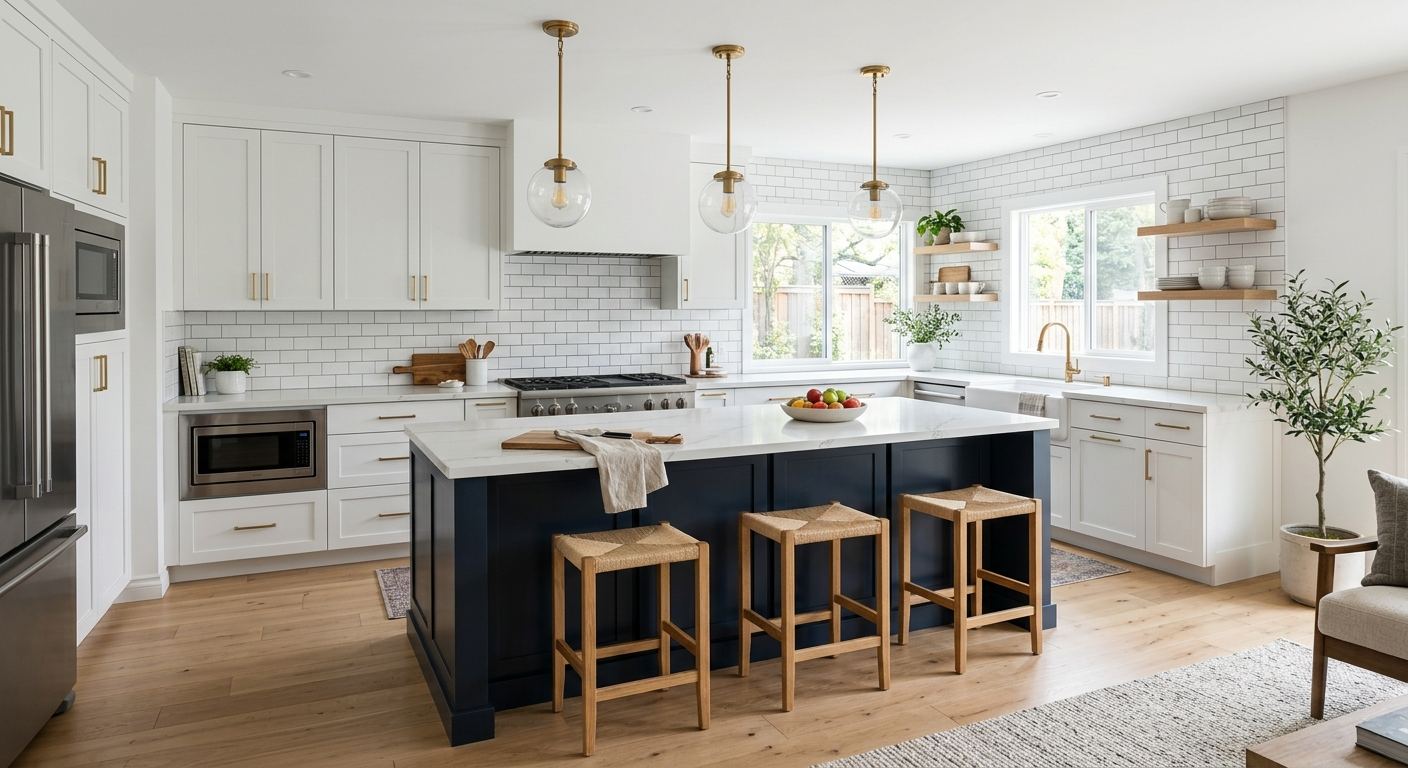
Kitchen renovation options and costs in Highway 11
Kitchen renovations along Highway 11 in the Lower Mainland–Southwest tend to be priced less by the weather and more by what buyers in Metro Vancouver expect to see in a resale kitchen. With a local population of about 5,500 (Statistics Canada, 2021 Census), most kitchen demand clusters through nearby built-up centres, so contractors price based on availability, labour demand, and the typical finish level for the neighbourhood. Homeowners also plan finishes around household purchasing power; in higher-income pockets, homeowners more often move toward semi-custom cabinetry and quartz or stone counters because the upgrade is easier to justify at resale.
In the Lower Mainland–Southwest, we still see plenty of “refresh” projects—paint, hardware, and appliance swaps—because the region has a steady flow of trades and materials. At the same time, moisture and humidity swings in the coastal climate can expose weak installation details: if cabinet boxes aren’t level and properly shimmed, doors don’t align and laminate edges can swell over time. That’s why a full renovation often includes careful subfloor checks, re-levelling, and proper waterproofing at the backsplash/tile transition.
One area where this trade is especially in demand is Burnaby, where many households aim for mid-range to semi-custom looks rather than basic stock layouts. From there, the scope usually determines the cost band more than anything else—so use the options below as a starting point for comparing quotes.
| Renovation Tier |
What's Included |
Typical Duration |
Price Range |
| Cosmetic refresh (paint, hardware, new appliances only) |
Cabinet/trim paint or refinish (no box changes), new pulls/knobs, appliance swap, minor touch-ups |
5–10 business days |
$8,000–$22,000 |
| Mid-range full renovation (new cabinets, counters, sink, tile) |
New semi-custom or upgraded stock cabinetry, counter replacement, sink + taps, backsplash tile, disposal, basic plumbing/electrical tie-ins as needed |
3–6 weeks |
$40,000–$85,000 |
| High-end full renovation (custom cabinets, stone counters, island) |
Fully custom millwork, stone counters, island (often with added electrical/plumbing), upgraded backsplash detailing, premium hardware and fixtures |
6–12 weeks |
$85,000–$120,000 |
| Cabinet refacing only (new doors + drawer fronts, same boxes) |
New door/drawer fronts and veneer panels, updated hardware, lighting updates if wiring is accessible |
2–4 weeks |
$8,000–$35,000 |
| Countertop swap only (laminate to quartz or stone) |
Remove laminate, template, install new quartz/stone, new sink cut-out as needed, caulking and basic reseal |
1–3 weeks |
$12,000–$40,000 |
| Backsplash tile installation only |
Tile supply + installation, surface prep, waterproofing at transitions, grout/sealing, trim details |
4–10 business days |
$1,500–$8,000 |
Prices are estimates only and vary by project scope, site access and material selection.
What affects the price of kitchen renovation in Highway 11
For the same kitchen footprint in the Lower Mainland–Southwest, quotes can vary by 30–50% because the “real scope” changes: cabinet tier, counter material, how much layout work is included, and how the contractor allowances materials and labour (especially millwork and trades) is applied. Climate plays a role—humidity and coastal moisture can reveal poor water management at the sink and behind the range—but in this region the biggest driver is local market expectation. In higher-value Metro Vancouver areas, homeowners often default to quartz or stone counters and semi-custom cabinetry since the upgrade aligns with resale buyer preferences. In more modest neighbourhoods, laminate and stock cabinets dominate because they deliver a solid ROI at a lower entry price point.
Layout changes are where estimates become unpredictable regardless of finish tier. Moving a wall, adding an island, or relocating a gas line can require new rough-in work and inspections, which can push a mid-range job from the $40,000–$85,000 band toward the higher end quickly. Appliance package tier matters too: switching from builder-grade to pro-grade affects ventilation, electrical requirements, and how cabinetry is set to fit.
Two practical Highway 11 examples: (1) older homes near busy corridors often have older electrical panels and limited circuit capacity, so adding under-cabinet lighting or moving outlets can add labour and parts; (2) houses with aged subfloors can need shimming and re-leveling before counters go in, which adds prep time. Even with stable market pricing, across British Columbia a contractor’s trade availability and procurement timing can influence whether you land closer to the $40,000–$120,000 full renovation range or a higher total within it.
| Price Factor |
Why It Matters |
Cost Impact |
| Cabinet tier — stock vs. semi-custom vs. fully custom millwork |
Higher tiers cost more and often require more precise fitting, custom sizes, and upgraded drawer hardware |
$8,000–$60,000 |
| Countertop material — laminate vs. quartz vs. granite vs. stone |
Material price, thickness, edge profiles, and how many seams/cut-outs are needed for sinks and appliances |
$3,000–$20,000 |
| Layout change — wall removal, island add, plumbing/gas move |
Creates demolition, new framing, re-routing utilities, and inspection-triggering work |
$10,000–$40,000 |
| Appliance package tier — builder vs. mid-range vs. pro-grade |
Pro-grade units can require different venting clearances, electrical needs, and custom cabinetry adjustments |
$3,000–$25,000 |
| Flooring — refinish existing vs. full replacement |
If floors must come up for cabinet leveling or for underlayment upgrades, costs escalate |
$2,000–$12,000 |
| Backsplash — ceramic tile vs. marble vs. full-height slab |
Higher-end stone and tall runs increase material, waterproofing, and labour time |
$1,500–$8,000 |
| Electrical — new circuits for island, under-cabinet lighting |
New circuits and code-compliant work require licensed electrician labour and permitting/inspection |
$1,500–$12,000 |
| Permit fees and licensed trade requirements |
Some work triggers permits, plus the scheduling and coordination of licensed trades |
$500–$6,500 |
Permits & regulations in British Columbia
In British Columbia, many kitchen updates are straightforward from a permit standpoint, but anything that changes plumbing, gas, structural load, or the electrical system can trigger permitting and inspections. Generally, cabinet and countertop swaps do not require a permit by default—meaning replacing existing cabinets or installing new counters on the current layout is typically treated as finishing work. However, moving plumbing supply lines or drain lines (for example, changing sink location), relocating gas for the stove, or altering venting where gas is involved needs the correct permit path and licensed trades.
Specifically, these types of work typically DO require permits and licensed professionals in BC: relocating or adding electrical circuits (such as for an island receptacle run or a dedicated under-cabinet lighting circuit), installing new/relocated outlets that change the circuit design, and any gas-related changes (stove/range relocation, gas line changes). Also, removing a load-bearing wall or changing structural elements usually requires permits and engineered direction as applicable.
Here’s how a Highway 11 homeowner should verify a contractor before signing: (1) check the contractor’s licensing status through the appropriate online provincial licensing/registry resources relevant to the trade(s) they claim; (2) request a current certificate of insurance and confirm it includes liability coverage; (3) ask for evidence of coverage (and clearance documentation where applicable) so you know the contractor is set up for workplace coverage requirements; and (4) confirm in writing who pulls the permits. Make sure the contract clearly states permit responsibility, inspection scheduling, and whether disposal and site protection are included.
Cabinets, countertops and layout decisions in Highway 11
In a Highway 11 kitchen renovation, the three most consequential decisions are: (1) cabinet tier, (2) countertop material, and (3) layout changes. Start with cabinets because they set the tone for the entire kitchen and often determine how much rework is needed. Stock cabinets are fastest and usually cheapest, but in a resale market they can look “dated” sooner—especially when buyers see clean-lined hardware and flush designs on newer renovations. Semi-custom cabinets are the most common mid-range choice because they balance practicality with better sizing and drawer storage. Custom cabinets cost more, but the fit is tighter, which matters in older homes where walls aren’t perfectly square.
Next, counters. Laminate is budget-friendly, quartz delivers consistent looks with low maintenance, granite/natural stone offer unique patterns and a premium feel, and butcher block adds warmth (but needs more routine care). In the Lower Mainland–Southwest, the coastal humidity makes good sealing and installation details important, especially at seams, sink cut-outs, and backsplash transitions—so you’ll often see fewer long-term complaints on quartz than on lower-tier surfaces if the install is done carefully.
Finally, layout changes. Removing a wall to open the kitchen can be justified when it creates usable dining adjacency, but it’s typically the cost swing factor. Adding an island can raise costs because of plumbing/gas and electrical coordination; if you can build the island without moving major utilities, the project often stays closer to the mid-range $40,000–$85,000 band. If you have to move gas lines and electrical circuits, the same renovation can move toward the $85,000–$120,000 range—so budget for uncertainty.
Dollar example: In a practical refresh-to-upgrade scenario, upgrading from laminate counters to quartz may add several thousand dollars, but it’s usually far less than the cost of re-framing for a new island location. If your cabinets are staying put and only the counter swap is needed, the value of quartz is often easier to justify than full layout demolition.
| Option |
Durability |
Maintenance |
Best For |
Price Range |
| Stock cabinets (big-box) |
Good for standard sizes; less forgiving with out-of-square walls |
Low day-to-day effort; finish wear depends on surface quality |
Fast updates when the layout is staying the same |
$8,000–$25,000 |
| Semi-custom cabinets (local dealer) |
Very solid; better sizing and upgraded drawer systems |
Routine cleaning; typically holds up well in humid climates with proper sealing |
Most homeowners targeting a modern look without custom pricing |
$25,000–$60,000 |
| Custom cabinets (local millwork shop) |
Highest fit and finish; best for irregular spaces |
Low maintenance; design-specific hardware needs normal care |
Layouts with tricky dimensions or premium storage goals |
$60,000–$90,000 |
| Laminate countertop |
Can chip or lift at edges if not installed/maintained well |
Wipe clean; avoid prolonged moisture exposure at seams |
Budget refreshes where counters are the only major change |
$3,000–$7,000 |
| Quartz engineered countertop |
High impact resistance and stable appearance |
Low maintenance; clean with standard non-abrasive products |
Busy family kitchens and resale-friendly aesthetics |
$6,000–$12,000 |
| Granite / natural stone countertop |
Very durable; natural variations make each slab unique |
Sealing may be needed depending on the stone; clean carefully |
Premium, design-forward kitchens |
$8,000–$16,000 |
| Butcher block countertop |
Durable but can scratch; edges and seams need attention |
More upkeep (oiling/sanding schedule) to manage moisture |
Warm, casual kitchens and homeowners willing to maintain |
$5,000–$11,000 |
| Marble countertop |
Premium look; can be more susceptible to etching from acids |
Regular care and quick wipe-down for spills |
Showpiece kitchens where appearance matters most |
$10,000–$20,000 |
How to choose a kitchen renovation contractor in Highway 11
Choosing the right contractor in British Columbia is mostly about verification and clarity. Start by confirming licensing for any work involving gas or electrical (those are licensed-trade areas). Ask for their proof of liability insurance so you know you’re not taking on risk if there’s property damage or an on-site injury. For coverage related to work carried out on your project, request documentation showing workplace coverage compliance and any clearance evidence they provide—then keep copies for your records.
Next, get 2–3 itemised written quotes. You want labour and materials broken out—cabinet supply, cabinet install, counter fabrication/templating, tile labour, plumbing/electrical tie-ins, demolition, disposal, and any allowance items for trim, caulking, or patching. A lump-sum quote with vague allowances is where cost creep happens. Read what’s excluded: is permit pulling included or “by homeowner”? Is disposal included (dump fees, haul-away)? Are floor protections and site cleanup part of the scope?
Confirm warranty details: workmanship warranty length (and what it covers), plus the product/manufacturer warranties for cabinets, counters, and hardware. Ask whether warranties are transferable to the next owner—this can matter for resale in the Highway 11 corridor. For payment, never pay more than about 10–15% upfront; use progressive payments tied to milestones, and hold back the final amount until completion and punch-list sign-off. Finally, require a start date and completion estimate in writing, plus a plan for scheduling cabinet/counter lead times.
- Ask for trade scopes in writing (cabinet installer vs. electrician/gas fitter responsibilities).
- Request certificates: liability insurance, and coverage/clearance documentation where applicable.
- Get itemised quotes with labour + materials, not one global number.
- Confirm who pulls permits and who pays permit fees.
- Verify disposal and protection (floor covering, dust control, appliance handling).
- Confirm cabinet measurements and how out-of-square walls will be handled.
- Ask about countertop templating timing and seam placement expectations.
- Ensure backsplash waterproofing and substrate prep are explicitly included.
- Check warranty terms: workmanship duration, manufacturer coverage, transferability.
- Use a milestone-based payment schedule; keep a holdback until punch list is done.
- Require a written schedule showing demolition, rough-in, install, and final finishing.
- Review how change orders are priced and documented (labour rates + material costs).
Common red flags in Highway 11 projects: vague scopes that omit demolition/disposal; refusal to itemise allowances; no written warranty terms; asking for large upfront payments (beyond 10–15%); and scheduling that ignores cabinet/counter lead times so your kitchen is left open longer than necessary.
Frequently asked questions — kitchen renovation in Highway 11
How do I get accurate kitchen renovation quotes in Highway 11?
To get accurate quotes in Highway 11 and across British Columbia, treat your request like a “scope package,” not a casual estimate. Provide photos, a rough floor plan with dimensions, and tell the contractor whether you’re keeping the same cabinet footprint or changing layout. Ask for itemised labour + materials so you can compare apples to apples—cabinet supply, install labour, counter templating/fabrication, backsplash prep, and disposal. If you’re aiming for a mid-range full renovation, confirm whether the quote aligns with the typical $40,000–$85,000 band, and if it’s moving toward a stone/island premium scope, verify how that affects the higher-end band. Also ask who pulls permits (if any) and whether plumbing/gas or electrical work is included.
What's the best countertop material for a busy Highway 11 kitchen?
For most busy Highway 11 households, quartz is the “best balance” between durability and low maintenance, especially in the Lower Mainland–Southwest where humidity makes installation quality and sealing important. Quartz typically offers a consistent look, resists staining better than many porous natural stones, and is easier to live with day to day. Natural stone (granite or marble) can look stunning, but marble in particular needs careful spill management to reduce etching risk. If you want the most budget-friendly route, laminate can work for a refresh, but it’s more sensitive at seams and edges—so good edge finishing and careful care matter. In practical pricing terms, quartz often lands in the range of the broader countertop install budget (commonly several thousand to low five-figure totals depending on size and edges).
How do I add an island to my Highway 11 kitchen?
Add an island by planning the “utility path” first, not the cabinet layout. In British Columbia, if you need to move plumbing or gas, you’ll need licensed trades and likely permits—so contractors typically budget and schedule rough-ins before cabinetry goes in. If your island can be built without relocating major services (for example, a seating island or a non-plumbed island), costs are usually easier to control and often stay closer to the mid-range scope. If you’re adding a sink or dishwasher at the island, factor in drain/supply routing and the electrical needs for lighting and receptacles. Get an itemised quote that separates cabinet work from electrical/plumbing changes, and ask how the contractor will handle floor leveling and countertop seam placement across the island.
How much does a kitchen renovation cost in Highway 11?
Kitchen renovation costs in Highway 11 typically depend on how “full” the rebuild is—cabinet tier, counters, and whether you change layout/utilities. As a practical range, a full kitchen renovation in this market often falls between $40,000–$120,000, with many projects clustering in the mid-range when layout changes are limited. Cosmetic refreshes (paint, hardware, new appliances only) are usually much lower, while cabinet refacing and countertop swaps sit in their own bands. For example, a countertop installation can be a meaningful chunk of the total, and backsplashes vary widely based on tile height and material. The key for budgeting is making sure your quote matches your intended tier—otherwise you can end up with a mid-range expectation priced into the high-end category due to island, plumbing/gas moves, or stone counters.
How long does a kitchen renovation take in Highway 11?
Timelines in Highway 11 usually depend on lead times and whether you’re doing only finishes or a full rebuild. A cosmetic refresh with paint, hardware, and appliance swaps can often be completed in roughly 5–10 business days. A mid-range full renovation commonly takes about 3–6 weeks, assuming cabinet and counter scheduling stays on track. High-end projects with custom cabinets and stone counters typically run 6–12 weeks because fabrication and coordination take time. Delays most often come from countertop templating timing, permit/inspection scheduling for electrical or gas work, and uncovering hidden issues in older housing stock (subfloor flatness, water-damaged areas behind older backsplashes). Ask every contractor for a written schedule and the expected start-to-completion window for your chosen finish tier.
Quartz vs granite countertops — which is better?
“Better” depends on how you use your kitchen and what look you want. Quartz is usually the most practical choice for a busy Highway 11 kitchen because it’s low maintenance and offers a consistent appearance, with fewer surprises day to day. Granite is extremely durable and has natural movement and uniqueness, which many homeowners love for design. However, granite and other natural stone may require sealing depending on the specific stone and finish, and the care routine can be slightly more demanding. If you’re comparing costs, granite often lands closer to the upper end of countertop budgets, especially with premium slabs and edge profiles. In most resale-oriented renovations in the Lower Mainland–Southwest, quartz delivers strong value and predictability, while granite is often chosen when homeowners prioritize the natural look as a focal feature.