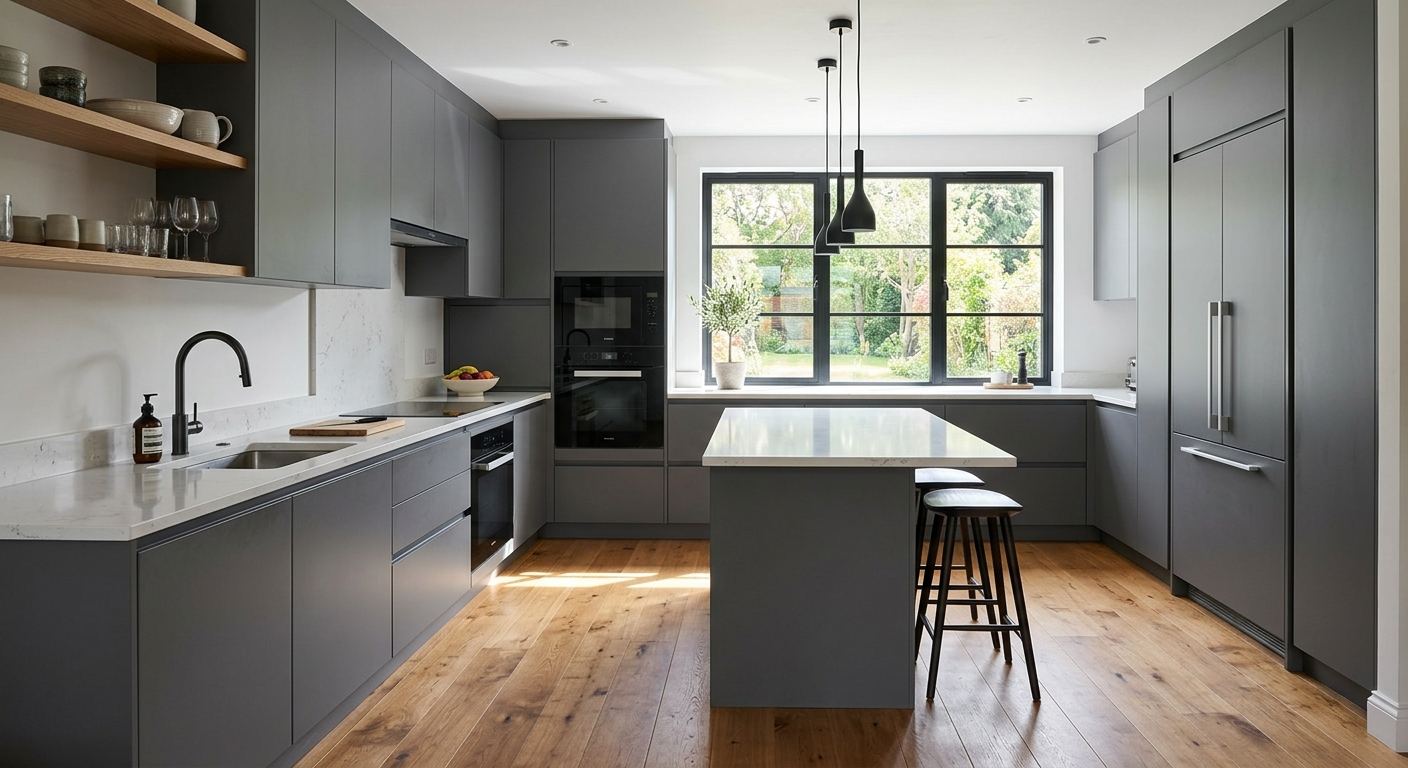
Kitchen renovation options and costs in Cameron
Cameron, British Columbia is a small community, but kitchen renovations here still reflect the wider Lower Mainland–Southwest market. With a population of 11,844 (Statistics Canada, 2021 Census), most homeowners renovate when they’re updating an aging space or preparing a home for resale in the region. In this part of B.C., day-to-day buying decisions are strongly tied to household purchasing power and home equity—so many projects skew toward finish choices that feel “current” to prospective buyers, even when the home isn’t on Vancouver-adjacent streets.
In the Lower Mainland–Southwest, contractor demand and pricing are shaped more by expected finish level than by climate alone. The coast means dampness and salt-air exposure can be a factor near the shoreline, but the bigger cost drivers are the value of the home and what buyers expect to see when they walk into the kitchen. That’s why the same kitchen size can range widely—from a refresh aimed at modernising hardware and appliances to a full rebuild with semi-custom cabinetry and quartz or stone counters.
Availability can also matter: in busy periods, trades will schedule more quickly for straightforward cosmetic work (paint, hardware, appliance swaps), while cabinet fabrication lead times often govern timelines for mid-range and high-end renovations. If you’re in the Cameron area where renovations are common—older neighbourhood pockets with original cabinetry and dated layouts—plan ahead for longer cabinet and countertop production.
Below is a practical way to compare options and budget in Cameron.
| Renovation Tier |
What's Included |
Typical Duration |
Price Range |
| Cosmetic refresh (paint, hardware, new appliances only) |
Cabinet paint or repaint, new pulls/knobs, appliance swap (no major plumbing/gas moves), simple countertop polish/cleaning, basic caulking/trim touch-ups |
3–7 days |
$8,000–$22,000 |
| Mid-range full renovation (new cabinets, counters, sink, tile) |
New stock-to-semi-custom cabinets, countertop replacement, sink and faucet change (within existing plumbing run), backsplash tile, flooring repairs, labour for install and basic electrical |
3–6 weeks |
$40,000–$85,000 |
| High-end full renovation (custom cabinets, stone counters, island) |
Fully custom millwork, stone counters (quartz or natural stone), island with upgraded storage, coordinated backsplash (including feature stone/tile), enhanced lighting, upgraded sink package |
6–12 weeks |
$85,000–$120,000 |
| Cabinet refacing only (new doors + drawer fronts, same boxes) |
Door/drawer replacement, new hardware, finish prep and installation, light trim work, removal/refit of existing doors and drawers |
1–3 weeks |
$8,000–$35,000 |
| Countertop swap only (laminate to quartz or stone) |
Old surface removal, new countertop install, seam finishing, sink cut-out transfer (if applicable), backsplash edge detail as needed |
3–10 days |
$10,000–$30,000 |
| Backsplash tile installation only |
Surface prep, tile layout/setting, grout/seal where appropriate, finishing at cabinets and countertop edges |
2–5 days |
$1,500–$6,000 |
Prices are estimates only and vary by project scope, site access and material selection.
What affects the price of kitchen renovation in Cameron
In Cameron and across the Lower Mainland–Southwest, the same kitchen scope can come back 30–50% apart depending on home value, target finish tier, and how complex the build becomes once trades start moving walls and services. In higher-value pockets of Metro Vancouver, homeowners and buyers often expect semi-custom or custom cabinetry, quartz/stone counters, upgraded hardware, and more design-led layouts—so budgets rise quickly. In more modest markets, renovations still happen, but the return-on-investment mindset pushes many owners toward stock cabinet systems and laminate or cost-controlled counters. Climate plays a smaller role than most people assume; the coast can increase attention to moisture management and ventilation, but it doesn’t usually explain the size of the quote gap by itself.
Layout changes are where unpredictability spikes: removing a wall, adding an island, or moving a gas line or plumbing run tends to be the hardest-to-price line item, regardless of whether you’re in a $40,000 mid-range plan or a $85,000+ high-end rebuild. In Cameron, I also see cost swings driven by the reality of older housing stock—some kitchens have out-of-square walls, dated subfloor levels, and inconsistent electrical grounding, which means more labour for prep before new cabinets go in.
Two concrete examples: (1) If your sink plumbing sits under an old interior chase, moving to a “clean” island location may trigger a drain rework—often pushing the project toward the upper end of countertop and cabinet install budgets (for instance, when a countertop swap is more like a full kitchen coordination job). (2) If you upgrade from laminate to quartz, the material cost lands in the $3,000–$12,000 countertop range, but the real swing comes from edge profiles, seam placement, and whether you also need to adjust backsplash height and outlet locations.
To keep quotes comparable, always match scope, cabinet tier, and countertop material across bidders—then the comparison becomes apples-to-apples.
| Price Factor |
Why It Matters |
Cost Impact |
| Cabinet tier — stock vs. semi-custom vs. fully custom millwork |
Cabinet construction method, door style variety, internal storage options, and how well the system fits uneven walls |
Stock typically keeps full reno closer to the lower band; semi-custom and custom commonly shift totals toward the mid/high bands |
| Countertop material — laminate vs. quartz vs. granite vs. stone |
Material pricing, fabrication complexity, edge/seam requirements, and weight handling on install day |
Laminate is cheapest; quartz and natural stone increase both material and fabrication labour |
| Layout change — wall removal, island add, plumbing/gas move |
Triggers structural checks, permit needs, added framing, new runs for drain/supply and/or gas lines |
Often the biggest swing—can move a “refresh” budget into full-reno territory |
| Appliance package tier — builder vs. mid-range vs. pro-grade |
Electrical/gas rough-in needs, ventilation sizing, fit and finish, and durability |
Pro-grade packages can raise totals even if cabinetry stays the same |
| Flooring — refinish existing vs. full replacement |
Protection during demo and whether joists/subfloor issues get corrected |
Full replacement adds both demo and install time; refinishing can preserve budget |
| Backsplash — ceramic tile vs. marble vs. full-height slab |
Tile layout difficulty, specialized stone handling, and whether feature heights require custom cuts |
Feature slabs and marble usually push higher within the backsplash band |
| Electrical — new circuits for island, under-cabinet lighting |
New circuit design, load calculations, and compliance inspections |
Costs rise quickly when new circuits are required rather than using existing outlets |
| Permit fees and licensed trade requirements |
Work that touches plumbing/drain, gas, electrical circuits, and structural changes requires permits and inspections |
Adds administrative steps and trade scheduling, which can affect total project cost |
Permits & regulations in British Columbia
In British Columbia, a kitchen refresh is often “no-permit” because it doesn’t change the building systems. Cabinet and countertop swaps typically don’t require a permit when you keep plumbing and gas where they are and you’re not altering load-bearing structure. However, once you move plumbing supply or drain lines, relocate gas work (stove/range hood connections), remove a load-bearing wall, or add new electrical circuits, permits and licensed trades are commonly required. For gas-related work, it must be done by a licensed gas fitter; for electrical work, by a licensed electrician—both then undergo inspection as required.
For Cameron homeowners, the practical approach is: (1) list every “move” you’re considering (sink location, dishwasher location, venting changes, island power, under-cabinet lighting tied to new circuits); (2) ask your contractor which items are permitted and who pulls the permit; (3) confirm in writing who is responsible for permit fees and inspection scheduling. Before signing, you should verify the contractor’s British Columbia licence and ask for a clearance letter where applicable, plus current liability insurance.
When checking credentials, look for: a valid trade licence for relevant trades (gas/electrical), a certificate of insurance showing they carry liability coverage appropriate for renovation work, and proof of coverage for workplace claims where applicable (often discussed as WSIB/WCB coverage depending on the employer and role). Finally, request a copy of the product/manufacturer warranty and confirm whether workmanship warranty is provided for the installation scope.
Cabinets, countertops and layout decisions in Cameron
The three decisions that most often determine whether a Cameron kitchen renovation lands on budget are (1) cabinet tier, (2) countertop material, and (3) layout changes. In the Lower Mainland–Southwest resale market, buyers tend to expect clean sightlines, durable finishes, and storage that “feels” built-in. For cabinets, stock systems are the fastest and cheapest, semi-custom is the most popular mid-range option because it offers more sizes and better fit, and custom millwork is the highest cost but gives you the best solution for unusual wall lengths or soffits.
Countertops follow a similar logic. Laminate can be a good choice when you want a refreshed look without heavy spending, but it’s less forgiving for heat and impact over time. Quartz is the common “busy family” upgrade because it’s low-maintenance and more resistant to everyday stains. Granite/natural stone and marble can look premium, but they come with additional care and, depending on pattern and slab availability, can push project totals upward.
Layout changes—especially removing an open wall, adding an island, or relocating plumbing/gas—are justified when they create clear functional gains: more seating, improved traffic flow, or making the work triangle practical for real cooking. If you’re working around older framing or limited width, it’s easy to overspend chasing a perfect layout that doesn’t actually improve usability. For a concrete example: moving from laminate to quartz can often keep you within the $3,000–$12,000 countertop band, but adding an island with new power and ventilation typically pushes the renovation toward the higher end of the full renovation range (for example, from a mid-range $40,000–$85,000 to a higher-end plan).
Finally, because Cameron sits within a coastal environment where ventilation matters, plan for an appropriate range hood and good airflow—this protects cabinets, finish longevity, and backsplash materials.
| Option |
Durability |
Maintenance |
Best For |
Price Range |
| Stock cabinets (big-box) |
Good everyday durability; limited flexibility for uneven walls |
Simple wipe-down; hinges and hardware replacements as needed |
Fast updates and tighter budgets |
$8,000–$25,000 |
| Semi-custom cabinets (local dealer) |
Strong construction with better sizing options and storage variety |
Easy cleaning; fine-tune adjustments at install improve long-term alignment |
Most homeowners targeting a balanced upgrade |
$20,000–$55,000 |
| Custom cabinets (local millwork shop) |
Highest fit and finish; designed for your exact layout and storage needs |
Moderate care similar to other quality wood systems |
Challenging spaces and premium, long-term upgrades |
$45,000–$90,000 |
| Laminate countertop |
Reasonable for daily use; can be sensitive to heat and heavy impact |
Quick clean with mild products; avoid prolonged standing water |
Cost-controlled remodels |
$3,000–$6,000 |
| Quartz engineered countertop |
Very durable for busy use; consistent surface performance |
Low maintenance; avoid cutting directly on the surface with heavy force |
Families who want a “set it and forget it” surface |
$6,000–$12,000 |
| Granite / natural stone countertop |
Hard and durable; variation means you choose carefully |
Periodic sealing may be needed depending on the stone |
Homeowners aiming for natural texture and premium character |
$7,000–$14,000 |
| Butcher block countertop |
Durable with proper care; sensitive to moisture exposure at seams |
Regular oiling; wipe and dry quickly |
Warm, traditional looks and kitchens used for cooking |
$4,000–$10,000 |
| Marble countertop |
Beautiful and premium; more prone to etching/staining than quartz |
Requires careful cleaning and protection |
Low-to-moderate wear households and designer-led aesthetics |
$10,000–$18,000 |
How to choose a kitchen renovation contractor in Cameron
Choosing the right contractor in Cameron starts with verifying British Columbia licensing, then confirming insurance and coverage so you’re not exposed if something goes wrong. For licensing, ask which trades will be performing gas or electrical work and verify their licences using the appropriate online trade listings. For coverage, request a certificate of insurance (liability) and ensure it lists the right entities and dates for the project. If the contractor uses subcontractors, ask how they handle workplace coverage; you should see evidence of workplace coverage where applicable (commonly referenced as WSIB/WCB depending on the employer structure).
Next, request 2–3 itemised written quotes with a clear breakdown—labour and materials listed separately, not a single lump sum. Confirm what’s included: cabinet installation, countertop fabrication and install, sink/faucet reinstall, backsplash scope, protection of floors during demo, and waste disposal. Also ask who pulls permits (if required), whether disposal is included, and whether electrical/gas rough-ins are covered in the quoted scope or billed separately.
Review warranty details: workmanship warranty length, who honours it, and whether it’s transferable if you sell. Product/manufacturer warranties may have different terms. For payment schedule, never pay more than 10–15% upfront; hold back a reasonable amount until key milestones are complete. Finally, insist on a written start date and an estimated completion window that accounts for cabinet and countertop production lead times common in the Lower Mainland–Southwest.
- Verify BC licence(s) for the relevant scope and confirm who is doing gas/electrical work.
- Request a current certificate of liability insurance before work begins.
- Ask for evidence of workplace coverage where applicable for the employer and trades used.
- Insist on itemised quotes (labour vs materials) and clearly matched specs between bidders.
- Confirm demolition and disposal are included (or priced separately).
- Confirm whether permit fees, inspections, and any required documentation are included.
- Ask how changes are handled: change-order process and timelines for approvals.
- Require cabinet and countertop lead times in writing and a schedule for installation.
- Check that backsplash includes surface prep, layout planning, and grout/seal details where needed.
- Confirm electrical scope: island receptacles, under-cabinet lighting, and lighting type if included.
- Ask about protection: floor covering, dust control, and how they prevent finish damage.
- Get warranty terms in writing, including what’s covered and expected response times.
In Cameron, common red flags include: quotes that don’t list permit responsibility, “allowance” pricing that’s too vague (no specific cabinet line or countertop thickness/edge), vague schedules that ignore fabrication lead times, refusing to provide insurance/licence documentation, and payment requests that front-load beyond 10–15% before any measurable work starts.
Frequently asked questions — kitchen renovation in Cameron
What's the best countertop material for a busy Cameron kitchen?
For a busy Cameron, British Columbia kitchen, quartz is usually the best balance of durability and day-to-day practicality. It’s engineered to resist stains and holds up well to frequent cleaning, which matters in coastal areas where moisture and humidity can affect surrounding finishes. If you want a premium look without extra maintenance time, quartz is typically the “sweet spot.” In budget planning, quartz commonly lands within the countertop range of $6,000–$12,000, and the total impact depends on seams, edge profiles, and whether you’re also changing sink cut-outs and backsplash height. Granite is also durable, but may need periodic sealing and careful selection based on your pattern and finish.
How do I add an island to my Cameron kitchen?
Adding an island in Cameron starts with measuring traffic flow and checking whether your floor plan can support the footprint. The cost then depends heavily on whether you’re leaving plumbing where it is or moving lines. If the island is just storage with no plumbing, you avoid many of the permit-driven variables; if you want a sink or range on the island, that often requires new plumbing or gas routing and additional electrical. In real terms, island projects typically push budgets toward full renovation scope—often aligning with the higher end of the $40,000–$120,000 band for Cameron, especially when electrical circuits for island outlets and under-cabinet lighting are added. The most important step is to have your contractor confirm feasibility before you commit to cabinet layouts.
How much does a kitchen renovation cost in Cameron?
Kitchen renovation costs in Cameron generally track project tier more than climate. A cosmetic refresh (paint, hardware, and appliance swaps only) can be relatively restrained, while cabinet and countertop work drives most of the budget. For a typical mid-range full renovation, homeowners often budget around $40,000–$85,000, while higher-end projects with custom millwork, stone counters, and an island frequently land closer to $85,000–$120,000. If you only need cabinets or counters, you can break the project down: cabinet installation or refacing sits in bands like $8,000–$50,000, and countertop installation is often $3,000–$12,000 depending on material and edge/seam complexity. Always match scope across quotes so the comparison reflects the same included work.
How long does a kitchen renovation take in Cameron?
Timelines in Cameron depend on what you’re doing and—crucially—how long cabinets and countertops take to fabricate. Cosmetic refresh work is often quick, commonly under a week if appliances are already in hand. Mid-range full renovations with new cabinets and counters typically take about 3–6 weeks, assuming site readiness and no surprises with plumbing or electrical. High-end custom millwork and stone can stretch to 6–12 weeks because fabrication and coordination take longer. The coastal environment can also matter indirectly: contractors need time for proper ventilation and curing for finishes, and good dust control helps keep installation clean. Your best estimate comes from an itemised schedule that includes measurable milestones (demo, rough-in, cabinet install, countertop install, backsplash) and confirmed delivery dates.
Quartz vs granite countertops — which is better?
Neither quartz nor granite is automatically “better”—it’s about how you cook, clean, and maintain. Quartz is generally the easiest option for busy households because it’s low-maintenance and resists everyday stains well, and it doesn’t usually require sealing like many natural stones. Granite is extremely durable and has natural variation, but it often benefits from periodic sealing depending on the stone and finish, and it can be more sensitive to certain acidic spills if not properly maintained. In Cameron, many homeowners choose quartz because it pairs well with modern cabinet styles and predictable fabrication timelines. If you’re budgeting, quartz commonly fits in the $6,000–$12,000 countertop range, while granite/natural stone frequently rises higher depending on slab selection and complexity of cut-outs.
Should I reface or replace my cabinets?
If your cabinet boxes are still solid, reface can be a smart way to refresh the look without the disruption of removing everything. Cabinet refacing typically keeps costs lower than full replacement, commonly sitting around $8,000–$50,000 depending on the number of doors/drawers and finish level. Replacing is usually better when boxes are damaged by moisture, sagging, or not square, or if you want major storage reconfiguration, new layouts, or full rework of interior systems. In Cameron’s housing stock, older kitchens sometimes have alignment issues and hidden water damage near sink areas—those are good reasons to replace rather than reface. A contractor should assess box integrity in person and advise based on structural condition, not just appearance.