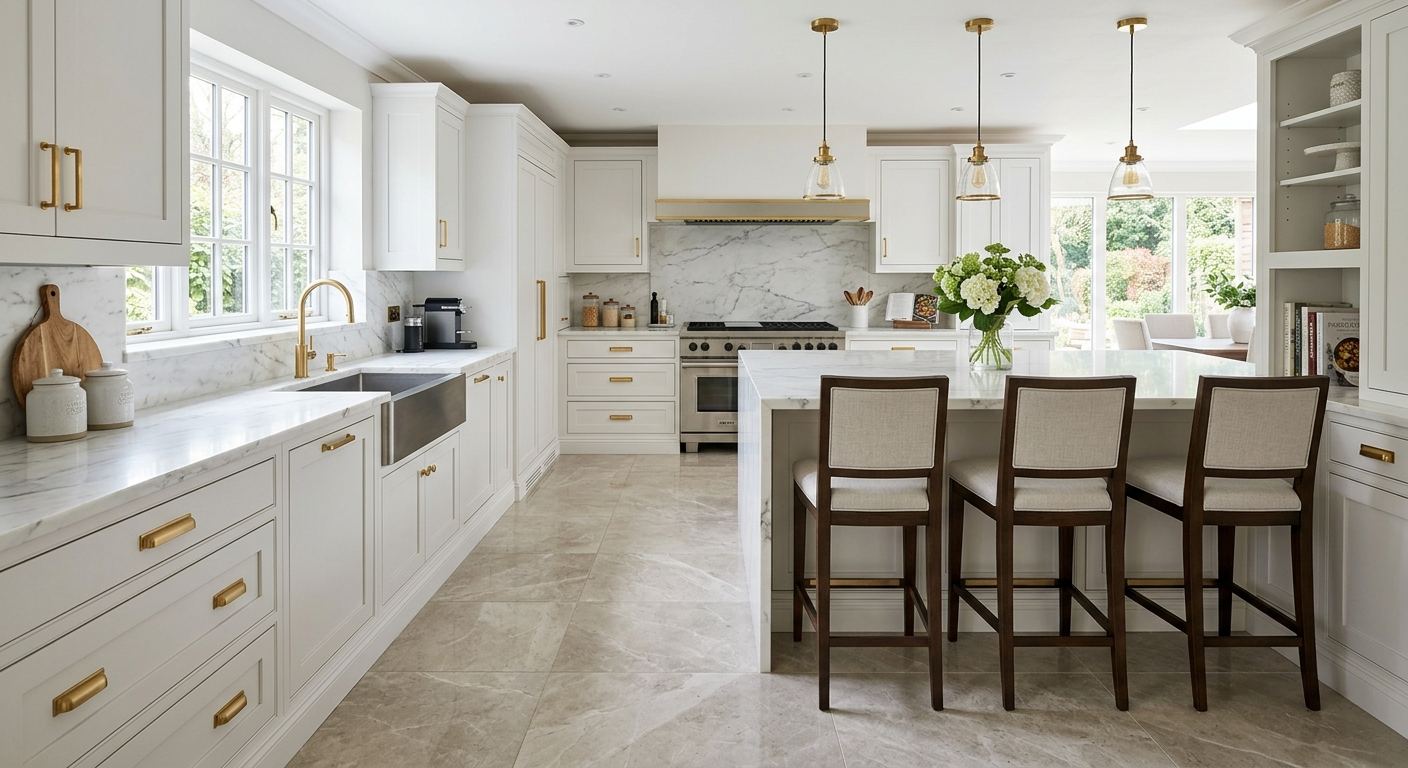
Kitchen renovation options and costs in Ladner
Ladner homeowners typically approach a kitchen renovation with a clear goal, whether it’s a quick refresh before hosting more family dinners or a full rebuild to match today’s open, bright layouts. While the city is part of Metro Vancouver’s Lower Mainland–Southwest, kitchen totals in Ladner are shaped less by weather and more by the local market value and expected finish level. Even with the same kitchen footprint, a project can price out very differently because higher-value homes tend to support semi-custom cabinetry and stone surfaces, and because labour and installation scheduling are often aligned with the rest of the Lower Mainland.
In 2021, Ladner’s wider municipality area included a population base of 23,016 (Statistics Canada, 2021 Census), and homeowners commonly shop upgrades with resale in mind. In the Lower Mainland–Southwest, contractors see more design-led work in well-established pockets and neighbourhoods where many older homes are being modernised for family comfort—so availability and workmanship standards can influence cost and timing. Moisture and coastal humidity in British Columbia can also affect how materials are installed and sealed, especially around sinks, dishwashers, and exterior-wall exposures, but it’s usually management of details (waterproofing, caulking, ventilation) rather than climate “penalties” that changes price.
Where the trade is especially in demand in Ladner is the Ladner Village area and nearby residential streets, because infill and renovation cycles overlap with other home projects. Next, use the tiers below as a realistic way to compare proposals side-by-side.
| Renovation Tier |
What's Included |
Typical Duration |
Price Range |
| Cosmetic refresh (paint, hardware, new appliances only) |
Cabinet paint/stain (if applicable), new pulls/handles, new appliances, minor caulking and touch-ups; no cabinet-box changes; countertop stays as-is |
1–2 weeks |
$8,000–$22,000 |
| Mid-range full renovation (new cabinets, counters, sink, tile) |
New stock or semi-custom cabinets, countertop replacement, new sink and faucet, backsplash tile, new flooring where needed, basic plumbing updates, delivery/installation |
3–6 weeks |
$40,000–$80,000 |
| High-end full renovation (custom cabinets, stone counters, island) |
Fully custom millwork, quartz/stone counters, island or reconfigured peninsula, premium hardware, upgraded backsplash (often more labour-dense), enhanced lighting and ventilation details |
6–12 weeks |
$80,000–$120,000 |
| Cabinet refacing only (new doors + drawer fronts, same boxes) |
Refaced cabinet fronts, new pulls, paint/sheen coordination, optional lighting upgrades; countertop generally unchanged |
2–4 weeks |
$8,000–$30,000 |
| Countertop swap only (laminate to quartz or stone) |
Remove old countertop, measure/template, install new countertop, re-seal seams, adjust sink/faucet clearances as needed |
1–2 weeks |
$3,000–$12,000 |
| Backsplash tile installation only |
Tile supply and installation, waterproofing prep where required, grout/seal finishing, tidy-up; excludes cabinet refacing and countertop replacement |
3–7 days |
$1,500–$6,000 |
Prices are estimates only and vary by project scope, site access and material selection.
What affects the price of kitchen renovation in Ladner
In Ladner and across the Lower Mainland–Southwest, it’s common to see quotes for the “same” kitchen land 30–50% apart once you look past the description and into cabinet build type, countertop selection, and the scope of layout and trade work. In British Columbia, labour and material scheduling is highly correlated across Metro Vancouver, and higher-end finishes (and more complex cabinetry) are pulled into the same installer calendars. That means finish choices and layout changes can influence total cost more than climate, even though coastal humidity can create extra care requirements around sealing and ventilation.
Local home values and household income tend to steer homeowners toward a particular finish tier far faster than weather does. In higher-value Lower Mainland–Southwest pockets, buyers are often expecting quartz or stone counters and semi-custom cabinetry, because those upgrades are easy to justify on resale. In more modest scopes, laminate or stock cabinets dominate simply because they deliver a visible improvement without the full cost of custom millwork. Even within Ladner, the decision matters: a full renovation using mid-range cabinetry and new counters often fits the $40,000–$80,000 band, while a custom island and premium stone can push you into the $80,000–$120,000 band quickly.
Concrete examples we see in Ladner: (1) moving a dishwasher or sink can add cost unpredictably because drain runs, shutoffs, and fitment constraints in older basements or crawl spaces can require extra labour; (2) adding an island is usually where electrical and ventilation scope expands, particularly if you want under-cabinet lighting and a properly vented hood; (3) reusing existing flooring and backsplash walls can lower demo/disposal labour, but if moisture has affected prior sealant, waterproofing prep can increase time. With coastal humidity and seasonal temperature swings, attention to sealing around sinks and exterior-wall cabinets helps prevent rework later—rework is what really inflates budgets.
| Price Factor |
Why It Matters |
Cost Impact |
| Cabinet tier — stock vs. semi-custom vs. fully custom millwork |
Build complexity, door styles, internal organisers, and fit-to-wall tolerances drive both material and install time |
Typically swings budget by $10,000–$60,000 within the same overall plan |
| Countertop material — laminate vs. quartz vs. granite vs. stone |
Material cost, fabrication labour, seam placement, and weight/rigging affect installation difficulty |
Often $3,000–$12,000 for the countertop line item alone |
| Layout change — wall removal, island add, plumbing/gas move |
Changes can uncover hidden framing, require new runs, and add time for inspections and trade coordination |
Can increase total scope by $5,000–$35,000 depending on what moves |
| Appliance package tier — builder vs. mid-range vs. pro-grade |
Brand mix affects venting needs, electrical requirements, depth fit, and installation clearances |
Commonly $2,000–$15,000 difference for comparable package footprints |
| Flooring — refinish existing vs. full replacement |
Matching existing finishes is hard; full replacement reduces risk if subfloor has taken moisture or wear |
Can add $1,500–$12,000 depending on area and material |
| Backsplash — ceramic tile vs. marble vs. full-height slab |
Tile layout complexity, cutting around outlets, and full-height coverage add labour and waste |
Typically $1,500–$6,000 for installation and materials |
| Electrical — new circuits for island, under-cabinet lighting |
More circuits and lighting means licensed work, inspection scheduling, and longer coordination |
Often $800–$6,000 beyond a basic refresh |
| Permit fees and licensed trade requirements |
Permits and inspections apply to specific work; arranging trades can lengthen schedule |
Can add $500–$5,000 depending on scope and trade mix |
Permits & regulations in British Columbia
For kitchen renovations in British Columbia, not every change triggers a permit. In general, cabinet and countertop swaps typically do not require a permit because they’re replacement work that doesn’t materially change services. However, if you’re moving plumbing supply or drain lines, relocating gas connections (including stove/range setup or certain range hood configurations when gas is involved), removing a load-bearing wall, or adding/altering electrical circuits, you should plan for permits and licensed trades.
A Ladner homeowner can verify what’s permit-required by treating the scope like a checklist:
- Typically no permit: replacing cabinets in the same locations, countertop replacement, backsplash installation, and hardware/appliance swaps that don’t change service connections.
- Typically requires permits: any plumbing move (new drain/supply routing), gas relocation or new gas fittings, load-bearing wall removal/reconfiguration, and new electrical circuits (for example, additional island receptacles or under-cabinet lighting if it requires circuit changes).
Step-by-step verification: first, ask your contractor for their British Columbia licence details for relevant trades (gas work and electrical work must be performed by licensed professionals). Next, request their liability insurance certificate of insurance, and confirm coverage is active for your project dates. For workers, ensure required coverage is in place—ask for proof of WCB coverage/clearance where applicable. Finally, confirm who pulls permits and who pays for them in the written contract; permit responsibility should never be left as a verbal understanding.
Cabinets, countertops and layout decisions in Ladner
When you renovate a Ladner kitchen, the three decisions that most strongly drive both cost and resale confidence are cabinet tier, countertop material, and whether you change the layout. Cabinet tier determines the speed and fit: stock cabinets are typically the fastest and cheapest, semi-custom is the most popular mid-range because it offers more options without fully custom lead times, and custom cabinetry provides the best fit for older wall conditions and awkward corners. Countertop material then sets the “daily usability” experience—laminate can look fresh but tends to be less forgiving with heat and impact; quartz delivers a strong balance of stain resistance and durability; natural stones like granite and other stones look premium but can require different maintenance expectations.
Layout changes are where you should be most selective. Removing a wall to create an open-concept flow, adding an island, or relocating plumbing/gas can be justified when it meaningfully improves traffic patterns, sightlines, and workspace for cooking and entertaining. The catch is that layout changes add unpredictable costs—new drain runs, electrical work for island outlets, and potentially ventilation details can push labour coordination higher even if your finish tier stays “mid-range.” That’s why, for example, a homeowner who stays in the $40,000–$80,000 mid-range band can sometimes keep cabinet costs controlled by choosing semi-custom and selecting quartz, but the moment they move plumbing for a different sink location, budgets often drift toward the higher end of the band or beyond.
In Ladner’s Lower Mainland–Southwest market, buyers often expect cohesive finishes at each price point. If you’re aiming for a modern buyer-ready look, quartz plus a thoughtful semi-custom cabinet upgrade is a common sweet spot—while full custom millwork and a stone island typically align with the $80,000–$120,000 high-end tier.
| Option |
Durability |
Maintenance |
Best For |
Price Range |
| Stock cabinets (big-box) |
Good daily durability; less custom tolerance for older walls; hinge alignment depends on install |
Low—wipe-clean surfaces; handle replacement if wear occurs |
Fast timelines, tighter budgets, straightforward layouts |
$8,000–$25,000 |
| Semi-custom cabinets (local dealer) |
Very good durability; better options for pull-outs, drawer organisers, and fit-to-space |
Low—routine cleaning and occasional hardware tightening |
Most Ladner homeowners targeting mid-range ROI and modern function |
$20,000–$50,000 |
| Custom cabinets (local millwork shop) |
Excellent durability; engineered for odd angles and full-height design details |
Low to moderate—follow manufacturer cleaning guidance for finishes |
Unique layouts, premium design, full-height storage and island packages |
$40,000–$90,000 |
| Laminate countertop |
Moderate—can chip or blister with prolonged heat exposure if not protected |
Low—wipe clean; avoid abrasive pads and hot cookware contact |
Refresh projects where the goal is improved look within budget |
$3,000–$7,000 |
| Quartz engineered countertop |
High—excellent resistance to stains; stable and consistent |
Low—typical household cleaners; protect seams and avoid extreme heat |
Everyday cooking, active households, and resale-friendly “upgrade” |
$6,000–$12,000 |
| Granite / natural stone countertop |
High—strong surface with natural character; durability depends on stone selection |
Moderate—may require periodic sealing depending on stone |
Premium look with natural variation; buyers who value distinct patterns |
$8,000–$15,000 |
| Butcher block countertop |
Moderate to high—durable but susceptible to water standing at seams |
Moderate—regular oiling and careful sealing near sinks |
Warm, traditional styles and if you’ll treat it like a working surface |
$5,000–$11,000 |
| Marble countertop |
High but delicate—can etch or stain because marble is softer than quartz |
Moderate to high—requires disciplined cleaning and sealing |
Design-forward kitchens where you want luxury and accept maintenance |
$9,000–$18,000 |
How to choose a kitchen renovation contractor in Ladner
Choosing a kitchen contractor in Ladner is mostly about verification and clarity. Start with licensing: any electrical work must be done by a licensed electrician, and gas work must be performed by a licensed gas fitter. Ask for their proof of licence/registration details for the relevant trades, and keep a copy with your project file.
For coverage, request a certificate of insurance (liability) and confirm the dates match your start and completion targets. For workers, ask for WCB coverage/clearance documentation—contractors should be able to provide straightforward proof. Then, get 2–3 itemised written quotes. You want a breakdown that separates labour from materials (cabinet install, countertop template/install, tile, disposal, electrical/plumbing allowances, and any permit-related costs), not one lump sum that hides scope risk.
Read the scope line-by-line. Does the quote include permit pulling where required? Is jobsite disposal included (or will you be paying extra for dumpster rentals)? Are appliances included in the pricing, or are they “allowances”? Warranty matters too: confirm workmanship warranty length and whether it covers problems like cabinet alignment, caulking failure, and tile grout cracking due to installation issues. Also check product/manufacturer warranty and whether it is transferable to you as the homeowner.
Payment schedule should be conservative. Avoid paying more than 10–15% upfront. Use progress payments tied to completed milestones, and hold back a final portion until the work is finished and inspected.
- Confirm the contractor’s trade scope: who does cabinets, who does tile, who pulls permits
- Get licences/coverage documents before work starts
- Require itemised quotes (labour, materials, allowances, and exclusions)
- Ask for a timeline with start date and completion estimate in writing
- Clarify demolition: disposal included or not, and where waste goes
- Confirm cabinet installation method and tolerances for floors/walls
- Specify countertop process: template timing, seam plan, and sink cut-out responsibility
- Confirm backsplash prep: waterproofing where needed and grout/seal details
- Ask how they protect your home: dust control, floor protection, and site clean-up
- Verify warranty: workmanship duration and what “service call” costs are included
- Use a holdback: final payment only after punch-list completion
- Ensure permits/inspections are assigned to the correct party in writing
Red flags I see in Ladner: a contractor won’t provide insurance paperwork; quotes with no permit/disposal/waste line items; vague scopes like “plumbing updates” without specifying what moves; overly large deposits (beyond 10–15%); and timelines that promise a full custom rebuild in an unrealistic window without explaining lead times for cabinets and stone.
Frequently asked questions — kitchen renovation in Ladner
How do I choose a kitchen contractor in Ladner?
Start by confirming the contractor’s ability to cover the full scope you want—especially when plumbing/gas or electrical work is involved. In British Columbia, ask for proof that any electrical work will be performed by a licensed electrician and that gas-related work is handled by a licensed gas fitter. Get a certificate of liability insurance with dates that cover your project, and request documentation of required WCB coverage/clearance for workers. Then compare 2–3 itemised quotes that split labour and materials (not just one lump sum). Finally, look for a workmanship warranty and a clear payment schedule with a holdback until the final punch-list is complete. If your target is a mid-range full renovation, you should be able to explain how your plan fits within typical bands like $40,000–$80,000.
What order do kitchen renovation steps happen in?
A typical kitchen sequence in Ladner starts with measurements and approvals, especially for cabinets and countertops. Demo happens next, followed by any rough work: electrical and plumbing adjustments (if your design requires changes) and any framing or wall removal work. Once rough trades are done and inspected where needed, cabinets are installed, then countertops are templated and fabricated, and finally set. Flooring and backsplash usually come after cabinet install so height tolerances are correct and tile can tie cleanly to the countertop line. Appliances are installed last, after finish work and caulking are complete. If you’re doing a countertop-only project, the order can be much shorter—template, install, then final sink/faucet checks—often aligning with countertop swap expectations within $3,000–$12,000.
Can I live at home during a kitchen renovation in Ladner?
Yes, many Ladner homeowners stay in the home, but it depends on your scope and how your contractor handles dust control and access. A cosmetic refresh or a cabinet refacing project is often more manageable because the kitchen disruption is shorter. For a full renovation, expect a kitchen “shutdown” period when countertops and trade rough work are in progress—yet you can still usually set up a temporary cooking station in another room or use a bar-style area. Coastal humidity means proper ventilation and sealing details are important, and contractors should keep areas ventilated to reduce odours and help finishes cure properly. Plan for noise, limited sink access, and dust protection—especially if you have floors and furnishings nearby.
Should I renovate my kitchen before selling in Ladner?
Often, yes—if the renovation improves function and modern buyer expectations without over-upgrading beyond what the neighbourhood supports. In the Lower Mainland–Southwest, kitchens still drive buyer decisions, so a thoughtful upgrade can help when you’re ready to list. That said, avoid spending on custom features you can’t reasonably recoup. A common strategy is to align your finish tier to a realistic resale outcome: for example, a mid-range full renovation with semi-custom cabinets and quartz can target the $40,000–$80,000 range, while a full custom rebuild with stone and a larger island often targets $80,000–$120,000 and should be treated like a long-term investment. If your layout is fundamentally dated but service infrastructure is expensive, consider whether you can refresh first (paint/hardware/appliances) and schedule full changes later.
What's the most popular kitchen style in Ladner right now?
In Ladner and the broader Lower Mainland–Southwest market, the most common request right now is a bright, modern transitional look: clean lines, warmer neutral colours, and practical storage. Homeowners frequently pair semi-custom cabinetry with quartz countertops because it gives the “designer” feel without requiring the higher maintenance expectations some natural stones can have. Hardware is usually in a brushed finish, and layouts often aim for better traffic flow—frequently adding or reconfiguring an island for cooking and entertaining. With British Columbia’s moisture and seasonal temperature shifts, many homeowners also choose designs that make sealing and cleanup easier around sink and exterior-wall cabinet runs. The result is a kitchen that reads contemporary and holds up to daily use.
How do I know if I need to update my kitchen plumbing in Ladner?
You may need plumbing updates if you’re moving a sink, dishwasher, or gas/electrical-adjacent components, or if your current lines are nearing end-of-life or showing signs of leakage, low water pressure, slow drains, or repeated repairs. In Ladner homes—especially older structures—hidden conditions in crawl spaces or older wall cavities can increase uncertainty once demo begins. A licensed plumber should inspect shutoffs, supply lines, and drain routing before you commit to major changes. If the plumbing stays in the same location and is in good shape, you can often limit costs by keeping the layout stable and only updating fixtures. But if you want a different sink location or rework the dishwasher position, expect that plumbing scope can become a major driver of your total renovation cost and can also affect permits and licensed-trade scheduling in British Columbia.