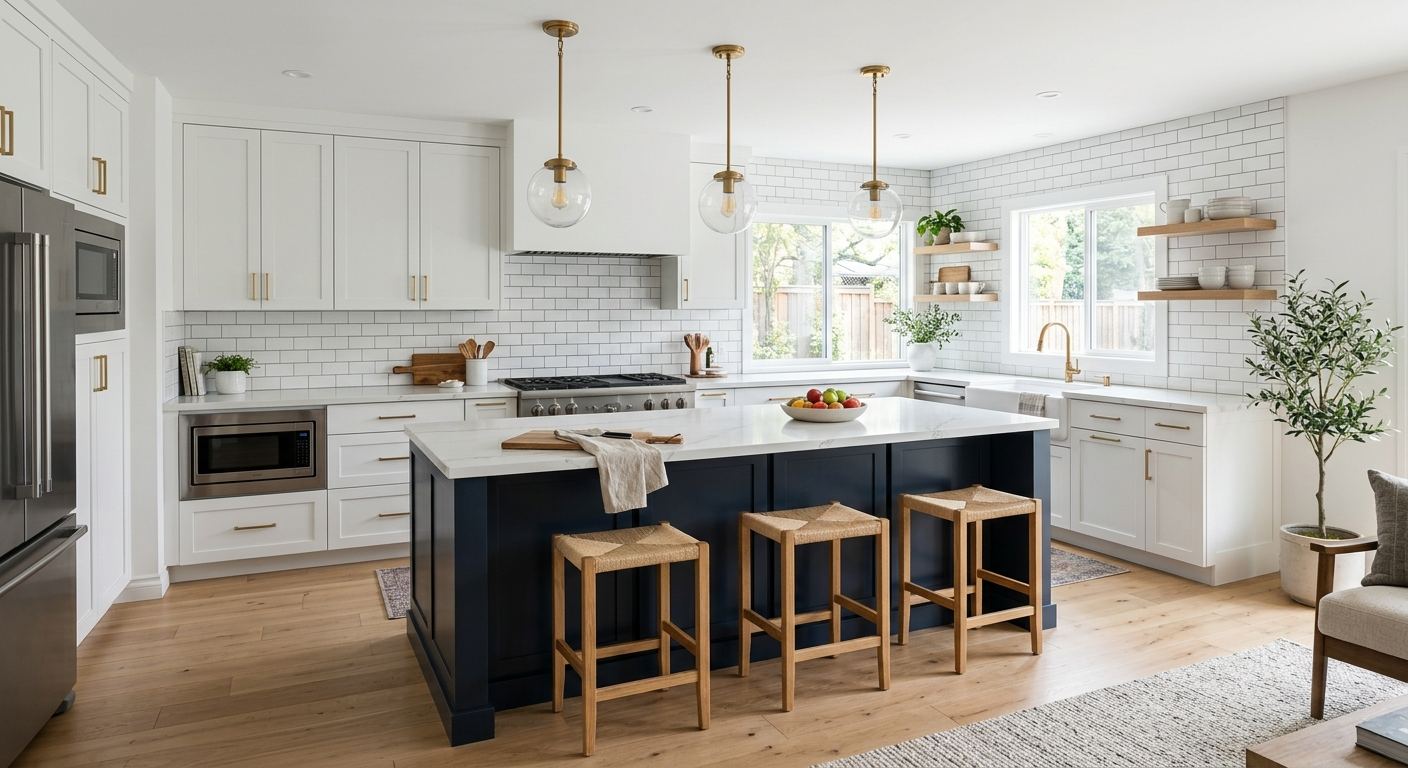
Kitchen renovation options and costs in Brow of the Hill
Brow of the Hill, British Columbia is a compact community on the edge of Metro Vancouver, and kitchen renovations here tend to price according to buyer expectations and resale payoff rather than the weather alone. With a population of 10,631 (Statistics Canada, 2021 Census), the local market is small enough that reputable trades are often booked by reach—so timing and site access can influence labour availability. And in a Lower Mainland–Southwest context, homeowners usually already have the household resources to “upgrade to match” when they renovate; national-income pressures show up locally as higher expectations for cabinetry finish and countertop selection (Statistics Canada, 2021 Census).
In the Lower Mainland–Southwest, contractors typically see two cost realities. First, the same kitchen footprint can swing widely: in higher-value parts of Metro Vancouver, semi-custom or custom cabinetry plus quartz or stone counters and upgraded hardware are common, pushing full renovation totals toward the top end of the provincial range. Second, climate affects the details of durability choices: kitchens face humidity swings and seasonal temperature changes, and materials that tolerate everyday moisture and heat cycles (quality under-mount sinks, sealed stone seams, properly detailed backsplash transitions) reduce callbacks.
Trade demand is especially noticeable around the older, character-style housing pockets near the Brow of the Hill area where homeowners often update layouts for better storage and more modern sightlines. Once you decide whether you’re doing a paint-and-appliance refresh or a full remodel, you can compare tiers side-by-side in the table below.
| Renovation Tier |
What's Included |
Typical Duration |
Price Range |
| Cosmetic refresh (paint, hardware, new appliances only) |
Cabinet paint or refinishing (no box changes), new pulls/hinges, appliance swap (like-for-like), touch-up drywall, basic install/leveling |
3–7 days (plus a few days for prep/curing) |
$10,000–$25,000 |
| Mid-range full renovation (new cabinets, counters, sink, tile) |
New semi-custom or mid-range cabinets, quartz/stone or upgraded laminate counters, sink + faucet, backsplash tile, vanity-grade plumbing fixtures, design-led layout within existing services |
3–6 weeks |
$40,000–$80,000 |
| High-end full renovation (custom cabinets, stone counters, island) |
Fully custom millwork, stone counters (quartz/stone slabs), island with upgraded lighting, built-in appliance package, full-height or premium backsplash, higher-end flooring transitions, complex detailing |
6–12 weeks |
$85,000–$120,000 |
| Cabinet refacing only (new doors + drawer fronts, same boxes) |
Door/drawer replacement, new mouldings and hardware, matching filler panels, paint/stain where needed, light labour for reveals |
1–3 weeks |
$12,000–$35,000 |
| Countertop swap only (laminate to quartz or stone) |
Remove and dispose of old countertop, new template + install, edge profile upgrade, sink and cooktop re-fit (where feasible) |
1–2 weeks (template lead time varies) |
$6,000–$18,000 |
| Backsplash tile installation only |
Tile removal (if needed), surface prep, new tile install, grouting/sealing, caulking at countertop and corners |
4–10 days |
$1,500–$6,000 |
Prices are estimates only and vary by project scope, site access and material selection.
What affects the price of kitchen renovation in Brow of the Hill
In the Lower Mainland–Southwest, it’s common to see quotes for the “same” kitchen vary by 30–50% when comparing contractors across British Columbia. The biggest driver isn’t climate—it’s the assumed finish tier and the resale logic behind it. In higher-value areas of Metro Vancouver, owners more often default to quartz or stone counters and semi-custom cabinetry because the renovation cost is more easily recovered on resale. In more modest markets, laminate and stock cabinets dominate because the goal is usually good function at a restrained price point.
Layout changes are the wildcard regardless of finish. Removing a wall, adding an island, or moving plumbing (sink) or gas/venting (stove range setup) tends to increase the unpredictability of labour, inspection steps, and material coordination. For example, a practical mid-range full renovation in Brow of the Hill might land in the $40,000–$80,000 band when services stay in roughly the same locations. The same kitchen can drift toward $85,000–$120,000 if you introduce an island, upgrade appliance rough-ins, and choose custom millwork and stone slabs.
Two local examples I see often here: (1) older homes with slightly out-of-square framing make cabinet installation take longer and increase filler needs; that pushes labour and cabinet adjustment time up. (2) winter-condensation and summer humidity swings can expose weak backsplash sealing details—so paying for proper waterproofing transitions and quality caulking is money well spent, even if the tile looks “basic” at first glance.
| Price Factor |
Why It Matters |
Cost Impact |
| Cabinet tier — stock vs. semi-custom vs. fully custom millwork |
Materials, door styles, internal storage options, tolerances, and the degree of made-to-fit planning |
Can change a full remodel by roughly $10,000–$40,000 depending on kitchen size and complexity |
| Countertop material — laminate vs. quartz vs. granite vs. stone |
Material cost, edge profiles, seam layout, and install difficulty (stone slabs and custom edges cost more) |
Often shifts countertop scope by about $3,000–$10,000+ across typical projects |
| Layout change — wall removal, island add, plumbing/gas move |
Structural trades, re-framing, new rough-ins, and inspection sequencing |
Frequently adds $8,000–$25,000+ even before finish upgrades |
| Appliance package tier — builder vs. mid-range vs. pro-grade |
Power/venting requirements, trim kits, and how well cutouts match the rest of the cabinetry |
Can add $3,000–$15,000+ depending on brand and features |
| Flooring — refinish existing vs. full replacement |
Surface prep, protection during demo, and matching transitions at kitchen-to-adjacent rooms |
Typically $1,500–$8,000+ depending on whether floors are replaced |
| Backsplash — ceramic tile vs. marble vs. full-height slab |
Surface flatness requirements and material handling; full-height coverage increases labour and detailing |
Often $1,500–$6,000 for tile, higher for slab-style treatments |
| Electrical — new circuits for island, under-cabinet lighting |
Licensed electrical work, new runs, and coordination with cabinet installation |
Commonly $1,000–$7,000+ depending on how many circuits and lighting zones |
| Permit fees and licensed trade requirements |
Inspection timing, documentation, and trade scheduling if plumbing/electrical/gas changes are involved |
Variable, but can add several thousand dollars plus schedule time on larger scope jobs |
Permits & regulations in British Columbia
In British Columbia, simple cabinet and countertop swaps generally do not require a building permit. Replacing doors and drawer fronts, painting cabinets, or installing new countertops over the existing base is typically a “no permit” kind of scope. However, if you’re moving plumbing supply/drain lines (for a relocated sink or dishwasher), relocating a gas appliance setup, removing a load-bearing wall, or adding new electrical circuits (common for island outlets or under-cabinet lighting), permits and licensed trades are usually required.
Gas work must be done by a licensed gas fitter, and electrical work must be done by a licensed electrician. Both require appropriate inspections before portions are covered up. If you’re adding an island and increasing receptacle count, that’s often where the permit/infrastructure requirements start to show up, even when the cabinetry finishes remain “mid-range.”
For a homeowner in Brow of the Hill, verify everything before signing:
- Ask for the contractor’s proof of liability insurance (and the clearance/contact details so you can confirm it’s current).
- Confirm the licensed trades will be used for gas and electrical, then request the gas fitter and electrician’s licence details.
- Request evidence of worker coverage status (WCB/WSIB equivalent coverage as applicable) through your contractor.
- Ask who pulls the permit and whether it’s included in the written quote, then keep that responsibility clear in the contract.
Step-by-step, check: online licensing registry for the trades, certificate of insurance for the contractor, and a clearance letter/confirmation of coverage if the contractor or subcontractor provides it. If a quote avoids the topic, that’s a red flag.
Cabinets, countertops and layout decisions in Brow of the Hill
When you renovate a kitchen in Brow of the Hill, the three choices that most strongly affect both the final look and the total cost are: (1) cabinet tier, (2) countertop material, and (3) whether you change the layout (especially around sink and cooktop locations). In the Lower Mainland–Southwest resale environment, buyers often expect modern, durable surfaces—so the finish upgrades that look “cosmetic” can carry real practical value in everyday use.
Cabinet tier: stock cabinets are the fastest and cheapest because sizing is standard. Semi-custom (the most popular middle option in this region) gives better storage and more flexibility for out-of-square older framing. Custom cabinets create the tightest fit—ideal if you want a true wall-to-wall pantry or a built-in hood profile—but the labour and build time push costs upward quickly.
Countertops: laminate is budget-friendly, quartz is the common sweet spot for durability and stain resistance, granite/natural stone feels premium but requires careful seam planning and sealing, and butcher block needs ongoing maintenance (oil and mindful moisture control). Marble looks high-end but is more reactive and needs protective habits.
Layout changes: opening an adjacent wall for an open-concept feel, adding an island, or relocating plumbing/gas can be worth it when the space gain improves traffic flow and storage. If you keep plumbing and gas in similar locations, you protect your budget. As a concrete example, moving from laminate to quartz might add a few thousand dollars within the countertop scope, while adding an island with new electrical and potential plumbing alignment can move you into a higher full-renovation band (for example, from the $40,000–$80,000 style scope toward the $85,000–$120,000 style scope if combined with stone and custom cabinetry).
Humidity and temperature variation in the Lower Mainland makes proper sealing at seams, edges, and backsplash transitions more important than many homeowners expect, which is why “how it’s installed” matters as much as “what it is.”
| Option |
Durability |
Maintenance |
Best For |
Price Range |
| Stock cabinets (big-box) |
Good for standard sizing; can be less forgiving with uneven walls |
Low; occasional hardware adjustment or touch-up paint |
Quick refreshes and budgets that prioritize speed |
$8,000–$18,000 |
| Semi-custom cabinets (local dealer) |
Very strong overall; better fit and storage customization |
Low; wipe-clean finishes and hardware upkeep |
Most Brow of the Hill homeowners aiming for a mid-range full renovation |
$18,000–$40,000 |
| Custom cabinets (local millwork shop) |
Highest fit and build quality; best for difficult spaces |
Low; protect finishes from excessive moisture at sinks and corners |
Built-ins, islands, and layout-driven upgrades |
$35,000–$70,000+ |
| Laminate countertop |
Decent daily durability; edges and seams are more vulnerable |
Low; avoid prolonged heat exposure and standing water at seams |
Value-focused renovations and rental-friendly options |
$3,000–$7,000 |
| Quartz engineered countertop |
Excellent stain and scratch resistance for busy kitchens |
Low; generally no sealing required |
Mid-range to high-end projects that want a “set and forget” surface |
$6,000–$12,000 |
| Granite / natural stone countertop |
Very durable and heat tolerant; natural variation is a feature |
Moderate; sealing and periodic maintenance depending on the stone |
Premium look with natural movement |
$8,000–$16,000 |
| Butcher block countertop |
Strong but can dent/scratch; sensitive near sink splash zones |
Higher; regular oiling and prompt drying |
Warm, traditional kitchens if you’re willing to maintain |
$5,000–$11,000 |
| Marble countertop |
Beautiful but more prone to etching and staining |
Higher; proactive sealing and careful cleaning are important |
Showpiece kitchens with lighter day-to-day use |
$9,000–$18,000 |
How to choose a kitchen renovation contractor in Brow of the Hill
Choosing a contractor in Brow of the Hill is about confirming capability, verifying coverage, and locking down scope details in writing. First, verify British Columbia licensing for any trade that will perform regulated work: electrical contractors and gas fitters must be licensed, and your general contractor should clearly document that licensed subs are being used where required. For coverage, ask for a current certificate of liability insurance and evidence of worker coverage (WCB/WSIB as applicable). How you check: verify licence numbers against the province/registry information they provide, review your contractor’s insurance certificate for active policy dates and limits, and request a clearance letter or confirmation of coverage status where provided.
Next, get 2–3 itemised written quotes. You want labour and materials broken down (cabinet supply vs. install, countertop template/install, plumbing fixture changes, electrical work, tile prep and setting). Avoid any quote that’s only a single lump sum without stating inclusions and exclusions. Read the scope: is permit pulling included, who handles inspection scheduling, and is disposal (demo hauling and jobsite sweep) included or billed separately?
Finally, confirm warranty and payment schedule. Workmanship warranty length should be stated clearly, and product/manufacturer warranties should be documented with what’s covered and whether they transfer to you. For payment timing, never pay more than 10–15% upfront; holdback should cover completion items and closeout. Ask for a start date and a completion estimate in writing so you can coordinate appliance delivery and countertop templating lead times.
- Ask for licence and insurance copies before deposit is due.
- Confirm which trades are subcontracted and what licences they hold.
- Require itemised labour vs. materials pricing for cabinets, countertops, and tile.
- Check if permit pulling is included (and who is responsible) when layout changes.
- Clarify disposal and recycling: demo hauling, packaging removal, and site cleanup.
- Verify cabinet lead times and whether delays affect your start date.
- Confirm countertop template timing and who pays if you change specs after templating.
- Ask what happens if the countertop arrives late (schedule and cost implications).
- Request a written warranty summary for workmanship and product coverage.
- Use a payment schedule tied to milestones; keep a holdback until punch list is done.
- Make sure electrical/plumbing/gas changes are scheduled to avoid rework.
- Get a written timeline that includes curing time, inspections, and cabinet install sequencing.
In Brow of the Hill, common red flags I see include: (1) quotes that refuse to state permit responsibility when moving plumbing or adding circuits, (2) no evidence of current liability insurance or missing coverage proof, (3) no itemised countertop/cabinet allowances (and only a generic “allowance” number), (4) schedules that ignore countertop templating lead times, and (5) deposits that exceed 15% or a holdback that disappears.
Frequently asked questions — kitchen renovation in Brow of the Hill
Quartz vs granite countertops — which is better?
In Brow of the Hill and across the Lower Mainland–Southwest, quartz is often the better “daily driver” because it resists stains and doesn’t typically require the same sealing rhythm as many natural stones. Granite is extremely durable and heat tolerant, and it gives that distinctive natural variation many homeowners love, but it may need periodic sealing to protect against everyday spills. If your household cooks often and you want low-fuss care through winter and summer humidity swings, quartz is usually the practical choice. Cost-wise, countertop-only scopes often fall within the provided band of about $6,000–$18,000, with quartz commonly landing in the middle of that range depending on edges, thickness and install complexity.
Should I reface or replace my cabinets?
Refacing is a strong option when the cabinet boxes are solid, straight, and structurally sound—especially in older homes where the layout is workable but finishes are dated. It’s also usually quicker and can keep your project closer to a refresh-style budget rather than a full cabinet replacement. Replacing the boxes is the better choice if you’re dealing with sagging boxes, water damage, or you want major storage/layout changes (like redesigned pantry interiors or moving drawer banks). In the local Lower Mainland market, semi-custom replacement commonly fits mid-range renovation scopes, while refacing tends to sit in a cabinet installation/refacing band such as $8,000–$50,000, depending on kitchen size and how many panels/doors are changed. If you’re unsure, a site inspection of the existing frames and toe-kick condition is the fastest way to decide.
Do I need a permit for a kitchen renovation in British Columbia?
Often, you don’t need a permit for cabinet and countertop swaps where plumbing, gas, and electrical are not being altered. In British Columbia, permits and licensed trade work usually come into play when you move plumbing supply or drain lines (relocating a sink or dishwasher), relocate gas components (or modify the stove/range hood setup with gas), remove a load-bearing wall, or add new electrical circuits (common for island receptacles and under-cabinet lighting). For homeowners in Brow of the Hill, the best approach is to ask the contractor, in writing, which parts trigger permits and who pulls them. Also confirm which licensed trades will do the regulated work and whether inspections are scheduled before walls are closed. The written contract should clearly assign permit responsibility so you’re not surprised later.
What's the ROI on a kitchen renovation?
ROI in the Lower Mainland–Southwest is strongly tied to the finish tier and whether the renovation improves functional layout rather than only looks. In higher-value Metro Vancouver markets (which influence buyer expectations around Brow of the Hill), buyers tend to pay more for modern, durable surfaces—like quartz counters and well-planned cabinetry—because those upgrades are easy to recognize during showings. If you keep plumbing/gas locations mostly unchanged and invest in cabinetry quality and countertops, your ROI is typically stronger than doing major demo and layout moves with mid-tier finishes. For ballpark budgeting, full renovations often sit in the $40,000–$120,000 range here, and the projects that recover better are usually the ones that look cohesive and address everyday usability (storage, circulation, and lighting). The most accurate ROI depends on your home value and the buyer segment you’re targeting.
How do I budget for a kitchen renovation?
Start by choosing your tier. If you’re keeping the footprint and services the same, a cosmetic refresh with hardware and appliances can stay in a lower band, while a mid-range full renovation with new cabinets, counters, a sink, and tile often lands around $40,000–$80,000. If you’re doing custom cabinets, stone counters and adding an island, budgeting toward the high-end band—up to $85,000–$120,000—prevents scope stress later. Then build in a contingency for the unpredictable parts: older framing that’s out of square, unexpected electrical updates, or minor plumbing corrections. In Brow of the Hill, the schedule also matters because cabinet and countertop lead times can affect when trades are available and whether you’re forced to pay for expedited ordering.
Can I move my kitchen sink or stove?
Yes, you can move a sink or stove, but in British Columbia the work becomes more complex and may require permits and licensed trades. Moving a sink usually involves altering plumbing supply and drain lines, and moving a stove can involve gas work and venting adjustments—gas changes must be done by a licensed gas fitter, and electrical modifications require a licensed electrician. Practically, the cost impact is often the biggest swing factor in a renovation quote, because the contractor must coordinate rough-ins, inspections, and wall/ceiling patching. If you keep the move small and within accessible paths, you may stay closer to typical countertop and cabinet scope ranges; if you need extensive rerouting, plan for budget movement into a full renovation band such as $40,000–$120,000. The best way to confirm feasibility is a site visit where they check venting paths, existing joists, and service locations.