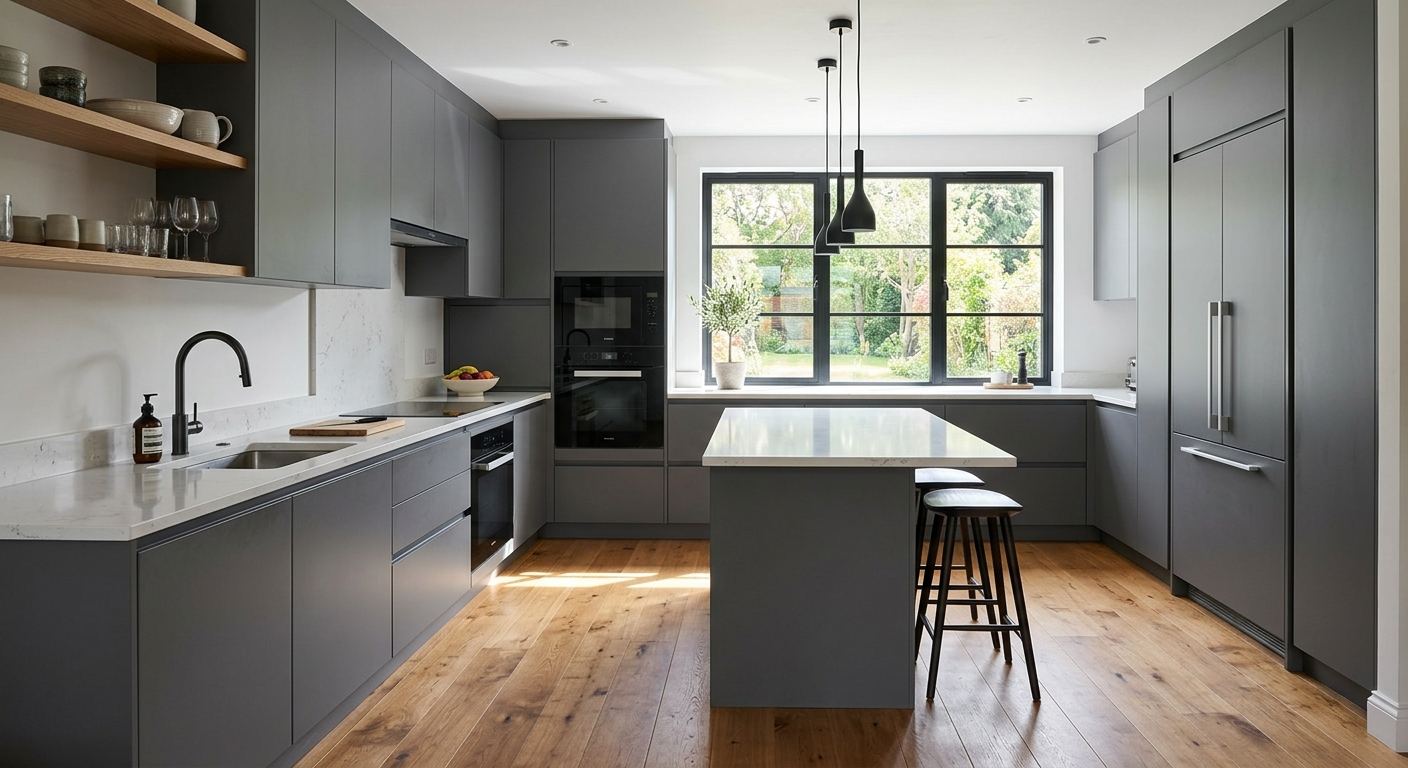
Kitchen renovation options and costs in Eagle Ridge
Eagle Ridge is a neighbourhood where kitchen renovations are heavily shaped by resale expectations and owner lifestyle—more than weather alone. With a population of 11,004 (Statistics Canada, 2021 Census), the local renovation market typically moves at a steady pace, and homeowners often aim for finishes that feel “current” when buyers tour. In the Lower Mainland–Southwest, pricing is also linked to household purchasing power: many projects cluster around upgrades that protect the home’s perceived value and function, which is why you’ll see a bigger swing between cabinet tiers and counter materials than in colder, more price-sensitive regions.
Because Eagle Ridge sits in the broader Metro Vancouver demand zone, contractor availability and labour competitiveness don’t rise and fall the way they do in parts of Canada with harsher winter shutdowns. Instead, costs track home value and the expected finish level. You’ll usually find that the same layout refresh can land in a mid-range scope when it’s a practical “update,” but it can quickly shift into a high-end rebuild once you add design-led cabinetry, upgraded hardware, quartz or stone counters, and an island. Neighbourhood demand is especially strong around the West Abbotsford / Sumas Prairie corridor where trades are busier and scheduling can affect labour pricing.
Below are common renovation tiers homeowners use as a baseline before getting site-specific measurements and material selections. Use this to compare quotes and spot where the real cost drivers are likely hiding.
| Renovation Tier |
What's Included |
Typical Duration |
Price Range |
| Cosmetic refresh (paint, hardware, new appliances only) |
Cabinet paint or refinish (no box changes), new hardware, appliance replacement, basic caulking and touch-ups |
3–7 days |
$8,000–$22,000 |
| Mid-range full renovation (new cabinets, counters, sink, tile) |
New semi-custom or quality stock cabinets, new counters, sink and faucet swap, backsplash tile, labour for typical demo and install |
3–6 weeks |
$40,000–$80,000 |
| High-end full renovation (custom cabinets, stone counters, island) |
Fully custom millwork, stone counters (quartz/stone with premium edges), island with upgraded finishes, detailed backsplash, upgraded hardware |
6–12 weeks |
$85,000–$120,000 |
| Cabinet refacing only (new doors + drawer fronts, same boxes) |
Replace doors/drawer fronts, update hardware, reface visible surfaces, re-install existing countertops if compatible |
1–3 weeks |
$12,000–$30,000 |
| Countertop swap only (laminate to quartz or stone) |
Remove old tops, install new quartz/stone (including edge profiles where selected), seal where required, reconnect sink |
3–10 days |
$6,000–$14,000 |
| Backsplash tile installation only |
Demo of existing backsplash (if needed), tile supply and installation, grout/seal, caulking at change-of-plane |
3–7 days |
$1,500–$6,000 |
Prices are estimates only and vary by project scope, site access and material selection.
What affects the price of kitchen renovation in Eagle Ridge
In the Lower Mainland–Southwest, you can see the same kitchen renovation idea come back 30–50% different across quotes because homeowners choose different “value decisions” (cabinet tier, counter material, and layout complexity), and because trade scheduling can shift labour intensity. Compared with other British Columbia markets where budgets skew tighter, the Lower Mainland tends to normalize higher finish expectations. That’s why a refresh with laminate surfaces may stay restrained, while a full remodel with premium millwork and quartz or stone counters rises quickly once cabinetry, trades, and layout changes are included.
Local home values and income strongly influence the typical finish tier far more than climate. In higher-value parts of the region, owners often default to quartz or stone counters and semi-custom cabinetry because the renovation cost is easier to recover on resale. In more modest-scoped projects, laminate and stock cabinets dominate because the ROI stays cleaner. Regardless of materials, layout changes are the most unpredictable cost driver. Removing a wall, adding an island, or moving a gas line can add significant labour and specialist work, even when the cabinetry is “mid-range.”
Here are a few Eagle Ridge realities that affect budgets in dollars: (1) older homes may have dated plumbing runs—switching from one sink location to another can mean extra framing and drywall patching; (2) some kitchens have tight appliance clearances, so “standard” cabinet widths don’t fit cleanly and may trigger custom tweaks; (3) if you choose quartz, you’re planning around template timing and edge/profile changes—delays can ripple into labour scheduling. As a rule of thumb, cabinet-and-counter packages often sit in the $40,000–$80,000 band for practical full renovations, while premium stone-and-island work commonly pushes into the $85,000–$120,000 range.
| Price Factor |
Why It Matters |
Cost Impact |
| Cabinet tier — stock vs. semi-custom vs. fully custom millwork |
Tier affects material quality, door/drawer construction, fit/finish, internal hardware, and how well cabinets match your room geometry |
~$8,000–$60,000 swing depending on size and complexity |
| Countertop material — laminate vs. quartz vs. granite vs. stone |
Material drives material cost, templating complexity, edge finishing and (for natural stone) sealing/handling requirements |
~$3,000–$12,000 for typical swaps; can move higher with premium edges/islands |
| Layout change — wall removal, island add, plumbing/gas move |
Triggers structural considerations, new framing, specialized plumbing/gas/electrical and more drywall/finishing work |
Often the biggest variable: +$5,000–$30,000+ |
| Appliance package tier — builder vs. mid-range vs. pro-grade |
Higher tiers add cost and can change ventilation needs and electrical requirements |
~$2,000–$12,000+ |
| Flooring — refinish existing vs. full replacement |
Matching existing flooring is harder after demo; full replacement adds materials, labour and transitions |
~$1,500–$8,000 depending on scope |
| Backsplash — ceramic tile vs. marble vs. full-height slab |
Material size/weight, cutting complexity, and whether you’re doing partial vs full-height coverage |
~$1,500–$6,000+ |
| Electrical — new circuits for island, under-cabinet lighting |
Electrical work needs licensed trade involvement and inspection; lighting adds wiring and labour time |
~$800–$6,000+ depending on circuits and fixtures |
| Permit fees and licensed trade requirements |
Where permits apply, you also pay for inspections and licensed trades time |
Usually adds hundreds to low thousands, but layout-heavy jobs increase the impact |
Permits & regulations in British Columbia
In British Columbia, simple cabinet and countertop swaps typically don’t require a permit. That means replacing cabinets in the same location and swapping countertops (including changing laminate to quartz/stone) is usually straightforward from a permitting standpoint. However, if your Eagle Ridge renovation moves plumbing supply/drain lines, relocates gas for the stove/range hood, removes a load-bearing wall, or adds electrical circuits (for example, powering island outlets or additional under-cabinet lighting circuits), permits and licensed trades are commonly required.
Gas work must be performed by a licensed gas fitter, and electrical work must be completed by a licensed electrician. Both categories typically trigger inspection requirements once the work is complete. For homeowners, the key is assigning responsibility up-front: always confirm who pulls permits, who schedules inspections, and how responsibility is documented—those details belong in your written contract, not just in email threads.
To verify a contractor’s legitimacy in Eagle Ridge, you can do it step-by-step: (1) ask for a copy of their licence details/registration and check the relevant online registry for active status; (2) request a current certificate of insurance (liability) showing the effective dates and correct insured address; (3) ask how they handle workplace coverage (WSIB/WCB) and obtain the clearance letter or documentation for your project; (4) confirm which subs they hire for gas and electrical and request their licence proof too. If they can’t provide documentation promptly, that’s a serious planning and liability risk.
Cabinets, countertops and layout decisions in Eagle Ridge
In an Eagle Ridge kitchen renovation, three decisions determine most of your cost and long-term satisfaction: (1) cabinet tier, (2) countertop material, and (3) layout changes. Start with cabinet tier. Stock cabinets are typically the fastest and cheapest because they’re standardized, with fewer design hours and quicker delivery. Semi-custom cabinets are usually the “sweet spot” in the Lower Mainland–Southwest: you get better fit options (width adjustments, better internal organization, and more door styles) without going fully custom. Custom cabinets offer the best fit for awkward spaces, but the design and millwork time is what pushes budgets into the higher tier.
Next, pick a countertop with maintenance in mind. Laminate is often the budget-friendly choice, while quartz is a common premium upgrade because it resists staining and wiping is simple—important for busy households in Metro Vancouver’s damp coastal environment, where kitchens still see humidity and condensation. Natural stone like granite is durable but typically needs more careful sealing and handling considerations during installation and long-term upkeep.
Finally, layout changes. Removing a wall, adding an island, or relocating plumbing/gas can be justified when it creates real space gain: better traffic flow, improved work triangle function, or room to add storage. But layout changes are also where uncertainty is highest—particularly when you’re opening walls and adjusting runs. For a concrete example, if you’re comparing a practical mid-range refresh (~$40,000–$80,000) to a higher-end rebuild (~$85,000–$120,000), the difference is rarely “just” counters—it’s often the jump in cabinetry tier plus the labour scope of layout upgrades like an island and added electrical/plumbing.
| Option |
Durability |
Maintenance |
Best For |
Price Range |
| Stock cabinets (big-box) |
Solid for typical use; durability depends on construction and hardware |
Low; keep hinges and slides maintained as with most cabinets |
Fast timelines and budget-focused refreshes |
$8,000–$25,000 |
| Semi-custom cabinets (local dealer) |
Better build quality and organization; stronger fit options |
Low; upgrade hardware can reduce wear |
Most Eagle Ridge homeowners targeting a mid-range full renovation |
$20,000–$55,000 |
| Custom cabinets (local millwork shop) |
Highest fit/finish and strongest craftsmanship for complex layouts |
Low-to-moderate; quality hardware matters and should be maintained |
Awkward room dimensions, premium resale presentation, island + storage design |
$45,000–$90,000+ |
| Laminate countertop |
Good for everyday use but can be more vulnerable to chips/edge wear |
Easy cleaning; avoid prolonged heat and sharp impact on edges |
Budget projects and rental-friendly durability expectations |
$3,000–$6,000 |
| Quartz engineered countertop |
Very durable surface; resists staining and daily wear |
Low; wipe-clean surface with routine care |
Busy households wanting “premium look” with practical maintenance |
$6,000–$12,000 |
| Granite / natural stone countertop |
Highly durable with unique veining; may be more sensitive at seams/edges |
Usually periodic sealing depending on product |
Owners who want natural character and premium curb appeal |
$7,000–$14,000 |
| Butcher block countertop |
Durable but can show wear; best with proper care |
Requires oiling/maintenance to prevent drying/warping |
Warm, casual looks; families who enjoy maintenance |
$4,000–$10,000 |
| Marble countertop |
Elegant and durable when sealed correctly, but can etch or stain |
Moderate care; sealing and prompt cleanup are important |
Design-led kitchens where appearance is a priority |
$10,000–$20,000+ |
How to choose a kitchen renovation contractor in Eagle Ridge
Choosing a contractor in Eagle Ridge is mostly about documentation, not just pictures. First, verify British Columbia licensing and insurance. Ask for proof of liability insurance and request the certificate of insurance showing coverage amounts and effective dates for your job period. For work coverage, confirm how they handle WSIB/WCB (or equivalent workplace coverage documentation) and request a clearance letter or proof of coverage for your project. Also, make sure the subcontractors they use for gas fitting and electrical are properly licensed—then request their licence proof as well.
Next, get 2–3 itemised written quotes. You want labour and materials broken out (cabinet supply, install labour, counter fabrication/templating, plumbing/electrical allowances, tile labour, disposal), not just one lump sum number. Read the scope carefully for inclusions and exclusions: permit pull included or not, disposal and dumpster costs, whether old cabinets/counters are removed and hauled away, and what happens if the existing walls require extra patching after demo.
Warranty matters too. Ask for the workmanship warranty length, whether it’s covered as parts and labour, and whether it carries forward if you sell the home. Compare product warranties separately—cabinet manufacturers and countertop suppliers often have different coverage terms. Payment schedule should be conservative: never pay more than 10–15% upfront, and keep a holdback until the job is complete and you’ve verified punch-list items. Finally, insist on a written start date and a completion estimate that matches realistic lead times for cabinets and countertops.
- Request proof of active BC licensing and project-appropriate insurance before work starts.
- Verify WSIB/WCB (clearance letter/proof of coverage) for their company and confirm how subs are covered.
- Ask for 2–3 itemised quotes with labour and material lines, not a single total.
- Confirm who pulls permits and schedules inspections (and whether that’s included in the quote).
- Check disposal: whether hauling/dumpster costs are included or billed separately.
- Confirm what’s included in demo and wall prep (especially drywall patching after moving plumbing).
- Get cabinet and counter specifications in writing: model/grade, door style, finish type and thickness.
- Ask about countertop templating timing and how delays are handled.
- Clarify electrical scope: outlets, under-cabinet lighting, and any added island circuits.
- Review warranty terms in writing, including workmanship start date and any exclusions.
- Use a payment schedule that holds back at least 10–15% until punch list completion.
- Ask for a written construction schedule with milestones: demo, rough-in, install, trim, final.
Red flags in the Eagle Ridge market include: refusing to provide insurance/coverage documents, quoting without a clear scope (no permit/disposal language), asking for large upfront payments (well above 15%), promising installation dates that ignore cabinet/counter lead times, and blaming “unforeseen issues” without a written change-order process.
Frequently asked questions — kitchen renovation in Eagle Ridge
Can I move my kitchen sink or stove?
Yes, in British Columbia you can move a kitchen sink or stove, but it’s the route of the plumbing and gas lines that determines complexity, cost and whether permits are required. If you’re moving the sink location enough to change supply or drain runs, you should expect licensed plumbing work and the possibility of permits and inspections, especially once walls are opened. For a stove move, if gas is involved (common in the Lower Mainland), gas relocation typically needs a licensed gas fitter and inspections. In Eagle Ridge, older home plumbing layouts can also add time because of what you uncover behind walls. Budget-wise, this is why quotes for the “same” kitchen can diverge—layout changes can push you from a mid-range scope into high-end renovation territory (for example, beyond the $40,000–$80,000 range) even if cabinetry stays similar.
What's the most cost-effective kitchen upgrade?
For many Eagle Ridge homeowners, the most cost-effective upgrade is usually a change with high visual impact and controlled labour scope. That often means upgrading hardware and doing a cosmetic refresh, or pairing new doors/drawer fronts with an existing cabinet box (refacing). Another strong value play is a countertop swap—especially moving from laminate to quartz—because you get a big look upgrade without the full cost of a complete cabinet tear-out. If you’re trying to stay near the lower band, a focused countertop change can land in the countertop installation range, while still keeping major trade work limited. As a practical example, a full refresh can start around $8,000–$22,000, while a countertop swap only often sits around $6,000–$14,000 depending on size and edge choices. If your existing layout is sound, these options typically beat the ROI of moving plumbing or adding an island purely for aesthetics.
Custom vs stock cabinets — is custom worth it?
Custom cabinets are worth it when you have a layout that needs perfect fit—like sloped ceilings, awkward wall lengths, or when you want an island and storage plan that’s truly made for your workflow. If your kitchen is straightforward and you mostly want a refreshed look, semi-custom or even stock can be the smarter value. In the Lower Mainland–Southwest, many homeowners choose semi-custom because it upgrades fit and interior features without the design/millwork time of fully custom cabinetry. That’s why you’ll often see mid-range renovations targeting a cabinet-and-counter plan closer to the $40,000–$80,000 range, versus high-end full renovations that move into $85,000–$120,000 when island millwork, premium finishes, and complex custom layouts are included. Also consider resale: in British Columbia’s higher-value segments, the expectation for quartz/stone and well-finished cabinetry tends to push buyers toward higher-tier visuals—but custom only pays off when it addresses real space constraints.
How do I choose a kitchen contractor in Eagle Ridge?
Choose a contractor by verifying documentation and demanding a clear, itemised scope. In Eagle Ridge and across British Columbia, you should ask for proof of active licensing where required, liability insurance, and project coverage documentation (WSIB/WCB clearance letter or proof of coverage). Then get 2–3 written quotes that separate labour and materials—so you can compare cabinet supply, counter templating/fabrication, tile labour, and allowances. Make sure the quote explicitly states what’s included for permits, disposal/hauling, and wall prep after demo. Review the warranty too: ask for workmanship warranty length and whether it’s transferable. A payment schedule should be conservative—never pay more than 10–15% upfront and keep holdback until the final punch list is done. If a contractor can’t explain scope exclusions or refuses to use a written change-order process, that’s a sign you’ll likely pay more later.
What order do kitchen renovation steps happen in?
A typical Eagle Ridge kitchen renovation sequence starts with measurements, finish selections, and (when needed) permit applications. Once materials are ordered and scheduled, demo happens first—removing old cabinets, countertops, and backsplash as outlined in the scope. Next comes rough-in work: plumbing and electrical adjustments, gas line work if applicable (by licensed trades), and framing/drywall prep. After that, cabinets go in (including any wall backing and leveling), then countertops are templated and installed when fabrication is ready. Tile and flooring usually follow installation stages that require the flattest surfaces, and backsplash gets installed after cabinets are set. Finally, you complete trim, caulking, painting/touch-ups as needed, appliance hook-up coordination, and a punch list. The homeowner takeaway: the schedule must align countertop templating lead times—this is why contractors often build in buffer time rather than rushing install dates.
Can I live at home during a kitchen renovation in Eagle Ridge?
Often, yes—but it depends on scope, dust control, and whether your layout changes require extensive rough-in work. In Eagle Ridge, many homeowners live in the home during a cosmetic refresh or a refacing-only project because the work is faster and less disruptive. For mid-range full renovations that involve cabinet and counter swaps, living at home is still possible, but you’ll need a safe temporary kitchen setup and a plan for dust containment, especially during demo and tile phases. If the job includes moving plumbing/gas lines and adding electrical circuits, rough-in work can take longer and may make safe cooking more difficult for a period. Cost-wise, expect living-at-home scenarios to reduce overall disruption but not necessarily total cost—labour and trade coordination still occur. Whether you’re planning a $40,000–$80,000 renovation or a higher-end build, the best approach is to talk through the daily work zone, water access, and how the contractor manages debris disposal and ventilation during construction in British Columbia’s coastal environment.