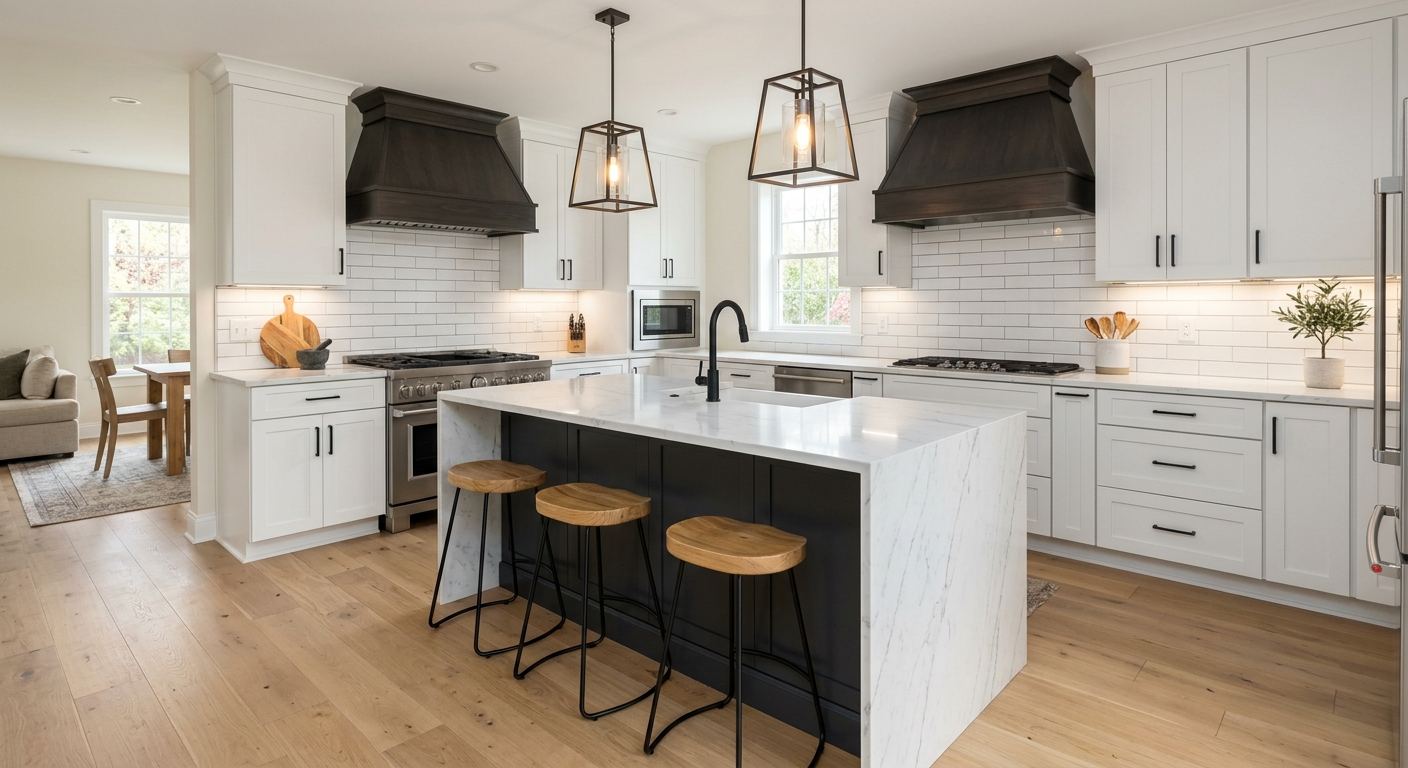
Kitchen renovation options and costs in Inlet Centre
Kitchen renovation costs in Inlet Centre tend to track the Lower Mainland–Southwest finish expectations more than the weather itself. Homeowners here are often renovating in a market where buyers can compare updates across nearby neighbourhoods, so “good enough” upgrades have to look modern and durable. In 2021, Inlet Centre had a population of 7,232 (Statistics Canada, 2021 Census), and that relatively smaller local population tends to push contractors to schedule jobs efficiently—helpful for timing, but you still need to book ahead for peak-season work.
Across the Lower Mainland–Southwest, pricing is driven by home value and expected resale appeal: in higher-value pockets of Metro Vancouver, people commonly move from laminate and stock cabinets up into quartz or stone counters and semi-custom cabinetry because the cost is easier to recover when the kitchen is marketed as “move-in ready.” In other areas, a practical refresh can stay closer to the $40,000–$120,000 full-renovation band by keeping layout changes minimal and choosing budget-friendly materials.
Even though British Columbia climate doesn’t change cabinet pricing directly, it affects what goes into the spec: moisture-tolerant installation details, high-quality sealants, and flooring that won’t cup during seasonal humidity shifts. Also, labour availability matters—when multiple homes in the same corridor are remodeling, crews may compress timelines, and that can nudge the final price up or down depending on the contractor’s schedule.
In Inlet Centre, demand is especially strong around the waterfront-adjacent residential areas where older homes are being updated for modern entertaining layouts. With that in mind, here’s a clear comparison of common renovation tiers to help you align your expectations before reviewing quotes.
| Renovation Tier |
What's Included |
Typical Duration |
Price Range |
| Cosmetic refresh (paint, hardware, new appliances only) |
Cabinet paint or repaint, new hardware/pulls, caulking and touch-ups, appliance swap (dishwasher/oven/range hood as applicable), minor electrical for appliance fit |
1–3 weeks |
$8,000–$25,000 |
| Mid-range full renovation (new cabinets, counters, sink, tile) |
New semi-custom or stock cabinets, countertop replacement, sink and tap, backsplash tile, vanity-style plumbing updates, flooring tie-in where required |
4–8 weeks |
$40,000–$85,000 |
| High-end full renovation (custom cabinets, stone counters, island) |
Custom millwork, stone (quartz/stone) counters, island build-out (including electrical and plumbing if needed), upgraded backsplash (tile/slab), premium hardware and lighting |
8–16 weeks |
$85,000–$120,000 |
| Cabinet refacing only (new doors + drawer fronts, same boxes) |
Replace doors/drawer fronts, new hardware, repaint/finish touch where needed, new trim and edging; boxes remain in place |
2–5 weeks |
$8,000–$35,000 |
| Countertop swap only (laminate to quartz or stone) |
Remove old surface, fabricate and install new quartz/stone, seam planning, reinstall sink if applicable, basic backsplash trim adjustment |
1–3 weeks |
$3,000–$12,000 |
| Backsplash tile installation only |
Surface prep, tile supply/instal (scope dependent), grout/seal, outlets cut-in, trim installation |
3–7 days |
$1,500–$6,000 |
Prices are estimates only and vary by project scope, site access and material selection.
What affects the price of kitchen renovation in Inlet Centre
For the same kitchen in the Lower Mainland–Southwest, quotes can differ by 30–50% from one contractor to another or between nearby neighbourhoods because the driver isn’t climate—it’s local market expectations. In higher-value Metro Vancouver areas, homeowners are more likely to choose semi-custom or custom cabinetry, quartz/stone counters, upgraded hardware, and layout-driven features (like islands with power and seating). In more modest parts of the region, the most common path to value is laminate or stock cabinets with fewer layout moves. That same choice shifts the project into different price bands quickly: a full renovation can land in the $40,000–$120,000 range, but a refacing approach or countertop-only swap is usually far narrower.
Median income and home values shape what “ROI” means. Where buyers expect premium finishes, the contractor’s spec pushes toward stone counters and cabinetry packages that can command a stronger resale story. Where budgets are tighter, ROI is about making the space feel clean and modern without moving plumbing or gas lines, so laminate surfaces and stock cabinetry stay popular.
Layout changes are the most unpredictable cost regardless of finish level. Removing a wall, adding an island, or moving a gas line can require permit work, licensed trades, and more complicated rough-in, which is why the spread between quotes can jump even when cabinet styles look similar on paper.
Concrete examples that affect pricing in Inlet Centre: (1) older home plumbing runs can force more demolition if you move a sink, increasing labour and disposal; (2) if your kitchen has limited exterior access for delivery, it can add crane/hoist logistics or longer carry times; (3) if you’re targeting a stone countertop, seam placement and edge profiles can change fabrication cost—sometimes only by a few thousand dollars, but enough to move the project up or down within the $40,000–$85,000 mid-range versus the higher-end tier.
| Price Factor |
Why It Matters |
Cost Impact |
| Cabinet tier — stock vs. semi-custom vs. fully custom millwork |
Material quality, door styles, internal storage layout, and how closely units fit your existing walls |
Often the largest swing: cabinet portion can move the total by tens of thousands |
| Countertop material — laminate vs. quartz vs. granite vs. stone |
Durability, fabrication complexity, seam/edge requirements, and tolerance for uneven substrates |
Countertop installs are commonly $3,000–$12,000 depending on material and complexity |
| Layout change — wall removal, island add, plumbing/gas move |
More demolition and rough-in; may trigger structural and permit work |
Can add several thousand dollars or more, even with “similar” finish packages |
| Appliance package tier — builder vs. mid-range vs. pro-grade |
Fit, venting needs, electrical/gas rough-in and performance features |
Small changes can swing the appliance line item by $2,000–$6,000+ in many projects |
| Flooring — refinish existing vs. full replacement |
Kitchen demo often exposes subfloor and affects matching; new flooring may require underlayment and transitions |
Refinish stays cheaper; replacement can add several thousand dollars |
| Backsplash — ceramic tile vs. marble vs. full-height slab |
Material cost, cutting complexity around outlets, and whether you need full-height coverage |
Backsplash & tile often runs $1,500–$6,000 depending on finish and coverage |
| Electrical — new circuits for island, under-cabinet lighting |
Licensed work and added wiring, switches/outlets, and lighting integration |
Lighting and circuit upgrades can add notable labour and materials costs |
| Permit fees and licensed trade requirements |
Permits, inspections, and documentation change the schedule and labour planning |
When triggered, adds both time and cost; impacts the “fast refresh” versus “full renovation” gap |
Permits & regulations in British Columbia
In British Columbia, many “swap-in-place” kitchen updates don’t require a permit. Cabinet and countertop swaps typically fall into the no-permit zone because you’re not altering building systems. For example, replacing laminate with quartz on the same footprint, swapping cabinet doors and drawer fronts (refacing), and installing a backsplash tile over existing surfaces generally don’t trigger permits.
Permits and licensed trades usually are required when you change plumbing, gas, electrical, or structural conditions. The work that commonly does require a permit includes relocating water supply or drain lines (moving a sink), relocating a gas stove or any gas appliance, adding or moving a range hood that involves gas venting, removing a load-bearing wall, and adding new electrical circuits (like dedicated power for an island, relocating outlets, or wiring under-cabinet lighting where the scope changes circuits). Gas work must be performed by a licensed gasfitter; electrical by a licensed electrician. Both trades require inspections before closing up walls or ceilings.
To verify a contractor in Inlet Centre before you sign, do this step-by-step: (1) ask for their licence details and confirm legitimacy through the appropriate online licence registry for the trade(s) they claim; (2) request a certificate of insurance (liability) and review coverage limits; (3) ask whether they have applicable workers’ compensation coverage and obtain proof; (4) confirm who pulls the permit for any scope that needs one—then ensure it’s written in your contract with responsibilities clearly assigned.
Cabinets, countertops and layout decisions in Inlet Centre
In Inlet Centre, your three most consequential decisions usually decide both the look and the long-term satisfaction: (1) cabinet tier, (2) countertop material, and (3) whether you change the layout. Cabinet tier choices are straightforward: stock cabinets are fastest and typically the lowest-cost path, semi-custom is the most popular mid-range option because you can adjust sizes and internal storage without fully commissioning millwork, and custom cabinets are the priciest route but can best fit older homes with uneven walls.
Countertops follow a similar pattern. Laminate is often the budget win, quartz is the most common “upgrade sweet spot,” and granite/stone bring premium aesthetic and heat tolerance at a higher material and fabrication cost. In the Lower Mainland–Southwest resale market, buyers often expect modern, clean surfaces—so laminate works best when the rest of the kitchen reads “new,” while quartz or natural stone becomes a more justified spend when the kitchen is positioned as a full refresh rather than a cosmetic update.
Layout changes are where costs can jump fast. Removing a wall or adding an island is usually only justified when the space gain meaningfully improves workflow (clearances, traffic flow) or entertainment use. When plumbing or gas must be moved, the project can climb toward the higher end of the $40,000–$120,000 full-renovation band due to licensed rough-in, inspections, and additional demolition.
For a dollar example: if your plan is “replace counters only,” you can often keep the countertop portion in the $3,000–$12,000 band. But if you add an island that requires new electrical and possibly plumbing, the same countertop choice may push the project into a larger full-renovation scope because the electrical/plumbing work and scheduling impact the entire build.
| Option |
Durability |
Maintenance |
Best For |
Price Range |
| Stock cabinets (big-box) |
Good for newer builds; depends on wall alignment |
Simple care; limited adjustments if your kitchen has out-of-square issues |
Fast refresh with minimal layout changes |
$8,000–$25,000 |
| Semi-custom cabinets (local dealer) |
Consistent quality with better fit options |
Easy upkeep; more customization helps hide minor imperfections |
Most Inlet Centre mid-range renovations |
$20,000–$55,000 |
| Custom cabinets (local millwork shop) |
Highest fit and storage potential |
Designed for longevity; requires careful installation and sealing |
When resale presentation and exact fit matter |
$45,000–$90,000 |
| Laminate countertop |
Solid for everyday use; less heat resistance than stone |
Wipe clean; avoid prolonged heat exposure to prevent damage |
Budget-conscious refresh |
$3,000–$6,000 |
| Quartz engineered countertop |
High durability and stain resistance |
Low maintenance; typically no sealing required |
Best balance of looks and practicality |
$5,000–$10,000 |
| Granite / natural stone countertop |
Excellent durability and unique patterning |
May require periodic sealing depending on the stone |
Premium aesthetic upgrades |
$7,000–$12,000 |
| Butcher block countertop |
Great longevity with proper oiling |
Regular conditioning; protect from standing water |
Warm, cottage-style or family-focused kitchens |
$4,000–$9,000 |
| Marble countertop |
Premium look; softer and more prone to etching |
Requires careful cleaning; may stain/etch without good habits |
Design-led kitchens where maintenance is acceptable |
$8,000–$14,000 |
How to choose a kitchen renovation contractor in Inlet Centre
Choosing a contractor in Inlet Centre comes down to verification and clarity. In British Columbia, you should confirm licensing for any trade scope that needs it—gas work (gasfitter), electrical (electrician), and any other regulated activities. How to check: (1) ask for licence numbers and confirm them through the relevant online registry; (2) request a certificate of insurance for liability (and ensure it’s current and matches the contractor’s legal name); (3) confirm workers’ compensation coverage—ask for proof so you’re not exposed if someone is injured on site; and (4) keep everything you verify in writing for your own records.
Next, request 2–3 itemised quotes with a labour and materials breakdown rather than a single lump sum. You want to see how they price demo, carpentry, countertop fabrication/installation, tile, and electrical/plumbing allowances. Read the scope carefully: what’s excluded (for example, subfloor repairs, new venting, disposal), is the permit pull included, and who handles changes if your walls reveal surprises. A good contractor will address unknowns with a contingency approach—not vague “we’ll figure it out” language.
Warranty matters. Ask for the workmanship warranty length (not just product warranties), and whether it’s transferable if you sell the home. For payment scheduling, never pay more than about 10–15% upfront; use progress payments tied to milestones and hold back until the job is complete and cleaned. Finally, insist on a written start date and a completion estimate that includes lead times for cabinets and stone.
- Confirm trade licensing for any permitted work before signing (gasfitter/electrician as applicable).
- Require itemised pricing for labour and materials so you can compare like-for-like scopes.
- Ask who pulls permits and who pays permit fees; ensure it’s stated in the contract.
- Get proof of liability insurance and workers’ compensation coverage.
- Confirm demolition, disposal, and site protection (plastic, flooring protection) are included.
- Clarify whether drywall patching, repainting, and trim reinstall are included or quoted separately.
- Verify countertop template, fabrication, and seam/edge details in writing before final approval.
- Ask how they handle out-of-square walls or subfloor issues discovered during demo.
- Review schedule by milestone (demo, rough-in, cabinets, countertops, tile, final trim).
- Check warranty terms for labour workmanship and product/manufacturer coverage.
- Use a payment schedule with a meaningful holdback until punch list completion.
- Make sure change orders are written, priced, and approved before work proceeds.
Red flags in Inlet Centre: contractors who won’t provide insurance/licence documentation, quotes that omit permits or disposal, vague scopes with no allowances for plumbing/electrical work, unusually low pricing that doesn’t match the specified cabinet/counter tiers, and crews that pressure you to sign quickly without a written timeline.
Frequently asked questions — kitchen renovation in Inlet Centre
Can I move my kitchen sink or stove?
Yes, you can move a kitchen sink or stove in Inlet Centre, but it depends on what moves are involved. Moving a sink usually means relocating supply and drain lines, which typically requires permits and licensed plumbing work, plus inspections before walls are closed. Moving a stove can be more involved if it’s gas: gas relocation generally requires a licensed gasfitter and permit activity, and the hood venting details matter too. If you’re keeping the same plumbing locations (swap the fixtures only), you can often avoid the permit-triggering scope.
Cost-wise, layout moves are where quotes vary. If you’re staying in a refit mindset (new fixtures, no rough-in), your costs can stay closer to targeted trades like countertop installs (often $3,000–$12,000). But once you add drain/supply or gas/electrical rough-ins, budgets commonly drift into broader full-renovation territory ($40,000–$120,000) depending on cabinetry and finish level.
What's the most cost-effective kitchen upgrade?
The most cost-effective upgrade is usually one that delivers “new kitchen” visual impact without triggering demolition of walls or major rough-in. In the Lower Mainland–Southwest, homeowners often get the best bang-for-buck from a cabinet refacing plus targeted hardware upgrades, or a countertop swap that updates the kitchen’s primary surface. If your cabinet boxes are still solid and your layout works, refacing can be a practical path because you’re keeping the underlying system and avoiding full carpentry replacement.
Another cost-effective route is a backsplash upgrade combined with modern lighting under cabinets. These upgrades are less disruptive and can improve resale-ready appearance quickly. If you want to stay within the “disciplined” band, consider a countertop-only project (often $3,000–$12,000 for installs depending on material and complexity) rather than a full renovation.
That said, if your cabinets are sagging, your countertop is damaged, or your workflow doesn’t work, the most cost-effective option long-term may be a mid-range full renovation.
Custom vs stock cabinets — is custom worth it?
Custom cabinets can be worth it, but only when your kitchen has constraints that stock can’t solve. In older homes common around Inlet Centre, walls may be out of square and floors/subfloors may not be perfectly level. Stock cabinets can still work, but you may end up with fillers, compromises in storage layout, or visual gaps that show up under modern lighting.
Custom is typically most justified if you want exact sizing, specialty storage (pantry pull-outs, tailored spice garages, built-in appliance garages), or a higher-end design look that buyers in your price tier expect. Semi-custom is often the “sweet spot” for most homeowners—better fit than stock without the full price of commissioned millwork. If you’re aiming for a refresh with a controlled budget, stock cabinets keep the project moving and costs closer to the lower end of full-renovation planning.
For many projects, a refacing plan or semi-custom package with quartz counters offers the best balance between cost and a resale-ready finish.
How do I choose a kitchen contractor in Inlet Centre?
Start with verification and transparency. Confirm that the contractor provides proper documentation for the work they’re responsible for in British Columbia—licensing for regulated trades (like gas and electrical), plus current liability insurance and proof of workers’ compensation coverage. You’ll also want an itemised quote that breaks out labour and materials rather than lump-summing every line. Ask who is pulling permits and whether disposal and site protection are included.
Next, check their warranty approach: workmanship warranty length, product/manufacturer warranty terms, and whether warranties are transferable if you sell. Make sure the payment schedule is milestone-based; in good projects, homeowners usually avoid heavy upfront payments beyond roughly 10–15%. Finally, lock in a timeline with a start date and completion estimate in writing, including realistic lead times for cabinets and stone. This is especially important in the Lower Mainland–Southwest where scheduling can tighten around peak renovation season.
If a contractor can’t clearly explain scope, exclusions, and the “what happens if we uncover issues” plan, keep looking.
What order do kitchen renovation steps happen in?
Typically, the safest kitchen renovation order is: design and ordering first, then demo, then rough-in, then build-out, then finishes. In practical terms, after measurements and final selections, cabinets and countertops usually go into production. When the site is ready, you demo the existing kitchen, protect the work area, and remove old finishes.
Next comes rough-in for anything that triggers permits—plumbing and gas relocation, plus electrical circuits for outlets and island lighting. After trades complete inspection milestones, you close up walls/ceilings as needed and then proceed with cabinet installation. Once cabinets are set, countertops get templated (and then fabricated), and installation happens before final sealing and trim. Tile/backsplash is usually installed after countertop placement so the edges line up cleanly. Final steps include appliance hookup, caulking, painting touch-ups, and punch-list corrections.
Keeping plumbing and gas in the same locations can help shorten the critical path and reduce scheduling surprises that can otherwise push costs up toward the $40,000–$120,000 full-renovation range.
Can I live at home during a kitchen renovation in Inlet Centre?
Often yes, but it depends on the scope and how your contractor stages the work. In Inlet Centre, smaller cosmetic refreshes and countertop/backsplash-only jobs can usually be done while you stay home because the “active zone” is limited. For mid-range or high-end full renovations, living at home is still possible if the contractor builds a workable plan: secure dust control, protect flooring, and designate a functional kitchen alternative (for example, a temporary sink setup or using an adjacent room for cooking).
The biggest factor is whether you’re doing rough-in behind walls and whether appliances are disconnected for extended periods. If you’re moving plumbing or gas, the timeline can be longer and more disruptive. Most homeowners plan for temporary inconvenience during cabinet installs and countertop fabrication/installation—the days when cooking and dishwashing access is limited.
If your renovation is closer to a full renovation budget (commonly $40,000–$120,000), consider creating a “minimum disruption” plan in your contract for dust barriers, debris removal, and daily site access rules.