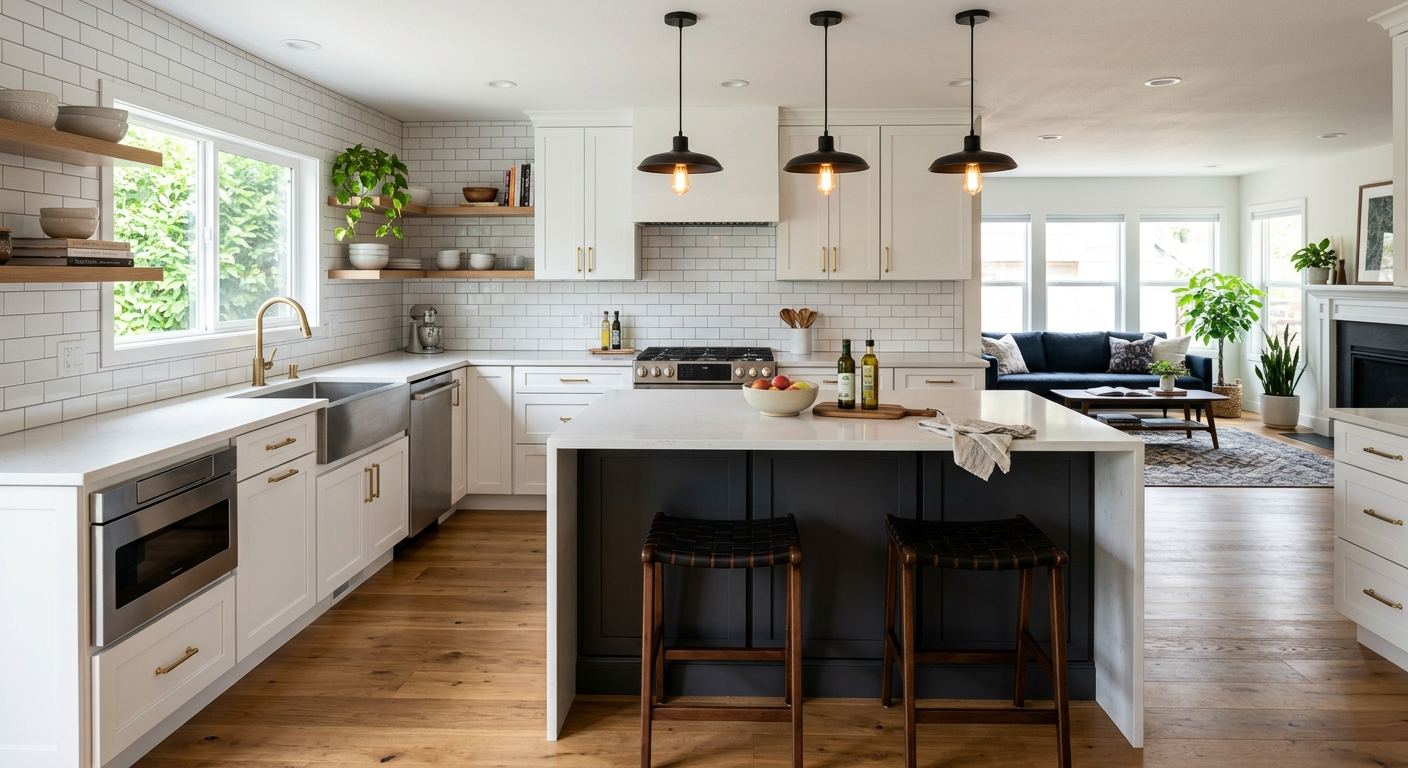
Kitchen renovation options and costs in Big Bend
In Big Bend, a kitchen renovation can range from a quick refresh to a full rebuild, and the total price usually follows what buyers in the Lower Mainland–Southwest expect for value and finish level. With a population of 1,651 (Statistics Canada, 2021 Census), the local market is smaller, so availability of specialty trades can affect scheduling when multiple homeowners renovate at the same time. Also, Big Bend sits in the broader Lower Mainland–Southwest where household budgets tend to support better finishes—so homeowners often choose upgrades that look “right” for resale, especially when the home is newer or in higher-value pockets.
Lower Mainland–Southwest pricing is driven more by home value, income, and planned finish tier than by climate. British Columbia’s marine conditions do matter for durability choices: coastal humidity can be tougher on wood finishes and cabinet hardware over time, and winter rain means floors and subfloors may need extra attention during demo. Still, contractor availability and material lead times play a bigger role than weather itself. In demand areas around Burnaby/Metrotown corridors (and nearby Lower Mainland neighbourhoods), kitchens tend to be booked first because designers and cabinet installers run fuller schedules.
Because of that, the same room size can price very differently: a cosmetic refresh can stay well below a mid-range full renovation, while premium cabinets and stone counters can quickly push toward the high-end full renovation band. Use the comparison below to anchor what you’re asking for, then we can narrow scope into a site-specific quote.
| Renovation Tier |
What's Included |
Typical Duration |
Price Range |
| Cosmetic refresh (paint, hardware, new appliances only) |
Cabinet paint or refinishing (if applicable), new pulls/handles, appliance swap, caulking/trim touch-ups, basic deep-clean and re-seal at the sink |
3–7 days |
$8,000–$20,000 |
| Mid-range full renovation (new cabinets, counters, sink, tile) |
New semi-custom cabinets, countertop replacement, sink and faucet, backsplash tile, flooring patching/refresh as needed, plumbing connections, basic lighting updates |
4–8 weeks |
$40,000–$75,000 |
| High-end full renovation (custom cabinets, stone counters, island) |
Fully custom millwork, stone counters (often quartz/stone), island build with added base/finish, upgraded hardware, more complex backsplash (feature treatment), expanded lighting plan |
8–16 weeks |
$80,000–$120,000 |
| Cabinet refacing only (new doors + drawer fronts, same boxes) |
New door/drawer fronts, new hinges/slides as upgraded, refinish cabinet interiors as agreed, new hardware, optional small trim updates |
2–5 weeks |
$8,000–$35,000 |
| Countertop swap only (laminate to quartz or stone) |
Remove/install new countertops, sink cut-out and reseal, backsplash edge updates (as required by material thickness), haul-away |
1–3 weeks |
$10,000–$20,000 |
| Backsplash tile installation only |
Surface prep, tile layout and install, grout/seal, minor wall patching, matching at outlets and seams |
3–7 days |
$1,500–$6,000 |
Prices are estimates only and vary by project scope, site access and material selection.
What affects the price of kitchen renovation in Big Bend
Homeowners in the Lower Mainland–Southwest often see kitchen renovation quotes swing by 30–50% for the same “basic” kitchen because the market values finish quality and resale-ready details. In higher-value areas across the Lower Mainland–Southwest, owners commonly move to quartz or stone counters, semi-custom cabinetry, and more design-led layouts (including islands and better lighting). Those choices push average project totals up even when the footprint is unchanged. In more modest markets, laminate and stock cabinets can dominate, keeping labour and material costs more controlled and improving ROI.
Two big drivers matter far more than climate: local home value and the typical finish tier homeowners are willing to pay for. In practice, if a household expects that the renovation cost can be recovered on resale, the decision often shifts to semi-custom or custom cabinetry and a countertop swap that lands in the mid-range full renovation band (for example, $40,000–$75,000) or higher when an island and better stone finishes are included. Layout changes are the wild card regardless of finish level: removing a wall, adding an island, or moving a gas line can change the cost more than choosing between upgraded hardware tiers.
Concrete examples I see in Big Bend: (1) Older, wood-framed homes can require extra subfloor prep after a sink cut-out and plumbing access are opened—this adds time even if you’re staying “mid-range.” (2) If you’re switching from laminate to quartz, the countertop thickness and support needs may require cabinet top adjustments; a mismatch can add labour. (3) Exterior-symptom moisture management matters too—marine humidity can stress finishes near the sink, so sealing and cabinet interior prep can prevent callbacks later. Then the project can move from countertop-only pricing toward the countertop installation and backsplash/tile bands quickly.
| Price Factor |
Why It Matters |
Cost Impact |
| Cabinet tier — stock vs. semi-custom vs. fully custom millwork |
Higher tiers use better box construction, tighter tolerances, upgraded hardware, and more fitting for unique layouts |
$10,000–$60,000 |
| Countertop material — laminate vs. quartz vs. granite vs. stone |
Material price, fabrication complexity, and support requirements change labour and installation time |
$3,000–$12,000 |
| Layout change — wall removal, island add, plumbing/gas move |
Creates new framing, new ducting/plumbing runs, longer trade coordination and inspection needs |
$5,000–$30,000+ |
| Appliance package tier — builder vs. mid-range vs. pro-grade |
Premium units can require different venting, electrical requirements, and sometimes different appliance sizing |
$2,500–$20,000 |
| Flooring — refinish existing vs. full replacement |
Subfloor condition after demo determines patch vs full replacement, and matching finishes can add cost |
$1,500–$12,000 |
| Backsplash — ceramic tile vs. marble vs. full-height slab |
Large-format and stone backsplashes require more precise prep, cutting and sealing |
$1,500–$6,000 |
| Electrical — new circuits for island, under-cabinet lighting |
Islands and upgraded lighting often mean additional circuits and permitted electrical work |
$800–$6,500 |
| Permit fees and licensed trade requirements |
Work that touches plumbing/gas/electrical may require permits, inspections, and coordination across trades |
$500–$5,000+ |
Permits & regulations in British Columbia
In British Columbia, a straightforward cabinet and countertop swap typically doesn’t require a permit. If you’re replacing cabinets with the same layout, swapping countertops, and installing a backsplash without moving plumbing or electrical, most projects fall under standard workmanship and building practice without separate permits. Where permits do enter the picture is when you alter the plumbing/gas/electrical systems, change structural elements, or require inspection-based sign-offs.
The work that typically requires permits and licensed trades includes: moving or modifying plumbing supply or drain lines; relocating or changing gas appliances (including work tied to the stove/range setup and certain hood venting arrangements); removing a load-bearing wall or making structural changes that affect support; and adding electrical circuits (for example, dedicated circuits for an island, under-cabinet lighting tied into new wiring, or adding receptacles to meet current requirements). Gas work must be performed by a licensed gas fitter, and electrical work must be done by a licensed electrician. Both usually require inspections after rough-in and/or completion, depending on the scope.
To verify a contractor in Big Bend, ask for three documents in writing: (1) a current licence (match the trade to the licence category), (2) liability insurance with the coverage amount visible, and (3) proof of coverage for workers (commonly WCB/clearance documentation, depending on the trade and contractor). Then confirm the contractor’s certificate of insurance and clearance letter match the legal name on the contract. Also, ensure the permit responsibility—if any—is clearly stated in the signed scope.
Cabinets, countertops and layout decisions in Big Bend
In Big Bend, the three biggest decisions that move your kitchen renovation price and long-term satisfaction are cabinet tier, countertop material, and layout changes. (1) Cabinet tier: stock is fastest and cheapest, semi-custom is the most popular mid-range option, and custom provides the best fit for odd wall dimensions and storage needs. (2) Countertop material: laminate is budget-friendly, quartz and natural stone are more durable and easier to maintain, while butcher block needs more care and marble needs extra sealing and cautious use. (3) Layout changes: opening a wall for flow, adding an island for work space, or relocating plumbing/gas can be worth it when it solves a functional problem—not just for aesthetics.
Because Lower Mainland–Southwest buyers often expect a clean, modern look, these choices typically track with resale expectations. If you’re staying near the mid-range band ($40,000–$75,000), semi-custom cabinets paired with quartz in a simple layout is a common “sweet spot.” Going into high-end territory ($80,000–$120,000) usually means custom millwork, a more substantial island, upgraded stone, and more complex backsplash and lighting.
Where the dollars really matter: for example, adding an island without moving plumbing/gas can cost far less than relocating lines. If you can design an island that uses existing supply/drain locations and existing electrical routing, you may keep the project closer to a mid-range full renovation. But if your island requires new plumbing runs or a gas-line adjustment, the labour and coordination often push the job toward the higher band even if cabinet and counter selections stay similar.
Finally, British Columbia’s marine humidity makes it especially important to address sink-area ventilation and proper sealing at the countertop edge. That’s a small line-item cost that helps cabinets and finishes last instead of “looking fine today, worn tomorrow.”
| Option |
Durability |
Maintenance |
Best For |
Price Range |
| Stock cabinets (big-box) |
Good day-to-day durability with less tailoring for corners/ceilings |
Minimal—just keep hardware tight and clean sealed surfaces |
Fast refresh, straightforward layouts, tighter budgets |
$8,000–$20,000 |
| Semi-custom cabinets (local dealer) |
Better fitting and construction; improved storage options |
Low—regular wipe-down; check hinges/slides seasonally |
Most Big Bend renovations aiming for resale-ready quality |
$20,000–$45,000 |
| Custom cabinets (local millwork shop) |
Highest durability with precise tolerances for unique spaces |
Low—same care as other cabinet finishes, plus better hardware access |
Complex layouts, perfect fit, premium resale finish |
$45,000–$80,000+ |
| Laminate countertop |
Resistant to everyday scratches but can be vulnerable at seams to water intrusion |
Wipe and keep edges sealed; avoid prolonged heat exposure |
Budget swaps and lower-commitment refreshes |
$3,000–$6,000 |
| Quartz engineered countertop |
Very durable and consistent; strong stain resistance for busy households |
Low—routine cleaner; best practice to reseal if any seams need it |
Busy kitchens wanting a “set-and-forget” surface |
$6,000–$10,000 |
| Granite / natural stone countertop |
Excellent durability; natural variation in pattern and hardness |
Moderate—periodic sealing recommended; protect from long-standing acidic spills |
Homeowners who want natural look and premium feel |
$8,000–$12,000 |
| Butcher block countertop |
Durable when maintained; can show dents if abused |
Higher—oil/condition regularly; keep dry around sink edges |
Warm, traditional style; families willing to maintain |
$4,000–$8,000 |
| Marble countertop |
Beautiful but softer than quartz; can scratch and etch |
High—frequent sealing and careful cleaning for acidic foods |
Low-traffic “show” kitchen or very careful households |
$10,000–$20,000+ |
How to choose a kitchen renovation contractor in Big Bend
Choosing the right contractor matters in Big Bend because kitchen renovations are coordination-heavy: cabinets, countertops, plumbing, electrical, flooring, and sometimes ventilation all overlap. Start by verifying British Columbia licensing for the trades involved. Ask for proof of licence for the contractor category that matches the work, and request liability insurance showing current coverage. For worker coverage, confirm their WCB/WCB clearance status via the documentation they provide—don’t rely on verbal assurances. When they give you a clearance letter, check it matches the legal business name and the address on the contract.
Next, get 2–3 itemised written quotes instead of a lump sum. The quote should break out labour and materials (cabinets by line item, countertop fabrication and install, demo/disposal, electrical/plumbing labour, and backsplash tile prep). Read the scope for what’s excluded: disposal, protection of floors during install, patching and painting, permit pulling (if needed), and whether light fixtures/fasteners are included or client-supplied. Also ask about warranty terms: workmanship warranty length, product/manufacturer warranty details, and whether warranties are transferable if you sell the home.
For payment, avoid large deposits. A common safe approach is to keep upfront payments to 10–15% and use a holdback until the job is substantially complete and you’ve confirmed punch-list items. Finally, insist on a written timeline with a start date, target completion, and how delays are handled (especially for cabinet and stone fabrication lead times). In British Columbia’s coastal climate, good contractors also build in extra care around subfloor drying and sealing near the sink.
- Confirm trade licences match the work (gas fitter, electrician, and any structural scope).
- Request a certificate of insurance (liability) and verify coverage amount before work starts.
- Ask for WCB/clearance documentation and confirm it matches the contractor’s legal name.
- Get an itemised quote: labour vs materials, and separate line items for demo, disposal, and installation.
- Check whether permits are included in the price or pulled separately.
- Verify electrical scope: island receptacles, under-cabinet lighting, and whether new circuits are included.
- Confirm plumbing scope: supply/drain changes, faucet/sink install responsibility, and resealing.
- Ask who protects flooring and how dust control is handled during demo and cabinet install.
- Clarify product selections and brands (cabinets, drawer slides, countertop brand/type, and tile specs).
- Confirm the backsplash approach (kerf cuts, edge returns, outlet finishing, grout type) in writing.
- Ask for workmanship warranty details and how to claim if something fails after handover.
- Use a payment schedule with minimal upfront and a holdback until punch-list completion.
Red flags I’ve seen with kitchen renovators in Big Bend: quotes that aren’t itemised (no breakdown of disposal, patching, or electrical/plumbing labour), refusal to provide insurance/licence proof, vague “allowances” for stone/cabinets without a price basis, schedules that ignore cabinet/stone lead times, and contracts that put permit responsibility on you without clarity.
Frequently asked questions — kitchen renovation in Big Bend
What's the best countertop material for a busy Big Bend kitchen?
For most busy households in Big Bend and across British Columbia, quartz is the practical “best overall.” It handles day-to-day cooking well, resists staining better than many natural stones, and usually keeps maintenance simple—important in a marine climate where moisture management at the sink area matters. Laminate can work for budget refreshes, but seam sealing is critical to prevent water issues over time. Natural stone like granite looks premium and durable, yet it typically needs periodic sealing and more mindful cleaning of acidic spills. If you want a realistic price anchor, countertop-only swaps often sit around the countertop installation band (for example $3,000–$12,000 depending on edge profiles and fabrication complexity), while the full kitchen picture changes once new cabinets and layout work are included.
How do I add an island to my Big Bend kitchen?
An island plan starts with two questions: can it be built “on existing services,” and does your layout improve work flow enough to justify the cost. If you’re able to position the island so it uses nearby plumbing/electrical routes, you can often keep the project closer to a mid-range full renovation. If the island requires new circuits for receptacles and under-cabinet lighting, and especially if it requires plumbing/gas relocation, the scope can shift upward quickly. In British Columbia, new electrical circuits typically require a licensed electrician and inspections, and any gas changes must be done by a licensed gas fitter. Expect the contractor to confirm measurements, cabinet base sizing, toe-kick and clearance requirements, and the countertop template timeline before ordering stone.
How much does a kitchen renovation cost in Big Bend?
In Big Bend, a kitchen renovation typically lands in one of the local price bands depending on how much you change. A cosmetic refresh with paint, hardware, and new appliances-only usually starts lower, while a mid-range full renovation (new cabinets and counters, sink, and tile) commonly falls around $40,000–$75,000. If you’re going all-in with custom cabinets, stone counters, and an island plus upgraded finishes, many homeowners target $80,000–$120,000. Cabinet refacing only can be a mid-cost path, and countertop swaps alone can be priced separately. Quotes vary because in the Lower Mainland–Southwest, finish tier and resale expectation influence selections as much as climate does. Site access, demo/disposal needs, and whether permits are required also affect the final number.
How long does a kitchen renovation take in Big Bend?
Timelines depend mainly on cabinet and stone lead times and how much trades coordination is required. In Big Bend, a cosmetic refresh is often a matter of days (about a week or less), while a mid-range full renovation is frequently scheduled around 4–8 weeks. If you add custom millwork, a stone island, or significant layout changes, plan for roughly 8–16 weeks. The reason is straightforward: demo and rough-ins may be quick, but cabinets and countertops have fabrication schedules that don’t “speed up” safely. If plumbing or electrical changes trigger inspections, that adds a step. A strong contractor will give you a start date, a completion target, and a written plan for delays—especially relevant in British Columbia where weather can affect drying/curing steps and access to exterior routes.
Quartz vs granite countertops — which is better?
“Better” depends on how you cook and how much maintenance you want. In most busy kitchens in British Columbia, quartz is often easier: it’s engineered for consistency, resists staining well, and generally needs less day-to-day care. Granite is extremely durable and can be stunning with natural variation, but it usually requires periodic sealing and more careful attention to acidic spills and long-standing moisture exposure. For Big Bend homeowners, the practical comparison is also about budgeting: countertop projects commonly fall within $3,000–$12,000 depending on material and complexity, and the full kitchen total moves based on whether you’re pairing the change with cabinet upgrades or layout work. If your sink area gets heavy use, quartz typically offers the most predictable experience.
Should I reface or replace my cabinets?
Refacing makes sense when the cabinet boxes are solid and square, the layout is staying the same, and you mainly want a new face look—doors, drawer fronts, and updated hardware. In Big Bend’s Lower Mainland–Southwest market, refacing is also attractive for homeowners who want a refresh without the disruption of full demolition. Replacing is better when the boxes are damaged, warped (sometimes from moisture near the sink), poorly built for today’s storage needs, or when you want changes in sizing and layout. A typical refacing-only range can run about $8,000–$35,000, while replacing cabinets inside a mid-range full renovation often pushes the project into the $40,000–$75,000 range depending on countertops, tile, and how much plumbing/electrical is adjusted. The right choice is determined by what you find after opening walls and checking the box condition during the first inspection.