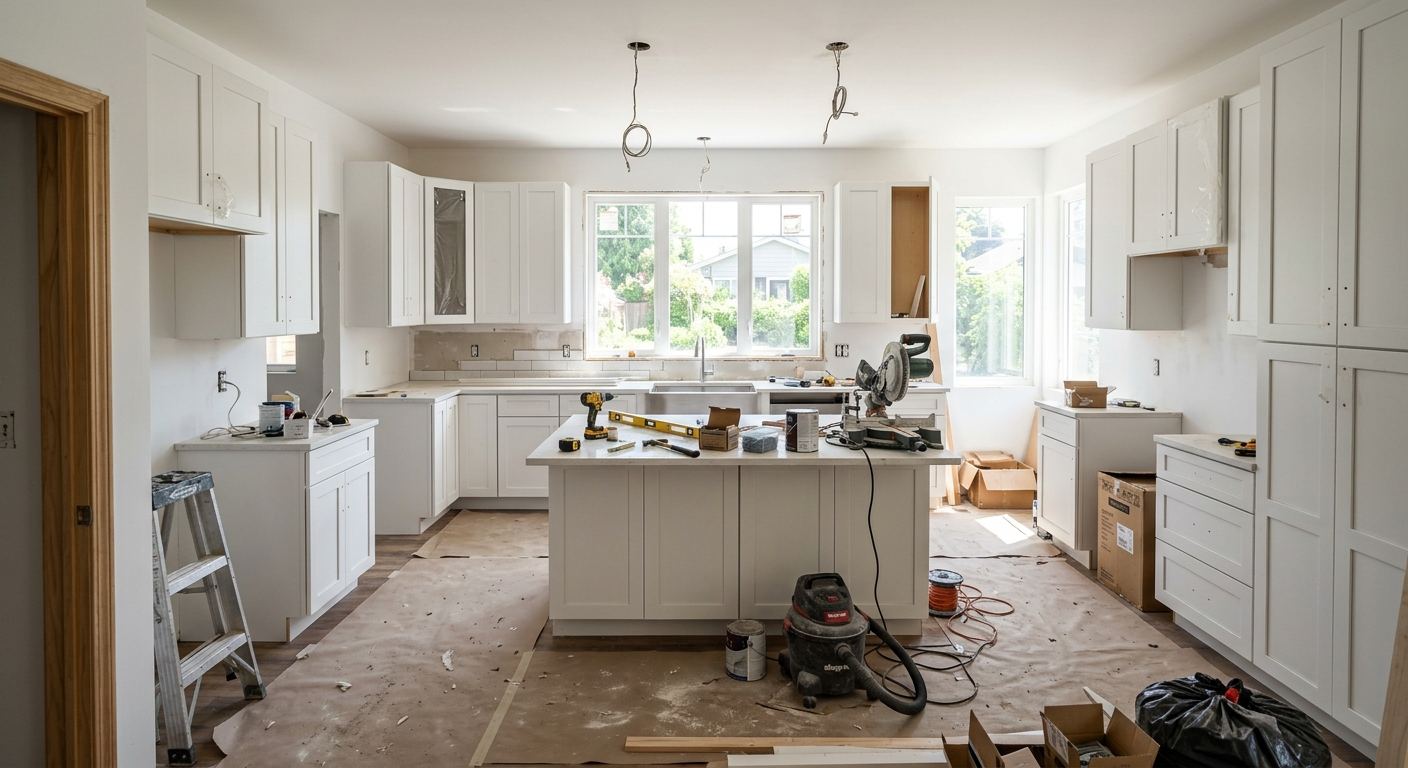
Kitchen renovation options and costs in Fairwinds
Fairwinds is a smaller community on Vancouver Island’s doorstep, but kitchen renovations still track the Lower Mainland–Southwest market—especially when homeowners plan for resale. With a population of 1,147 (Statistics Canada, 2021 Census), most local projects are owner-driven and scoped around how quickly the kitchen can be modernized without losing functionality. In practice, the finishes you choose tend to mirror what buyers in the broader Lower Mainland expect, because home values are what usually set the “finish ceiling.” The Lower Mainland–Southwest demand profile also means contractors often steer clients toward semi-custom or custom cabinetry and quartz/stone countertops when the goal is a more design-led result.
Climate matters too, but in this region it usually shows up indirectly: kitchens here experience humidity swings and coastal dampness, so moisture-tolerant cabinet products and durable surfaces are favored in long-term scopes. Availability is generally good for standard refreshes; however, full cabinetry and stone work can take longer due to lead times, templating, and scheduling. In Fairwinds, trade demand is often highest around family-oriented streets where buyers want practical storage upgrades and safer layouts for everyday use—especially in neighbourhood pockets with older, original 1990s–2000s housing stock.
Below are typical renovation tiers and what they usually include, so you can compare quotes apples-to-apples before you talk materials and layout changes.
| Renovation Tier |
What's Included |
Typical Duration |
Price Range |
| Cosmetic refresh (paint, hardware, new appliances only) |
Prep/paint, new pulls/handles, appliance swap, basic caulking and touch-ups |
1–3 weeks |
$12,000–$30,000 |
| Mid-range full renovation (new cabinets, counters, sink, tile) |
Semi-custom or stock cabinets, countertops, sink + faucet, backsplash tile, new flooring sections as needed |
4–8 weeks |
$40,000–$85,000 |
| High-end full renovation (custom cabinets, stone counters, island) |
Custom millwork, quartz or natural stone, island (often with upgraded lighting), extended backsplash, premium hardware |
8–16 weeks |
$85,000–$120,000 |
| Cabinet refacing only (new doors + drawer fronts, same boxes) |
Door/drawer replacement, new hardware, re-staining/finishing, optional new crown and filler panels |
2–5 weeks |
$8,000–$28,000 |
| Countertop swap only (laminate to quartz or stone) |
Remove laminate, template, fabricate/install new countertop, reconnect sink as required |
1–3 weeks (plus template time) |
$12,000–$35,000 |
| Backsplash tile installation only |
Remove/prepare surface, tile layout, waterproofing where required, grout/seal, finish trims |
5–10 days |
$1,500–$6,000 |
Prices are estimates only and vary by project scope, site access and material selection.
What affects the price of kitchen renovation in Fairwinds
In the Lower Mainland–Southwest, it’s common to see the same kitchen renovation come back with bids that differ by 30–50%. The biggest driver isn’t usually climate—it’s market expectations tied to local home values, household income, and the resale finish level buyers gravitate to in high-value neighbourhoods. When homeowners aim for a premium look, contractors price in semi-custom or custom cabinetry and quartz/stone counters because those finishes tend to be easier to justify at resale than “cheap looks” later. In more modest scopes, laminate counters and stock cabinets keep the budget anchored, even if the layout and workflow are improved.
Layout changes are the most unpredictable cost regardless of finish tier. Removing a wall, adding an island, or moving a gas line can require extra framing, service work, and inspection coordination. Even a countertop swap can become more expensive if the existing base is out of level, because the job quality depends on solid support.
Here are a few concrete Fairwinds examples of where cost commonly rises or falls. First, older cabinets in some homes may have non-standard opening sizes, so “easy” refacing can turn into filler rebuilding and a wider materials list. Second, if you’re upgrading from laminate to quartz, the installation may trigger more delicate sink/faucet detailing; expect the countertop swap to land near the $12,000–$35,000 band, but it can swing toward the higher end when templating reveals hidden base issues. Third, if you’re doing a mid-range full renovation in the $40,000–$85,000 range and want a layout shift, trade hours and coordination can push you out of that band faster than changing from semi-custom to custom would.
| Price Factor |
Why It Matters |
Cost Impact |
| Cabinet tier — stock vs. semi-custom vs. fully custom millwork |
Custom builds add time for design, fitting, and shop fabrication; stock is faster and standardized |
Can swing project totals by roughly 20%–40% |
| Countertop material — laminate vs. quartz vs. granite vs. stone |
Premium slabs need higher labour tolerance, heavier logistics, and more precise templating |
Often shifts countertop budgets by several thousand dollars |
| Layout change — wall removal, island add, plumbing/gas move |
Service rework (water, drain, gas) and structural considerations drive the biggest unknowns |
Can add 10%–30%+ depending on complexity |
| Appliance package tier — builder vs. mid-range vs. pro-grade |
Pro-grade often changes ventilation, rough-in clearances, and venting requirements |
Appliance selections can move costs by $3,000–$15,000 |
| Flooring — refinish existing vs. full replacement |
Removing cabinets can require floor corrections and surface prep for level transitions |
Typically adds $1,500–$8,000 depending on finish |
| Backsplash — ceramic tile vs. marble vs. full-height slab |
Higher-end materials require more precise layout and labour-intensive installs |
Can range from near-basic to premium within the $1,500–$6,000 band |
| Electrical — new circuits for island, under-cabinet lighting |
Adding circuits triggers licensed work, inspection, and longer scheduling |
Often adds $800–$4,000+ |
| Permit fees and licensed trade requirements |
Some changes require permits and inspections; missing this can derail timelines and budgets |
Varies, but can add coordination and schedule costs |
Permits & regulations in British Columbia
In British Columbia, not every kitchen change triggers a permit. A cabinet swap and a countertop replacement generally do not require a permit because they’re considered finish work. Likewise, a cosmetic refresh—paint, hardware, and appliance replacement (when done like-for-like)—typically doesn’t need permits. The permit and licensed-trade requirements show up when you change how services run through the home.
Work that typically does require permits and licensed trades includes relocating plumbing supply or drain lines, moving a gas line, removing a load-bearing wall (structural changes), or adding new electrical circuits (for example, island receptacles or under-cabinet lighting that requires new wiring). Gas work must be performed by a licensed gas fitter, and electrical work must be done by a licensed electrician—both require inspection before you close up walls and finalize finishes.
To verify a contractor before signing in Fairwinds, ask for (1) their licence number and trade registration details, (2) a certificate of insurance showing liability coverage, and (3) proof of worker coverage where applicable (WSIB/WCB clearance information). Then cross-check: confirm the licence on the appropriate provincial registry, review the certificate of insurance dates and coverage amounts, and ask for a clearance letter or evidence of coverage status. Put the responsibility for permits in writing so it’s clear who applies, pays, and schedules inspections.
Cabinets, countertops and layout decisions in Fairwinds
For a Fairwinds kitchen renovation, there are three decisions that most strongly determine both cost and long-term satisfaction: (1) cabinet tier, (2) countertop material, and (3) layout change. Cabinet tier drives speed and fit: stock cabinets are the fastest and cheapest, semi-custom is the most popular mid-range route because you get better sizes and options, and custom cabinets are the highest cost but deliver the best fit around irregular walls, vents, and awkward corners that older homes sometimes have. Countertops then change the “feel” of the kitchen—laminate and butcher block can look great on day one, while quartz, granite, and stone are chosen for durability and buyer-friendly maintenance expectations.
Layout changes are where value either gets created or budget gets burned. In the Lower Mainland–Southwest resale market, buyers often expect functional storage and a clear working triangle, plus a safer approach to traffic flow. That’s why wall removal or an island add only makes sense when the space gain is real (more prep room, better seating, or improved circulation). If you’re already tight on square footage, a full layout shift can cost more than it returns, particularly when it requires plumbing or gas relocation.
Climate-wise, Fairwinds homeowners benefit from selecting moisture-tolerant cabinet products and sealing strategies around sinks and backsplash areas. As a dollar example, upgrading from laminate counters to quartz often lands in the countertop-only band (around $12,000–$35,000)—but the price is well-justified when your existing cabinets are sound. Conversely, switching to custom cabinetry to “chase perfection” without addressing a cramped layout can push you toward the high-end renovation range ($85,000–$120,000) without improving day-to-day usability enough to match resale expectations.
| Option |
Durability |
Maintenance |
Best For |
Price Range |
| Stock cabinets (big-box) |
Good for standardized spacing; durability depends on box quality and hinges |
Low—normal cleaning; touch-ups may be needed on cut edges |
Fast refreshes where the layout is staying put |
$8,000–$25,000 |
| Semi-custom cabinets (local dealer) |
Consistent build quality with better sizing options and upgraded components |
Low; wipe-clean finishes and better hardware longevity |
Most Fairwinds renovations targeting strong day-to-day performance |
$20,000–$55,000 |
| Custom cabinets (local millwork shop) |
Highest fit and build quality; best for complex wall lines and storage systems |
Low; tailored finishes with fewer gaps and better alignment |
Premium look and maximum storage in a plan you’ll keep |
$40,000–$90,000 |
| Laminate countertop |
Moderate; edges can wear if not properly protected |
Easy daily care; avoid prolonged standing water at seams |
Budget-conscious refreshes |
$3,000–$8,000 |
| Quartz engineered countertop |
High durability; resists staining and typical kitchen wear |
Low—wipe clean; minimal sealing |
High-traffic kitchens and buyer-friendly finishes |
$6,000–$12,000 |
| Granite / natural stone countertop |
Very durable; strong heat resistance (varies by stone) |
Medium—periodic sealing recommended |
Homes aiming for a premium look with unique veining |
$7,000–$14,000 |
| Butcher block countertop |
Good but requires mindful care; surface can scratch with misuse |
Higher—oil/finish maintenance needed; protect from standing water |
Warm, traditional style and home cooks who maintain surfaces |
$4,500–$10,000 |
| Marble countertop |
Beautiful but softer; can etch/stain if not managed |
Higher—requires careful cleaning and protection |
Design-forward kitchens used more gently |
$8,000–$18,000 |
How to choose a kitchen renovation contractor in Fairwinds
Choosing a contractor in Fairwinds is mostly about proof: licences, insurance, itemized pricing, and a scope that matches what you want. In British Columbia, confirm the contractor’s trade licensing where applicable (general contractors may coordinate, but electrical and gas work must be performed by properly licensed trades). Ask for a certificate of liability insurance and verify it covers your project dates and risks. For worker coverage, request WSIB/WCB clearance documentation or evidence of coverage status—don’t rely on verbal assurances.
Next, get 2–3 written quotes that are itemized with a labour + materials breakdown rather than a single lump sum. Ensure they specify whether cabinet supply includes installation, whether countertops include template and sink cut-outs, and whether disposal/dump fees are included. Scope clarity prevents “change order” surprises mid-project, especially for older homes where removal may expose surprises (subfloor unevenness, outdated rough-ins, or missing shutoffs).
For warranty, ask for the workmanship warranty length (how long the contractor stands behind install quality) and separate it from manufacturer warranties on cabinets and countertops. Also ask whether the warranty is transferable if you sell.
Payment schedule matters: never allow more than about 10%–15% upfront. Use a holdback until key milestones are complete, like cabinet installation, countertop set, and final punch-list sign-off. Finally, require start date and completion estimate in writing so scheduling aligns with countertop lead times and any permit inspections.
- Ask for licence numbers and confirm they match the exact trade scope (especially electrical and gas).
- Request certificates of liability insurance and confirm coverage dates and limits.
- Get WSIB/WCB clearance evidence before work starts.
- Require 2–3 itemized quotes (labour and materials separated).
- Confirm disposal/dump fees and who hauls debris off-site.
- Clarify whether permits are included or excluded—and who applies.
- Check if plumbing/gas relocations are quoted as a line item, not rolled into “contingency.”
- Ask for start date, estimated completion, and a construction schedule or sequencing plan.
- Confirm countertop template timing and how delays are handled.
- Review warranty terms in writing for both workmanship and product.
- Use milestone payments; avoid large deposits.
- Require a final punch-list walkthrough and written sign-off.
In Fairwinds, red flags I commonly see include: no written scope or exclusions list, refusing to provide insurance/licence proof, quoting big-ticket items without specifying brand/models, only offering lump-sum pricing with no allowance breakdown, and demanding large upfront deposits beyond 10%–15% or skipping a documented holdback.
Frequently asked questions — kitchen renovation in Fairwinds
Should I reface or replace my cabinets?
If your cabinet boxes are structurally solid (sound frames, level floors, good hinge locations), refacing can be the smartest path in British Columbia because you avoid demolition of everything and keep timelines tighter. Refacing typically falls into the $8,000–$28,000 range, depending on door styles and hardware. Replace is usually the better choice when boxes are warped, water-damaged near the sink, or when you need meaningful storage changes like new corner systems, pantry sizing, or reconfiguring drawer layouts. In Fairwinds, I often see older kitchens where the boxes survive but the doors are dated—refacing delivers a fast “new kitchen” look while keeping disruption manageable. The risk is only if you’re refacing over boxes that aren’t square; that’s why a good contractor measures and confirms alignment before quoting.
Do I need a permit for a kitchen renovation in British Columbia?
In most cases in Fairwinds, a straight cabinet and countertop swap doesn’t require a permit. Same goes for a cosmetic refresh—painting, hardware, and like-for-like appliance replacements—because you’re not changing the building’s structure or services. Permits and licensed trades generally come into play when you move plumbing supply/drain lines, relocate gas lines, remove a load-bearing wall, or add new electrical circuits (like additional island receptacles or major lighting runs). Always confirm permit responsibility in your written contract—who applies, who pays, and who schedules inspections. If your scope includes gas or electrical work, the contractor should coordinate the trades and inspection timing; don’t assume those are “no-permit” tasks just because cabinets and countertops are finishing-only.
What's the ROI on a kitchen renovation?
ROI is usually strongest when the renovation matches what local buyers expect for the price point—clean lines, durable surfaces, and functional storage. In the Lower Mainland–Southwest, kitchens often sell as much for usability as for materials; that’s why quartz/stone counters and updated cabinet hardware tend to hold value better than short-lived surface-only upgrades. That said, ROI depends heavily on whether you keep the layout practical versus doing expensive plumbing/gas moves. A modest refresh can provide a noticeable lifestyle improvement, but a full renovation is typically where the buyer “wow factor” shows up. If you’re planning a mid-range full renovation, budgets commonly sit in the $40,000–$85,000 band, while high-end projects often reach $85,000–$120,000. If your plan targets resale, keep changes focused: upgrade what buyers see, and limit structural/service moves unless the space gain is meaningful.
How do I budget for a kitchen renovation?
Start by choosing your renovation tier, then budget for the “unknowns” that show up during demo. In Fairwinds and across British Columbia, even well-planned projects can reveal uneven floors, older rough-ins, or mismatched opening sizes—especially in homes with dated cabinet installations. For budgeting, I recommend anchoring to price bands: a cabinet refacing may land around $8,000–$28,000, a countertop-only swap can fall near $12,000–$35,000, and full renovations commonly range from $40,000–$120,000 depending on cabinetry and counter material. Then add a contingency line item for site conditions and finishing adjustments. Finally, don’t forget the extras homeowners miss: disposal, upgraded electrical requirements, new under-cabinet lighting, and any flooring work needed after cabinet removal.
Can I move my kitchen sink or stove?
Yes, but expect it to cost more and require licensed work in British Columbia. Moving a sink typically involves changing plumbing supply and drain lines, which triggers permitting and inspection for much of the “services relocation” portion. Moving a stove can involve gas line relocation if you have gas; that must be done by a licensed gas fitter with inspections. Even when the cabinet layout looks easy on paper, the real cost depends on how far the services must travel and whether soffits/walls need to be opened and rebuilt. If you want better workflow, I often recommend a “minimal-move” strategy first—reorienting within the existing plumbing footprint or improving storage and lighting—then only relocate services if the layout improvement is substantial.
What's the most cost-effective kitchen upgrade?
The most cost-effective upgrade is usually one that upgrades visual impact and functionality without triggering major service work. In Fairwinds, homeowners often get the best bang-for-buck from a cabinet refacing plus updated hardware, especially when the boxes are sound—commonly around $8,000–$28,000. Another strong option is a countertop swap from laminate to quartz/stone if your cabinet bases are level; that typically fits the $12,000–$35,000 countertop-only band and refreshes the whole room instantly. Backsplash tile installation can also deliver high visual payoff for relatively lower cost (often $1,500–$6,000 depending on scope). If you’re considering moving plumbing/gas, that’s rarely the “most cost-effective” route—save it for when the layout change clearly fixes a workflow problem rather than purely chasing a trend.