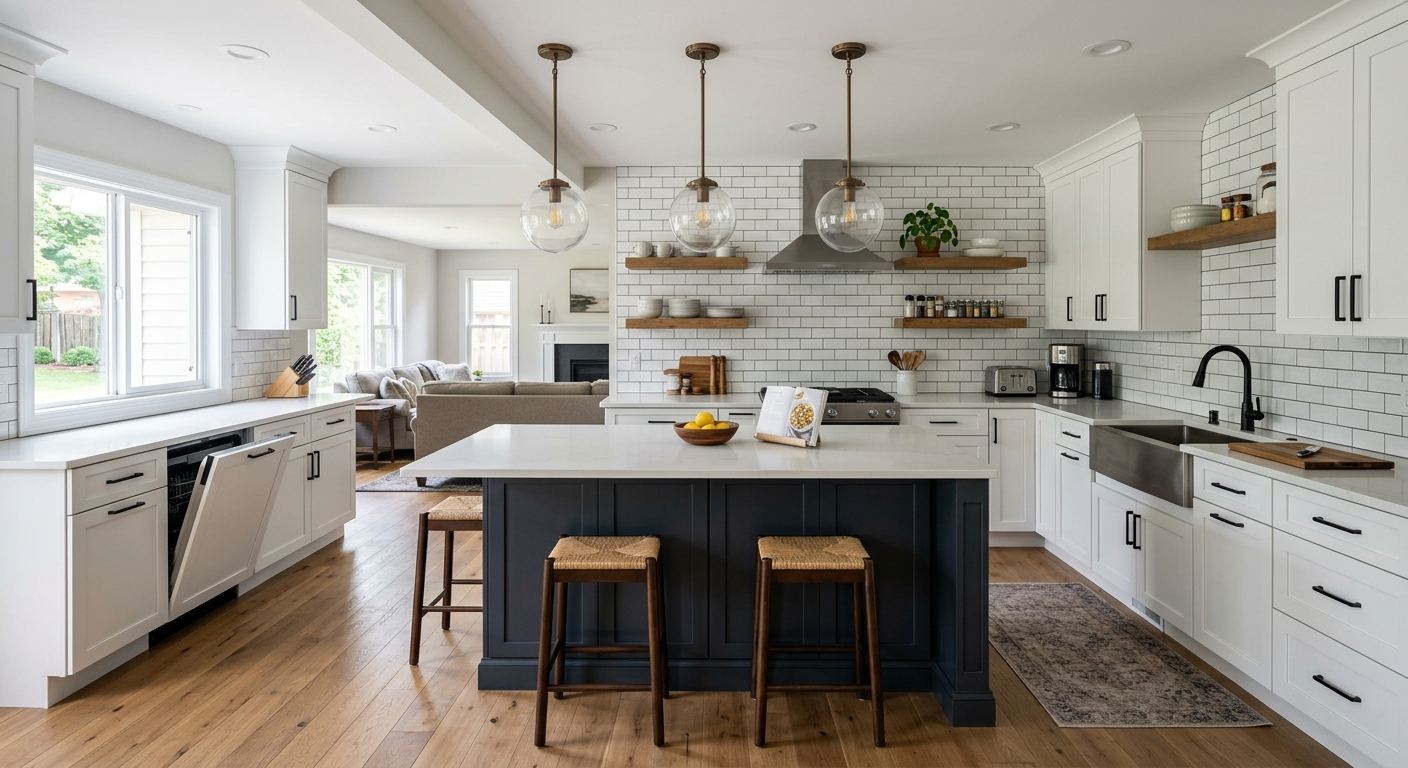
Kitchen renovation options and costs in Garden Village
In Garden Village, British Columbia, kitchen renovation costs tend to track the finish level and how custom the work needs to be—more than the weather itself. With a population of 10,087 (Statistics Canada, 2021 Census), this part of the Lower Mainland–Southwest is close enough to the Vancouver market that many homeowners plan upgrades with resale expectations in mind. Even when project size stays similar, choices like semi-custom cabinetry and quartz or stone counters can quickly move the budget into the higher bands because buyers in the region commonly expect a more “designer” look.
Market pressures here are also tied to household purchasing power. In practical terms, higher-value Lower Mainland homes often justify durable surfaces and better millwork because the renovation cost is easier to recover when the finish matches what buyers want. Labour availability in Surrey/Abbotsford and along the broader Metro Vancouver corridor can also affect pricing—crews get booked faster when multiple trades are needed at once (cabinet installs, countertop templating, electrical, and tile).
In Garden Village specifically, you’ll often see two patterns: (1) a cosmetic refresh for homeowners who want faster, lower-disruption changes, and (2) full remodels where layout improvements and upgraded materials are prioritized. The city’s housing stock includes plenty of older kitchens, where opening walls, updating plumbing, and replacing worn flooring can add unpredictability even if the final style is simple. Use the tiers below to compare realistic options before you talk to a contractor.
| Renovation Tier |
What's Included |
Typical Duration |
Price Range |
| Cosmetic refresh (paint, hardware, new appliances only) |
Cabinet repaint or reface-ready prep, new hardware/handles, new appliances (no cabinet changes), minor touch-ups |
1–2 weeks |
$8,000–$22,000 |
| Mid-range full renovation (new cabinets, counters, sink, tile) |
New semi-custom/selected cabinets, new counters, new sink & faucet, backsplash tile, under-cabinet lighting hookup (if included), updated flooring where specified |
4–7 weeks |
$40,000–$85,000 |
| High-end full renovation (custom cabinets, stone counters, island) |
Fully custom cabinetry, stone counters (quartz/stone), island build with upgraded hardware, full-height/statement backsplash, expanded lighting, coordinated trade work |
8–14 weeks |
$85,000–$120,000 |
| Cabinet refacing only (new doors + drawer fronts, same boxes) |
Door/drawer-front replacement, veneer/finish on existing boxes, new hardware, re-install and alignment adjustments |
1–3 weeks |
$8,000–$35,000 |
| Countertop swap only (laminate to quartz or stone) |
Demolition and disposal of old top, templating, install of quartz/stone, sink cut-out adjustments (if required), basic caulking/sealing |
1–2 weeks (plus templating lead time) |
$3,000–$12,000 |
| Backsplash tile installation only |
Tile supply and install, waterproofing/adhesive where needed, caulking at countertop edges |
3–7 days |
$1,500–$6,000 |
Prices are estimates only and vary by project scope, site access and material selection.
What affects the price of kitchen renovation in Garden Village
In the Lower Mainland–Southwest, quotes for the “same” kitchen can land 30–50% apart when owners choose different finish tiers, cabinetry complexity, or whether the plan includes layout moves. Across British Columbia, the biggest driver isn’t typically climate—it’s the combination of local home value expectations and how complex the cabinetry and trade coordination become. In higher-value Metro Vancouver settings within the region, homeowners often default to quartz or stone counters and semi-custom cabinetry because it aligns with how the renovation is marketed on resale. In more modest scopes, laminate surfaces and stock cabinets dominate because they offer strong value per square foot.
Layout changes are the most unpredictable cost regardless of finish. Removing a wall for an open-concept feel, adding an island, or relocating a gas line/plumbing tends to add labour, inspection requirements, and sometimes subfloor repair—so the “mid-range” plan can quickly drift toward full-renovation totals. Even a small plumbing move can change the schedule because countertop templating, cabinet install, and inspections need to line up.
For Garden Village homes, a few concrete situations regularly raise or lower cost: (1) older ducting or outdated rough-in behind tile walls can make demolition messier than expected, pushing projects toward the mid-range full renovation band (for example, $40,000–$85,000). (2) If your layout already supports an island without major rerouting, you may stay closer to the $8,000–$50,000 cabinet-and-reface-related range; but if you need new circuits and a gas adjustment, costs can jump rapidly. (3) Flooring condition matters—if subfloors are uneven, tile upgrades are not just a surface decision; they can require leveling and additional prep.
Use the cost bands as a starting point, then align your choices with resale expectations and the realities of your existing walls and services.
| Price Factor |
Why It Matters |
Cost Impact |
| Cabinet tier — stock vs. semi-custom vs. fully custom millwork |
Custom parts, tighter tolerances, and made-to-fit framing add time and material. |
Typically +$10,000 to +$40,000 depending on scope |
| Countertop material — laminate vs. quartz vs. granite vs. stone |
Material cost plus templating/installation complexity varies widely. |
Laminate-to-quartz often +$3,000 to +$8,000; stone can add more |
| Layout change — wall removal, island add, plumbing/gas move |
Rough-in, inspections, and structural/joist considerations drive labour and risk. |
Commonly +$8,000 to +$25,000 (sometimes more) |
| Appliance package tier — builder vs. mid-range vs. pro-grade |
Dimensions, power requirements, and finish matching affect installation time. |
Often +$2,000 to +$15,000 across tiers |
| Flooring — refinish existing vs. full replacement |
Hidden damage behind cabinets/tile can require prep, underlayment, or subfloor work. |
May swing +$3,000 to +$12,000 |
| Backsplash — ceramic tile vs. marble vs. full-height slab |
Material and labour intensity increase with large-format and full-height installs. |
Usually +$1,000 to +$5,000+ |
| Electrical — new circuits for island, under-cabinet lighting |
Additional wiring, permits, and licensed electrical work add both cost and schedule. |
Commonly +$1,500 to +$8,000 |
| Permit fees and licensed trade requirements |
When scope triggers permits, you pay for admin and trade compliance, not just labour. |
Often +$500 to +$4,000, plus trade timing impacts |
Permits & regulations in British Columbia
In British Columbia, not every kitchen update needs a permit. Cabinet and countertop swaps—when you are not moving plumbing, gas, or major electrical—typically do not require permits. Likewise, replacing an existing backsplash with tile often falls under non-structural finishing work. However, permits and licensed trade involvement are commonly required when you change the “systems,” not just the surfaces.
Work that typically does require a permit includes: relocating plumbing supply or drain lines (for example, moving a sink to a new cabinet run), moving or adding a gas line for a stove/range, relocating a gas range and/or making changes that affect the ventilation and gas connection, removing a load-bearing wall or making structural changes, and adding electrical circuits (such as dedicated island receptacles, under-cabinet lighting changes that require new runs, or upgrading service where needed). Gas work must be done by a licensed gas fitter; electrical must be done by a licensed electrician; both require inspections when permits are involved.
To verify a contractor in Garden Village, homeowners should: (1) ask for the contractor’s British Columbia licence details for the applicable trade scope; (2) request a certificate of insurance (liability) showing the contractor’s active coverage; (3) confirm the coverage for workers—commonly WCB/clearance documentation—before work starts; (4) review the contract for who pulls permits and who pays; and (5) verify any permit numbers/inspection schedule after the rough-in stage.
When you sign, ensure the written contract clearly states permit responsibility, inspection responsibility, and what you are paying for versus what the contractor is covering.
Cabinets, countertops and layout decisions in Garden Village
In Garden Village, three decisions usually determine 80% of your kitchen budget outcome: (1) cabinet tier, (2) countertop material, and (3) whether you change the layout. Cabinet tier matters because it directly affects lead time, fit, and how smoothly the project lands on your walls and existing framing. Stock cabinets are fastest and typically cheapest; semi-custom is the most popular mid-range choice because you get better sizing options without fully custom pricing. Custom cabinets deliver the tightest fit and best storage planning, but they escalate cost and scheduling.
Countertop material is similar: laminate is the lowest-cost option but it’s not as heat- or scratch-tolerant as engineered stone. Quartz is a strong middle ground: it looks premium, resists staining better than many natural options, and usually lands in the countertop installation band of about $3,000–$12,000 depending on size and features. Granite/natural stone adds visual drama but can require more careful sealing and templating. If you’re considering marble, plan for a more delicate maintenance routine.
Layout changes are where value can be justified. If adding an island creates real circulation and additional seating, buyers often perceive it as a lifestyle upgrade—especially in the Lower Mainland–Southwest resale market where open, functional planning sells. That said, if the island requires major plumbing/gas rerouting, the cost jump can outweigh the gain. For example, a countertop swap only may fit the $3,000–$12,000 range, but moving plumbing or gas for a new position can push you toward the full renovation budget band ($40,000–$120,000). A practical approach is to measure circulation first, then confirm whether services can be reused.
Humidity and coastal moisture are a fact of life in the region, so proper ventilation and cabinetry detailing (including sealing at vulnerable edges) help materials last longer in day-to-day use.
| Option |
Durability |
Maintenance |
Best For |
Price Range |
| Stock cabinets (big-box) |
Good for light-to-normal wear; limited sizing can leave awkward gaps. |
Low to moderate; wipe clean and adjust hardware as needed. |
Fast refreshes and tight budgets |
$8,000–$20,000 |
| Semi-custom cabinets (local dealer) |
Very durable with better sizing and stronger construction options. |
Low; keep hinges aligned and control moisture near sinks. |
Most Garden Village remodels seeking best value |
$20,000–$45,000 |
| Custom cabinets (local millwork shop) |
Highest fit and finish; optimized storage and specialty features. |
Low; premium finishes can show damage if abused but are repairable. |
Reconfiguring layout and maximizing storage |
$45,000–$80,000 |
| Laminate countertop |
Solid for daily use; seams and edges need careful protection. |
Wipe spills; use trivets to reduce heat/impact risk. |
Budget-focused renovations and rental-like timelines |
$3,000–$6,000 |
| Quartz engineered countertop |
Highly durable; strong resistance to staining and everyday wear. |
Low; avoid abrasive pads and excessive heat exposure. |
Homeowners aiming for premium look with practical care |
$6,000–$11,000 |
| Granite / natural stone countertop |
Very durable with unique patterns; performance depends on stone selection. |
Moderate; sealing maintenance may be needed depending on product. |
Premium aesthetics and traditional stone character |
$7,000–$12,000 |
| Butcher block countertop |
Durable when maintained; can be vulnerable at sink edges. |
Higher maintenance—regular oiling and dry-protecting edges. |
Warm, family-friendly kitchens with a bit more upkeep |
$5,000–$10,000 |
| Marble countertop |
Beautiful but softer; can etch with acidic spills. |
Higher care—clean promptly and use protective routines. |
Statement kitchens where aesthetics matter most |
$8,000–$12,000 |
How to choose a kitchen renovation contractor in Garden Village
Choosing the right kitchen renovation contractor in Garden Village starts with verifying credentials before you compare design ideas. In British Columbia, confirm the contractor’s licensing for the scope you’re purchasing, request a certificate of liability insurance, and verify workers’ coverage documentation (WCB/WCB clearance if applicable). You can typically cross-check licensing details using the appropriate provincial online tools and validate insurance by requesting an up-to-date certificate naming your project/contractor as the insured party.
Next, get 2–3 itemised written quotes instead of one lump-sum number. The quote should separate labour and materials (cabinet supply, countertop install/templating, tile, electrical and plumbing labour, demolition, disposal, and any drywall/paint). Ask whether permits are included and who is responsible for pulling them. Also confirm exclusions: what happens if they discover old water damage behind the sink wall, or if the subfloor is uneven?
Warranty clarity matters in kitchen renos. Look for a workmanship warranty length stated in writing and confirm whether product/manufacturer warranties apply to the installed parts and whether they’re transferable. For payment, avoid paying more than 10–15% upfront; hold back a portion until key milestones are complete (for example, after rough-in inspections and after cabinet/counter installs are done). Get the timeline in writing—start date, material lead times, and completion estimate—so you can plan around countertop templating and trade scheduling.
- Ask for the contractor’s licence and the specific trade roles on your project.
- Request a current certificate of liability insurance and review dates.
- Confirm WCB/clearance documentation before work begins.
- Require itemised labour/materials pricing (no vague “allowances” only).
- Confirm whether permits, inspection fees, and inspections are included.
- Clarify disposal and dump fees (and whether they haul demolition debris).
- Verify cabinet lead times and countertop templating scheduling.
- Insist on a written scope for electrical/plumbing changes and responsibilities.
- Check workmanship warranty coverage and start/end dates.
- Review payment schedule and keep a holdback until completion.
- Ask who handles change orders and how they’re priced (rate card or unit rates).
- Confirm protection measures for floors/doorways during demolition and install.
In Garden Village, a few red flags I see repeatedly: contractors who won’t provide insurance or proof of coverage, quotes that only show a single lump sum with no breakdown, “permit included” claims without written responsibility for licensed work, pressure to pay most of the balance upfront, and timelines that ignore countertop templating lead times.
Frequently asked questions — kitchen renovation in Garden Village
Custom vs stock cabinets — is custom worth it?
In Garden Village (and across the Lower Mainland–Southwest), custom cabinets can be worth it when you’re solving a real fit or storage problem: an odd corner, a legacy layout that needs better pantry pull-outs, or a kitchen that will include an island with specialty drawers. If your plan is more straightforward, stock cabinets are often a sensible path because you get speed and cost control—especially for a refresh where cabinet boxes already align well. The “worth it” question usually becomes: are you paying for efficiency, not just aesthetics. A mid-range project in this region commonly lands around $40,000–$85,000 when you’re doing a full update with upgraded cabinets and counters, while more custom-heavy builds often push toward the higher end. A practical contractor will also tell you early if your walls are out of square; custom helps hide less-perfect existing framing.
How do I choose a kitchen contractor in Garden Village?
Start with credentials and proof, then move to the quote quality. For British Columbia, ask for the contractor’s licensing (as it applies to the trades they manage), a current certificate of liability insurance, and workers’ coverage documentation. Next, request 2–3 itemised quotes so you can compare labour and materials line-by-line—especially cabinets, countertop templating/installation, tile, electrical and plumbing scope, and demolition/disposal. Your contract should clearly state who pulls permits if you’re moving plumbing supply/drain, relocating gas, removing a load-bearing wall, or adding electrical circuits. Prices can vary widely for similar work across the Lower Mainland–Southwest, so you want scope clarity. A good sign is a contractor who can explain how your specific kitchen will stage work to protect countertop templating and inspection timing. The goal is fewer surprises, not just a lower number.
What order do kitchen renovation steps happen in?
Typically in Garden Village, the workflow starts with measurement and detailed layout finalization, then demolition and rough-in work. If you’re changing plumbing or gas lines or adding electrical circuits, rough-in and permit inspections need to happen before cabinets and counters go in. After approvals, the contractor installs cabinets (after wall prep and leveling), then proceeds to countertop templating and installation. Flooring tie-ins usually happen around cabinet install—sometimes flooring is done before cabinets if your plan uses a full replacement. Tile/backsplash comes after countertop edges are set (so you get a clean line at the countertop), then paint and final hardware adjustments follow. This staging matters because quartz and stone counters require accurate templating and lead time; if timelines slip, you can stall multiple trades. A well-run remodel keeps cabinet install, inspections, and countertop templating aligned.
Can I live at home during a kitchen renovation in Garden Village?
Many homeowners in British Columbia choose to stay in their home, especially if the project is a shorter cosmetic refresh or a countertop-only change. A cosmetic refresh (paint/hardware/new appliances only) might take about 1–2 weeks, and a countertop swap can often fit into a similar install window once templating is done. However, full renovations with cabinet removal and tile work can disrupt water access and create dust, so you may need an alternate setup. Contractors in the Lower Mainland typically plan a temporary kitchen area (microwave, kettle, and a safe food prep zone) and protect floors/doorways. If you’re moving a sink, rerouting plumbing, or adding electrical circuits, it can be harder to maintain full function during rough-in and inspection stages. If you do stay, ask your contractor how they’ll handle dust control, debris hauling, and whether there’s a clear “water-off” window. The most important point is confirming the schedule and protection measures in writing.
Should I renovate my kitchen before selling in Garden Village?
Often yes—but it depends on your current kitchen condition and your intended buyer segment. In the Lower Mainland–Southwest, many buyers respond quickly to kitchens that look updated: modern cabinet fronts, durable counters, clean backsplash lines, and functional lighting. If your kitchen is dated but structurally sound, a mid-range full renovation can make sense because it upgrades the look without taking on the highest complexity. For example, you can typically plan a mid-range full renovation around $40,000–$85,000. If the home’s finishes are already close to market expectations, a smaller step (like a backsplash-only install or countertop swap) can help avoid overspending—especially when the layout doesn’t need changes. But if you’re considering major layout moves or gas/plumbing relocation, be sure the cost is justified by the space gain. Also note local housing stock: older basements and original framing can mean hidden prep work, so choose a scope that won’t balloon right before you list.
What's the most popular kitchen style in Garden Village right now?
Right now, the most common style direction you’ll see in Garden Village and the broader Lower Mainland–Southwest is a clean, modern-transitional look: shaker-style cabinet doors, warm neutrals, and quartz or stone counters that read as bright and premium under natural and task lighting. The popularity isn’t just aesthetic—these finishes also photograph well for listings and hold up to day-to-day use in the region’s coastal moisture swings when properly ventilated. Many homeowners choose semi-custom cabinet tiers for better sizing and smoother lines, then pair them with quartz to keep maintenance simple. On pricing, that combination often fits within typical kitchen renovation bands—mid-range full renos usually land in the $40,000–$85,000 range depending on whether you add an island, upgrade tile, and change electrical or plumbing. Full custom builds with statement islands and stone can push toward the higher totals. A good contractor will help you pick finishes that still feel “current” two or three listing cycles from now.