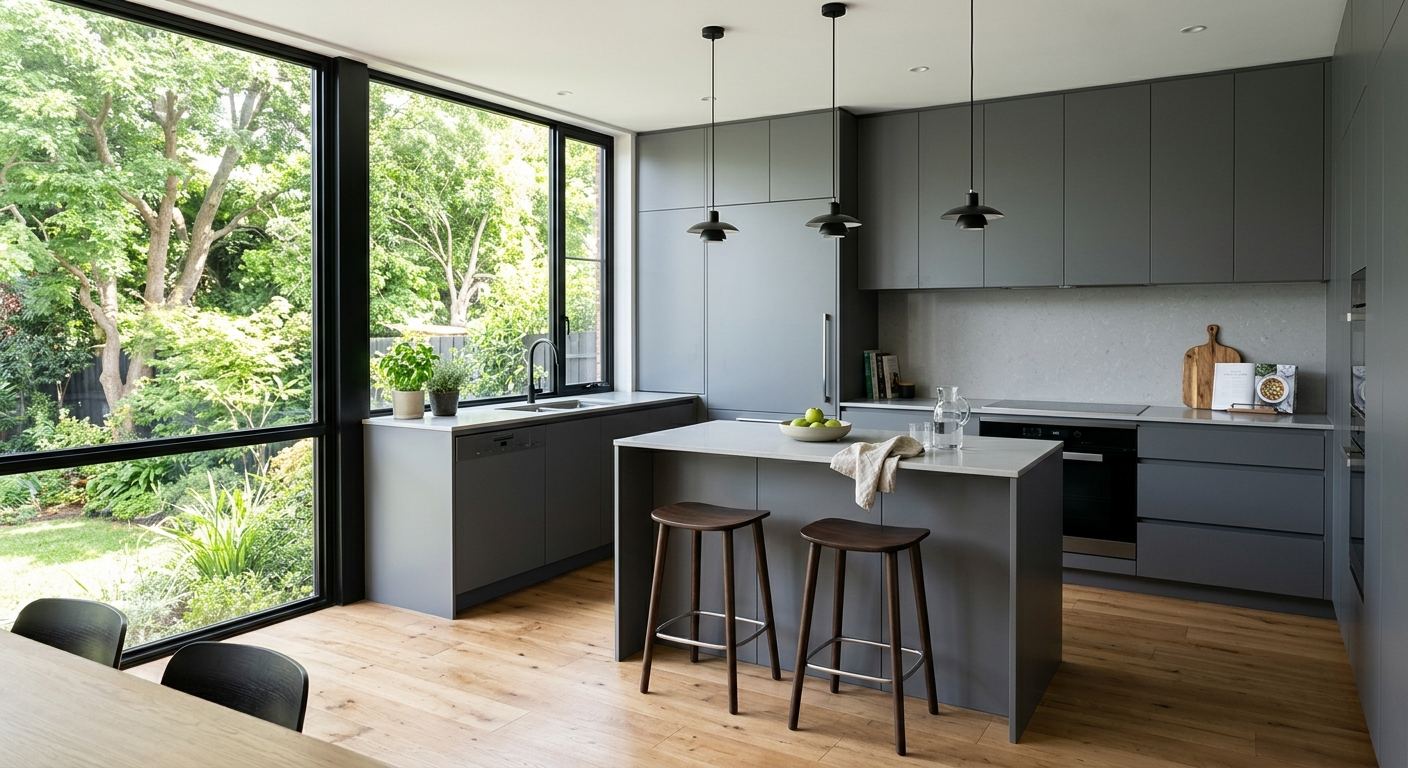
Kitchen renovation options and costs in Kimberley
In Kimberley, British Columbia, kitchen renovation costs tend to track your home’s market expectations and the quality of finishes buyers want, more than they track weather. With a median household income of $81,000 (Statistics Canada, 2021 Census), most homeowners gravitate toward a refresh-to-mid-range approach: updated cabinets and counters that look current but don’t trigger a full custom build. Kimberley’s housing stock is also older—69.1% of homes were built before 1981 (Statistics Canada, 2021 Census)—so many renovations include changes to aging wiring, aging shutoffs, or dated door styles, even when the visible scope looks “cosmetic.”
On the Kootenay side, contractor availability and the small-batch nature of trades work can influence turnaround times and labour premiums. You’ll also see higher pricing when a job requires careful dust control, snowbird-style scheduling, or multiple site visits for material ordering—especially in areas like the Kimberley neighbourhoods around downtown core and Cranbrook Road, where many homes are compact and access is tight.
That said, British Columbia quotes can still swing widely—because the same kitchen can be built as a laminate-and-stock-cabinet refresh or a quartz-and-custom-island centerpiece. Use the table below to compare the typical bundle costs by renovation tier, and then we’ll break down the specific price drivers that explain most of the differences.
| Renovation Tier |
What's Included |
Typical Duration |
Price Range |
| Cosmetic refresh (paint, hardware, new appliances only) |
Cabinet paint or refinish (no cabinet box changes), new hardware, new/updated appliances, basic caulking and touch-ups |
1–3 weeks |
$5,000–$15,000 |
| Mid-range full renovation (new cabinets, counters, sink, tile) |
Semi-custom or stock cabinets, laminate or entry quartz counters, new sink and faucet, backsplash tile, updated lighting over main work areas |
4–8 weeks |
$30,000–$50,000 |
| High-end full renovation (custom cabinets, stone counters, island) |
Fully custom cabinetry, premium quartz or natural stone (granite/stone), island or peninsula with upgraded hardware, more extensive backsplash (often to slab height), upgraded electrical/lighting |
8–14 weeks |
$55,000–$70,000 |
| Cabinet refacing only (new doors + drawer fronts, same boxes) |
New door/drawer fronts, new veneer and edges where needed, hardware upgrade, repaint/repair minor damage; counters and tile typically unchanged |
2–5 weeks |
$8,000–$22,000 |
| Countertop swap only (laminate to quartz or stone) |
Removal and reinstall of counters, backsplash skim or light reset, undermount sink re-fit where applicable |
1–3 weeks |
$6,000–$16,000 |
| Backsplash tile installation only |
Tile supply and install for standard backsplash area, edging, caulking and finishing around outlets |
5–10 business days |
$1,200–$5,000 |
Prices are estimates only and vary by project scope, site access and material selection.
What affects the price of kitchen renovation in Kimberley
In Kootenay and across British Columbia, you can see the same kitchen concept priced 30–50% apart, even when the “measured” square footage is similar. The biggest reason is that homeowners don’t select finishes the same way: local home values and household income push many buyers toward either a refresh-to-mid-range tier or a premium, more resale-oriented tier. In higher-value markets, quartz or natural stone and semi-custom cabinetry are common because owners expect the upgrade to carry forward at resale. In more modest markets, laminate counters and stock cabinets are frequently the better ROI choice. Climate plays a smaller role in determining price tier, but it affects execution—hot/cold swings in older homes can influence how materials are acclimated and how carefully we manage caulking and sealing near exterior walls.
In Kimberley, layout and service work creates unpredictable cost regardless of finish level. For example: (1) removing a wall to open the kitchen can add structural engineering and more framing labour; (2) adding an island often means new electrical and, if you’re relocating plumbing, additional drain and supply lines; (3) older pre-1981 homes commonly have outdated supply valves, knob-and-tube remnants, or undersized venting—so even “appliance-only” upgrades can uncover work that wasn’t visible at the initial walkthrough.
Practically, that’s why a mid-range full renovation in the $30,000–$50,000 band can climb toward the upper side when you add layout changes, while a cabinet/refacing project in the $8,000–$22,000 range stays steadier when boxes are sound and you avoid plumbing moves. In a climate with cold winters and rapid shoulder-season temperature changes, proper sealing around exterior-facing countertop seams and tile edges also matters for call-backs, especially in kitchens that sit against outside walls.
| Price Factor |
Why It Matters |
Cost Impact |
| Cabinet tier — stock vs. semi-custom vs. fully custom millwork |
Different lead times, hardware quality, door styles, and build precision change both material and labour |
Often the largest swing: roughly +$10,000 to +$25,000 between tiers |
| Countertop material — laminate vs. quartz vs. granite vs. stone |
Material cost, fabrication method, edge profiles, and waste/templating affect price |
Can shift total by several thousand dollars (commonly +$2,500 to +$12,000) |
| Layout change — wall removal, island add, plumbing/gas move |
Engineering, framing, and service rework add trades and inspection steps |
Typically +$5,000 to +$20,000 depending on what’s moved |
| Appliance package tier — builder vs. mid-range vs. pro-grade |
Ventilation requirements, install complexity, and fit/finish tolerances drive labour |
Often +$1,500 to +$8,000 across the appliance set |
| Flooring — refinish existing vs. full replacement |
Existing floor condition determines prep labour; uneven subfloors raise installation time |
Can add +$1,000 to +$6,000 |
| Backsplash — ceramic tile vs. marble vs. full-height slab |
Pattern matching, stone setting complexity, and higher coverage area increase labour and material |
Ranges from modest (+$1,200) to premium (+$4,000+) |
| Electrical — new circuits for island, under-cabinet lighting |
Licensed electrician time and inspection requirements govern cost |
Commonly +$800 to +$4,000 |
| Permit fees and licensed trade requirements |
Permits affect administrative time; licensed trades may require separate scheduling |
Often +$500 to +$3,000 and can affect timeline |
Permits & regulations in British Columbia
In British Columbia, many straightforward kitchen updates do not require a permit—cabinet swaps, countertop replacements, and typical backsplash installs generally fall under “like-for-like” work. However, once you move services, change the building’s structure, or add new electrical work, permits and licensed trades become the rule. That’s why two contractors can quote different totals for what looks like the same kitchen: one includes permitted service work as part of the schedule, the other assumes it’s not needed.
Work that typically DOES require permits/licensed trades: moving plumbing supply or drain lines (sink repositioning, adding dishwasher lines), relocating gas for the stove/cooktop, changing or adding gas range hood ventilation where gas components are involved, removing a load-bearing wall, adding an island that requires new electrical circuits, and adding/altering electrical beyond simple receptacle swaps. Gas work must be done by a licensed gas fitter; electrical work must be done by a licensed electrician, and both require inspection steps.
Work that typically does NOT require a permit: replacing cabinets in the same footprint, swapping countertops, installing a standard backsplash, and painting or refacing cabinets—so long as no structural work or service reroutes are involved. That said, always confirm permit responsibility with the contractor before signing; it should be clearly stated in the written contract.
To verify properly in Kimberley: ask for the contractor’s licence details, certificate of liability insurance (and request the certificate directly), and proof coverage for workers. For subcontractors, request their licence documentation and insurance as well. A clearance letter or similar completion/inspection documentation should be provided once permitted work is finished.
Cabinets, countertops and layout decisions in Kimberley
In Kimberley, the three decisions that most affect both your satisfaction and your resale appeal are: (1) cabinet tier, (2) countertop material, and (3) whether you change the layout (open-concept wall removal, island addition, and plumbing/gas relocation). Cabinet tier determines how fast the job runs and how “built-in” the kitchen feels. Stock cabinets are the quickest and cheapest, semi-custom is the most common mid-range path, and custom millwork is the highest cost with the best fit for unusual wall lines and tall pantry needs.
Countertop material is where you’ll feel the biggest daily-life difference. Laminate can look sharp on a budget, quartz is low-maintenance and handles bumps well, and granite/stone add natural variation that many buyers still love—especially in homes where the kitchen anchors the main living space. Kimberley’s older housing stock means you often need to pay attention to installation details at seams and edges; cold-season temperature swings can make minor gaps more noticeable later if sub-surfaces weren’t prepped and sealed correctly.
Layout changes justify cost only when they solve a real problem: for example, adding an island that improves traffic flow, or removing a wall to create a better sightline for social spaces. But if your plan requires moving plumbing or gas, the permit and trades steps can push you into the upper end of the $30,000–$70,000 full-renovation range quickly.
Concrete example: if you’re deciding between entry quartz and laminate, upgrading to quartz might add a few thousand dollars. That can be worth it when you’re already investing in semi-custom cabinets and new tile, because the visual “wow” reads at resale—whereas swapping countertops alone tends to deliver less value if your cabinet faces and hardware are still dated.
| Option |
Durability |
Maintenance |
Best For |
Price Range |
| Stock cabinets (big-box) |
Good day-to-day durability; limits on sizing and custom fit |
Wipe clean; hardware upgrades can improve long-term feel |
Budget-friendly refresh and straightforward layouts |
$5,000–$18,000 |
| Semi-custom cabinets (local dealer) |
Strong build quality; better options for storage and finishes |
Low ongoing care; hinges/adjustments depend on hardware tier |
Most Kimberley mid-range renovations seeking a “built-in” look |
$12,000–$30,000 |
| Custom cabinets (local millwork shop) |
Highest fit and finish; ideal for odd corners and full storage plans |
Low maintenance; quality hardware and alignment matter most |
Owners prioritizing perfect fit and premium resale presentation |
$25,000–$45,000 |
| Laminate countertop |
Moderate impact resistance; seams need good installation |
Wipe clean; avoid standing water at edges and chips |
Cost-controlled projects and rental-to-owner transition |
$2,500–$6,000 |
| Quartz engineered countertop |
High durability and consistent surface; good scratch/heat resistance (within reason) |
Easy cleaning; minimal sealing |
Mid-range to premium builds that want low-maintenance performance |
$5,500–$11,000 |
| Granite / natural stone countertop |
Very durable; natural variation and edge details make each slab unique |
Typically requires periodic maintenance depending on finish |
High-end renovations aiming for “real stone” character |
$8,000–$14,000 |
| Butcher block countertop |
Impact-friendly but sensitive to moisture at seams and edges |
Oil/maintain regularly; use cutting boards and wipe promptly |
Warm, heritage-style kitchens where owners will maintain it |
$4,000–$9,000 |
| Marble countertop |
Beautiful but softer; can be more vulnerable to staining and etching |
Requires sealing and careful cleaning habits |
Premium showpiece kitchens with lighter daily wear |
$10,000–$16,000 |
How to choose a kitchen renovation contractor in Kimberley
When hiring a kitchen renovator in Kimberley, British Columbia, I recommend checking licensing, insurance, and work quality in that order. For permits and service work, the key is ensuring the right people are licensed: gas fitting must be done by a licensed gas fitter, and electrical by a licensed electrician. For the main contractor, ask for proof of liability insurance and documentation showing how workers are covered (commonly via workplace coverage). If you’re unsure, you can request certificates directly and verify that the names on the certificates match the company doing the work.
Next, insist on 2–3 itemised written quotes. You want labour and materials broken down—cabinets, countertops, tile, demo/disposal, electrical/plumbing allowances, and any permit costs—rather than a single lump sum. Scope clarity prevents “change order surprises,” especially in older pre-1981 kitchens where concealed issues can appear once demolition starts.
Also review warranty details: workmanship coverage length, product/manufacturer warranty terms, and whether coverage is transferable if you sell the home. Payment structure matters too—never accept an agreement that demands large upfront deposits. A fair approach is typically keeping deposits around 10–15%, then releasing holdback only after milestones are complete.
Finally, get timing in writing: the start date, a realistic completion estimate, and how long lead-time items (cabinets and stone) will take before installation. In a small market, material lead times can drive your schedule as much as labour availability.
- Request contractor licence details and confirm they’re active for the work being performed.
- Ask for certificate of liability insurance; ensure it’s current and matches the contracting entity.
- Verify worker coverage (commonly via workplace coverage documentation) or ask how it’s handled.
- Get permit responsibility in writing: who pulls permits and who pays for permit fees.
- Ensure quotations are itemised (labour, materials, disposal, and allowances are separate).
- Confirm what’s included in demo and disposal (dump fees, hauling, and protection of flooring).
- Ask whether electrical/plumbing rough-ins and inspections are scheduled and billed separately.
- Clarify backsplash and flooring transitions: who supplies underlayment, trim, and edge finishing.
- Review cabinet installation scope: shims/levelling, wall prep, and alignment tolerances.
- Confirm countertop templating timing and who coordinates measurement before fabrication.
- Ask for warranty documents: workmanship term, exclusions, and manufacturer warranty transfer.
- Set payment milestones: cap upfront at 10–15% and keep a holdback until completion/deficiencies are corrected.
In Kimberley, red flags I commonly see include: vague “allowance” language with no ranges, missing proof of insurance/licensing for subcontracted electrical or gas work, unrealistic timelines that ignore cabinet/stone lead times, refusal to provide a detailed written scope (especially for permits and disposal), and lowball pricing that doesn’t include proper sealing, wall prep, or countertop templating.
Frequently asked questions — kitchen renovation in Kimberley
Should I reface or replace my cabinets?
In Kimberley, refacing can be the best move when your cabinet boxes and framing are solid, doors are the main eyesore, and the layout doesn’t need redesign. If your boxes are sagging, water-damaged near the sink, or you have widespread drilling/poor patching from past hardware changes, replacement is usually more cost-effective long-term. A cabinet refacing project often sits around the $8,000–$22,000 range, while a full mid-range renovation with new cabinets and counters often lands in the $30,000–$50,000 band depending on your choices. Because many Kimberley homes are older (69.1% built before 1981), we often assess hinges, wall integrity, and whether electrical/plumbing changes affect the cabinet carcass. The right answer depends on how much “hidden work” the kitchen needs, not just how the doors look.
Do I need a permit for a kitchen renovation in British Columbia?
In British Columbia, cabinet and countertop swaps typically do not need a permit when they’re like-for-like and you’re not changing the structure or moving services. However, permits are usually required when you move plumbing supply/drain lines, relocate gas lines for the stove/cooktop, remove a load-bearing wall, or add/alter electrical circuits (for example, new under-cabinet lighting circuits or island power). Gas work must be completed by a licensed gas fitter and electrical by a licensed electrician, with inspections as required. The key for Kimberley homeowners is to confirm permit responsibility before signing the contract—good contractors spell out what they will permit and what trade work is included. Always ask for written scope language and the inspection plan if your renovation changes services or layout.
What's the ROI on a kitchen renovation?
ROI is best understood as “buyer appeal + functional improvement” rather than a guaranteed dollar-for-dollar return, and it varies by where your kitchen sits in the finish tiers for your community. In Kimberley, most buyers still expect a modern, clean look with durable counters (often quartz) and updated cabinet hardware, especially in homes built before 1981 where outdated finishes can feel dated. The finish tier you choose also matters: a mid-range renovation in the $30,000–$50,000 band tends to align with what many households can justify based on current local household income (median $81,000, Statistics Canada, 2021 Census). If you go high-end—custom cabinetry and stone counters—the ROI depends on whether the rest of the home matches that level. The most reliable ROI usually comes from fixing pain points (poor storage, awkward work zones) and improving material durability, not from adding expensive features you won’t use.
How do I budget for a kitchen renovation?
Start by deciding your tier, then budget the “unseen” work. In Kimberley, a cosmetic refresh can be roughly $5,000–$15,000, while a mid-range full renovation is often $30,000–$50,000 and a high-end full remodel moves toward $55,000–$70,000. After you pick cabinets and counters, add a contingency for older-home realities—especially homes built before 1981—where plumbing shutoffs, wiring conditions, and subfloor flatness may need repair once demo begins. If you’re changing layout (wall removal or adding an island), budget more for permits, framing, and new electrical/plumbing. A smart approach is to require itemised quotes with allowances so you can see what you’re paying for (disposal, tile detail, electrical scope, and countertop templating), not just the final lump sum.
Can I move my kitchen sink or stove?
Yes, you can move a kitchen sink or stove in Kimberley, but the cost and complexity jump once you move plumbing supply/drain lines or relocate gas. Sink relocation generally requires reworking drain and supply, plus venting considerations—often handled through permitted work and licensed plumbing. Moving a stove/cooktop can involve gas relocation by a licensed gas fitter, and it may also affect ventilation for the range hood. Those changes typically push you beyond a simple countertop swap and into the “layout/service” category that affects both timeline and price. If you’re choosing a budget path, consider whether you can achieve your goals with cabinet refacing or counter-only updates rather than moving services. When you do move them, plan your layout first, then allow time for inspection scheduling and rough-in coordination.
What's the most cost-effective kitchen upgrade?
The most cost-effective upgrade is usually the one that changes the visual “front” without triggering heavy service work. For many Kimberley homeowners, cabinet refacing or a targeted cabinet-and-hardware refresh can deliver a big look change for less than a full gut. If your boxes are in good shape, refacing often sits around $8,000–$22,000 and can be less disruptive to timeline and permitting. If cabinets are fine but the countertops look tired or worn, a countertop swap (for example, laminate to quartz or stone) is another strong option—often adding several thousand dollars rather than replacing everything. When deciding, think about where buyers notice first: clean cabinet faces, modern hardware alignment, and a durable counter surface. In older Kimberley homes, prioritize proper sealing and installation quality at seams to reduce future call-backs through cold-season temperature swings.