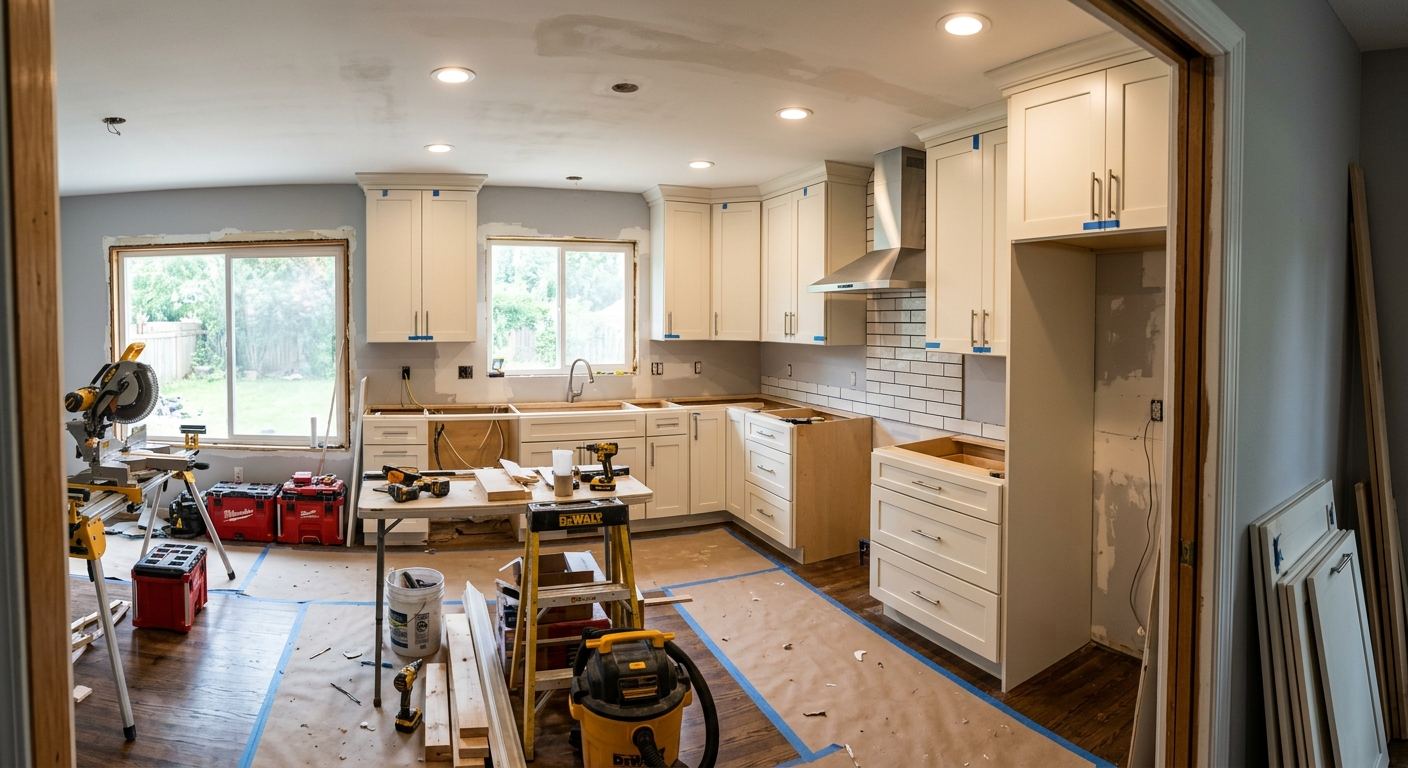
Kitchen renovation options and costs in Ardmore
Renovating a kitchen in Ardmore, British Columbia usually starts with deciding how much of the space you want to change, because that choice drives the labour hours and material pricing more than weather alone. While Ardmore is small (population 1,014, Statistics Canada, 2021 Census), Lower Mainland–Southwest pricing is strongly influenced by the broader Metro Vancouver market—especially owner expectations around resale-ready finishes. In higher-value pockets across the region, homeowners increasingly default to quartz or stone counters and semi-custom cabinetry, since those upgrades hold value when the home is listed; that’s why the same “average” kitchen can land very differently depending on the finish tier selected.
In the Lower Mainland–Southwest, contractors tend to price for demand swings tied to local construction timelines and trade availability, not because climate “adds” cost. The coastal environment can mean more humidity in transition seasons, so surfaces that tolerate moisture swings—solid cabinet construction, quality sealants, and well-installed tile—tend to be specified. If your home’s original build dates from the mid-20th century, expect older plumbing/electrical runs, which can push labour and upgrade costs even during a “mid-range” remodel.
Many homeowners in the Ardmore area—especially around the denser pockets near local commercial strips and busier commuter routes—also ask for accessibility-friendly layouts, which increases planning time (and sometimes permit steps if services move). With that context, here’s a realistic comparison of renovation tiers to help you anchor your quote before you shop contractors.
| Renovation Tier |
What's Included |
Typical Duration |
Price Range |
| Cosmetic refresh (paint, hardware, new appliances only) |
Paint/stain, hardware swap, appliance replacements, minor caulking and touch-ups (no cabinet box changes) |
1–3 weeks |
$8,000–$22,000 |
| Mid-range full renovation (new cabinets, counters, sink, tile) |
Semi-custom or stock cabinets, new counters, sink and faucet, backsplash tile, select flooring updates, basic electrical for under-cabinet lighting if included |
3–7 weeks |
$40,000–$85,000 |
| High-end full renovation (custom cabinets, stone counters, island) |
Custom cabinetry, stone/quartz counters (often with island), detailed mouldings, premium hardware, full-height backsplash options, more complex layout work |
6–12 weeks |
$85,000–$120,000 |
| Cabinet refacing only (new doors + drawer fronts, same boxes) |
New doors/drawer fronts, new mouldings, new hardware, limited cosmetic adjustments, counter and backsplash usually optional |
2–5 weeks |
$8,000–$35,000 |
| Countertop swap only (laminate to quartz or stone) |
Remove old laminate, fabricate and install new quartz/stone, sink cut-out and reseal, basic splash/edge finishing |
1–2.5 weeks |
$3,000–$12,000 |
| Backsplash tile installation only |
Demo (if needed), tile supply/installation, waterproofing at wet areas, grout/seal, clean-up |
4–10 days |
$1,500–$6,000 |
Prices are estimates only and vary by project scope, site access and material selection.
What affects the price of kitchen renovation in Ardmore
For the same kitchen work, quotes across the Lower Mainland–Southwest (including the Ardmore area) can differ by roughly 30–50% compared with other British Columbia markets because finish expectations and resale strategy are different. Climate in coastal BC can affect how materials perform, but it doesn’t usually create the kind of cost swings homeowners feel year-to-year. Instead, home value and typical buyer preferences drive the “default” finish tier: in higher-value Metro Vancouver-style markets, homeowners often choose quartz or stone counters and semi-custom cabinetry because those materials are easier to market and recover at resale. In more modest scopes, laminate and stock cabinets still offer strong ROI, particularly when you keep layout changes minimal.
In Ardmore specifically, two common conditions raise costs even when the cabinet tier doesn’t change. First, older plumbing/electrical runs can require rework to support a clean sink location, proper shutoffs, and safe under-cabinet lighting; if you’re moving plumbing for a new island sink, that can quickly push you toward the higher band of a full renovation (for example, mid-range work often sits around $40,000–$85,000, while layout-heavy jobs trend higher). Second, coastal humidity and seasonal swings can expose poorly sealed countertop edges or subfloor issues—those come up during demo and add “hidden” labour.
Here are practical examples you’ll see in the Ardmore market: replacing a damaged cabinet base after water exposure can add cabinet labour time; upgrading to quartz with a new undermount sink can add templating and plumbing trim-outs; and adding a dedicated circuit for island lighting may be necessary even if the rest of the renovation is cosmetic. Those are why layout changes—removing a wall, adding an island, or relocating a gas line—create the most unpredictable cost regardless of whether you’re aiming for cosmetic refresh or a full custom rebuild.
| Price Factor |
Why It Matters |
Cost Impact |
| Cabinet tier — stock vs. semi-custom vs. fully custom millwork |
Higher tiers improve fit, storage planning, and durability; they also take longer to fabricate and install |
Often shifts the project from mid-range into the high-end band |
| Countertop material — laminate vs. quartz vs. granite vs. stone |
Material, thickness, edge profile, and fabrication complexity change both cost and install time |
Can add thousands depending on sink cut-outs and edge/backsplash integration |
| Layout change — wall removal, island add, plumbing/gas move |
Service moves drive trades, inspection steps, and re-framing/drywall adjustments |
Usually the biggest swing factor; can move you 20–40%+ |
| Appliance package tier — builder vs. mid-range vs. pro-grade |
Pro-grade units often require ventilation coordination and more demanding cut-out tolerances |
Increases the “systems” portion of the budget, not just the appliance line |
| Flooring — refinish existing vs. full replacement |
Refinishing saves demo/disposal but depends on subfloor condition; replacement is more consistent |
Typically adds cost only if flooring has to be removed/levelled |
| Backsplash — ceramic tile vs. marble vs. full-height slab |
Premium stone increases material and fabrication/installation labour |
Can turn a $1,500–$6,000 backsplash into a much larger line item |
| Electrical — new circuits for island, under-cabinet lighting |
Adding circuits increases licensed electrician time and inspection coordination |
Commonly pushes costs upward even in “mid-range” remodels |
| Permit fees and licensed trade requirements |
Work that touches gas, load-bearing structures, plumbing/drain, or circuits triggers formal steps |
May add both direct fees and scheduling time |
Permits & regulations in British Columbia
In British Columbia, not every kitchen change needs a permit. Simple cabinet door swaps, counter replacements that don’t alter plumbing or gas, and backsplash installation typically don’t require permits because you’re not changing the underlying services. However, if you’re moving plumbing supply or drain lines, relocating a gas cooktop/range, removing a load-bearing wall, or adding new electrical circuits (for example, for island lighting or additional outlets), you generally need permits and licensed trades to do the work and pass inspections.
For Ardmore homeowners, think of it as “touch the infrastructure, trigger the process.” That means: drywall-only cosmetic work is usually easier; but if you open walls to run new lines, you’re often in permit territory. Gas work must be performed by a licensed gas fitter, and electrical work by a licensed electrician; both typically require inspections after rough-in and again before close-up.
To verify a contractor before you sign in Ardmore, ask for three documents and check them yourself: (1) their British Columbia licence/registration details (from the relevant online registry your contractor provides), (2) a current certificate of insurance showing liability coverage appropriate for residential renos, and (3) proof of workers’ compensation coverage (commonly shown as WCB clearance or equivalent proof, depending on the trade and employer). Make sure those certificates cover the dates of your project. Then confirm—by name in the written contract—which scope items include permits, and whether the contractor or homeowner is responsible for submitting paperwork.
Cabinets, countertops and layout decisions in Ardmore
The three most consequential decisions in an Ardmore kitchen renovation are the cabinet tier, the countertop material, and whether you change the layout. These choices matter because they determine your rebuild speed, your maintenance needs in a coastal climate, and—most importantly for Lower Mainland–Southwest buyers—how “finished” the kitchen looks when it’s listed.
1) Cabinet tier: Stock cabinets are fastest and cheapest, but they may require more filler and less precise fit. Semi-custom cabinets are the most popular mid-range option because you can improve storage planning without the full cost of custom millwork. Custom cabinets offer the best fit to your room geometry (especially useful in older Ardmore homes with out-of-square walls), but they raise budgeting and lead time.
2) Countertop material: Laminate is budget-friendly and durable for everyday use, but it’s more vulnerable at seams and to heat damage. Quartz is the “sweet spot” for many resale-minded homeowners in British Columbia: consistent colour, low maintenance, and cleaner edges around sinks. Granite/natural stone looks premium but needs more care; marble is beautiful and can be high-maintenance in a busy family kitchen.
3) Layout changes: Wall removal or adding an island often justifies its cost when it improves traffic flow and creates practical work zones. But moving plumbing or gas lines is expensive and schedule-sensitive. A common “justify it” example: if an island improves seating and you only move wiring, you might stay in the mid-range band around $40,000–$85,000. If you add an island sink and move a gas cooktop, the job often rises toward $85,000–$120,000 due to trades, demo, and inspection coordination.
| Option |
Durability |
Maintenance |
Best For |
Price Range |
| Stock cabinets (big-box) |
Good for daily use; may show gaps if the room is out of square |
Low; protect from moisture at base edges |
Fast refreshes and tight budgets |
$8,000–$25,000 |
| Semi-custom cabinets (local dealer) |
Very good durability; improved storage options and better fit |
Low; wipe clean and keep caulking intact near sinks |
Most Ardmore renovations aiming for strong resale finish |
$20,000–$50,000 |
| Custom cabinets (local millwork shop) |
Excellent durability and fit; tailored to your measurements and needs |
Low; higher quality hinges and stable frames |
Unusual layouts, heritage homes, and premium finish goals |
$45,000–$85,000 |
| Laminate countertop |
Good day-to-day durability; seams can be a weak point long-term |
Easy clean; avoid prolonged standing water and direct heat |
Cost-controlled renos and rental-friendly upgrades |
$3,000–$6,000 |
| Quartz engineered countertop |
High durability; resists stains and everyday impacts better than laminate |
Low—routine cleaning and gentle care around seams |
High-performing, low-maintenance “sellable” kitchens |
$6,000–$12,000 |
| Granite / natural stone countertop |
Very durable surface; performance varies by slab and finish |
Moderate—may need periodic sealing depending on stone |
Premium look with natural variation |
$7,000–$14,000 |
| Butcher block countertop |
Durable but susceptible to scratches and moisture ingress if neglected |
Higher—needs regular oiling and prompt wipe-down |
Warm, traditional kitchens and homeowners who maintain surfaces |
$4,500–$10,000 |
| Marble countertop |
Premium aesthetic; can etch or stain if you’re not careful |
Higher—requires protection, careful cleaning products |
Design-led kitchens with lighter use patterns |
$8,000–$18,000 |
How to choose a kitchen renovation contractor in Ardmore
Choosing the right kitchen contractor in Ardmore, British Columbia comes down to proof: licences, insurance, and clear documentation of scope. Start with British Columbia licensing/registration details relevant to their trade and the work they’ll perform. Request their liability insurance certificate and ensure it’s current for your project period, not expired. For workers’ compensation coverage, ask for proof of WCB coverage or clearance (as provided by their insurer/employer documentation). If they can’t produce these items quickly, that’s a major warning sign before you spend design dollars.
Next, collect 2–3 itemised written quotes with a labour + materials breakdown rather than a single lump sum. Itemisation should spell out demo/disposal, cabinet supply and installation, countertop fabrication/installation, backsplash labour, electrical rough-in allowances, and any drywall/paint restoration. Read exclusions carefully: is the permit pull included where required, and is inspection scheduling in their responsibility? Also confirm waste disposal and whether they protect floors and doorways during demo.
Warranty matters for both workmanship and product. Ask for the workmanship warranty length and what triggers it (and in writing). Confirm manufacturer warranties on cabinets/doors and counters, and whether warranties are transferable if you sell the home.
For payment schedule, avoid large deposits: a common rule of thumb is never more than 10–15% upfront, with the balance tied to milestones. Hold back until key completion points and walkthrough punch-list items are done. Finally, timeline should be in writing with a start date and completion estimate, plus lead-time assumptions for cabinets and countertops.
- Provide BC licence/registration details and explain what trade scopes they personally cover
- Show current liability insurance certificate with your project dates
- Confirm WCB coverage or clearance documentation for the company and trades involved
- Use itemised quotes: labour, materials, allowances, and line-by-line totals
- List what’s included in demo and disposal (and who cleans the site daily)
- Spell out permit responsibility and whether permit fees are included where required
- Confirm electrical/gas/plumbing scope and which parts trigger licensed trade work
- Detail cabinet installation method (including adjustments for out-of-square walls)
- Clarify countertop template date, fabrication lead time, and install scheduling
- Request a written warranty: workmanship duration and product warranty terms
- Set payment milestones (keep upfront to 10–15%, holdback until final walkthrough)
- Get start/completion dates in writing, not just “estimated soon”
In Ardmore, a few red flags I frequently see are: (1) contractors who refuse to list permit responsibility or avoid explaining which trades are licensed, (2) quotes that use vague allowances for cabinets/counters without specs, (3) deposit requests above typical ranges without a signed contract and schedule, (4) no written workmanship warranty terms, and (5) rushing you to choose materials before measurements/templates—often leading to costly rework.
Frequently asked questions — kitchen renovation in Ardmore
How much does a kitchen renovation cost in Ardmore?
In Ardmore and the wider Lower Mainland–Southwest market, costs usually land inside the common BC renovation bands once you decide the finish tier and whether you change the layout. For many homeowners, a cosmetic refresh stays relatively contained, while full renos move quickly once cabinets, counters and tile are included. As a baseline, a full kitchen renovation commonly ranges from $40,000–$120,000 depending on cabinet tier and countertop material. If you’re not changing cabinets and only want a materials upgrade, countertop swaps alone often sit around $3,000–$12,000, and backsplash tile installation is frequently $1,500–$6,000. Exact totals vary with trade scheduling, room access, and hidden conditions found during demo (older plumbing/electrical, moisture issues, or flooring repairs).
How long does a kitchen renovation take in Ardmore?
Timelines in Ardmore are usually driven by cabinet and countertop lead times, plus whether plumbing, gas, or electrical circuits are changing. Cosmetic refresh projects can often be completed faster—typically about 1–3 weeks—because they’re largely paint, hardware, and appliance install. Mid-range full renovations often take 3–7 weeks, while high-end builds with custom cabinetry and an island commonly run 6–12 weeks. A key local schedule note: even when trades are available, countertop templating and fabrication can be the pace-setter, especially for quartz/stone and custom edges. If your reno involves wall removal or service relocation, add time for inspections and coordinating licensed trades before walls are closed.
Quartz vs granite countertops — which is better?
Both quartz and granite are “premium” options, but they behave differently day to day. Quartz (engineered) is typically the easier choice for busy British Columbia kitchens: it’s consistent in appearance, resists stains well, and usually requires less day-to-day maintenance than natural stone. Granite offers dramatic natural variation and is very durable, but it may require periodic sealing depending on the slab and finish you choose. If you want low-maintenance performance with a resale-friendly look in Ardmore’s Lower Mainland–Southwest market, quartz is often the practical winner. Budget-wise, quartz commonly falls around $6,000–$12,000 for many typical installations, while granite/natural stone can trend higher—often about $7,000–$14,000. Your contractor should also advise on seams, edge profiles, and sink cut-outs for your specific layout.
Should I reface or replace my cabinets?
Cabinet refacing can be a smart move when the existing cabinet boxes are solid, level, and not showing moisture damage—especially in older homes where the frames are usable but the doors/drawer fronts are dated. Refacing typically costs less than a full replacement and can refresh the look quickly, often landing in a range around $8,000–$35,000, depending on how many doors/drawers are involved and how detailed the finishing is. Full replacement becomes the better option if your boxes are warped, the layout is inefficient, or you need structural changes for modern storage solutions. In Ardmore and across British Columbia’s coastal environment, I recommend evaluating under-sink and base areas closely: if there’s swelling or repeated moisture exposure, replacement is usually the safer long-term investment for both performance and resale appeal.
Do I need a permit for a kitchen renovation in British Columbia?
In British Columbia, many kitchen updates don’t require permits, but several common changes do. Typically, cabinet door/drawer refacing, straightforward counter replacements that don’t move plumbing or gas, and backsplash work often don’t require permits. You generally need permits and licensed trades if you move plumbing supply or drain lines, relocate gas components (cooktop/range situations), remove a load-bearing wall, or add new electrical circuits (for example, under-cabinet lighting or island outlets). Gas work must be done by a licensed gas fitter, and electrical by a licensed electrician, with inspections as required. Before you sign, confirm in writing what permits your contractor will pull and who is responsible—permit responsibility should be clearly assigned in the contract.
What's the ROI on a kitchen renovation?
ROI in Ardmore is influenced by how your kitchen matches current resale expectations in the Lower Mainland–Southwest. Generally, renovations that modernize the “visible surfaces” (cabinets, counters, tile) and avoid risky layout changes tend to recoup more reliably. Cosmetic refresh projects and targeted updates are often safer ROI plays when you’re not touching core systems. Full renovations can produce higher buyer appeal, especially when you move into popular finish tiers—like semi-custom cabinets and quartz counters—where buyers expect a polished look. As a practical framing, a mid-range full renovation often sits around $40,000–$85,000, and high-end projects can move toward $85,000–$120,000. Whether that spend returns strongly depends on your neighbourhood fit and the extent of changes to plumbing/gas/electrical systems, because those add cost and complexity. A well-specified renovation with durable materials usually positions the home best for resale.