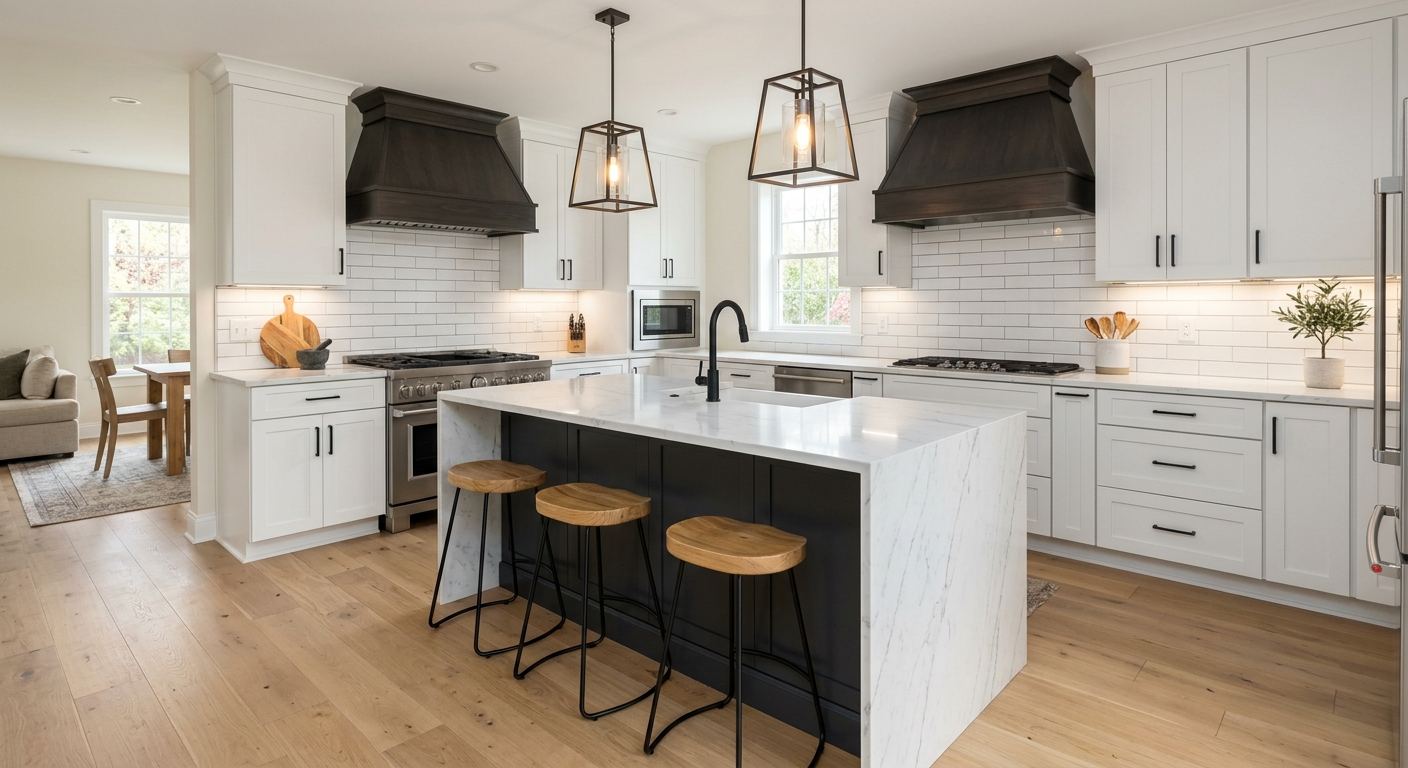
Kitchen renovation options and costs in Popkum
Popkum homeowners usually start with “what can we afford?” and then quickly land on “how does the finish level change the total cost?” With a population of 1,710 (Statistics Canada, 2021 Census), Popkum sits in a Lower Mainland–Southwest building market where trades availability is generally healthy, but pricing is still strongly tied to the broader Metro Vancouver demand for labour and materials. In higher-value Lower Mainland–Southwest neighbourhoods, owners more often choose semi-custom or custom cabinetry and quartz/stone counters, and those upgrades tend to carry over into Popkum renovation expectations—especially for open-concept layouts that are meant to feel modern for resale.
Climate influences the approach in a different way: the Lower Mainland–Southwest has wet winters and humid shoulder seasons, so sealed finishes, moisture-tolerant materials, and properly ventilated cooking areas matter. Even when weather doesn’t directly spike the price, it can affect product choices (durable finishes) and the time needed for scheduling and site drying. The cost spread is also driven by how many “unknowns” show up once cabinets come down—old water shutoffs, subfloor softness, or hidden electrical and lighting upgrades.
In Popkum, this work is particularly in demand for homes in the Popkum/Abbotsford corridor where many renovation plans are tied to family use and long-term comfort. If you’re comparing scope options—refresh versus full rebuild—the table below will help you translate design decisions into realistic budget tiers.
| Renovation Tier |
What's Included |
Typical Duration |
Price Range |
| Cosmetic refresh (paint, hardware, new appliances only) |
Cabinet paint or stain (no box changes), new hardware, new appliances, touch-up trim and caulking |
1–2 weeks |
$8,000–$22,000 |
| Mid-range full renovation (new cabinets, counters, sink, tile) |
New semi-custom or stock cabinets, countertops, sink and faucet, backsplash tile, new flooring prep as needed, basic lighting refresh |
4–8 weeks |
$40,000–$85,000 |
| High-end full renovation (custom cabinets, stone counters, island) |
Custom cabinetry, stone counters (quartz/stone), island with electrical/plumbing coordination, upgraded backsplash, appliance package upgrade, higher-end lighting |
8–16 weeks |
$85,000–$120,000 |
| Cabinet refacing only (new doors + drawer fronts, same boxes) |
Refacing panels, new doors/drawer fronts, hardware swap, matching trim, minor prep and repainting |
2–4 weeks |
$18,000–$45,000 |
| Countertop swap only (laminate to quartz or stone) |
Templating, new countertop install, sink cut-out adjustments, sealing, disposal of old surfaces |
1–3 weeks |
$6,000–$20,000 |
| Backsplash tile installation only |
Tile supply and install, waterproofing prep where needed, grout/seal, basic finishing at edges |
3–7 days |
$1,500–$6,000 |
Prices are estimates only and vary by project scope, site access and material selection.
What affects the price of kitchen renovation in Popkum
The same kitchen can price 30–50% differently across Lower Mainland–Southwest and other British Columbia markets because pricing tracks more closely to housing values, resale expectations, and the finish tier than it does to seasonality alone. In high-value areas, upgrades like quartz/stone counters, upgraded hardware, and semi-custom or custom cabinetry are easier to justify on resale—so the labour and material “target” rises with buyer expectations. In more modest markets, homeowners often choose laminate or stock cabinets to protect ROI, keeping total spend nearer to the lower end of the $40,000–$120,000 full-renovation band.
In Popkum specifically, two local realities can raise or lower cost quickly: (1) many homes have older cabinet layouts and electrical runs that need updating, and (2) wet-season humidity makes ventilation and moisture detailing more important once counters and tile are removed. For example, if you’re upgrading from laminate to quartz, your cost can stay relatively controlled—often within the countertop-only band—unless the existing sink base needs repair or the backsplash substrate is compromised. Conversely, a simple “make the island” change can jump into the high-end band because the trade coordination (electrical, plumbing/gas clearance, and cabinetry modifications) becomes a schedule driver.
Concrete examples we see often around Popkum/Abbotsford: an island addition where the gas line must be relocated (higher labour and coordination) and an under-cabinet lighting plan that requires new circuits. If your layout needs a wall removal or major plumbing move, that unpredictable cost rises regardless of whether you choose laminate or stone. That’s why contractors commonly price layout changes as the risk area, even before material selections are final.
| Price Factor |
Why It Matters |
Cost Impact |
| Cabinet tier — stock vs. semi-custom vs. fully custom millwork |
Higher tiers add customization, better door/drawer detailing, and more expensive fabrication and finishing |
Small job could move from roughly mid-range to high-end totals; often a 15–40% swing inside full renovations |
| Countertop material — laminate vs. quartz vs. granite vs. stone |
Material cost and templating/installation complexity increase with premium surfaces |
Countertop-only can range within about $3,000–$12,000 for typical installs, with premium stone higher |
| Layout change — wall removal, island add, plumbing/gas move |
These create hidden labour: framing, electrical/plumbing routing, and sometimes permit work |
Often the biggest unpredictable jump; can add 10–30% or more to a full kitchen |
| Appliance package tier — builder vs. mid-range vs. pro-grade |
Higher tiers add ventilation power, better finish options, and electrical requirements |
Can add thousands quickly; pro-grade packages commonly push totals toward the upper band |
| Flooring — refinish existing vs. full replacement |
Kitchen footprints change; mismatches are visible and removal/prep adds labour |
Replacing flooring can add several thousand compared to refinish/reuse |
| Backsplash — ceramic tile vs. marble vs. full-height slab |
Premium materials and full-height installs increase setting time and detailing |
Backsplash tile installation typically lands around $1,500–$6,000 |
| Electrical — new circuits for island, under-cabinet lighting |
New receptacles/lighting require licensed work and testing |
Can range from minor add-ons to a significant line item for island wiring |
| Permit fees and licensed trade requirements |
Some work triggers permits and inspections; labour must be done by licensed trades |
Usually modest in dollars but can add time and coordination overhead |
Permits & regulations in British Columbia
In British Columbia, not every kitchen change triggers a permit. Typically, cabinet and countertop swaps—like replacing laminate with quartz, or changing cabinet doors while leaving the box footprint alone—generally do not require a permit. However, once you move plumbing supply/drain lines, relocate gas (for a range or related venting), remove a load-bearing wall, or add electrical circuits, permits and licensed trade involvement become part of the process. Gas work must be performed by a licensed gas fitter, and electrical work must be performed by a licensed electrician; both require inspections where applicable.
For a homeowner in Popkum, the verification steps should be simple and documented. First, ask the contractor for their licence details (and any subcontractor licence details) and check the online registry information they provide. Second, request a current certificate of insurance (liability) showing coverage limits appropriate to the job scope. Third, confirm workers’ compensation coverage (commonly WCB/WSIB) by asking for proof/clearance documentation—this is particularly important when multiple trades are on site. Finally, confirm that the contractor will pull permits where required and that the contract clearly states who is responsible for permit applications, inspections, and any associated fees.
Before signing, make sure the written scope lists what does require permits versus what doesn’t. This prevents surprises when you learn the island plan includes electrical circuit additions or a gas relocation.
Cabinets, countertops and layout decisions in Popkum
In Popkum, the three most consequential decisions usually are cabinet tier, countertop material, and whether you change the layout. For cabinets, the choice is typically stock (fastest and cheapest), semi-custom (most popular mid-range balance), or custom (highest cost, best fit for older or irregular spaces). For countertops, laminate is budget-friendly but needs careful handling near seams; quartz is a strong “set it and forget it” option for everyday cooking; granite/stone adds natural character and toughness with extra sealing considerations; butcher block can look warm and upscale, but it’s more maintenance-heavy; marble is elegant but tends to be more sensitive to etching and stains.
For layouts in the Lower Mainland–Southwest, open-concept wall removal or adding an island is often justified when it creates real circulation and storage—not just when it looks good in photos. Because resale buyers in the region expect modern sightlines and convenient work triangles, a practical island can help resale appeal, but it also brings coordination costs for electrical, lighting, and sometimes plumbing or gas venting. That’s why we often see a “near-mirror” difference: a full mid-range renovation might land around $40,000–$85,000, but once you add an island plus the associated trades, totals can push toward the high-end band.
Dollar example: upgrading laminate counters to quartz might fit within the countertop-only scope if your sink cut-outs and substrate are sound. But if the backsplash substrate needs replacement or the base cabinets show water damage, the same upgrade can escalate and start affecting the full renovation budget.
Climate-wise, the Lower Mainland–Southwest’s damp periods make ventilation and moisture detailing important around sinks, under-cabinet areas, and behind backsplashes—so planning for proper sealing and breathable finishing systems pays off over time.
| Option |
Durability |
Maintenance |
Best For |
Price Range |
| Stock cabinets (big-box) |
Good everyday durability; limited flexibility in sizing |
Low; wipe-clean surfaces and routine hardware checks |
Budget-first refreshes and quicker turnaround timelines |
$8,000–$25,000 |
| Semi-custom cabinets (local dealer) |
Very durable; better internal organization and finish options |
Low; finish is designed for kitchen use |
Most Popkum renovations targeting strong resale appeal |
$18,000–$45,000 |
| Custom cabinets (local millwork shop) |
Highest durability and fit; ideal for irregular walls/ceilings |
Low to moderate; high-quality finishes reward careful cleaning |
Homes where layout constraints require made-to-fit solutions |
$35,000–$80,000 |
| Laminate countertop |
Solid for daily use; seams require attention over time |
Moderate—avoid standing water at seams and protect edges |
Cost-controlled projects and refresh budgets |
$3,000–$8,000 |
| Quartz engineered countertop |
Very durable and stain-resistant; consistent surface |
Low—routine cleaner only; avoid abrasive pads |
Busy households and resale-focused finishes |
$5,500–$12,000 |
| Granite / natural stone countertop |
Highly durable; resists heat and everyday impact well |
Moderate—typically requires periodic sealing depending on stone |
Homeowners wanting natural variation and premium character |
$6,500–$14,000 |
| Butcher block countertop |
Durable but can scratch; great resilience with proper care |
Moderate to high—oil and regular maintenance routines |
Warm design styles and homeowners who like hands-on upkeep |
$4,500–$10,500 |
| Marble countertop |
Beautiful but more sensitive to acidic spills and etching |
Higher—seal and protect from stains and acids |
Display-level kitchens where appearance outweighs heavy-duty use |
$8,000–$18,000 |
How to choose a kitchen renovation contractor in Popkum
Choosing a contractor in Popkum starts with verification. In British Columbia, confirm licensing for any trade work (and for the contractor coordinating subs if they do trade scope). For liability insurance, ask for a certificate of insurance showing active coverage for the renovation scope. For workers’ compensation coverage, request proof/clearance documentation; this matters when drywall, electrical, plumbing/gas, and flooring are happening under one schedule. If they can’t provide these documents quickly, that’s a red flag.
Next, require 2–3 itemised written quotes, not lump sums. You want a labour and materials breakdown that clearly identifies what’s included (demo, haul-away/disposal, cabinet install, countertop templating/installation, backsplash tile set, trim, caulking and finishing). Read the scope for exclusions: are permits included and handled by the contractor, or is that your responsibility? Is old material disposal included, or will you pay separately? Confirm warranty details too—workmanship warranty length and what it covers, plus the manufacturer warranty on cabinets and countertops and whether it’s transferable to a future owner.
For payment, use a schedule with conservative upfront payment—never more than about 10–15%—and hold back a portion until completion and punch list items are finished. Finally, get the start date and a completion estimate in writing, along with what happens if countertops or cabinets arrive late.
- Ask for licence details and proof of coverage before signing (liability certificate + workers’ compensation clearance).
- Confirm who is responsible for permits and inspections if you’re moving plumbing, gas, electrical, or walls.
- Use 2–3 itemised quotes with a line-by-line labour/material breakdown.
- Verify countertop templating timing and who schedules template visits.
- Clarify disposal/haul-away: what’s included and where it goes.
- Check warranty length for workmanship and how claims are handled.
- Confirm manufacturer warranty terms for cabinets and countertops (and transferability).
- Ensure the quote lists backsplash prep requirements and waterproofing approach.
- Ask how they protect floors and adjacent finishes during demo and install.
- Get a written timeline with milestone dates (demo, rough-in, install, finish).
- Confirm the payment schedule and punch list/holdback process.
- Ask for references from recent Lower Mainland–Southwest kitchen projects with similar scope.
Red flags we see in Popkum include vague scopes that don’t list disposal or permit responsibility, contractors asking for large upfront payments, quotes that don’t break down labour vs materials, missing proof of liability/coverage documents, and timelines with no allowance for cabinet or countertop manufacturing lead times.
Frequently asked questions — kitchen renovation in Popkum
What's the most cost-effective kitchen upgrade?
In Popkum and the surrounding Lower Mainland–Southwest, the most cost-effective upgrade is often a focused scope that changes how the kitchen feels without triggering big layout or trade work. Two common “best value” paths are a backsplash refresh (typically around $1,500–$6,000) or a cabinet hardware plus appliance refresh if your cabinet boxes and countertops are still solid. If you want a bigger impact per dollar, swapping old laminate countertops to quartz can be a strong move—usually more affordable than a full rebuild because you avoid redoing cabinets. If your backsplash substrate and sealing are already in good shape, countertop-only work stays cleaner and faster. The key is avoiding hidden demo surprises: if there’s water damage behind base cabinets or aged plumbing shutoffs, address those first so the project doesn’t balloon.
Custom vs stock cabinets — is custom worth it?
Custom cabinets are worth it when your kitchen has irregular walls, tight dimensions, or you’re chasing a very specific storage layout (pantries, appliance garages, deep drawers, or built-ins) that stock can’t solve. In Popkum, many older homes have small quirks—out-of-square corners or ceiling slopes—that make “one-size” cabinet runs look off unless you cut and trim selectively. Semi-custom is often the best middle ground, but stock can be the most cost-effective if your measurements are straightforward. Budget-wise, the difference is noticeable: moving toward custom millwork often pushes total renovation spend upward, especially when you also add an island and upgrade counters. If resale appeal is your goal and your space is workable, semi-custom plus a durable countertop (often quartz) can hit the sweet spot. For a full renovation, most Popkum projects still aim within the broader $40,000–$120,000 band depending on finish tier and whether layout changes are included.
How do I choose a kitchen contractor in Popkum?
Start by choosing a contractor who can provide written proof of British Columbia liability insurance and workers’ compensation clearance before work begins. Then confirm they can coordinate licensed trades (electrical and gas/plumbing when applicable) and explain what requires permits in your specific plan. Ask for 2–3 itemised written quotes with a labour and materials breakdown—especially for cabinets, countertop templating/installation, backsplash tile set, and electrical/lighting additions. Review scope details like whether disposal is included and who pulls permits. For timing, request a written start date and completion estimate, with realistic allowances for cabinet and countertop lead times. Also confirm warranty terms: workmanship coverage length, what’s included in a punch list, and whether manufacturer warranties on cabinets/counters are transferable. If a contractor pressures you with minimal documentation or large upfront payments, pause and ask for clarification in writing.
What order do kitchen renovation steps happen in?
A typical order for a kitchen renovation in Popkum is: measurement/templating first, then demolition, followed by rough-ins (electrical, plumbing, gas routing if needed), then framing/repairs for layout changes, and finally cabinet install. Countertops usually come after cabinets are set and level, because templating depends on the installed base. Backsplash installation follows countertop placement so the lines meet cleanly at the counter edge. Flooring transitions happen based on whether you’re reflooring the entire kitchen or matching to existing surfaces; often flooring prep is handled during the rough stage. Finish steps include caulking, sealing, paint/touch-ups, installing hardware, and checking appliance fit. If your project includes permits or inspections, rough-in and final sign-offs can affect the schedule—so the contractor should map inspection points in the written timeline.
Can I live at home during a kitchen renovation in Popkum?
Often, yes—especially for cosmetic refreshes or countertop/backslash-only scopes. For full renovations, it’s possible but more challenging because kitchens become a construction zone with limited cooking access. Many Popkum homeowners plan for a temporary kitchen setup (microwave, kettle, and a small fridge elsewhere) and keep daily routines functional by scheduling the noisiest phases—like demo and cabinet install—back-to-back when trades are on site. If your project involves plumbing/gas or major electrical updates, there may be short periods where the stove or sink can’t be used until inspections and final connections are complete. The wet-season climate in the Lower Mainland–Southwest also matters: dust control and ventilation help, and contractors should protect floors and adjacent finishes carefully. If you need to move multiple utilities, some households prefer to stay elsewhere for a few weeks—your contractor should help you estimate the realistic “downtime” based on the scope you choose.
Should I renovate my kitchen before selling in Popkum?
Usually, you should renovate before selling only if you’re targeting improvements that match what local buyers expect and if you can control the budget to avoid over-improving. In the Lower Mainland–Southwest, buyer expectations often trend toward modern finishes—like quartz/stone counters and cleaner layouts—but the highest ROI comes from practical updates rather than expensive changes that don’t solve a functional problem. A smart approach is to upgrade the “visible daily touchpoints”: cabinets (or refacing), counters, backsplash, and lighting. If you’re staying within the $40,000–$120,000 full-renovation band, choose the finish tier that aligns with your home’s condition and the resale market. For example, a full high-end custom rebuild can be hard to justify if your layout doesn’t add real usable space. If your goal is curb-to-close impact with less risk, you may do best with a mid-range renovation or a focused countertop upgrade first, then reassess based on inspection findings and your timeline to list.