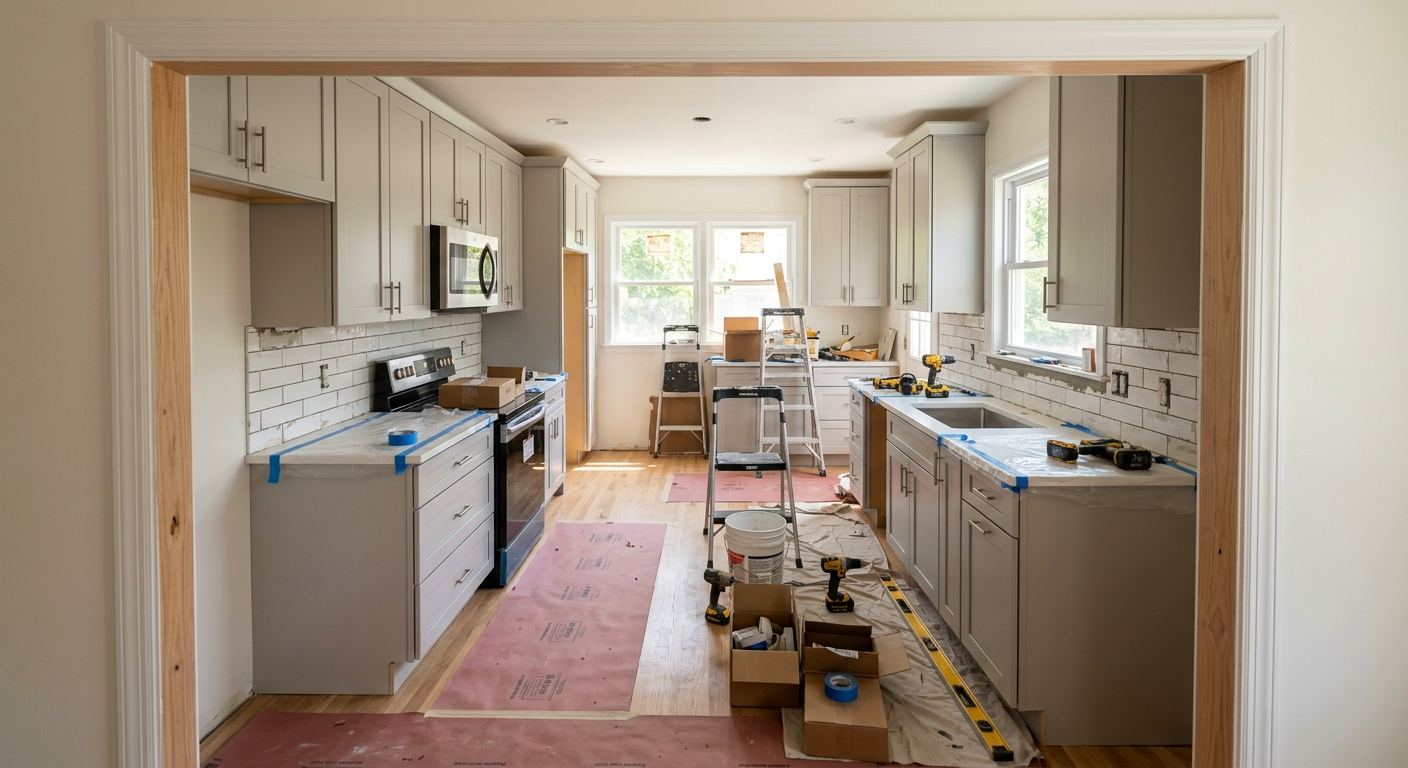
Kitchen renovation options and costs in Capitol Hill
Kitchen renovations in Capitol Hill tend to follow three main paths: a quick refresh, a mid-range full remodel, or a full custom rebuild. With a population of 6,330 (Statistics Canada, 2021 Census), the neighbourhood’s renovation demand is concentrated around practical updates in older housing stock, plus occasional design-led upgrades for the resale market. In the Lower Mainland–Southwest, pricing is driven more by home value, income, and expected finish level than by climate. That means the same kitchen can land very differently across the region—from a laminate refresh to a quartz/stone-centred rebuild—because homeowners in higher-value pockets often choose semi-custom cabinetry, upgraded hardware, and designer layouts.
Capitol Hill sits within a coastal West Coast climate: sustained humidity and freeze-thaw cycles are less brutal than inland areas, but moisture management still matters for cabinetry longevity, tile adhesion, and grout/caulk performance. Labour availability can also shape your budget—when trade scheduling tightens around the busiest renovation months, quotes can shift as contractors prioritise larger jobs with predictable scopes. If you’re looking at a refresh, the budget is usually easier to control; if you’re moving plumbing lines or planning an island, the variability increases.
In practice, contractors see especially strong demand in the Cook Street–to–Cedar Hill–style corridors where older bungalows and townhomes are frequently updated. From there, it’s straightforward to compare options in the table below.
| Renovation Tier |
What's Included |
Typical Duration |
Price Range |
| Cosmetic refresh (paint, hardware, new appliances only) |
Cabinet repaint or touch-ups, new hardware, appliance swap (range, fridge, dishwasher), minor caulking, basic cleaning and re-installation |
5–10 business days |
$10,000 – $28,000 |
| Mid-range full renovation (new cabinets, counters, sink, tile) |
Semi-custom or quality stock cabinets, new countertops, new sink and taps, backsplash tile, flooring refresh (select options), demolition and disposal |
4–7 weeks |
$40,000 – $85,000 |
| High-end full renovation (custom cabinets, stone counters, island) |
Fully custom millwork, quartz or natural stone counters, island build, upgraded hardware and lighting, full backsplash/feature detailing, layout and service upgrades |
8–14 weeks |
$85,000 – $140,000 |
| Cabinet refacing only (new doors + drawer fronts, same boxes) |
Removal and replacement of doors/drawer fronts, new veneer finish, updated hinges/pulls, minor sanding/prep, typically no cabinet box changes |
2–4 weeks |
$16,000 – $45,000 |
| Countertop swap only (laminate to quartz or stone) |
Template and install, removal of old laminate surface, new quartz/stone slab install, sink cut-outs, edge profile |
1–3 weeks |
$4,500 – $16,000 |
| Backsplash tile installation only |
Surface prep, tile install, grout and caulking at edges, electrical outlet trimming, sealing where required |
4–8 days |
$1,800 – $6,500 |
Prices are estimates only and vary by project scope, site access and material selection.
What affects the price of kitchen renovation in Capitol Hill
In Capitol Hill and across the Lower Mainland–Southwest, it’s common to see the same “size” kitchen quote swing by about 30–50% depending on finish tier, material sourcing, and how many hidden issues the contractor expects to uncover. In British Columbia, those variations often track home value and household purchasing expectations more than climate. In higher-value Lower Mainland–Southwest pockets, homeowners lean toward quartz or stone counters and semi-custom cabinetry because the incremental spend is easier to justify on resale. In more budget-conscious scenarios, laminate and stock cabinetry dominate because they deliver a refresh look closer to a “safe return” than a fully premium build.
Layout changes are the biggest wild card regardless of finish level: removing a wall, adding an island, or moving a gas/electrical run can add cost even if you keep cabinets simple. Concrete examples from Capitol Hill: (1) older homes with unknown subfloor condition can drive floor and substructure prep, which then increases labour before cabinets can be set; (2) service relocation—especially moving a sink to align with an island—typically pushes the project beyond a “typical” mid-range $40,000–$85,000 renovation and closer to the high end once plumbing rough-ins and patching are included; and (3) limited site access (parking constraints or tight staging windows) can increase labour hours and disposal scheduling.
Material choices also shift labour intensity. For example, a countertop swap may look like a straightforward install, but moving from laminate to quartz/stone can require more precise templating and longer lead times; that’s why many homeowners start with a $3,000–$12,000 countertop band and then add cabinet work once they see the wall condition. Overall, coastal humidity doesn’t usually “freeze” projects like inland climates, but it does make proper ventilation, caulking, and moisture-resistant installation details non-negotiable.
| Price Factor |
Why It Matters |
Cost Impact |
| Cabinet tier — stock vs. semi-custom vs. fully custom millwork |
Custom boxes/fit, better drawer mechanisms, and more layout options increase design and install labour |
Can shift your project by roughly $15,000–$55,000 depending on cabinet scope |
| Countertop material — laminate vs. quartz vs. granite vs. stone |
Material pricing, thickness/edge work, and template complexity affect both product and install time |
Typical countertop band changes of about $3,000–$12,000+ |
| Layout change — wall removal, island add, plumbing/gas move |
These items trigger extra trades, rough-in work, patching, and inspection steps |
Often the largest unpredictable add; commonly $8,000–$35,000+ |
| Appliance package tier — builder vs. mid-range vs. pro-grade |
Higher tiers cost more and may require different electrical specs or venting details |
Can swing $2,000–$12,000+ even before install |
| Flooring — refinish existing vs. full replacement |
Older subfloors may need prep, and new flooring extends demo, patch, and finish time |
Often adds $3,000–$15,000 depending on damage |
| Backsplash — ceramic tile vs. marble vs. full-height slab |
Premium tile/stone requires skilled layout, extra cutting, and careful finishing |
Can range about $1,500–$6,000+ |
| Electrical — new circuits for island, under-cabinet lighting |
New circuits mean a licensed electrician, inspections, and longer scheduling coordination |
Commonly adds $1,000–$6,000+ |
| Permit fees and licensed trade requirements |
Anything involving plumbing, gas, structural changes, or new electrical circuits drives compliance time and cost |
Often $500–$4,000+ depending on scope |
Permits & regulations in British Columbia
In British Columbia, the rule of thumb for kitchen projects is that replacing surfaces is often simpler than relocating systems. Cabinet and countertop swaps generally do not require permits, and homeowners can often proceed without municipal submissions when the work stays within existing cabinet boxes and existing service connections. However, permits and licensed trades are typically required when you move plumbing supply or drain lines, relocate gas (for the stove, range, or certain range hood venting scenarios involving gas), remove a load-bearing wall, or add electrical circuits (for example, dedicated circuits for an island receptacle, new lighting layouts, or under-cabinet lighting tied to an upgraded feed).
For homeowners in Capitol Hill, the practical step-by-step verification looks like this: first, ask your contractor for their licence details for gas work (gas fitter) and electrical work (electrician). Next, request a certificate of insurance (liability coverage) and confirm they have workers’ compensation coverage through their system for the province—this is commonly referred to as WCB coverage in BC. Then, for added assurance, check the contractor’s and relevant trade licences online and match the name and licence number to what’s on their documentation. Finally, confirm who is pulling permits—your contractor should specify it in the written contract, including inspection responsibility and timelines—before any demolition starts.
Always treat “we’ll handle it” as a checklist item, not a promise. The permit responsibility belongs in the scope and in writing.
Cabinets, countertops and layout decisions in Capitol Hill
In a Capitol Hill kitchen renovation, the three decisions that most affect both cost and resale appeal are: (1) cabinet tier, (2) countertop material, and (3) layout changes. Cabinet tier sets the tone for the project. Stock cabinets are fastest and cheapest, but their sizing and door options can force compromises. Semi-custom cabinets are usually the most popular mid-range choice in Lower Mainland–Southwest kitchens because you can fine-tune fit around older corners and window reveals without paying fully custom millwork pricing. Custom cabinets give the best fit and detailing for awkward spaces and built-ins, but they’re the biggest driver of the $85,000–$140,000 high-end renovation band.
Countertops affect both durability and daily maintenance. Laminate looks good on day one and can land in a tighter budget, while quartz brings consistent performance, lower maintenance, and a cleaner look that many buyers expect at mid-to-higher price points. Granite/natural stone is also premium and durable, but it’s typically higher maintenance (sealing routines) and has variability in veining and edge choices. Coastal humidity makes proper installation details important across materials—good sealing at edges and reliable underlayment matter.
Layout changes justify the cost when they create real function: an island can improve workflow and storage, but it becomes expensive if it requires substantial plumbing/gas relocation or major electrical upgrades. A practical dollar example: if you move from a mid-range cabinet/counter package into a layout plan that adds an island, many homeowners see the project jump from the $40,000–$85,000 band toward the upper range once rough-ins, cabinetry modifications, and finishing time are included. If your goal is only modern styling, a refresh or countertop swap usually delivers better value than a full service relocation.
| Option |
Durability |
Maintenance |
Best For |
Price Range |
| Stock cabinets (big-box) |
Good day-to-day strength; best when sizing matches your space |
Low routine upkeep; occasional touch-up for chips/scratches |
Time-sensitive refreshes and straightforward layouts |
$8,000 – $25,000 |
| Semi-custom cabinets (local dealer) |
High build quality; improved drawer tracks and better fit options |
Low-to-moderate; wipe-down and handle care |
Most Capitol Hill homeowners balancing cost and fit |
$18,000 – $50,000 |
| Custom cabinets (local millwork shop) |
Excellent longevity; tailored joinery and built-ins |
Low upkeep; quality hardware reduces wear |
Awkward spaces, premium resale finish, integrated storage goals |
$35,000 – $85,000 |
| Laminate countertop |
Decent for light-to-moderate use; edge damage needs quick repair |
Easy daily cleaning; avoid prolonged moisture at seams |
Budget-first projects and cosmetic remodels |
$1,500 – $4,500 |
| Quartz engineered countertop |
Very durable; resistant to staining for normal household use |
Low maintenance; wipe clean, standard care, no sealing |
Busy kitchens that need a polished look with minimal fuss |
$4,000 – $10,000 |
| Granite / natural stone countertop |
Hard and resilient; each slab’s performance depends on the specific stone |
Higher maintenance: periodic sealing and careful stain prevention |
Premium look when you want natural variation |
$6,000 – $12,000 |
| Butcher block countertop |
Durable with proper care; can scratch and needs refinishing |
Oiling/conditioning; treat like a working surface |
Casual, warm design and homeowners who cook a lot |
$3,000 – $7,500 |
| Marble countertop |
Beautiful but softer; more prone to etching and staining than quartz |
Higher care: avoid acidic spills; regular sealing |
Design-forward kitchens for lower-impact use |
$7,000 – $16,000 |
How to choose a kitchen renovation contractor in Capitol Hill
Choosing a kitchen renovation contractor in Capitol Hill comes down to proof: licensing where required, proper insurance, and transparent quoting. In British Columbia, verify the trades involved. For gas work, you should see confirmation that the gas fitter is licensed. For electrical, request the electrician’s licence and check their details through the appropriate online registry. Next, get documentation for liability insurance and request a certificate of insurance; it should match the contractor/company name you’re hiring. Also confirm workers’ compensation coverage (commonly referred to as WCB coverage in BC) so you’re not exposed if a worker is injured on site.
Then get 2–3 itemised written quotes—not a single lump-sum number. A good quote breaks labour and materials into categories (demo, framing/patching, cabinets, countertops, tile, plumbing/electrical rough-ins, disposal, and finish carpentry). Read the scope for inclusions and exclusions: is permit pulling included, who schedules inspections, and is disposal/haul-away included? Review warranty terms for workmanship and products separately. Ask if the workmanship warranty length is stated and whether product/manufacturer warranties transfer if you sell the home.
Payment schedule matters: avoid paying more than about 10–15% upfront. Use milestone payments tied to progress, and hold back until the job is complete and walkthrough items are addressed. Finally, timeline should be in writing: start date, countertop/cabinet lead times, and a completion estimate that accounts for inspections and trade coordination.
- Ask for licence numbers for the specific trades involved (gas/electrical where applicable).
- Request proof of liability insurance and confirm the certificate covers the renovation scope.
- Confirm WCB coverage for workers before demo starts.
- Get 2–3 itemised quotes with labour and materials separated.
- Clarify what “demo” includes (wall protection, dust control, and subfloor treatment).
- Confirm disposal/haul-away is included and where debris goes.
- Verify permit responsibility: who pulls permits and who pays fees.
- Ensure electrical scope is explicit (island circuits, under-cabinet lighting, switches/outlets).
- Check countertop templating and lead time assumptions in the schedule.
- Ask for the backsplash/tile scope (surface prep, waterproofing method if needed).
- Read warranty details: workmanship duration and manufacturer warranty conditions.
- Use a payment plan with a holdback until punch-list completion.
Red flags in Capitol Hill include: contractors who refuse itemised labour/material breakdowns, promises of “no permits needed” even when services or load-bearing walls change, missing or mismatched insurance/WCB documentation, quoted timelines that ignore countertop/cabinet lead times, and contracts that don’t specify who is responsible for inspections and deficiencies.
Frequently asked questions — kitchen renovation in Capitol Hill
How do I get accurate kitchen renovation quotes in Capitol Hill?
To get an accurate kitchen renovation quote in Capitol Hill, ask for a site visit and a measurement/template day, not just a phone estimate. Provide a clear goal (refresh vs. full remodel) and include whether you’re keeping the existing layout or planning an island and service moves. A quote should be itemised: demo/disposal, cabinet package, countertop supply and install, tile/backsplash, flooring transitions, and plumbing/electrical labour where applicable. If you’re aiming for a mid-range full renovation, many projects in this area fall around the $40,000–$85,000 band, while layout-heavy builds can push higher into the $85,000–$140,000 range. Also confirm whether permit pulling is included if plumbing/gas/electrical changes are part of your scope.
What's the best countertop material for a busy Capitol Hill kitchen?
For most busy Capitol Hill households, quartz is the practical sweet spot. It offers a polished look similar to premium stone, resists staining better than natural options, and typically requires less day-to-day maintenance than granite or marble. Laminate can work for a refresh budget, but seams and edge wear are more likely to show over time, especially in a coastal BC kitchen where moisture control at seams matters. If you’re renovating in the mid-range band, a countertop portion commonly lines up with the $3,000–$12,000 range depending on thickness, edge profiles, and whether you’re adding an island. If your household cooks frequently, keeps spills moving, and wants fewer maintenance routines, quartz usually performs best for the effort versus cost trade-off.
How do I add an island to my Capitol Hill kitchen?
Adding an island is feasible, but it’s usually more about services and clearances than cabinetry style. First, confirm your floor plan: you need safe walk paths around the island for multiple people. Then determine whether you’re moving plumbing (for a sink) and whether you need electrical (for outlets or an induction cooktop). Any move of plumbing lines or new electrical circuits can trigger permits and require licensed trades in British Columbia. In budgeting, an island often changes the entire scope, which is why contractors see bigger swings than “just cabinets.” A kitchen that was trending around the $40,000–$85,000 mid-range can climb quickly if rough-ins, patching, and inspection scheduling add labour. The right approach is to design the island placement first, then finalize cabinet and countertop specs.
How much does a kitchen renovation cost in Capitol Hill?
Kitchen renovation costs in Capitol Hill generally follow the same banding you’ll see across the Lower Mainland–Southwest, with finish tier and service work driving the biggest differences. For example, a cosmetic refresh typically starts around the lower end of the market, while a mid-range full renovation commonly lands in the $40,000–$85,000 range. If you’re planning custom cabinets, stone counters, and an island with more complex service upgrades, high-end projects often fall into the $85,000–$140,000 band. Cabinet installation/refacing can be a major share of cost—cabinet refacing and installs vary widely based on whether boxes stay and how much fitting is needed. Because Capitol Hill homes often involve older finishes and tight tolerances, you should also plan a contingency for subfloor and wall patching once walls are opened.
How long does a kitchen renovation take in Capitol Hill?
Timelines in British Columbia depend on scope and product lead times. A cosmetic refresh (paint, hardware, appliance-only swaps) can often be completed in about 1–2 weeks. A mid-range full renovation typically takes around 4–7 weeks, while higher-end projects with custom millwork and a more complex island plan can run 8–14 weeks. The schedule can expand if you’re waiting on cabinets and countertops for templating and fabrication, or if inspections are needed after plumbing/electrical changes. Capitol Hill jobs also sometimes require extra time for careful dust control and patching due to older housing details. The best way to protect your timeline is to get a written start date, a completion estimate, and a sequence plan that shows when demo, rough-ins, inspections, cabinet install, countertop templating, and finishing happen.
Quartz vs granite countertops — which is better?
“Better” depends on your priorities. Quartz is often the best fit for busy kitchens in Capitol Hill because it’s engineered for consistent performance, generally requires less maintenance, and is less fussy than many natural stones. Granite is also durable and premium-looking, but it’s natural—so variation is part of the package—and it typically needs sealing routines to manage stain resistance over time. Marble is beautiful but usually not the most practical for heavy cooking use, while laminate is the most budget-friendly but can wear at seams and edges. In cost terms, quartz frequently fits within the $4,000–$10,000 countertop band, while granite/natural stone more often lands around $6,000–$12,000 depending on slab selection and edges. If you want the most predictable care and performance, quartz is usually the safer bet; if you want natural veining and can commit to the maintenance, granite can be worth it.