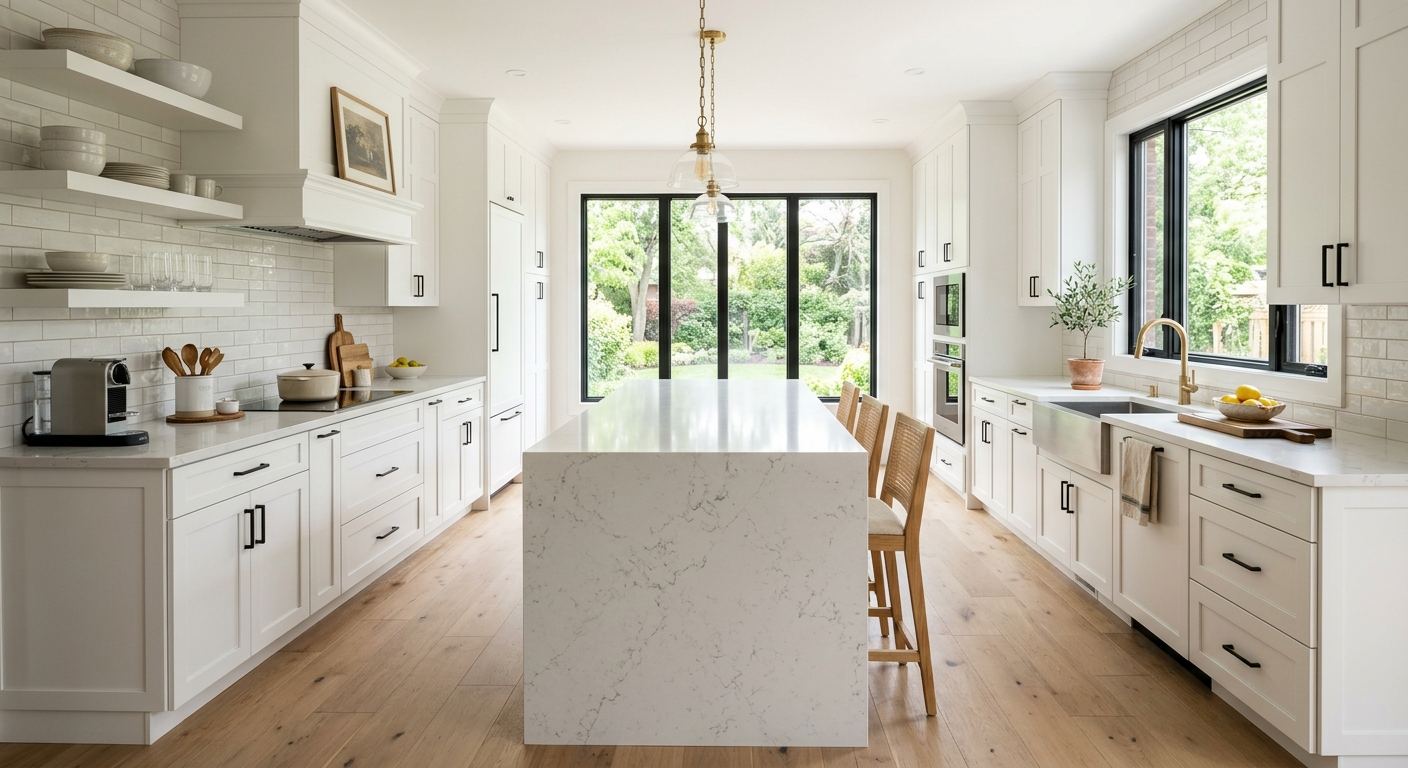
Kitchen renovation options and costs in Gibsons
In Gibsons, British Columbia, homeowners usually start by choosing the renovation “tier,” because the scope you pick determines everything from cabinetry lead times to how much trade work is required. With a median household income of $70,000 (Statistics Canada, 2021 Census), many local clients plan around a practical mid-range finish that still feels updated and resale-friendly. That’s especially true in a community of 4,758 residents (Statistics Canada, 2021 Census), where contractors can be booked but scheduling is often tied to overall Lower Mainland–Southwest demand. If your home is in the older housing stock (37.3% built before 1981), expect more variability: older ducting, dated electrical, and floor irregularities can add hidden labour even when finishes look similar.
In the Lower Mainland–Southwest, pricing is driven more by home value expectations and the finish level you choose than by climate alone. Still, local conditions matter: kitchens here often experience higher humidity swings, and that can affect cabinet face adhesion, grout longevity, and how well new caulking and tile transitions hold around plumbing penetrations. Trade availability is also a real factor—demand concentrates around the same seasonal windows, so lead times for popular cabinet lines and quartz slabs can shift your start date.
In Gibsons, the trade is especially in demand around the downtown core and along the Sea-to-Sky corridor (where many homes are older and layouts are compact), because people want kitchens that work better for entertaining without a full rebuild. Use the table below to compare typical tiers, then match the option to your budget and how much layout change you want.
| Renovation Tier |
What's Included |
Typical Duration |
Price Range |
| Cosmetic refresh (paint, hardware, new appliances only) |
Paint/finish updates, hardware swaps, appliance replacements (no plumbing/electrical changes), light touch-ups |
3–7 days |
$5,000–$18,000 |
| Mid-range full renovation (new cabinets, counters, sink, tile) |
New stock/semi-custom cabinets, new countertop, sink & tap swap, backsplash tile, flooring tie-ins, standard plumbing/electrical updates |
3–6 weeks |
$40,000–$80,000 |
| High-end full renovation (custom cabinets, stone counters, island) |
Fully custom millwork, premium stone (quartz/stone), larger tile scope, island build-out, expanded lighting plan, more complex layout and trade coordination |
6–12 weeks |
$85,000–$120,000 |
| Cabinet refacing only (new doors + drawer fronts, same boxes) |
Door/drawer front replacement, new end panels, existing-box prep, hardware, optional interior organizers |
2–4 weeks |
$8,000–$25,000 |
| Countertop swap only (laminate to quartz or stone) |
Removal and replacement of existing countertop, cut-outs for sink/cooktop (as applicable), standard re-sealing and finishing |
2–5 days |
$3,000–$12,000 |
| Backsplash tile installation only |
Tile supply and install, preparation, grout/seal, caulking around walls and backsplash outlets |
2–6 days |
$1,500–$6,000 |
Prices are estimates only and vary by project scope, site access and material selection.
What affects the price of kitchen renovation in Gibsons
In the Lower Mainland–Southwest and across British Columbia, the same kitchen can come back with bids that differ by roughly 30–50% because labour complexity, material tiers, and the amount of “hidden work” aren’t always captured by a quick site walk. In this region, quotes are often driven more by local home value expectations and the typical finish tier than by climate. Many owners in higher-value Lower Mainland areas (within the wider region) choose quartz or stone counters and semi-custom cabinetry because that cost is easier to justify on resale. In more modest scopes, laminate and stock cabinets keep the project closer to the $40,000–$80,000 mid-range band for full renovations, while premium stone and island builds often push totals toward the $85,000–$120,000 high-end band.
Layout changes are the biggest “unpredictable” cost driver, regardless of finish: removing a wall, adding an island, or moving a gas line or drain line can require additional engineering, longer trade scheduling, and more demolition and patching. Even small plumbing relocations can trigger a chain reaction—subfloor repairs, new venting routes, and electrical updates for new lighting or under-cabinet outlets.
Two concrete examples that commonly swing costs in Gibsons: (1) older homes built before 1981 often have uneven framing and dated electrical runs, so fitting new cabinets and adding circuits for an island can cost more than on a newer layout; (2) if you’re changing the backsplash height or moving outlets to suit a new countertop thickness, tile prep and wall patching can add labour even when the tile line itself looks straightforward. Climate plays a supporting role—humidity can affect how well sealants perform around wet areas, so better prep and ventilation details can prevent callbacks, but it’s rarely the main driver compared with finish selection and layout.
| Price Factor |
Why It Matters |
Cost Impact |
| Cabinet tier — stock vs. semi-custom vs. fully custom millwork |
Custom boxes, door styles, and internal fit reduce rework but increase material cost and lead time |
Typically shifts cabinet portion by about $10,000–$35,000 depending on scope |
| Countertop material — laminate vs. quartz vs. granite vs. stone |
Material cost and fabrication complexity (seams, edge profiles, cut-outs) change pricing |
Often adds $2,000–$10,000 or more versus laminate on similar kitchen sizes |
| Layout change — wall removal, island add, plumbing/gas move |
Demolition, framing, and trade coordination add unpredictability and schedule impact |
Commonly a $8,000–$30,000 swing on “same kitchen, new layout” projects |
| Appliance package tier — builder vs. mid-range vs. pro-grade |
Power requirements, cut-out tolerances, and features (venting, integrated systems) affect labour |
Can vary by $2,500–$15,000 depending on selection |
| Flooring — refinish existing vs. full replacement |
Older subfloors and transitions can require patching, leveling, and matching materials |
Typically ranges from a minor $500–$2,000 to $3,000–$10,000+ for replacement |
| Backsplash — ceramic tile vs. marble vs. full-height slab |
Surface prep and finish installation vary widely by material weight and complexity |
May add $500–$4,000+ over a basic tile scope |
| Electrical — new circuits for island, under-cabinet lighting |
Additional outlets, lighting, and dedicated circuits require licensed work and planning |
Often $800–$4,500+ depending on how many new points are added |
| Permit fees and licensed trade requirements |
Some changes trigger permits and inspections; even when trades are scheduled, paperwork affects time |
Can add $500–$3,000+ plus schedule coordination costs |
Permits & regulations in British Columbia
In British Columbia, many “like-for-like” swaps don’t require a permit, but several common kitchen renovation moves do. Cabinet and countertop swaps typically do not require permits because you’re replacing finishes without changing the building services. Likewise, replacing fixtures in a way that doesn’t move plumbing locations is usually treated as a straightforward replacement.
Where permits and licensed trades do come into play: moving plumbing supply or drain lines, relocating gas connections (for a stove/range or a gas-powered range hood), removing a load-bearing wall, and adding new electrical circuits (for example, new island outlets, dedicated lighting circuits, or significant panel adjustments) generally require permits and inspections. Gas work must be completed by a licensed gas fitter, and electrical work must be done by a licensed electrician—both should be inspected as required by the local process. Always confirm in your contract which scope is responsible for permits, pulls, and inspections; it should be written down, not assumed.
To verify a contractor in Gibsons step-by-step, ask for: (1) a copy of their liability insurance certificate of insurance (COI) with your project named or at least showing coverage and limits; (2) confirmation of the coverage they hold for workers (WSIB/WCB-related coverage, where applicable to their trade arrangements); and (3) their licensing details for trades they perform or sub-contract. Check their credentials through the relevant online registry for licences, and request a clearance letter or updated status proof where available. If they can’t provide documentation quickly, that’s a red flag.
Cabinets, countertops and layout decisions in Gibsons
For a Gibsons kitchen renovation, three decisions determine most of your comfort, look, and long-term resale value: (1) cabinet tier (stock, semi-custom, or custom), (2) countertop material (laminate, quartz, granite, butcher block, marble), and (3) whether you change the layout (open-concept wall removal, island addition, or plumbing/gas relocation). In the Lower Mainland–Southwest, buyers tend to expect clean, durable surfaces—so even when budgets are controlled, the finish tier often becomes the “headline” upgrade. That’s why many projects land in a mid-range band (often $40,000–$80,000) with semi-custom storage and quartz counters, while island builds and premium stone tend to push toward $85,000–$120,000.
Climate matters in a practical way: kitchens here deal with humidity and frequent steam from cooking and dishwashing, so you want materials and sealing systems that tolerate moisture cycles. Quartz and stone generally perform well when properly installed and sealed at transitions; laminate can also work, but it’s more sensitive at seams and edges over time if prep and finishing aren’t done well. Cabinet choices should also reflect aging home realities—older homes built before 1981 may have out-of-square walls, so semi-custom or custom can reduce visible gaps and improve door alignment.
Dollar example: if you’re comparing quartz engineered countertops to marble, a project that adds about $3,000–$6,000 for stone variation and fabrication may be justified if you’re keeping the kitchen as a long-term home and want a higher-end look. If you’re planning a shorter stay or need to control cash flow, quartz typically delivers most of the visual payoff with easier maintenance and fewer worries about staining.
| Option |
Durability |
Maintenance |
Best For |
Price Range |
| Stock cabinets (big-box) |
Good for standard layouts; durability depends on hinge/box build quality |
Low; wipe-down only, watch for moisture at sink edges |
Fast updates with minimal layout changes |
$8,000–$25,000 |
| Semi-custom cabinets (local dealer) |
Very solid; better options for sizing, pull-outs, and interior storage |
Low; easier to keep straight alignment in real-world homes |
Most renovations aiming for strong resale appeal |
$20,000–$45,000 |
| Custom cabinets (local millwork shop) |
Highest fit and finish; best for unusual spaces and tight tolerances |
Low; quality hardware and better seal lines reduce maintenance surprises |
Complex layouts, older-wall irregularities, and premium styling |
$40,000–$75,000+ |
| Laminate countertop |
Decent for everyday use; can be more vulnerable at seams and edges |
Easy; avoid prolonged standing water at cut-outs and seams |
Budget-friendly refresh where you’re upgrading cabinets and tile |
$3,000–$7,000 |
| Quartz engineered countertop |
High durability and consistent appearance; resists staining better than many naturals |
Low; wipe clean, manage heat protection around hot pans |
Balanced choice for the Lower Mainland resale market |
$5,000–$12,000 |
| Granite / natural stone countertop |
Very durable; natural variation can hide wear patterns differently |
Moderate; periodic sealing may be recommended depending on stone and finish |
Owners wanting authentic stone character |
$7,000–$16,000 |
| Butcher block countertop |
Durable with proper oiling; can show dents/scratches over time |
Higher upkeep; requires regular sealing/oiling and gentle care |
Warm, traditional kitchens and heavy “daily use” lifestyles |
$6,000–$13,000 |
| Marble countertop |
Beautiful but softer; can etch and stain if not protected |
Moderate to high; use proper cleaners and consider etching-stain risk |
Design-led, lower-impact cooking households |
$10,000–$22,000 |
How to choose a kitchen renovation contractor in Gibsons
When you’re hiring a contractor in Gibsons, start with verification, not promises. For British Columbia jobs, ask for the contractor’s proof of liability insurance (certificate of insurance) and confirm they have the right coverage for their workers and subcontractors (WSIB/WCB-related coverage where applicable). If they’re doing trades like electrical or gas-related scopes, you should still see licence details for the licensed trades involved—don’t accept “we have a guy.” To check, look up their licence status through the relevant BC online registry resources, request updated documentation, and ensure the certificate of insurance is current and covers your project timing. If something goes wrong, you want someone who can show coverage and stand behind workmanship.
Next, get 2–3 itemised written quotes with labour and materials separated, not a single lump sum. A good quote lists cabinet pricing (tier and model), countertop allowance, tile quantities/backsplash height assumptions, plumbing/electrical scope, and whether disposal and protection are included. Read what’s excluded: removal and haul-away, drywall patching, subfloor leveling, temporary power, and permit pulling (if required) should be clearly stated. Ask about warranty coverage: workmanship warranty length, how manufacturer warranties apply to cabinets/counters, and whether warranties are transferable to the homeowner. Payment schedules matter—never pay more than 10–15% upfront, and hold back a portion until the job is complete and deficiencies are corrected. Finally, demand a start date and completion estimate in writing so you have a timeline you can actually plan around.
- Request licence details for relevant trade scopes and verify them before signing.
- Confirm liability insurance COI is current and includes adequate limits for renovations.
- Ask how WSIB/WCB-related coverage is handled for their crew/sub-trades.
- Get 2–3 itemised quotes with labour + materials breakdown (not lump sum only).
- Verify cabinet tier: stock vs semi-custom vs custom, and what “allowances” cover.
- Confirm countertop details: thickness, edge profile, sink cut-out assumptions.
- Clarify tile scope: backsplash height, outlet treatment, and floor tie-ins.
- Check whether disposal/haul-away is included in the quoted price.
- Confirm permit responsibility: what’s needed and who pulls it, if applicable.
- Review warranty terms in writing (workmanship vs product/manufacturer warranty).
- Ensure payment schedule is staged with a holdback until close-out.
- Get a written schedule: demo date, cabinet/counter install dates, final inspection/close.
In Gibsons, common red flags include: refusing to provide an itemised quote (only a single lump sum), vague warranty terms (“we’ll fix it” without timelines), starting without proof of insurance, promising countertop or cabinet delivery dates without acknowledging lead times, and asking for large deposits (more than 10–15%) before anything measurable is underway.
Frequently asked questions — kitchen renovation in Gibsons
How much does a kitchen renovation cost in Gibsons?
In Gibsons, pricing usually tracks the Lower Mainland finish tier expectations more than climate. A cosmetic refresh (paint, hardware, and new appliances only) often stays in the $5,000–$18,000 range. For a full mid-range remodel with new cabinets, counters, a sink, and backsplash tile, many projects land around $40,000–$80,000. If you’re going into a high-end scope with custom cabinets, stone counters, and an island build-out, totals more commonly move into $85,000–$120,000. Your quote can rise quickly if you’re changing layout, moving plumbing or gas connections, or adding new electrical circuits.
How long does a kitchen renovation take in Gibsons?
Timelines vary mainly with product lead times and whether you’re changing plumbing, gas, or electrical layouts. A cosmetic refresh is often the quickest at about 3–7 days. A mid-range full renovation typically takes around 3–6 weeks for demo, rough work, cabinetry installation, countertop fabrication/templating, and finishing. High-end projects with custom millwork and island work commonly run 6–12 weeks. In Gibsons and the wider Lower Mainland–Southwest, cabinet and quartz scheduling can push dates, so the best way to keep to a plan is to lock materials early and get a written schedule that names key milestones.
Quartz vs granite countertops — which is better?
For most Gibsons homeowners, quartz is the “low-drama” winner. It’s engineered, typically more consistent in appearance, and generally resists staining better for everyday cooking habits. Granite is durable and beautiful with natural variation, but it may require periodic sealing depending on the stone and finish, and it can show differences that some people love and others find unpredictable. If you’re choosing between the two primarily for resale appeal and ease, quartz often aligns with the mid-range-to-premium expectations in the Lower Mainland–Southwest. As a cost reference, countertop swaps alone (depending on size and cut-outs) often fall within $3,000–$12,000, and natural stone can increase that end of the range depending on slabs and fabrication complexity.
Should I reface or replace my cabinets?
Refacing can be a strong choice when your existing cabinet boxes are solid, level, and not water-damaged—especially if you want a fresh look without tearing everything out. Replacing cabinets makes more sense when boxes are sagging, walls are out of square, or you want a totally different storage plan (pull-outs, taller pantry columns, new internal organizers). In terms of ballpark costs, refacing only is often in the $8,000–$25,000 range, while full cabinet replacement sits much higher within the broader full renovation tiers (often $40,000–$80,000 for mid-range scopes). In older Gibsons homes built before 1981, I often see refacing work best when the base boxes are intact and the layout doesn’t require major changes.
Do I need a permit for a kitchen renovation in British Columbia?
In British Columbia, cabinet and countertop swaps generally don’t require permits because you’re replacing finishes, not altering building systems. However, permits and licensed trades are typically required when you move plumbing supply or drain lines, relocate gas connections, remove a load-bearing wall, or add new electrical circuits (for example, new island outlets or major under-cabinet lighting runs). Gas work must be done by a licensed gas fitter and electrical by a licensed electrician, with inspections as required. For a Gibsons homeowner, the simplest protection is to ask your contractor—before signing—who is pulling permits, what will be inspected, and to have that responsibility spelled out in your written contract.
What's the ROI on a kitchen renovation?
ROI varies because it depends on how much value you add versus what buyers in your area expect visually and functionally. In the Lower Mainland–Southwest, kitchens are usually value-led by finish tier: practical mid-range updates (new cabinets and quartz counters) tend to perform better than “cheap-looking” refreshes, while high-end custom and stone work can pay off when it matches the home’s overall value and buyer expectations. It’s also influenced by layout—smart storage and better flow often matter more than one premium material choice. Because housing stock in Gibsons includes a substantial share of older homes (37.3% built before 1981), improvements that address functional issues (circulation, outlets placement, better ventilation) can be especially compelling to buyers. For budgeting, many homeowners target the $40,000–$80,000 band for a balanced ROI, then decide on premium upgrades only where they’re consistent with the home’s market.