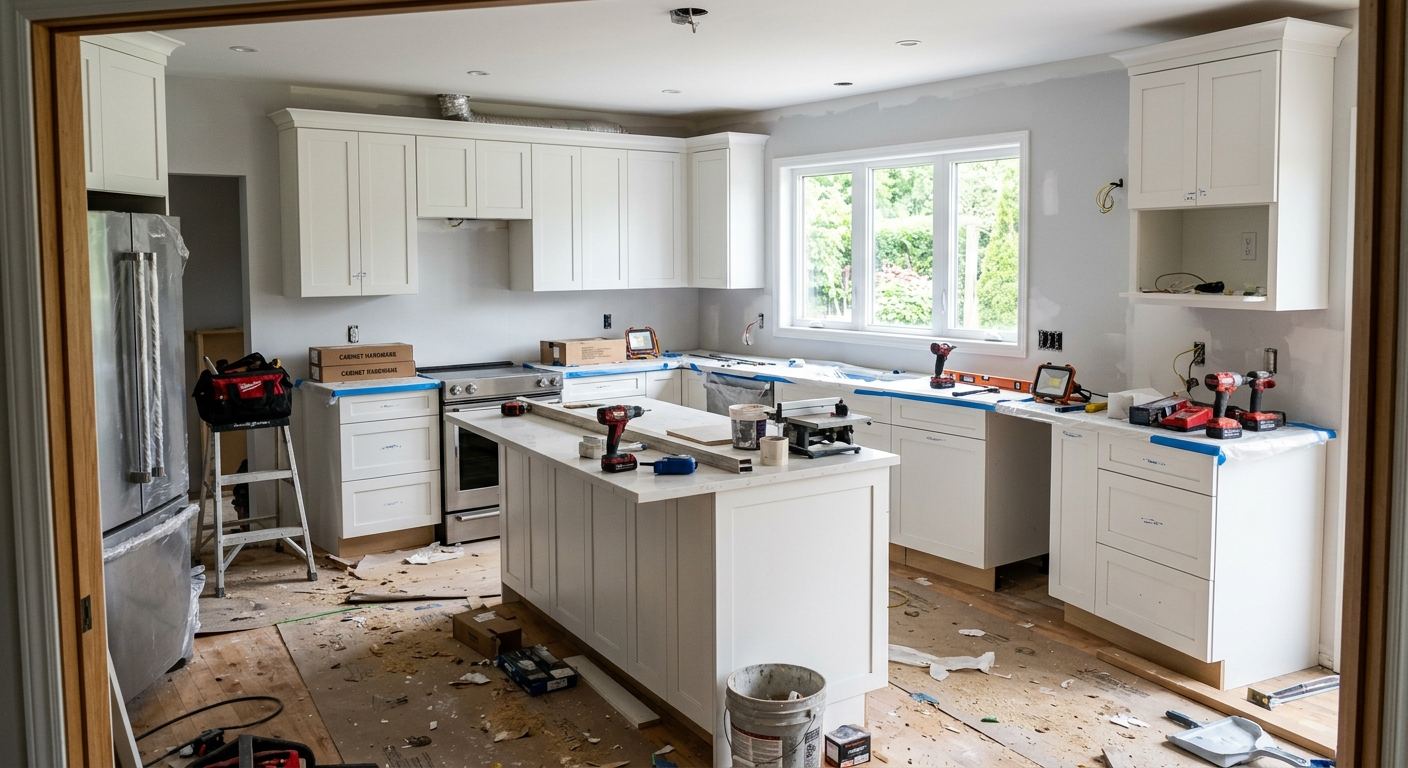
Kitchen renovation options and costs in Agassiz
In Agassiz, kitchen renovations tend to follow predictable price logic: the scope you choose matters more than the weather alone, but the Lower Mainland–Southwest market influences what finishes homeowners expect when they open a quote. With a population of about 6,300 (Statistics Canada, 2021 Census), the town’s renovation work is often tied to trades’ availability from the broader Fraser Valley corridor, which can affect scheduling and lead times for cabinets and stone. At the same time, the Lower Mainland–Southwest is strongly driven by regional resale expectations—owners commonly target the same “mainstream premium” look you’d see across nearby communities, rather than choosing ultra-budget materials.
Across British Columbia, the widest swings in cost usually come from finish level and cabinetry complexity, not from a climate-driven building envelope issue. That’s because kitchen pricing is “market-led” here: in higher-value areas of the Lower Mainland, homeowners more often pick semi-custom or custom cabinetry, quartz or stone counters, and upgraded hardware, which raises labour and material totals. Even though Agassiz doesn’t typically have Metro Vancouver’s highest-end pricing pressure, the region still pulls contractors and supply chains toward those finishes. For many homes, especially older stock, a practical refresh can stay in the lower bands, while a full remodel can quickly move into the higher range once you add an island, change plumbing/gas, or rework the floor plan.
If you’re deciding between tiers, the comparison table below is the fastest way to line up what most homeowners get in each option—then you can match the tier to your goals before we talk specifics like cabinets, counters, and layout.
| Renovation Tier |
What's Included |
Typical Duration |
Price Range |
| Cosmetic refresh (paint, hardware, new appliances only) |
Cabinet paint or refinish (where applicable), new pulls/knobs, appliance swap (range/fridge/dishwasher), minor caulking, basic cleaning and touch-ups |
5–10 business days |
$8,000–$25,000 |
| Mid-range full renovation (new cabinets, counters, sink, tile) |
New cabinetry (stock to semi-custom), countertops, sink and faucet, backsplash tile, under-cabinet sealing, new flooring sections or tile replacement as needed |
3–6 weeks |
$40,000–$80,000 |
| High-end full renovation (custom cabinets, stone counters, island) |
Custom/fully custom millwork, stone counters (quartz/stone), island or peninsula with updated storage, upgraded hardware, designer backsplash, higher-spec finishes |
6–12 weeks |
$90,000–$120,000 |
| Cabinet refacing only (new doors + drawer fronts, same boxes) |
New doors/drawer fronts and veneers, new hardware, light prep and alignment, limited hardware and trim upgrades |
1–3 weeks |
$8,000–$35,000 |
| Countertop swap only (laminate to quartz or stone) |
Remove and dispose of existing top, install new countertop material, sink cutout adjustments, basic reseal |
3–10 business days |
$5,000–$12,000 |
| Backsplash tile installation only |
Tile supply and install (typical kitchen coverage), surface prep, grout/seal, standard trim and caulking |
3–7 business days |
$1,500–$6,000 |
Prices are estimates only and vary by project scope, site access and material selection.
What affects the price of kitchen renovation in Agassiz
Two homeowners in the Lower Mainland–Southwest can receive quotes that differ by 30–50% for what sounds like the same kitchen, and it usually comes down to market and finish decisions rather than climate. Home values and household income expectations influence the finish tier homeowners default to—quartz or stone counters and semi-custom cabinetry are common choices when the renovation can be “paid back” through stronger resale appeal. In more modest scopes, laminate and stock cabinetry dominate because they reduce risk while still modernizing the space.
Layout changes are the most unpredictable part of the estimate because they trigger multiple trades at once: removing a wall, adding an island, moving a sink, or relocating a gas line forces structural checks, plumbing work, electrical adjustments, and sometimes permit requirements. That’s why a kitchen that starts as a straightforward refresh can drift toward a mid-range full renovation once you start moving plumbing/gas.
In Agassiz, you’ll typically see cost pressure go up or down in a few concrete ways: (1) older homes may have out-of-level walls or uneven subfloors, increasing shimming and labour before cabinets can sit properly; (2) limited parking or narrow driveways can slow material delivery, raising jobsite coordination time; and (3) choosing premium stone or full-height tile backsplashes tends to add both material cost and extra install time. On the other hand, if you stay within the backbone full renovation band—say aligning the job closer to $40,000–$80,000 rather than building a stone-and-island package—the labour and trade coordination stays more contained.
For a price anchor, countertop-only upgrades often sit around the $3,000–$12,000 band depending on the material, while a cabinet-focused scope can land anywhere in the $8,000–$50,000 range. Flooring and lighting choices then decide whether you keep the project lean or push it into the $90,000–$120,000 territory.
| Price Factor |
Why It Matters |
Cost Impact |
| Cabinet tier — stock vs. semi-custom vs. fully custom millwork |
Higher tiers use better materials, tighter tolerances, more storage options, and more labour-intensive fitting |
Can shift the project by tens of thousands, often the biggest driver of total cost within the same kitchen footprint |
| Countertop material — laminate vs. quartz vs. granite vs. stone |
Material price and fabrication complexity vary; edge profiles and undermount sink cutouts increase labour |
Typically adds a few thousand to upgrade; premium stone can push totals toward the upper bands |
| Layout change — wall removal, island add, plumbing/gas move |
Triggers structural, plumbing, and electrical work plus more site coordination |
Often the costiest “surprise” because it’s bundled across trades |
| Appliance package tier — builder vs. mid-range vs. pro-grade |
Higher tiers can require upgrades to ventilation, power, and sometimes cabinet framing |
Can add several thousand quickly; pro-grade suites raise both parts and install time |
| Flooring — refinish existing vs. full replacement |
If you replace flooring, removal/patching becomes part of the scope and may affect cabinet installation levels |
Refinishing is usually cheaper; full replacement adds labour and downtime |
| Backsplash — ceramic tile vs. marble vs. full-height slab |
Stone and full-height coverage need more precise cutting, sealing, and labour time |
Backsplash can range from low thousands to mid/high thousands depending on material and height |
| Electrical — new circuits for island, under-cabinet lighting |
More lights and dedicated circuits mean licensed electrician time and component cost |
Can noticeably increase the allowance even when cabinets and counters stay the same |
| Permit fees and licensed trade requirements |
Permits and inspections add administration time; licensed trades can’t be substituted |
Most often increases both cost and schedule, especially for plumbing/gas/electrical changes |
Permits & regulations in British Columbia
In British Columbia, simple cabinet and countertop swaps typically do not require a permit. Replacing like-for-like countertops, reinstalling cabinets in the same footprint, and installing a new backsplash usually fall into “no permit” territory. However, permits and licensed trades are commonly required when you change the kitchen’s systems or structure—specifically moving plumbing supply or drain lines, relocating a gas stove/range setup, removing a load-bearing wall, or adding new electrical circuits (for example, extra outlets or an island lighting run that needs a dedicated circuit).
Gas work must be done by a licensed gas fitter, and any electrical work must be done by a licensed electrician. Both typically require inspections once installed, so your timeline can’t just be “cabinet lead time plus stone fabrication.” Before you sign anything, confirm who pulls permits in the written contract, because responsibility for permits isn’t a handshake item—it should be explicit.
To verify a contractor in Agassiz, start with three checks: (1) licensing—ask for their contractor and trade licence numbers and verify them through the appropriate provincial online listings; (2) liability insurance—request a current certificate of insurance showing the effective dates and coverage limits; and (3) worker coverage—confirm they carry WSIB/WCB coverage where required. Also ask for a clearance letter or proof of coverage. Keep copies with your contract so you’re protected if anything goes wrong.
Cabinets, countertops and layout decisions in Agassiz
The three decisions that most influence your outcome in an Agassiz kitchen renovation are: (1) cabinet tier, (2) countertop material, and (3) whether you change the layout. In the Lower Mainland–Southwest, buyers and appraisers often respond quickly to a clean, updated cabinet and countertop combination. That means even if climate isn’t the driver, your chosen finish still needs to look right for resale—especially when you plan to market the home after renovations.
Cabinet tier: stock is fastest and cheapest, semi-custom is the most common “best value” choice, and custom millwork is where you pay for perfect fit and storage efficiency. Countertops: laminate is budget-friendly but less durable than engineered quartz; quartz is a popular middle ground with strong stain/impact resistance; granite and other natural stone add high-end appeal but can require sealing and more careful maintenance. Layout: removing a wall, adding an island, or relocating plumbing/gas is justified when it meaningfully improves flow and storage—not just for appearance.
Lower Mainland–Southwest resale expectations also shape your material choices. At the mid-range level, quartz paired with semi-custom cabinets often lands in the $40,000–$80,000 band for a full refresh-plus-replace scope. If you jump to custom cabinets and an island with stone counters, you’re commonly in the $90,000–$120,000 band. As a concrete example, if your plan is simply replacing countertops, moving from laminate to quartz might raise your countertop line by a few thousand, but it can be a smart upgrade compared to reworking the plumbing/gas just to “add a feature.”
Finally, consider Agassiz housing stock: older homes can have walls that aren’t perfectly plumb, which makes cabinet and countertop installation quality more important than the material name alone. Paying for professional layout and proper shimming often protects the look you’re paying for.
| Option |
Durability |
Maintenance |
Best For |
Price Range |
| Stock cabinets (big-box) |
Solid for everyday use, but limited sizing and less storage variety |
Routine cleaning; minor adjustments if walls aren’t perfectly level |
Fast timelines and lean budgets |
$8,000–$25,000 |
| Semi-custom cabinets (local dealer) |
Good build quality with more storage options and better fit |
Low day-to-day care; depends on finish type |
Most mid-range renovations seeking a “custom look” |
$20,000–$60,000 |
| Custom cabinets (local millwork shop) |
Highest precision; best for awkward spaces and tailored storage |
Low day-to-day care; long-term finish care follows manufacturer guidance |
Homes where fit, storage planning, and design are priorities |
$45,000–$90,000+ |
| Laminate countertop |
Durable enough for light-to-average use; can chip at edges if impacts occur |
Wipe clean; avoid soaking seams |
Budget-focused updates |
$3,000–$6,000 |
| Quartz engineered countertop |
Very resistant to stains and typical kitchen wear |
Low maintenance; no sealing required for most quartz |
Busy households wanting a premium look without heavy upkeep |
$6,000–$10,500 |
| Granite / natural stone countertop |
Hard and resilient; variations in stone density affect performance |
Sealing often required; periodic maintenance based on stone type |
Premium appearance and a unique, natural pattern |
$8,000–$12,000 |
| Butcher block countertop |
Good durability, but sensitive to standing water and cuts if not maintained |
Oil/condition regularly; protect from heat and moisture |
Warm, traditional or farmhouse-style kitchens |
$4,000–$8,000 |
| Marble countertop |
Beautiful but softer; can etch or scratch more easily than quartz/granite |
Requires diligent sealing and gentle cleaning to prevent etching |
Design-forward kitchens where maintenance expectations are clear |
$10,000–$14,000+ |
How to choose a kitchen renovation contractor in Agassiz
When you’re hiring a kitchen renovation contractor in Agassiz, the goal is to confirm they’re properly licensed, insured, and accountable before work starts. In British Columbia, electrical and gas-related work must be handled by licensed professionals, so you should verify that the contractor coordinates licensed trades and can show proof of coverage. Ask for their liability insurance certificate (active dates, coverage limits), and request evidence of WSIB/WCB coverage for their workers. For licensing, ask for the correct licence numbers and check them using provincial online registries; don’t rely only on verbal confirmation.
Next, get 2–3 itemised written quotes. You want a labour-and-material breakdown—not a single lump-sum—so you can compare cabinet supply method, countertop fabrication inclusions, backsplash tile type, demo/disposal, and electrical/plumbing allowances. Read exclusions carefully: is demolition included, is disposal included, are you paying for any mould remediation, and is the permit pulling included when required?
Warranty should be clear and practical: ask for workmanship warranty length and what’s covered (for example, cabinet install adjustments, caulking rework, and countertop support). Also ask how product/manufacturer warranties work and whether they transfer to you if you sell the home.
On payment terms, never pay more than 10–15% upfront. Hold back a portion until the job is substantially complete, especially after cabinets and stone are installed and functionality is confirmed. Finally, insist on a written start date and completion estimate; kitchen renovations are often limited by cabinet/stone lead times, so timelines should be realistic, not optimistic.
- Ask who pulls permits (if any) and confirm it in writing.
- Verify liability insurance certificate dates and coverage limits.
- Confirm WSIB/WCB coverage and request proof/clearance.
- Require itemised quotes for demo, disposal, install, and finish work.
- Check cabinet scope: are hardware, toe-kicks, and fillers included?
- Confirm countertop scope: sink cutout details, edge profile, and seam plan.
- Ask how uneven walls/older framing will be handled (shimming, re-leveling).
- Clarify what happens if materials arrive late (schedule adjustments).
- Review warranty in plain language: length, coverage, and exclusions.
- Use staged payments tied to milestones (demo, cabinetry set, counters installed).
- Ensure cleanup and dust control are included in the scope.
- Get a written schedule with dependencies (cabinet lead time, stone fabrication).
Red flags I see frequently in Agassiz kitchen jobs: (1) “all-in” quotes with no itemised allowances, (2) no written permit/electrical/gas responsibility clarity, (3) pushing for large upfront payments beyond 10–15%, (4) weak warranty language or no workmanship terms, and (5) contractors who won’t provide insurance/coverage proof when asked.
Frequently asked questions — kitchen renovation in Agassiz
How long does a kitchen renovation take in Agassiz?
In Agassiz, timelines usually depend on how much you change the kitchen systems. A cosmetic refresh (paint, hardware, appliances) can often be completed in about 5–10 business days. A mid-range full renovation typically takes 3–6 weeks once cabinets and counters are on site, and a high-end custom scope can stretch to 6–12 weeks due to millwork lead times and stone fabrication. If your project includes layout changes—like moving a sink, adding an island, or relocating gas—plan extra time for inspections and coordination between trades. The Lower Mainland–Southwest market can also affect delivery schedules, so a good contractor will confirm cabinet and countertop lead times early in the process. (Statistics Canada, 2021 Census)
Quartz vs granite countertops — which is better?
For most homeowners in British Columbia, quartz is the “easy-care” winner. Quartz is engineered for consistent appearance and typically performs very well against everyday stains and impacts; it usually doesn’t require routine sealing in the way some natural stones do. Granite offers unique natural variation and a high-end look, but it often needs sealing and more careful maintenance based on the specific stone and finish. If you’re trying to stay within a common full renovation budget (for example, closer to $40,000–$80,000 rather than an island-heavy premium rebuild), quartz is often the practical premium. If you want a one-of-a-kind pattern and you’re comfortable with maintenance routines, granite can be worth the upgrade.
Should I reface or replace my cabinets?
Refacing is usually the right move when the existing cabinet boxes are solid, the layout is staying the same, and you want a quicker, less invasive upgrade. It generally keeps the demolition and plumbing/electrical scope smaller, so it can be a strong ROI option for homeowners trying to modernize without a full rebuild. Replacement is better when boxes are sagging, water-damaged, poorly aligned, or when you need significant layout changes (like deeper storage, new pull-outs, or a reconfigured island). In Agassiz, where older homes can have out-of-level walls, refacing can still work, but your installer must ensure proper alignment and shimming. If you’re planning a larger scope that includes new counters and tile, replacing cabinets often pairs better with the upgraded look buyers expect.
Do I need a permit for a kitchen renovation in British Columbia?
Often, you do not need a permit for straightforward cabinet and countertop replacements in British Columbia. Swapping countertops, reinstalling cabinets in the same footprint, and installing a backsplash typically don’t trigger permits. You do typically need permits—and licensed trades—for work that changes the kitchen’s systems: moving plumbing supply or drain lines, relocating gas components (like the range setup), removing a load-bearing wall, or adding electrical circuits (including certain island outlet or lighting scenarios). Gas work must be done by a licensed gas fitter, and electrical by a licensed electrician, with inspections after installation. Before signing, confirm in your contract who pulls permits and who schedules inspections—permit responsibility should be spelled out in writing.
What's the ROI on a kitchen renovation?
ROI in Agassiz isn’t one-size-fits-all, but your best returns usually come from choices that buyers recognize instantly: updated cabinet fronts (or new cabinetry), countertops that look current, and an overall clean layout. The Lower Mainland–Southwest market tends to reward practical “mid-range premium” finishes more consistently than ultra-budget materials, which is why many homeowners move toward semi-custom cabinets and quartz. If you keep your project within common bands—such as a mid-range full renovation around $40,000–$80,000—you’re less likely to overspend relative to what the home’s resale market supports. The most common ROI trap is spending heavily on layout changes (or premium stone) without a plan that improves function and flow. In other words: spend where it’s visible, but also where it’s useful.
How do I budget for a kitchen renovation?
Start by choosing a renovation tier based on what you want to change. If you’re only updating surfaces and appliances, a cosmetic refresh is often the leanest route, while a full renovation that includes cabinets, counters, sink and tile moves you toward the bigger ranges. Use local bands as anchors: a full kitchen renovation in this tier typically sits between $40,000–$120,000, countertop-only upgrades often fall around $3,000–$12,000, and cabinet-related scopes commonly range from $8,000–$50,000. Add a contingency for surprises—especially in older homes where walls aren’t perfectly level or where concealed damage appears after demo. Finally, insist on itemised quotes so you can see what’s included for permits, disposal, electrical/gas allowances, and flooring transitions. This prevents “budget creep” before it starts.