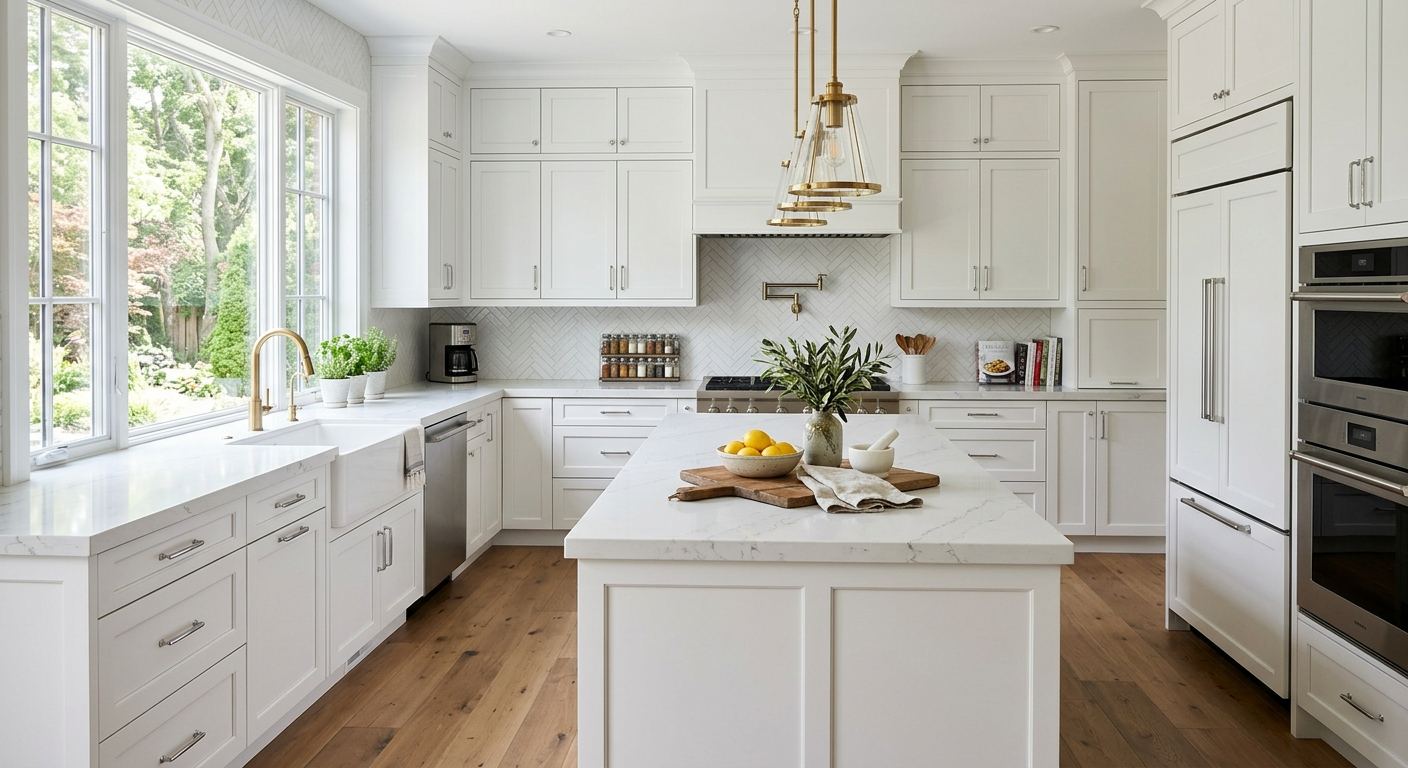
Kitchen renovation options and costs in Juniper Ridge
Kitchen renovations in Juniper Ridge typically start with a decision about how “fresh” you want the space to feel and how long you plan to stay in the home. With a local population of 4,151 (Statistics Canada, 2021 Census), the area draws steady demand for practical upgrades—especially in neighbourhood pockets near older resale housing where owners want a modern look without triggering a major rebuild. In the Lower Mainland–Southwest, pricing is less about climate damage and more about buyer expectations on resale. Even though costs are regional, your neighbours’ finish choices often track broader market income and home-value expectations across the Lower Mainland–Southwest, which tends to steer homeowners toward semi-custom cabinetry and upgraded surfaces rather than purely bargain refreshes.
Contractor availability and scheduling also matter in Juniper Ridge. When demand runs high, labour pricing can rise, and wait times can add friction to projects that need coordinated trades (cabinet installers, countertop fabricators, tile and electricians). Weather in British Columbia does influence site logistics—especially for dust control, ventilation, and drying time during trades—but the biggest driver of total cost is still scope: whether you’re keeping the layout or changing plumbing, gas, electrical, and ventilation paths.
In nearby Surrey and the wider South Fraser corridor, kitchen contractors are particularly busy, and that demand often ripples into the scheduling and pricing homeowners see. That’s why the same kitchen size can land as a cosmetic refresh or move into a full renovation band depending on how far you go—use the table below to compare typical options.
| Renovation Tier |
What's Included |
Typical Duration |
Price Range |
| Cosmetic refresh (paint, hardware, new appliances only) |
Cabinet paint/stain or repaint, new hardware, appliance swap, caulking/trim touch-ups |
5–10 business days |
$8,000–$22,000 |
| Mid-range full renovation (new cabinets, counters, sink, tile) |
New semi-custom cabinets, countertop install, sink and faucet, backsplash tile, demo and disposal |
3–6 weeks |
$40,000–$75,000 |
| High-end full renovation (custom cabinets, stone counters, island) |
Fully custom millwork, quartz/stone counters, island build, upgraded hardware, premium backsplash and detailing |
6–10 weeks |
$85,000–$120,000 |
| Cabinet refacing only (new doors + drawer fronts, same boxes) |
Replace doors/drawer fronts, new trim/finish, re-hang hardware, limited surface prep |
2–4 weeks |
$18,000–$35,000 |
| Countertop swap only (laminate to quartz or stone) |
Remove and install new countertops, cut-outs for sink/edge finishing, basic sealing |
3–7 business days |
$6,000–$16,000 |
| Backsplash tile installation only |
Tile supply allowance, install, grout/seal, finish trim and tidy-up |
5–10 business days |
$1,500–$6,000 |
Prices are estimates only and vary by project scope, site access and material selection.
What affects the price of kitchen renovation in Juniper Ridge
In Juniper Ridge and across the Lower Mainland–Southwest, quotes for the “same” kitchen can differ by 30–50% because homeowners don’t just buy materials—they buy finish level, design complexity, and the amount of structural and utility work required. In higher-value Metro Vancouver pockets, many buyers default to quartz or stone counters, semi-custom or custom cabinetry, and design-led layouts (often including island upgrades and coordinated lighting). In more modest scopes, laminate surfaces and stock cabinetry are common, keeping the renovation closer to a refresh band.
Climate in British Columbia is usually not the main reason kitchen costs swing; it’s more about what the market expects and what the trades can price efficiently. That said, the Lower Mainland–Southwest market does create real cost pressure: when home values and expected resale appeal are high, owners tend to treat cabinetry and countertops as “value recovery” upgrades. When the plan is practical and you stay in the same footprint, you can often land closer to cabinet installation/refacing pricing bands and the countertop installation band. But once you start layout changes—removing a wall, adding an island, or moving a gas line—the uncertainty rises because every trade needs access and the utility path determines materials and labour.
Concrete examples I see in Juniper Ridge: (1) an island added in a kitchen with older venting can trigger extra electrical and ventilation work, pushing a mid-range renovation toward the high-end band; (2) replacing rotting cabinet bases often isn’t visible until demo, which can shift “cosmetic” plans upward quickly; and (3) full-height tile backsplashes or slab-style backs increase tile time and require tighter measurement around outlets and trim. Even a countertop swap—from laminate to quartz—can add cost once edge profiles and sink cut-outs are considered, but it’s one of the most predictable upgrades within the countertop installation price band.
| Price Factor |
Why It Matters |
Cost Impact |
| Cabinet tier — stock vs. semi-custom vs. fully custom millwork |
Custom boxes, internal storage, and fit/finish change both material cost and install time |
Typically the largest swing; can move a project across major price bands |
| Countertop material — laminate vs. quartz vs. granite vs. stone |
Material plus fabrication/edge complexity; stone can require more labour handling |
Can add thousands depending on thickness, edges, and sink/edge cuts |
| Layout change — wall removal, island add, plumbing/gas move |
Triggers additional framing, trades coordination, and potential permitting |
Often the biggest “unpredictable” cost, regardless of finish level |
| Appliance package tier — builder vs. mid-range vs. pro-grade |
Electrical/venting specs and install details differ by tier and model |
Usually moderate, but can rise quickly with premium ranges/hoods |
| Flooring — refinish existing vs. full replacement |
Subfloor condition and transition details drive labour and materials |
Can add a noticeable premium if subfloor repairs are needed |
| Backsplash — ceramic tile vs. marble vs. full-height slab |
Higher-end tile/slab increases cutting, layout time, and material handling |
Can shift a small add-on into a mid-scope line item |
| Electrical — new circuits for island, under-cabinet lighting |
Upgraded lighting and circuits require licensed work and careful routing |
Cost varies widely based on number of runs and complexity |
| Permit fees and licensed trade requirements |
Some work requires permits and inspections; this adds scheduling and administrative steps |
Usually manageable, but can be significant if multiple permits are triggered |
Permits & regulations in British Columbia
In British Columbia, cabinet and countertop swaps typically do not require a permit as long as you’re not changing plumbing or electrical connections beyond what’s needed for standard installation. For a Juniper Ridge homeowner, that usually means you can replace cabinets, swap countertop surfaces, update a backsplash, or change fixtures like a sink faucet without permits—provided you’re not moving supply/drain locations.
Where permits and licensed trades enter the picture is when you change the “service path” or the structure. Work that typically DOES require permits and licensed trades includes: relocating plumbing supply or drain lines; moving or installing gas connections (including stove/range changes and any range hood venting that’s tied to gas appliances); removing a load-bearing wall or making structural changes; and adding or altering electrical circuits (like new island receptacles, dedicated circuits for appliances, or under-cabinet lighting when it involves new wiring). Gas work must be performed by a licensed gas fitter, and electrical work by a licensed electrician, with inspections arranged for the completed work.
How to verify your contractor’s licence and coverage in Juniper Ridge (step-by-step): 1) Request their licence details and look them up in the appropriate provincial online registry (you can usually find it from the trade regulator pages); 2) Ask for a current certificate of insurance (liability) naming you as applicable and confirm coverage for renovation work; 3) Request evidence of WSIB/WCB coverage for workers (often provided as a clearance letter or similar proof); 4) Ensure the written contract clearly states who pulls permits (you want this explicitly assigned before you sign).
Cabinets, countertops and layout decisions in Juniper Ridge
In Juniper Ridge, the three most consequential decisions for cost and resale appeal are: (1) cabinet tier, (2) countertop material, and (3) layout changes. Cabinet tier sets your baseline because it affects not only the price but also the fit, storage functionality, and how quickly the job can be installed. Stock cabinets are the fastest and cheapest option, while semi-custom (the most popular mid-range choice) balances local lead times with better height, door styles, and storage features. Fully custom cabinetry creates the best fit for tricky corners and uneven walls, but it’s also the most expensive and the most sensitive to design revisions.
For countertops, the market in the Lower Mainland–Southwest generally rewards durability and appearance—especially for quartz/engineered stone versus laminate. Laminate is budget-friendly and durable enough for everyday cooking, but it doesn’t match the “premium” feel buyers expect in higher finish tiers. Quartz engineered countertops are a common sweet spot: they resist staining and stand up well in homes with active families. Natural stone like granite looks upscale and lasts, but it can involve higher material and fabrication costs and more attention to sealing depending on the stone.
Layout changes are where costs can jump fastest. Removing a wall or adding an island can justify the spend when it improves flow, adds seating, or makes the kitchen more functional for entertaining—however, moving plumbing or gas lines typically drives the project toward the full renovation bands. For example, keeping plumbing in place while upgrading from stock cabinets to semi-custom and swapping to quartz may keep you within a mid-range full renovation. But if you add an island and shift plumbing for a new sink, the extra electrical and plumbing coordination can push the budget closer to the high-end full renovation range.
| Option |
Durability |
Maintenance |
Best For |
Price Range |
| Stock cabinets (big-box) |
Good for straightforward runs; limited flexibility for corners |
Low; keep hinges adjusted and clean regularly |
Speed, tight budgets, basic updates |
$8,000–$22,000 |
| Semi-custom cabinets (local dealer) |
Very good; better fit and storage layouts |
Low to moderate; routine cleaning and hardware care |
Most Juniper Ridge homeowners aiming for resale appeal |
$20,000–$45,000 |
| Custom cabinets (local millwork shop) |
Excellent; optimized storage and exact sizing |
Low; built for longevity with careful installation |
Complex layouts, off-standard wall conditions, premium designs |
$45,000–$85,000 |
| Laminate countertop |
Good day-to-day; edges are more vulnerable than stone |
Low; avoid heavy impact and moisture at seams |
Budget-conscious refreshes |
$3,000–$6,500 |
| Quartz engineered countertop |
Very good; resistant to staining and everyday scratches |
Low; wipe-clean routine |
Busy households and buyers seeking a premium look |
$5,500–$12,000 |
| Granite / natural stone countertop |
Excellent; heat tolerant but varies by slab |
Moderate; sealing may be needed based on stone type |
High-end finishes and unique stone appearance |
$7,000–$14,000 |
| Butcher block countertop |
Good; can scar and needs ongoing care |
Moderate to high; oiling and maintenance required |
Warm, casual style and frequent food prep |
$4,500–$9,000 |
| Marble countertop |
Beautiful but softer; can be more susceptible to etching |
Moderate; sealing and gentler cleaning |
Low-traffic showpiece kitchens and premium aesthetics |
$9,000–$14,500 |
How to choose a kitchen renovation contractor in Juniper Ridge
Choosing the right kitchen contractor in Juniper Ridge starts with proof, not promises. In British Columbia, confirm the contractor’s licensing for the trades they control (especially when plumbing, gas, or electrical work is included). Ask for their certificate of insurance (liability coverage) and request evidence of WSIB/WCB coverage for workers (often provided as a clearance letter). If they can’t produce documents on request, that’s usually a sign to slow down and get clarification.
Next, get 2–3 itemised written quotes with clear line items for labour and materials—don’t accept a single lump sum that hides allowances. You want the quote to show what’s included (demo, haul-away/disposal, cabinet install, countertop fabrication coordination, tile prep, electrical rough-ins) and what’s excluded (permit pull, drywall patching, subfloor repairs, or the cost of bringing electrical/plumbing to a revised layout). If permits are required, confirm who is pulling them and whether any fees are included or listed as a separate allowance.
On warranty, ask for two layers: the workmanship warranty length, and the manufacturer/product warranty coverage for cabinets, countertops, and any tile systems. Also confirm whether warranties are transferable if you sell the home. For payments, use a schedule that protects you—never pay more than about 10–15% upfront and use a holdback until key completion milestones are met. Finally, require a written timeline with a start date and a completion estimate.
- Request licence details for relevant trades (plumbing/gas/electrical) before signing.
- Ask for current liability insurance and confirm renovation-specific coverage.
- Get proof of WSIB/WCB coverage for crew members via clearance documentation.
- Use itemised quotes: separate labour, materials, and allowances.
- Confirm who pulls permits and whether permit fees are included.
- Verify disposal/haul-away is included in the scope.
- Check warranty terms in writing for both workmanship and products.
- Confirm timeline dependencies: cabinet lead times and countertop templating dates.
- Make sure the contract covers site protection (floor protection, dust control).
- Require change-order rules (pricing method and approval in writing).
- Ensure the finish schedule includes colours, door styles, and hardware selections.
- Limit upfront payment and plan for a holdback after substantial completion.
Red flags I see in Juniper Ridge: contractors who won’t provide licence/insurance documents, quotes that rely on vague allowances with no material brands or specs, schedules that don’t account for countertop fabrication lead times, a contract that doesn’t define permit responsibility or change-order approvals, and requests for large upfront deposits that reduce leverage once work is started.
Frequently asked questions — kitchen renovation in Juniper Ridge
Should I renovate my kitchen before selling in Juniper Ridge?
In Juniper Ridge, a kitchen refresh is often worth it when your current layout still works but finishes feel dated (think older cabinet fronts, worn hardware, or laminate that looks tired). If you’re aiming to sell soon, prioritize predictable upgrades with broad appeal: fresh paint, new hardware, updated lighting, and (if budget allows) a countertop swap. A full mid-range renovation can start around the $40,000–$75,000 band depending on cabinet and counter choices, but many sellers find a smaller scope improves showing appeal without overextending. Also consider the realities of older housing stock—hidden cabinet base water damage or subfloor dips may appear only after demo, so plan a buffer. If your layout is fundamentally awkward or utilities are outdated, the ROI can improve only when the renovation corrects flow and functionality, not just surfaces (Statistics Canada, 2021 Census).
What's the most popular kitchen style in Juniper Ridge right now?
For Juniper Ridge and the broader Lower Mainland–Southwest market, the most popular look tends to be clean-lined contemporary with warm neutrals—think shaker or simple slab doors, light-to-medium wood tones, and quartz countertops with minimal visual clutter. Many homeowners choose semi-custom cabinetry because it delivers better storage and more consistent door alignment than stock options, while staying within a practical mid-range budget. Quartz remains the go-to counter choice for everyday kitchens because it handles routine cooking better than laminate, while still looking premium in photos and showings. Style choices also reflect what buyers expect at different price points: in higher-finish scopes you’ll often see islands, coordinated hardware, and upgraded backsplash detailing, while “refresh” projects usually keep the footprint and focus on paint, hardware, and appliances.
How do I know if I need to update my kitchen plumbing in Juniper Ridge?
You may not need a full plumbing replacement, but it’s smart to evaluate plumbing when you notice leaks, inconsistent hot water, low pressure at the sink, or old shutoff valves that don’t fully close. If you’re planning to move the sink, add a dishwasher, or relocate plumbing for an island (for example, a new sink or prep area), then plumbing updates are almost always triggered because drain and supply lines must be re-routed to a new location. In British Columbia, that kind of work typically requires permits and licensed trades, so confirm responsibility in your contract before work starts. Even if you’re only doing a countertop swap, check the condition of under-sink connections—sometimes corrosion or improper past work becomes visible during demo and should be addressed before cabinets go back in place.
What is the difference between a galley and open-concept kitchen?
A galley kitchen is typically a narrow, corridor-style layout with counters on two parallel walls. It’s efficient for prep and often works well in older homes where plumbing runs are already aligned. An open-concept kitchen combines the kitchen with living/dining space by removing or bypassing walls, or by using an open flow that visually connects rooms. Open-concept designs can feel larger and are very popular for entertaining, but in Juniper Ridge (and across the Lower Mainland–Southwest), converting to open-concept can add cost due to framing, potential structural considerations, updated electrical, and ventilation changes. The cost difference can be significant even if finishes are similar, because layout changes introduce unpredictable trade coordination and, in some cases, permit requirements.
How do I get accurate kitchen renovation quotes in Juniper Ridge?
To get accurate quotes, start by giving contractors consistent information: room dimensions, a clear wish list (what you want to keep vs change), and your target finish tier. Ask for itemised quotes that separate labour from materials and show allowances for cabinets, countertops, tile, and fixtures. Confirm whether permit pull, disposal/haul-away, drywall patching, and any subfloor repairs are included. Quotes often swing by 30–50% in the Lower Mainland–Southwest because one contractor assumes a “like-for-like” install while another includes relocation of plumbing/gas lines or additional electrical circuits. Also confirm cabinet lead times and countertop templating steps so you can match dates. If you’re comparing bids for a countertop swap only, make sure sink cut-out and edge profile are clearly defined within the $3,000–$12,000 countertop installation band (depending on materials and complexity).
What's the best countertop material for a busy Juniper Ridge kitchen?
For most busy Juniper Ridge households, quartz is the most reliable “best overall” choice: it resists staining, handles everyday wear well, and typically requires less day-to-day maintenance than natural stone. Quartz also looks consistently premium, which matters when you’re balancing personal use with future resale appeal in the Lower Mainland–Southwest. If you’re cost-conscious, laminate can work for a refresh, but it’s more sensitive at seams and edges—so it’s best when your goal is predictable budget control rather than long-term showpiece durability. Natural stone like granite or marble can look stunning, but maintenance and sealing requirements may not fit every household routine. For reference, countertop installations often fall within the $3,000–$12,000 range across options depending on material and edge complexity.